
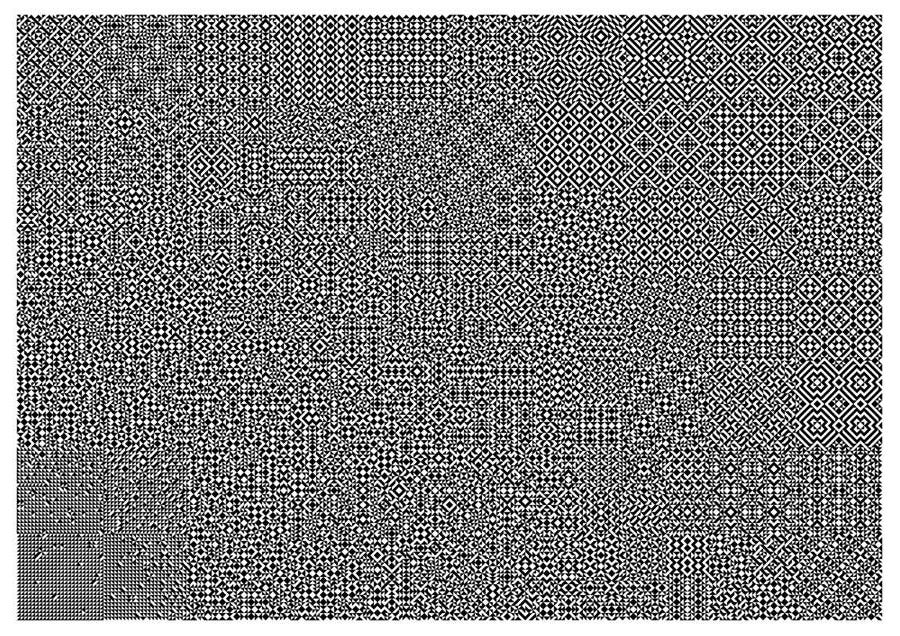
‘A machine has no conception of reality.’ The second post in our new series on technology and imagination is an essay by environmental philosopher and activist Rupert Read. As thousands of data centres are planned across the world to fuel the advance of artificial intelligence, he argues that this material and existential threat is a call for human beings to resist (as some communities are already doing). Crucial within this is a conscious decision to value and embody what it means to be human. With geometric artwork (shifting from ancient tile design to computer code) by Mattias Jones from Issue 8 – Technê, (full caption at end of post).
THE EXISTENTIAL THREAT that artificial intelligence poses can be seen as a double-edged sword. For in the process of forcing major change upon us, it forces us into existential reflection in the other, older sense of that word: the philosophical sense. In other words: AI not only threatens our existence; at the very same time it calls us to make that existence meaningful once more.
The creative task imposed by AI is firstly to undertake the work of imagining what such a machine-dominated future will actually look and feel like. Secondly, to enter more deeply into what it is to be distinctively human; to find ways of mattering outside what a computer can execute way faster and easier than we can; as well as simply to find ways of surviving, economically and socially as it rapidly transforms many aspects of our lives or contexts.
We can shed some light on this creative task by situating the AI threat in the context of a threat for which we have at least had longer to prepare: climate breakdown.
We are already deep into the climate danger zone, and the biggest ever El Nino is about to take us deeper still. As a result, climate adaptation is finally just starting to happen at scale. Which is to say: governments, communities and households are in some cases starting to get real about having to deal with the unprecedented vulnerability and impacts which are coming. Preparing for these, and changing how we live to ready ourselves for them.
A global example can be found in how the United Nations is taking this dimension of our lives and future more seriously at last. Even at the very moment when international multilateralism is taking an enormous hit, the UN is quietly making it possible to finance some of the desperately-needed adaptation to higher temperatures and to more chaotic weather patterns. In the UK Scottish civil society initiatives are among those helpfully showing what is possible, by planning for the likely coming climate and geopolitical shocks. (But everyone is still way off the pace of what is actually required.)
This welcome uptick in adaptation endeavours is occurring in recognition of the historic failure of the world adequately to decarbonise. Put more bluntly: the writing is on the wall for (this) civilisation, because of how wildly late in the day it is: a pivot to adaptation and preparedness is thus little more than late-dawning common-sense.
By contrast, in the case of AI – which we should see as an analogous existential threat – it is much earlier. And yet, even here, the writing is already on the wall. The world shows as yet no sign of moving to pre-empt its unprecedented, gargantuan risks.
The exact analogy here is between fossil fuels and AI. Both offer such enormous benefits to their users that their even-more-enormous disbenefits collectively – their unfathomable harm to the world as a whole – are incredibly hard to effectively prevent.
This is a tragedy of largely unregulated markets, a tragedy of the collision/co-arising of private interests and massive negative ‘externalities’. This is why the climate- and AI- tragedies are far harder to act on than biological weapons, nuclear weapons, or the ozone hole: none of which offered such wide private benefits to users (not to mention, huge private economic benefits to owners).
And so there is at present very little reason to believe that the likely catastrophic collective consequences of AI will be successfully guarded against by pausing its rapid penetration into our world (think the on balance largely negative effects of the ‘social’ media revolution, only faster and wider and deeper). Those who have seen AI as a would-be terminator who will rule or eliminate us are, I’d argue, overplaying its potential; but the coming disasters that AI will unleash have been underplayed in respect of how catastrophic it is almost certainly going to be for several central aspects of how we live. Unless, perhaps, we adapt very imaginatively.
There has been much talk, and rightly so, of the way in which the rise of AI (and, increasingly, of robotics) is going to throw millions out of work, and suppress wages. Marx spoke of the unemployed as a ‘reserve army’, available to break the pay and conditions of those employed. In roughly Marxian terms then: what is coming is the ultimate ‘reserve army’. AI will make many of us unemployed, and will seem to make some of us unemployable. And increasingly it will hang over the pay and conditions of people in work, dragging those down.
Of course, this farrago could potentially have upsides, inducing new/old politics of resistance. There will be a double movement: as capital, with a new super-tool, moves one way, some of us will inevitably move a different way. Are we about to see unprecedented numbers of people (including some who had been devoted urbanites) insisting on being able to return to the land, like landless peasants movements before them, to subsist together? Such a question itself suggests how we need to seek to exercise creative foresight to anticipate how the revolutionary effects of the reckless rollout of AI can be coped with. How we can roll with its punches: how we can transformatively adapt. How we can refind ourselves in the new/old spaces that this will force us into.
How this fast-coming crisis may be the making of us.
We are about to see a further explosion of disinformation (and of organised polarisation), for instance by means of bespoke personalised deep fakes. Why is AI likely to make the disinformation situation immeasurably worse? It isn’t just because of its capacity to create worryingly realistic deep fakes. It’s because a machine has no conception of reality. It’s because it is just as good as making false representations – of which there are an infinity – as true representations – of which, in each case, roughly, there is only one. Before AI, reality and truth had a built-in advantage. That has now gone. AI is almost certainly going to be a full-on catastrophe for our shared sense of reality, and for areas in which truth utterly matters (for example in politics and governance, climate, pandemics).
A machine has no conception of reality. It’s because it is just as good as making false representations – of which there are an infinity – as true representations – of which, in each case, roughly, there is only one.
How do we intelligently, imaginatively, adapt to this? A place to start is by developing together practical ‘literacy’ as to the nature of the threat. We (will) need to return to thinking, as the ancients did, more deeply, in our agoras (market-places, both literal and of ideas), about what truth and reality are, how we can track them, how we can remain grounded. This might start with education to be able to spot disinformation. But it needs to go much beyond that: for it needs to include serious public reflection upon how the ability to track, to inhabit, reality is basic to our being in the world. My use of the word ‘track’ here is deliberate: we track reality above all by tracking. That is, by noticing and pondering tracks, by following tracks, by making tracks. Unlike AI, we have and make (and are) paths in the world.
There is an enormous overlap between climate adaptation and AI-adaptation; partly because in turn there is an enormous overlap between (and mutual reinforcement of) climate- and AI-threats. AI, to flourish as our ‘leaders’ intend it to, is going to need plenty of nature to be cannibalised (most notably, water); it is going to be used to ‘efficiently’ ravage more of nature still; its data-centres pivoted to be vast kill zones for the climate, especially insofar as they are fossil-fuelled.
AI adaptation begins with community-strengthening and -resilience. And it ultimately it will have to include water husbandry and community energy; because the task of resourcing out-of-control AI will increasingly threaten to take over our water supplies and electricity supplies from us. Again, this will demand a highly creative and determined human communal response, to put it mildly.
The stock market currently has what is almost certainly an AI bubble. But that doesn’t mean that AI itself is going to burst, any more than the bursting of the ‘dot com bubble’ slowed down the rise of the internet (i.e. hardly at all). Partly because of the intense era of geopolitical competition and chaos that is upon us, AI will be driven hard, virtually regardless of the economics of it. Consider for instance the deeply scary, profoundly reckless efforts of the current US administration to prevent US states from implementing any AI safety laws and regulations. Here again we can see the nature of the polycrisis (or better, the metacrisis) in action: the threat from AI is accelerated by the threat from global warring states. The worst possible thing for the world, namely unsafe unconstrained AI, is accelerated by dynamics of rivalry between the world’s hegemons.
Thus, much as the fundamental driver of climate breakdown is a massive, impossibly hard ‘tragedy of the commons’ (or rather, the tragedy of the unregulated global market), so the fundamental driver of AI-driven breakdowns is an impossibly hard collective action tragedy, which expresses itself between individuals, between firms, and between power blocs. Or consider the related way in which we are entering the first ever period in which authoritarian states can bypass the ultimate defence that the powerless have against the powerful: the ability to cause police or soldiers to question whether they ought to fire on crowds of protesters, if and when ordered to.
This ability, this possibility, was famously vital to what happened in 1989 in Eastern Europe, and later in Tunisia and Egypt in the Arab Spring. We are about to see states using autonomous drones not only to surveil (as China and Iran are already doing) but almost certainly to violently police their own people, with no such ‘safety valve’, no such possibility of appeal to conscience.
This too, we will have to find ways of adapting to. This will mean an initially depressing and certainly profound creative challenge for those who would resist tyranny. Responses may include not just new forms of hacking and jamming, but new forms of virtual protest, or of appeal to the human beings who run (or make) the drones.
The ‘deep adaptation’ agenda – the agenda for adapting to civilisational collapse, set out initially by Jem Bendell – needs repurposing: to cope with the various breakdowns and collapses that AI is likely to mediate.
And to be clear: you don’t have to be convinced that the phenomena I have described above are certain or even likely, for it to be rational for you to begin to contemplate them and how we might cope with them. It is enough to be convinced that they are possible, not implausible. And they clearly are that, at least. A potential ‘going back to the future’ that follows from a realistic appraisal of such AI threats, is that it will, ironically, make a return to a number of ‘old-fashioned’ technologies – such as simply meeting face to face – newly attractive, de rigueur. Some of the transformative changes suggested here, such as the one just mentioned, and the potential human return to the land, are consummations devoutly to be wished. My point though is that they are not going to be voluntary. They are going to be imposed upon us whether we like it or not. The task then is to turn the imposition as much as possible into something welcome. To transform the needful response in the direction of flourishing, and of meaning.
The great work of our time is to respond creatively and in a way that doubles down on our humanity (and our animality) to the interlocking existential threats to which we are exposed.
The great work of our time is to respond creatively and in a way that doubles down on our humanity (and our animality) to the interlocking existential threats to which we are exposed. The threat which is rising the fastest right now is that from AI. We will not begin to meet it unless we perceive it, and understand how our own ongoing quest for existential meaning is its best antidote.
Our embodied nature, our vulnerability, our resulting capacity for care and love: these, I would claim, are the basis of our imaginary. That is to say: of the natal way in which it is meaningful for us to create anything worthwhile (as opposed to the facile, rapid, sterile, mechanical ultra ‘left-hemisphere’ mode of combining, recombining and analysing that is AI’s prerogative.) We need a ‘right-hemisphere’ language, to accomplish this demanding task.
Imagination now is more than just thinking boldly as well as realistically about our future; it is doing so in a way which doubles down on everything that AI is not.
Rupert Read is co-director of the Climate Majority Project, a former Professor of Philosophy at the UEA, and author of several books including Transformative Adaptation, Do You Want to Know the Truth?, This Civilisation Is Finished, and Parents For A Future.
IMAGE: Rotation by Mattias Jones (from Isssue 8: Technê )
This artwork contains multiple sources of pattern. Historically, the tessellations top right come from an 1860 tiling manual on how to best work with a single tile arrangement of two right angled triangles into a square, divided on the diagonal black to white, and the multitude of ways in can be arranged for best effect. Essentially, there is a grid of squares, which are rotated in ninety degree intervals, and little else.
These antique plans are joined by new generative elements, where the design is born purely from code and symmetry. This extension on the pattern design is another from collaboration with coder Chris Godley.
The wave of tessellation is made from generative elements, where the nature of the tessellation that the mosaic makers of old applied to their craft is taken into code. This is applied to decreasing sizes of square mosaic and then arranged together by hand.
I’ve taken the binary nature of this single element as the best way to represent data – the world of absolutes, ones and zeros, on and off, black and white. We are stuck in the modern age now, where celebrating disorder is a necessary part of honest work.
This is an idea, spawned from old plans, translated into newer mathematics, given power by tools and the directed hand of the makers in ways that weren’t possible until now.
The depictions of what appears to be chaos are exactly that, what appears to the observer to be chaos, but they aren’t. In this case, as in many other places, chaos has a pattern.
The inversion of invention is uniformity. (M.J.)
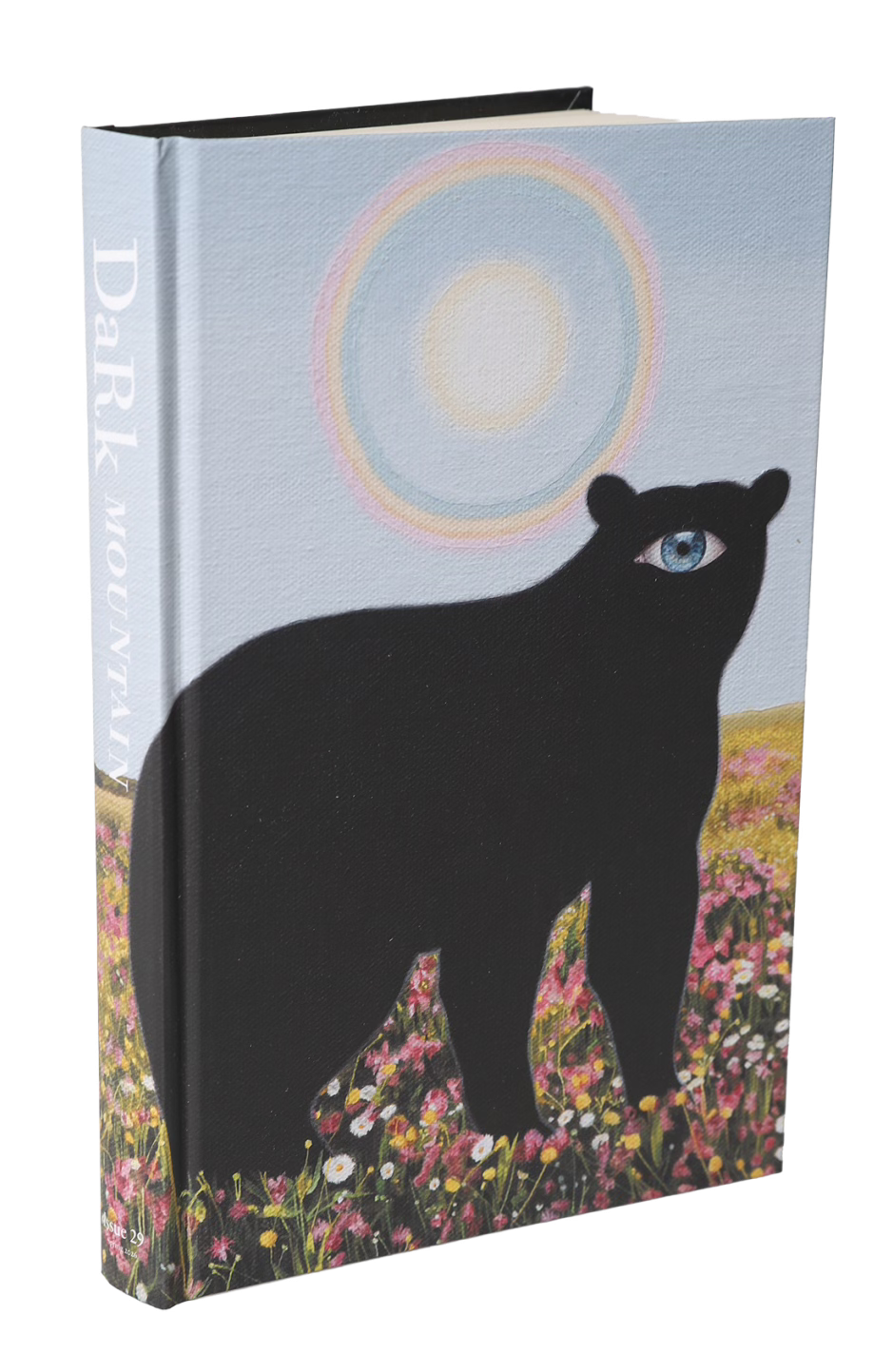
Dark Mountain: Issue 29 (£19.99)
Our Spring 2026 anthology is a hardback collection that steps outside the human bubble and puts animals at its heart. Order from our website or take out a subscription to future issues of Dark Mountain and get Issue 29 for only £14.99.
Subscribe to Dark Mountain's Books
The Dark Mountain Project is an entirely reader-funded organisation. If you enjoy these newsletters or posts, please consider supporting our work by visiting our shop or becoming a subscriber to our books and/or our online weekly edition on Substack. All back issues in the archive are available both in print (Issues 21, 22, 25-28) and PDFs (from £5). Many thanks!
No posts
Comments
Nothing yet. Say the first thing.
Sign in to join the conversation.