
Welcome Friends
In putting together these sessions, I spend as much time deliberating on what to include and what to leave out as I do on the actual lecture itself. The anxiety embedded in that labour of curation is, I suspect, partly related to imposter syndrome. When one is situated inside an academic institution, the very fact of one’s presence there bestows a certain validity: on the utterances themselves, but also on the right to make them. Whereas, when one simply offers to speak for a couple of hours about a subject in the wilds of the internet, the context and presentation have to account for themselves much more directly and immediately.
In delivering these first three sessions, I’ve also been acutely conscious of what Bergson calls durée: lived, subjective time, which is likely to feel very different for me than it does for the audience. I’m perennially torn between going deep on specific texts and the core concepts they extol and simply introducing the fundamental ideas of a particular critic, theorist or tradition. The outcome has been something of a balance.
The sessions are now nudging towards two hours and, even then, I feel as though I’m barely scratching the surface of these expansive subjects: critical judgement, taste, the nature of authorship, and this week, approaches to close textual analysis and genre theory.
Without suggesting that any of my wonderful audience members might struggle with their attention spans, asking anyone to take two or three hours out of their day means the “value” has to evidence itself through both the presentation and the content. I’m holding myself to the maxim that these sessions have to justify their own duration: not simply through the quantity of material covered, but through the sense that they open up avenues of thought in a grounded, usable way.
They are conceptually grounded, for sure, but not structured by a “how-to” proceduralism. Throughout, I try to point to the influence and application of these ideas for myself as a thinker, viewer and writer. In turn, my hope is that this provides an interpretive space for the audience to do something similar: not simply to absorb concepts, but to test them against their own approaches of looking, thinking and writing.
Starting points are always important for me. It was never really a question of whether I would use Victor Perkins as the gateway into an exploration of mise-en-scène and detailed film analysis. I first read Film as Film at university, and even then it felt radical in its ability to amalgamate seriousness and pleasure in its treatment of cinema. Perkins wrote about films with the rigour of someone who believed judgement mattered, but without losing the sensual, dramatic and emotional charge of the experience itself. There was no sneering at popular cinema either, no embarrassed apology for taking Hollywood seriously.
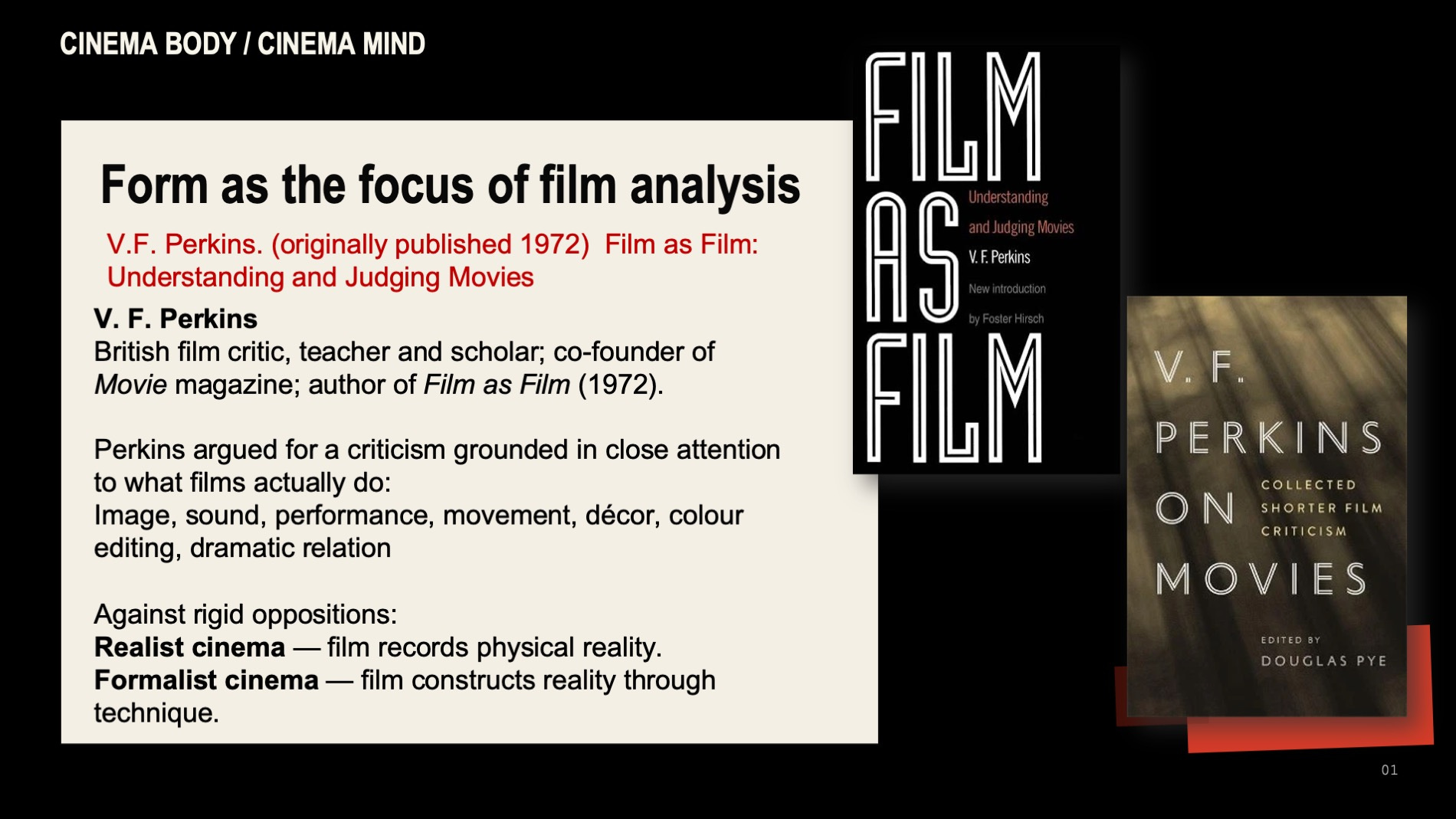
He was also, in certain ways, an outsider to the critical establishment. Perkins emerged from the Movie Magazine tradition in Britain, which positioned itself against what it saw as the complacencies of mid-century British film criticism: the tendency to value “good intentions,” literary prestige or respectable subject matter over form, style, technique and cinematic intelligence.
That gives his work a particular edge. He is not an outsider in the sense of being marginal to film studies. Indeed, he became one of its most important teachers and critics. But his criticism retains the energy of someone arguing against an inherited hierarchy of taste. Popular cinema, melodrama, Hollywood genre, the work of directors like Ophüls, Ray, Preminger or Hitchcock: these were not guilty pleasures to be rescued by theory, but complex works demanding serious attention.
Have a look at this page dedicated to his legacy. - And this tribute on the BFI website.
Fundamentally, his writing navigates the intersection of academic film studies and film criticism in a way that I have used as a guide and inspiration. There is a precision to his prose, a seriousness about judgement, but also a refusal of grand theoretical swagger. Perkins does not proceed by announcing a system and then processing films through it. His writing has the feeling of thought being compelled by the film in front of him.
It might seem banal to say this, but more than almost any other critic, Perkins starts with the film — with what it does, what it shows, what it withholds, and what it asks us to notice. In that sense, his approach feels almost antithetical to some tendencies in contemporary criticism, where political or ideological positioning can arrive before the film has been properly looked at. The baggage we bring into the cinema matters, of course; none of us watches from nowhere. But Perkins’ approach can be drawn on as a rejoinder to the use of a film merely as evidence for a position already held.
I don’t mean that as a dismissal of ideological criticism, far from it, and that is very much where the next session will take us, but political, cultural and ethical claims become stronger, not weaker, when they are answerable to direct evocation of a film’s audio-visual inscriptions. If a film is politically evasive, formally reactionary, ethically compromised or ideologically revealing, then the criticism still has to show where and how that takes place. And critical claims have to be earned through the articulation of formal attention.
Another reason for beginning with Perkins is his critique of Bordwell’s account of interpretation, which I discussed in relation to Making Meaning in the previous session. Perkins is not rejecting interpretation. He is questioning whether interpretation should be imagined as something added after the fact, as if the film presents a surface and the critic then arrives to excavate a hidden meaning beneath it. For Perkins, meaning is often already embedded in what has been filmed. His criticism asks us to take seriously the idea that films think through form, and that the critic’s job is to make that thinking perceptible.
Shifting one’s mindset so that a film is conceived, not so much as an artifactual outcome but as a process of thinking, undoubtedly reframes the critic’s relationship to it. Certainly with regard to the basic oppositional interpretation of “good” versus “bad”.
In order to define the concept of mise-en-scéne I take a step back, thinking through the relationship between the pro-filmic and the filmic: between the basic reality of what we see on screen and the way that reality is orchestrated, shaped, intensified or distorted by the mechanics of cinema. It sits right at the centre of what I wanted to do here, to think about how criticism earns its interpretations by paying attention to form.
The difficulty of this session was making a coherent turn from close reading, textual analysis and Perkins’s form-first approach into the structural foundations of genre.
Steven Neale became a key thinker here because his account of genre as both repetition and difference allows us to connect the details of film form to larger systems of expectation. The movement I was trying to make was from the shot, the gesture, the object, the lighting choice, the placement of bodies in space, towards genre as a wider grammar through which those details become meaningful.
I was actually taught by Neale at Sheffield Hallam University. Looking back in retrospect, it's weird to think that when I started as an undergrad, and to be honest, not until I’d more or less completed, did I have a true sense that I was being taught by some of the most influential figures in British criticism.
There is a great piece in Film International on Neale by Frank Krutnik who also worked at Sheffield Hallam and was my dissertation supervisor.
The films I cite in the lecture include Caught (Max Ophüls) which Perkins analyses in detail in the core reading (below), several of the Sirk melodramas include Magnificent Obsession (1954) & Written on the Wind (1956), Westerns including Ride the High Country (Sam Peckinpah, 1962)) The Good, the Bad and the Ugly (Sergio Leone, 1966), Noir In a Lonely Place (Nicholas Ray, 1950) and the generically malleable Cat People (Jacques Tournier, 1942). Of course, horror is a key element with Halloween (John Carpenter, 1978), The Brides of Dracula (1960), and Weapons (Zach Cregger, 2025) being the key films.
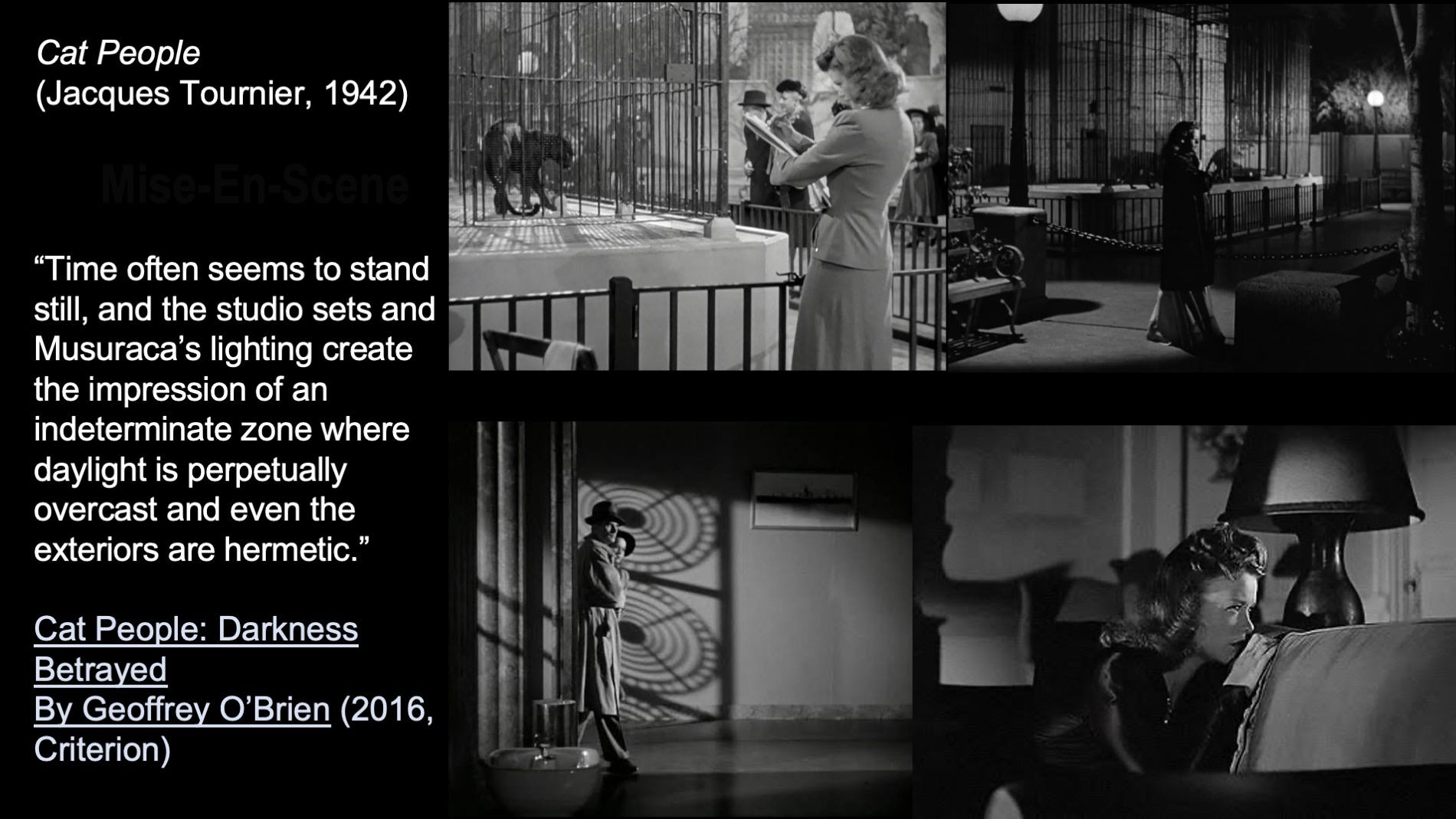
The very much non-genre Citizen Kane (Orson Welles, 1941) and L’éclisse (Michelangelo Antonioni, 1962) also crop up.
I realised, a little belatedly I confess, that it is a very male-centric set of resources. This failure on my part will be righted next week with greater alacrity and mindfulness. Indeed, it’s the genre aspect that I could potentially deliver an entire series on, as the viewing list above reflects the historical contexts of the writing I’ve drawn upon. One of the options for a future series.
In the two hours, I didn’t cover nearly as much as I would have liked, which is either the eternal problem of teaching and evidence that I should finally accept that “six problems” was a wildly optimistic subtitle.
Key themes covered:
Victor Perkins and Film as Film as a model of criticism grounded in close attention to the film itself.
The relation between realism and formalism: cinema as both recording of the world and transformation of that world.
The distinction between the pro-filmic and the filmic.
Close reading and textual analysis as overlapping but distinct critical practices.
Mise-en-scène as the organising ground of film analysis: framing, lighting, décor, costume, props, gesture, movement and performance.
Perkins’s critique of interpretation as something imposed from outside the film.
The idea that meaning is “filmed”: embodied in gesture, space, sound, timing and visual arrangement.
Caught as a case study in Perkins’s method of close reading.
L’eclisse and Halloween as examples of how pro-filmic space is transformed through filmic organisation.
Sirkian melodrama as mise-en-scène: homes, objects, windows, colour and décor as structures of repression.
Shot size, focal length and editing in The Good, the Bad and the Ugly.
Lighting as genre meaning, from high-key melodrama to low-key horror.
Cat People as a case study in shadow, withheld vision and horror atmosphere.
The transition from close reading to genre criticism.
Genre as an industrial, aesthetic and audience-facing system.
Steven Neale’s account of genre as repetition and difference.
Rick Altman’s semantic/syntactic distinction as a bridge between formal detail and genre structure.
The broader question of how criticism moves from what we notice to what we can persuasively argue.
If you’re new here, Cinema Body / Cinema Mind is where I write, teach and podcast about cinema, media and art through a mixture of close analysis, film theory, cultural criticism and personal reflection. The aim is to bring the depth of academic film study into a more open, accessible and conversational space.
If you’ve enjoyed this piece, or if the work here feels useful to the way you think about cinema, I’d be very grateful if you considered becoming a subscriber. It helps sustain the time, research and care that goes into the essays, podcasts, resources and live sessions I produce.
You can also support the work in smaller but genuinely meaningful ways: by liking, restacking, commenting, or sharing posts with people who might be interested. In the digital attention economy, human recommendation still matters. Perhaps more than ever.
A paid subscription is £5 per month, or £50 for the year. It gives you access to the full archive of subscriber-only articles, podcasts, teaching resources and recordings, including all sessions and materials from my online course Becoming a Better Film Critic.
For anyone who is thinking of signing up there are 6 sessions in this series in total and there will be another one starting in autumn.
Or, if you appreciate my work you can also Buy me a Coffee.

Below, for paid subscribers, is an extended resource list with links for session 3, including a PDF of the PowerPoint.
Comments
Nothing yet. Say the first thing.
Sign in to join the conversation.