
Friends,
I am nearing the end of my 30th lap around the sun. 30 years, and how many lifetimes I’ve must have lived in that time. Over the years different faces, places, names and stories shift in and out of the frame. Something or someone once dear to me drifts out and away, only re-emerge within the frame years and years later. The frame is the view of our lives and we have a role in its composition.
The frame of my life has shifted back to Paris, nine years after originally coming here for eight months to study French on exchange. The frame was composed of the novelty of living abroad for my first time and decorated by the naive bubbly confidence we carry in our early twenties. Friendships were centre-frame : it was here Julia and I found each other and our laughs bounced off the city’s stone facade; it was then when I met the people whose lives proved to me the one I want is possible; it was here were I tasted for the first time the bittersweet fruit of being faraway from friends — the distance gives friendship added significance, or takes it away.
The frame shifts back to Paris but in a very different way than before. In this frame there is me sitting at my desk or in the park or at the library, my nose in a book or on my screen. I’m studying, I’m swimming, I’m biking around. I practice switching between tongues at a higher speed and with greater precision. There’s Phoebe who purrs next to me while I write and licks my face when I fall into bed. There’s my friend and roommate who bakes delicious threaded breads. But for the most part, in the present frame, there is Darian and he is alone.
My late 20s taught me the importance of cultivating one’s solitude. Being alone gives me the time and space to listen to what I want and need, and then respond accordingly. Whereas before I would have fought against the lonely days and searched eagerly for even the most temporary glint of connection on the surface of a wave in the sea of solitude, now I find myself happily returned to my secret garden and tending to my plants there on my own. My writing and reading practices have grown tremendously for the simple fact that I am happy to return there. While I know not everyone can or wants to lead such reclusive lives, and I know that the frame may very well soon shift away from this quiet seclusion, my belief is that solitude is essential for making art and it is essential to making friendships last.
I’ve been thinking about these two things in tandem — friendship and solitude — a lot after my trip to Barcelona and Marseille with my pals Leti and Alitzel from Mexico City. On one level, their visit took me out of my routine of school and work, allowing me to reconnect with a more spontaneous part of me. On another, the time we spent together cast light within the room I’ve built around my “me” and let me see my self again in the mirror that is being a friend. Since they’ve left back to the other side of the Atlantic’s shores, I can’t stop thinking about all the friendships that I have literally become distant from by deciding to move to Europe.
I’m lucky that my studies allow me to fold my lived experience into my philosophical deviations and creative practice. I finished my first year at school in France as a ‘mature student’ last Tuesday evening when I submitted a paper on the poetics of Sohrab Sepehri. There are a lot of things I could write to you about the frame of this poet’s life, who Hamid Dabashi characterizes as “an ascetic mystic of radical contemporaneity,” but I’ll suffice it to say that Sepehri spent his life travelling between city and desert, between countries in the East and countries in the West, and between his inner and outer worlds.
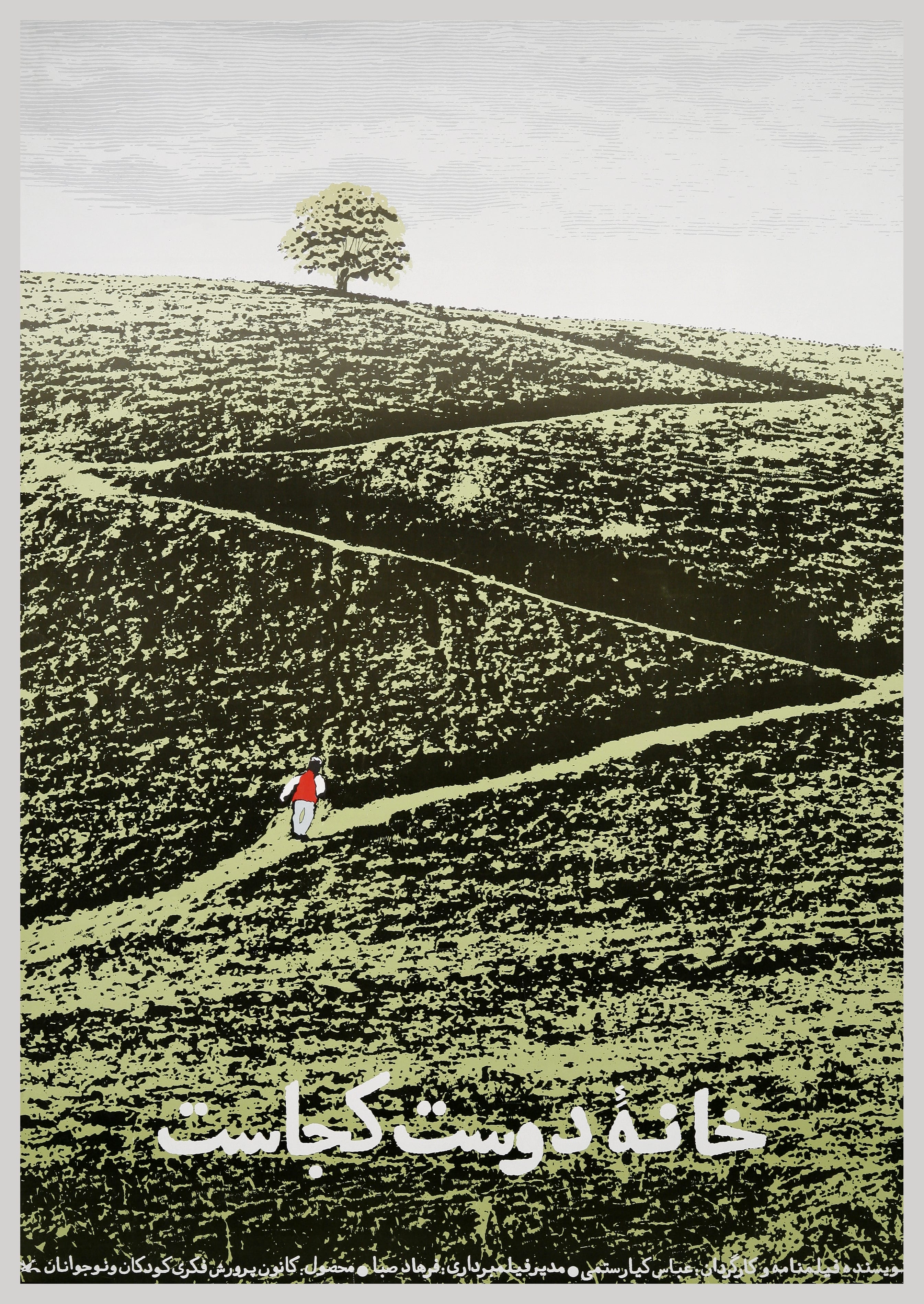
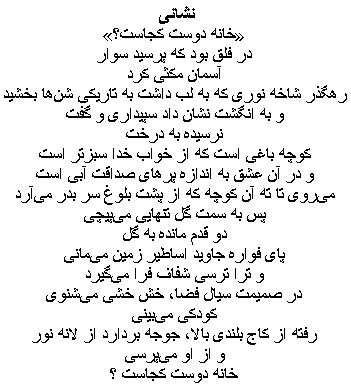
Sepehri was an artist who knew intimately well the joy and pain of both friendship and solitude. You might be familiar with his poem “Address” [نشانی] by way of Abbas Kiarostami’s film entitled after the poem’s first (and last) line : Where is the ٔfriend’s house? [خانه دوست کجاست؟].
*
In his most well-known poem, The Sound of Water’s Footfall (صدای پای آب), published before the above “Address,” Sepehri reminds us to be with each other, despite and in spite of the forces that seek to break us apart :
Text within this block will maintain its original spacing when published
"One must close the Umbrella,
one must walk in the rain
One must carry Thought and Memory into the rain.
One must go into the rain with all the People of the City.
One must go meet the Friend in the rain.
One must seek Love in the rain.
One must make Love in the rain.
One must play in the rain.
One must write the Thing, strike the Speech, plant the Lotus in the rain.
Life is a successive soaking,
life is wading in the pool of the Present."
(my translation)
Sepehri’s friend and French translator, Daryush Shayegan wrote in the preface to his translations how the poet exerts “an effort to move past the corrosive nihilism of our times and locate a source within the dust of knowledge” (Le Pas de l’eau, 1991: 18). I agree : there is something in these lines that accepts life’s grief openly but doesn’t wallow in pity; rather, the poem uses grief to make the rest of life more meaningful. Grief is not solitude (but it is one of the many parts of friendship) and the transformation of grief into meaning would not be possible without it.
I’m almost 30 and I am grieving the fact that I am faraway from most of my friends. The itinerant frame of my 20s enriched my life with numerous beautiful people and places, but it has also resulted in a sadness arising from the fact that I cannot be present with them all at once. Later in his preface, Shayegan asks “Is not all poetry a quest to locate the Friend in a world where the friend is absent?” That’s what cuts through the nihilistic feeling: real poetic practice allows us to not only locate the Friend but to frame beautiful abnormal and dissident lives in the process of relation-location.
Writing more about the search for the Friend in the poem “The Traveller” [مسافر], Sepehri reminds me to embrace the distance that always separates even the closest things.
Text within this block will maintain its original spacing when published
"How lucky are the plants who are in love with light,
And the expansive hand of the light is upon their shoulder
No reaching is impossible,
There will always be a distance.
Although the curve of the water is an excellent pillow
For the pleasant and fragile sleep of the water lilies
There is always distance,
One must be afflicted
Otherwise, the bewildering whispers in between two words
Would be wasted,
And love
Is a journey to the mobile light of the solitude of things
And love
Is the sound of the distances
The sound of the distances
That are drowned in uncertainties—
No,
The sound of the distances that are cleaned like silver
And with the slightest hearing of a ‘nothing’ they get smudgy,
The lover is always alone,
And the hand of the person who is in love
Is in the fragile hands of the seconds,
As love and those seconds move toward the other end of the day"
(translated by Pouneh Shabani-Jadidi and Prashant Keshavmurthy)
This passage gives me goosebumps. Reading line lines “No reaching is impossible, / There will always be a distance” and “One must be afflicted / Otherwise, the bewildering whispers between two words / would be wasted” makes me think about how there is always a failure in desire.
The poem reminds me that it is important to not shy away from the hard feelings we face in certain frames of our lives. It reminds me how pain makes pleasure sweet and how solitude gives friendship reason. There’s a sense that the distance that separates us is that which also brings us together; how we never truly reach that which we want the most.
In this way, to Sepehri’s poetics I bring my reading of Anne Carson’s Eros the Bittersweet and Lauren Berlant’s On the Inconvenience of Other People, in which the authors write (in their own ways) how being in relation is about being bothered and that we love and hate this at the same time. Reading Sepehri through the lens of Carson and the lens of Berlant, I find in his poems an edge that divides us, that which animates the desire that drives us closer and that which never lets us truly meet. I also come across an edge that allows for the relation between me and you to exist and an edge that gives life to the bewildering whisper in the space between this word and the next.
*
This, friends, is where today’s letters end.
If you’re reading this, I miss you!
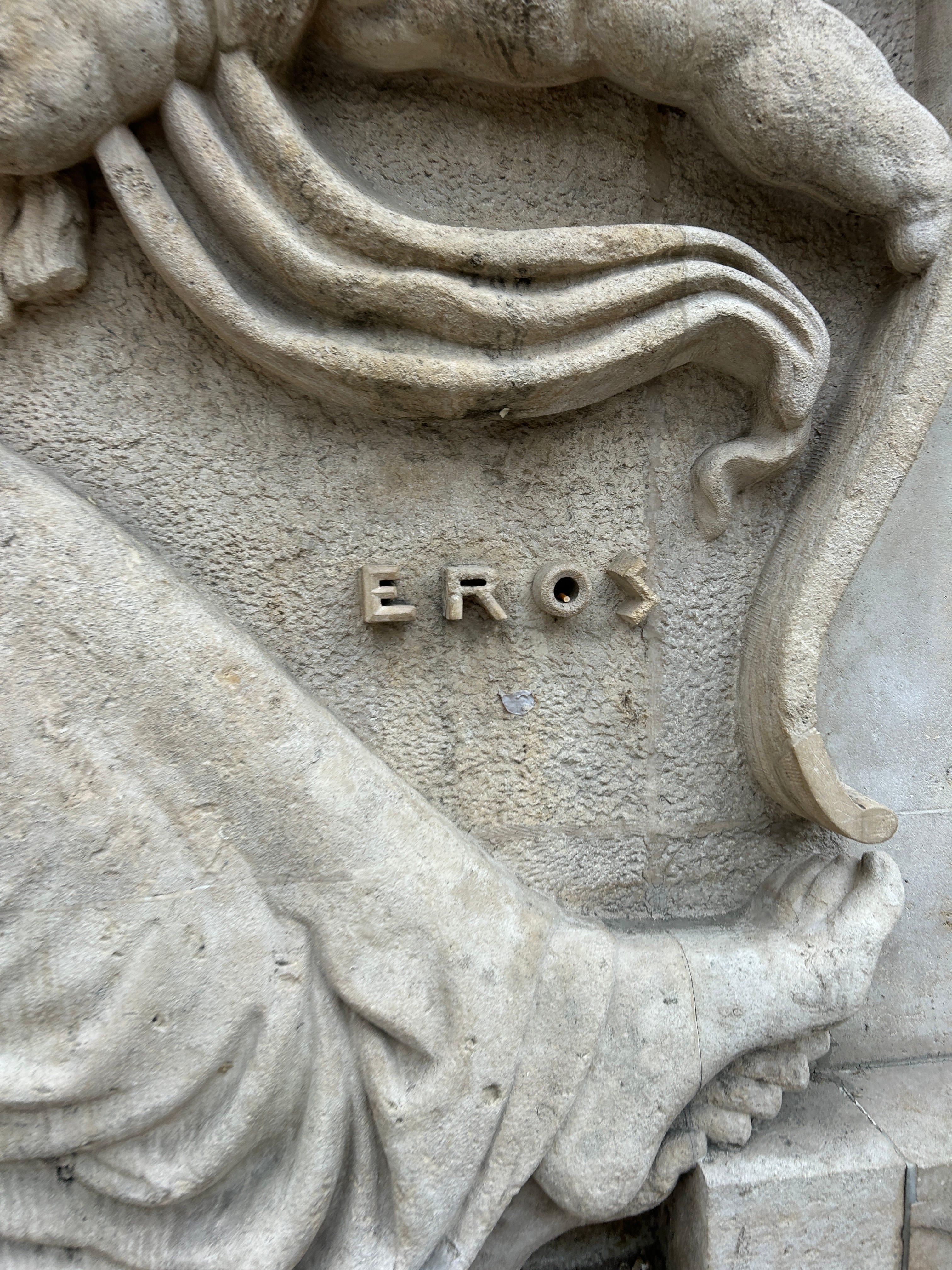
If you (or any of your friends) happen(s) to be in Paris this weekend, bring your writing to share or join to listen at a poetry reading I’m organizing with Erin Honeycutt in front of the “EROS” relief in the courtyard of Palais de Tokyo : Saturday 06 June, 20h30. This reading is happening during Paris Ass Book Fair but is not part of the festival program!
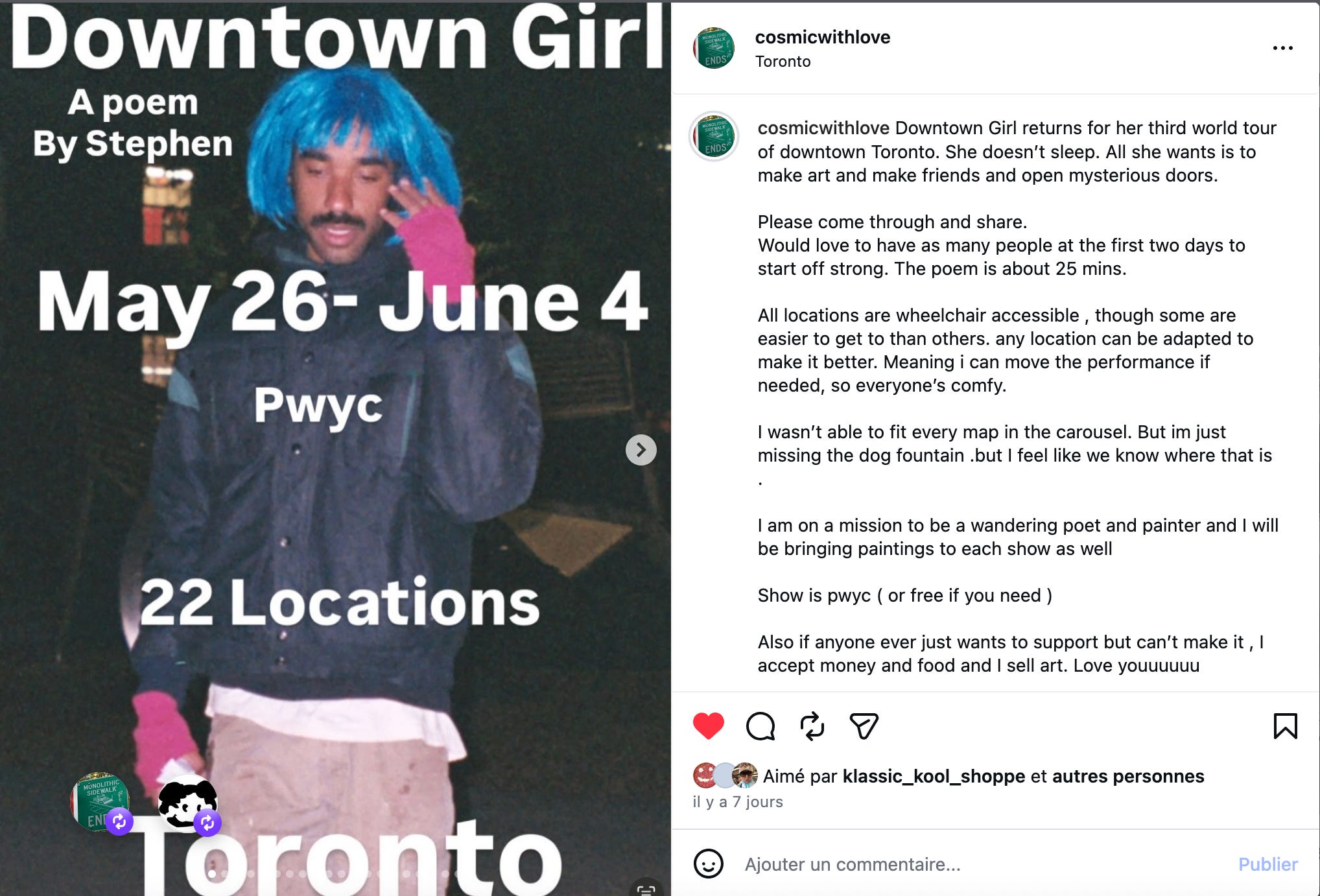
If you’re reading this and you’re in Toronto, I implore you to see my dear friend Stephen’s street theatre poetry epic Downtown Girl for me, as I am an ocean away and sadly can’t join in on the fun (send me videos pleeeeease!) For dates, times, and locations, check out their insta post here.
Until next time,
Darian
Comments
Nothing yet. Say the first thing.
Sign in to join the conversation.