
Dear friends,
There are moments when life slides along a well-traced path frictionlessly. There are weeks or months that go by in the cycle of routine — wake, stretch, bike, school, feed, work, pool, study, rest, rinse, repeat — with little interruption. Those are times when I feel mechanical. The priority becomes fueling and resting the machine of my body to perform its best in repetitive, demanding tasks. There’s the intellectual demands of being a writer and a student, and then there’s the physical ones.
These are not such mechanical times. The inertia of my summer — out of school and unstructured, marked by rupture and followed by a series of relational junctures — has tended toward entropy. Time slips away, lovers come and go, friends come up close and leave. This summer won’t let me forget the importance of spontaneity and adaptability. Just when we thought that we’ve already learned all our lessons, life reminds us that school is never truly out. We’re just sliding from class to class.
Here’s one case of entropy: my favorite independent publisher had an open call for manuscripts, so I was editing that of my first full-length book to submit before the 6AM deadline. After two years of writing and a few months of revisions, with the helpful eye of Erin Honeycutt (a most methodological first reader), I have finally found the shape I want the book to take: a shape that works like a play that unfolds in many acts, one that descends, goes deep, loses itself and emerges on the other side, but changed — completely changed and at a loss for words.
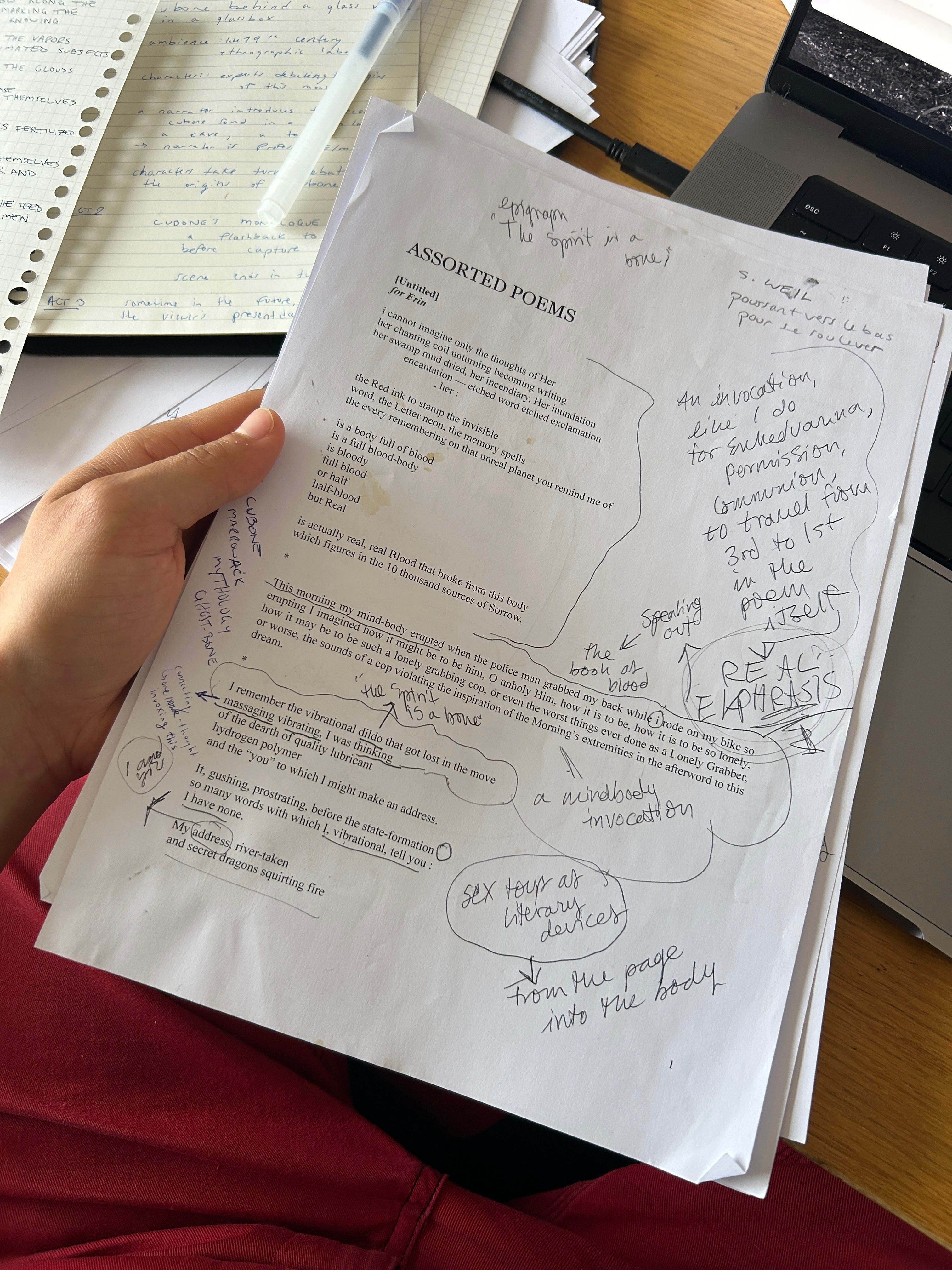
At about 2am, I knew that this manuscript would not be ready by the morning. I came to realize that this book required more than a few hours, but a few months, of work before I’d be ready to submit it anywhere. Just after seeing the clock pass 4, I swallowed half a sleeping pill and took myself to bed.
0:00
-2:24
I woke up this morning thinking about the time I spent with my friend Nahrain, who met up with me two weeks ago in the south of France. We spent the weekend at the documentary festival in Marseille, stopped by the photography festival Arles, spent a few days in the village of Pompignan just outside les Cévennes (the letter’s audio comes from the July 14th party in the village just after France was eliminated from the World Cup), visiting the city of Montpellier and the grotto of Trabuc before taking the train back north to Paris. I won’t spend much time writing about friendship here — you can read my letter “One must be afflicted” for some recent reflections on this subject — but let it suffice to say that the friends like Nahrain are mirrors reflecting certain features back to yourself in a new light.
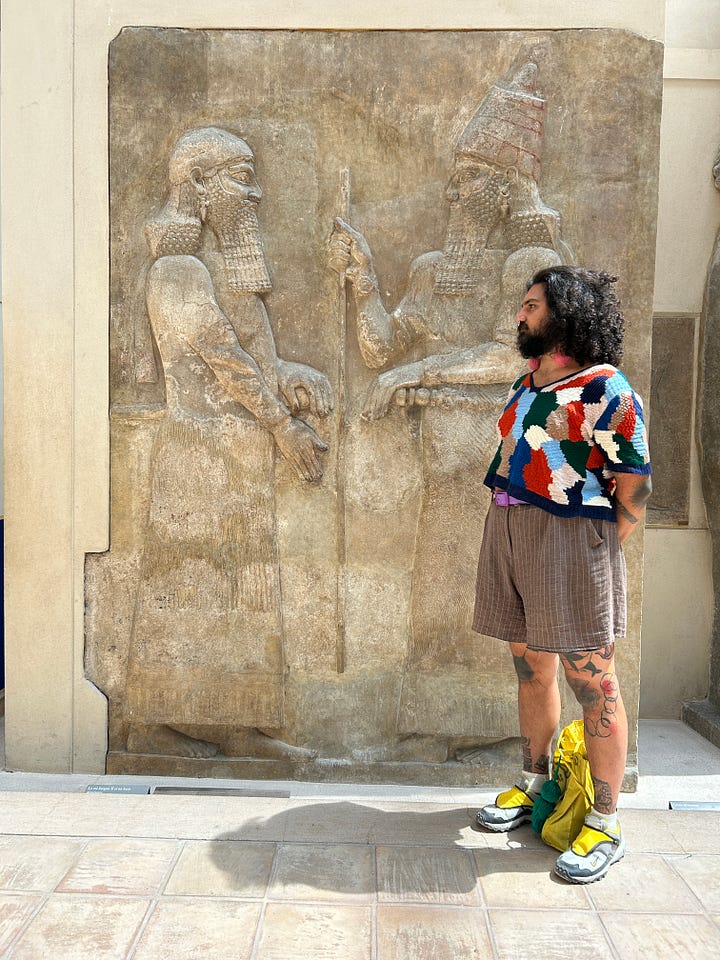
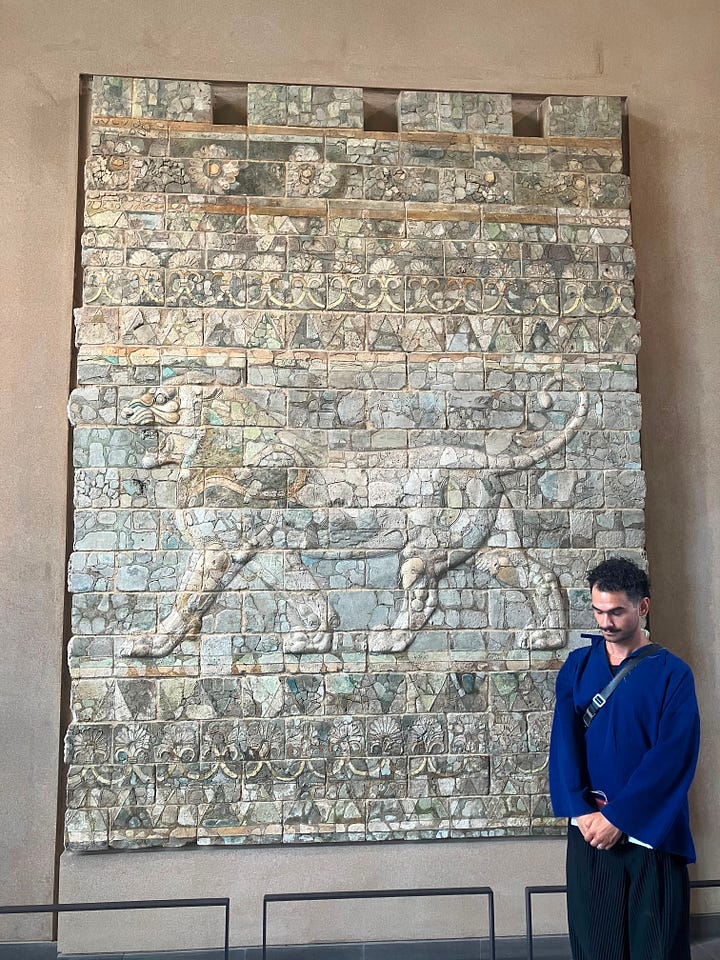
Nahrain asked to visit the Louvre during their short stay in Paris. I was happy to join them as it had been almost a decade since I last visited the museum. They specifically want to visit the Louvre’s expansive collection of Assyrian artifacts, which include the palace reliefs of giant men vanquishing lions, big man-headed bulls, raptor-faced winged men pollinating trees, and the famed monolith etched with man’s first laws, the Hammurabi Code. The size and scale of all these manly relics collected and presented for us in the Richelieu Wing of the Louvre was surely impressive, but I left our museum visit amazed by something much more mundane: writing (verrryy surprising, I know)
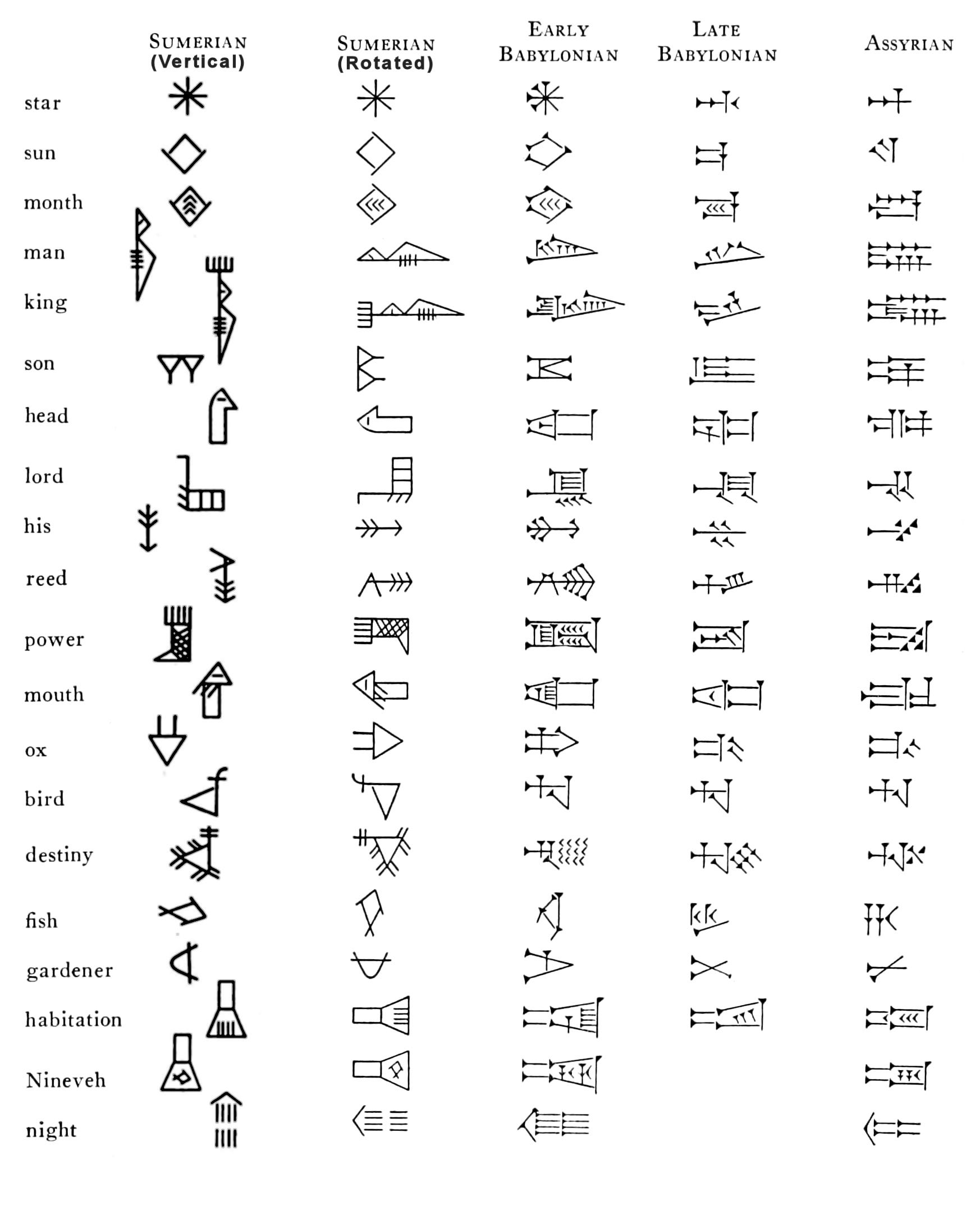
The Mesopotamian writing system, also known as cuneiform, evolved from Sumerian pictograms etched within rectangular grids around 3000 BCE into the Assyrian script of lines and dashes about 1000 years later. This writing system would be later used to derive the Old Persian script by Dariush the Great around the 5th century BC — the first writing system of the Persian language. We learn that they used a special stylus to write on clay tablets, that the tablets serving as permanent records would be fired in a kiln while the majority of tablets were left moist and reused as permanence of writing was not always necessary. Funnily enough, it’s these scrap pieces of temporary writing that we’ve inherited in the archaeological record — baked by accidental fires and ensuring their longevity.
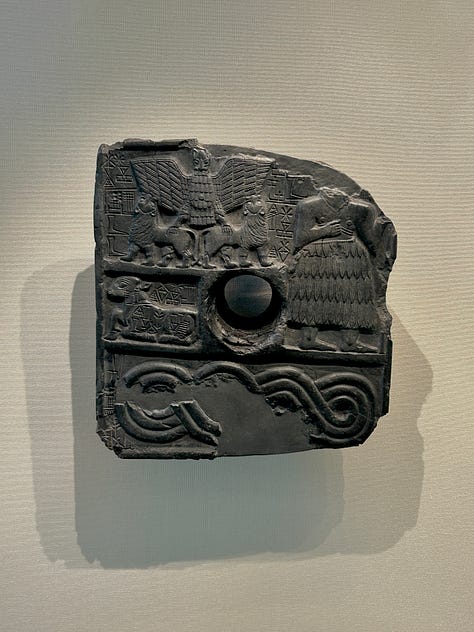
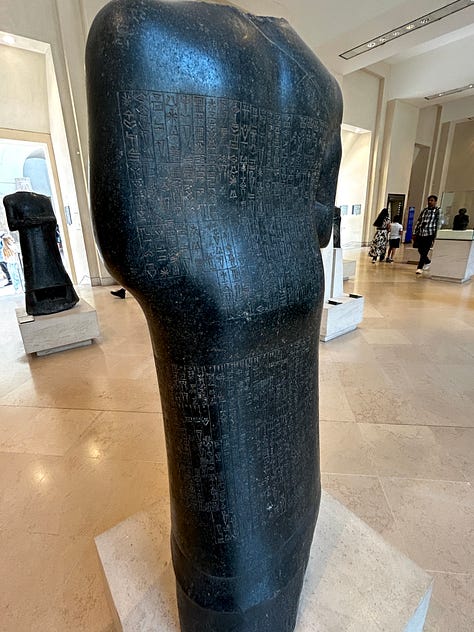
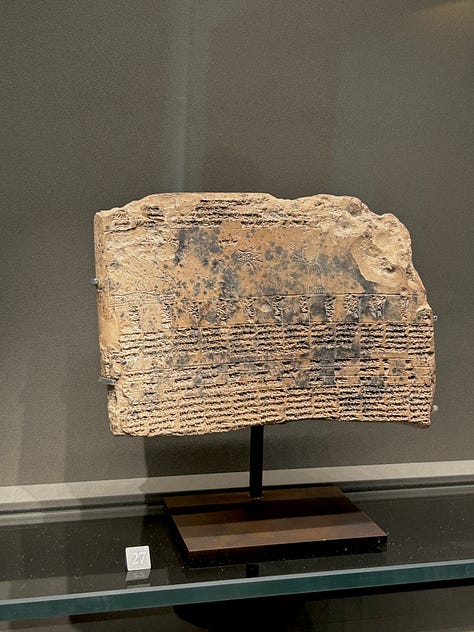
Imagine inventing writing — what do you do with this power? You write everywhere, of course.
The Louvre’s public collection exhibits a striking quantity of the pieces of writing that ancient Mesopotamians intended to survive: praises and blessings covering statues of nobles, spells and curses stamped on amulets, predictions of astrological phenomena etched on slabs of clay, poems wrapping polished stones, protection prayers to Ishtar etched onto a foundation block of a home.
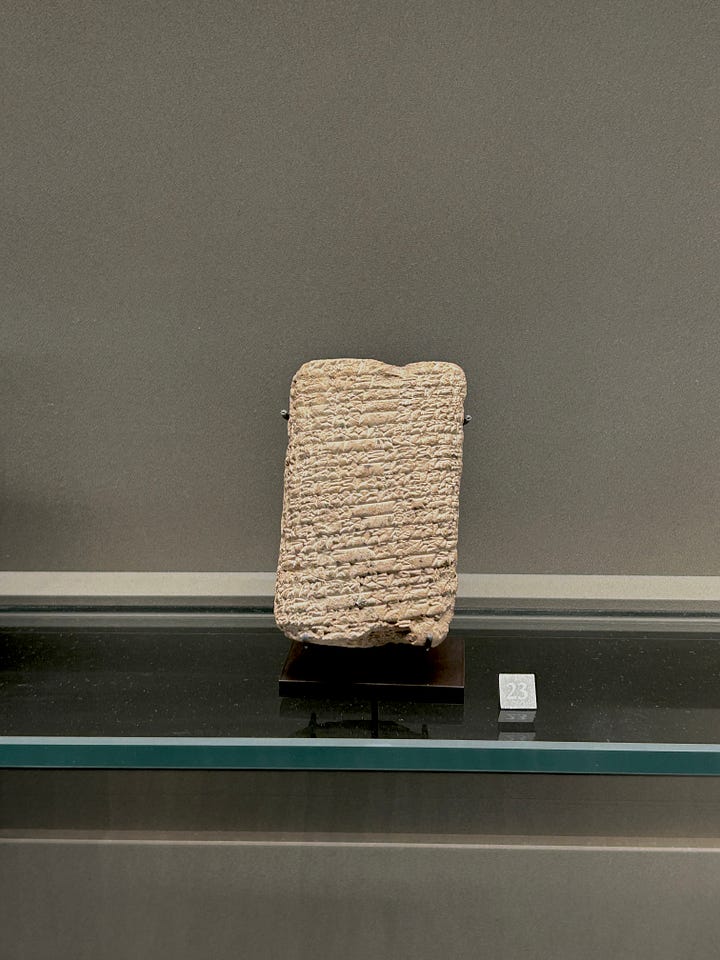
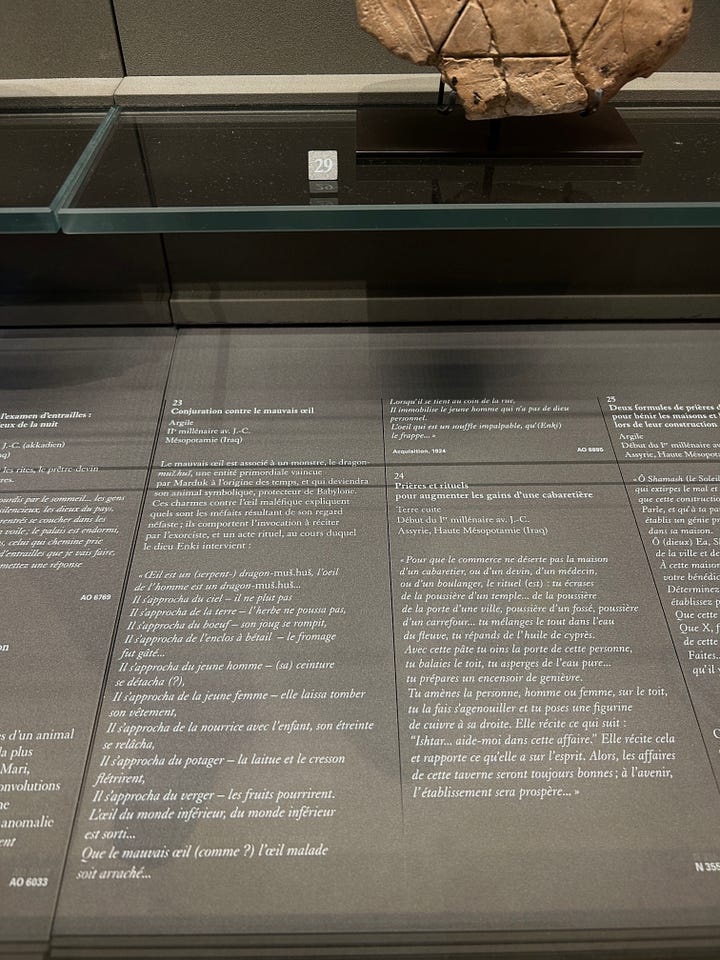
The words were beyond my comprehension, save for spare translations that I’m sure few visitors spend the time to read. We stumbled upon the littlest clay tablet that included a spell to cast away the Evil Eye. I’ve translated the French translation of the spell into the English for you, below:
Text within this block will maintain its original spacing when published
“The eye is a (serpent-) dragon-muš.huš, the eye
of the man is a dragon-muš.huš…
It came close to the sky — it did not rain
It came close to the earth — the grass did not grow,
It came close to the bull — its yoke broke,
It came close to the livestock pen — the cheese spoiled…
It came close to the young man — (his) belt came undone (?),
It came close the young woman — she let clothing fall,
It came close to the wet nurse with the babe, her grip loosened,
It came close to the garden — the lettuce and watercress withered,
It came close to the orchard — the fruits rotted
The eye of the underworld, from the underworld has gone…
May the evil eye (as?) the sickened eye be torn away…
While it sits on the corner of the street,
It makes the young man, without his personal god, freeze
The eye, which is an impalpable breath, may (Enki) strike it down…”
Translating this in real time for Nahrain, I had the undeniable feeling that I am actually the young man without his personal god, that my belt has come undone, that all my cheese and fruit have really gone bad, that my grass is irreparably yellowed, that the yoke of my big bull has fallen to pieces . . . The bad dragon-muš.huš looked me in the eye long ago, perhaps before I was even born, and I have never seen the same since. The Evil Eye — this phantasm of badness that we’ve grown up with since at least the 4th millennium BCE, the thing I’ve been warned to protect myself against since the first time my mother burned esfand over my head days after my birth — knows me well. What if everything we’ve been told about the Evil Eye isn’t true, that we’ve actually lived alongside it for our whole lives, that without it we wouldn’t have the courage to question our elders, to defy conventions, to break with norms. . .
Imagine you have a personalized Evil Eye. What color is it? Where does it look? How do you feel when it looks you in the eye? What does this feeling ask of you?
All of this talk of evil and antiquity makes me think of the book I recently finished, The Blind Owl (بوف کور) by Sadegh Hedayat, the hallmark novel of modern Iranian literature which follows an unnamed protagonist falling between opium-induced nightmares in the ancient city of Ray. I first read it in English when I was about 21 years old and didn’t quite grasp the plot. My uncle Mehrdad told me that I needed to have more life under my belt before being able to really understand the story. My Persian professor Shafigheh, an expert on Hedayat, told me that there’s no good English translation of the novel and recommended I read the French translation by Lescot. Either the French translation was more engaging or the events of the past 9 years have allowed me to better enter into the protagonist’s feverdreams . . . whatever the cause, I was left with a sense that the Evil Eye had taken hold of the world of the Blind Owl and its writer and that it’s exactly thanks to this bad gaze cast over the plot that makes it so puzzling and moving.
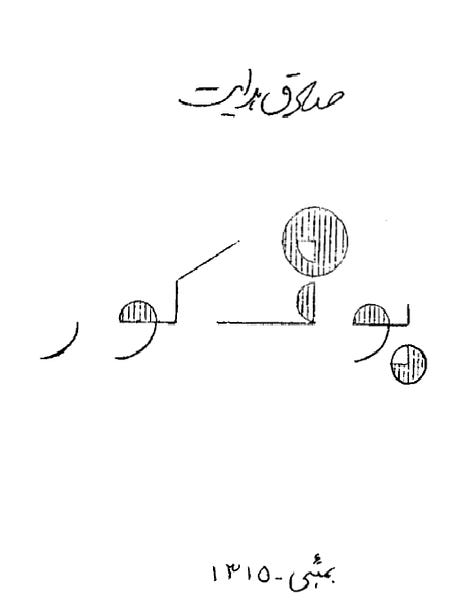
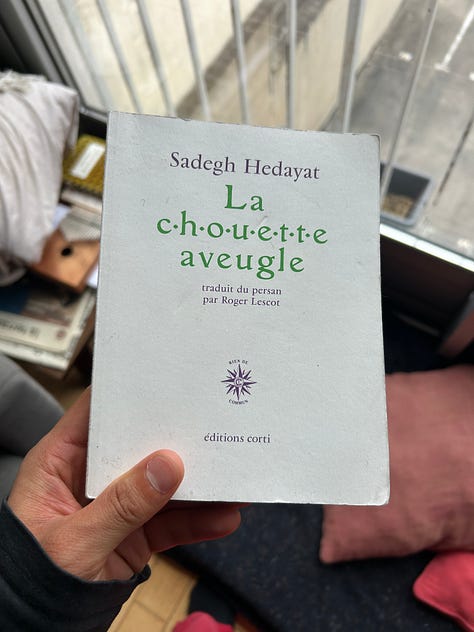
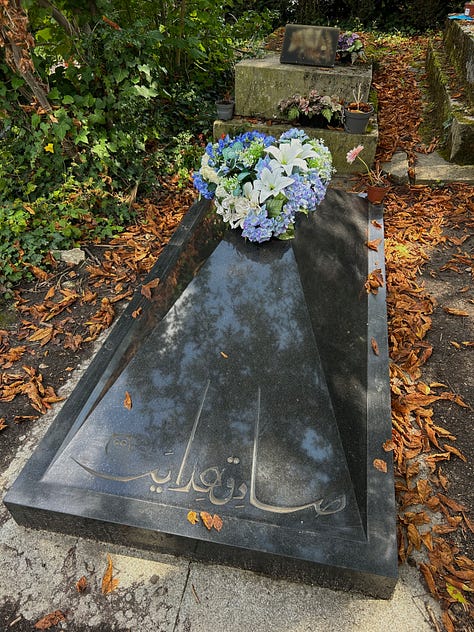
Hedayat, born and raised in Tehran, had lived in Belgium, France, and India and read avidly the work of Rilke, Poe, Chekaov, and Kafka. He is buried at Père Lachaisse in Paris, where I go occasionally to visit his grave.
Has there ever been a book you’ve come back to, years after setting it down, and experienced a completely different reading?
This is all I have time for today. I hope to write you next week with information about my upcoming tour and travels in the Rust Belt and some research that I’ve been doing on Pokémon and mythology. Until then, take care.
Darian
ps. I’m reading at After8 in Paris this Tuesday, 28 July at 19h, alongside fellow Canadian writer Nora Fulton. Come through if you’re in town : )
Comments
Nothing yet. Say the first thing.
Sign in to join the conversation.