
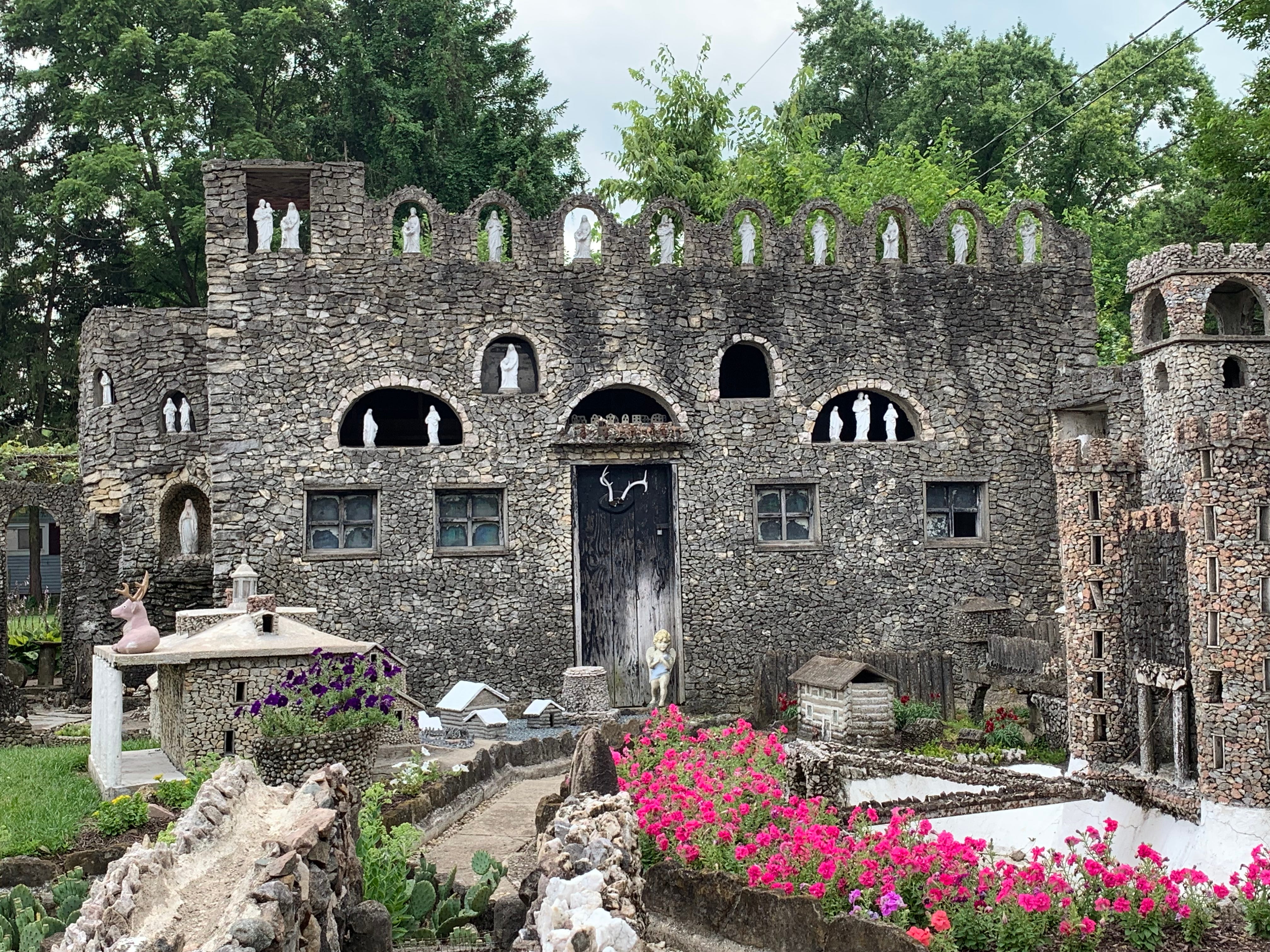
What do the Lone Ranger, the Virgin Mary, and Mae West have in common? They all live at 1905 Russell Avenue in Springfield, Ohio. They’re residents of the alternative world Ben Hartman dreamed up in his backyard in 1932, in the middle of the Great Depression. The medium? Mostly rocks, tons and tons of rocks. Fortunately, there were plenty close to his house. Out of those rocks he fashioned Abe Lincoln’s log cabin, the White House, and a 14-foot-tall cathedral modeled after the medieval cathedrals in Italy, replete with arches. Not one to skimp on details, he tucked a sculpture of Leonardo Da Vinci’s The Last Supper into one of the niches.
Between 1932 and 1939, Hartman constructed more than four dozen structures in his backyard, filling it up with tributes to Jesus, patriotism, and education, as well as shout-outs to Snow White, Felix the Cat, and Little Orphan Annie, among others. He constructed a schoolhouse and a monastery, a miniature sporting goods store, and a tableau of Valley Forge, where George Washington quartered his troops in 1777. The cabins even have tiny icicles hanging from the rooftops.
His re-creation of Noah’s Ark features fourteen miniature pairs of animals marching up a ramp to the boat, where sets of birds nestle on the roof. Although Ben Hartman wasn’t Catholic, he became something of a favorite with the nuns and parishioners of St. Mary’s Catholic Church nearby. They kept bringing him religious objects to cast, and he obliged them.
“I think they saw him as a kind of prophet,” said Kevin Rose, the executive director of Hartman Rock Garden. “Here was a man to spread religion or—who knows? They probably just loved the garden and wanted to support it.”
There are deserts and mountains, cacti and wishing wells, shrines and castles, mailboxes and pumpkins. Hartman even invented a scene representing California’s Death Valley, where a twenty-mule team pulls two wagons, made famous by the Borax commercials that aired during Death Valley Days, one of his favorite radio programs. He listened faithfully to that show while he tinkered down in his basement. In addition to rocks and pebbles, he used concrete, glass, stone, wood, and any other free, useful materials he could find for his creations.
What to make of this simulated version of America? Art’s gatekeepers would call Hartman’s bursting-at-the-seams paean to America folk art or “primitive art” or even “art brut.” Some may even label it “dementia concretia,” which is a nice way of describing someone who decides to fill up all their outdoor space with homemade art.
But here in Springfield, lots of people love what Hartman did in his backyard. They’re loyal fans. They get a huge kick out of his cathedrals and dams, historic displays, and patriotic tributes. In 2009, local citizens formed Friends of the Hartman Rock Garden, and with support from the Kohler Foundation (yes, the bathroom fixture people), they’ve worked to preserve and interpret this site.
I visited Hartman Rock Garden earlier this summer and I will say this: it’s a lot to take in, a jumbled amalgam of heart, nostalgia, and unbridled imagination. If you’re looking for thematic consistency or one big unifying idea, you’ll get whiplash in this 9,720-square-foot-lot plot. Felix the Cat and Jesus? Noah’s Ark and Little Orphan Annie? The Last Supper and Maxwell House Coffee? Yes, yes, and yes. Ben’s garden celebrates religion, history, education and Depression-era pop art through a boggling display of kitsch, architecture, patriotism, cartoon characters, Madonnas, and statuettes.
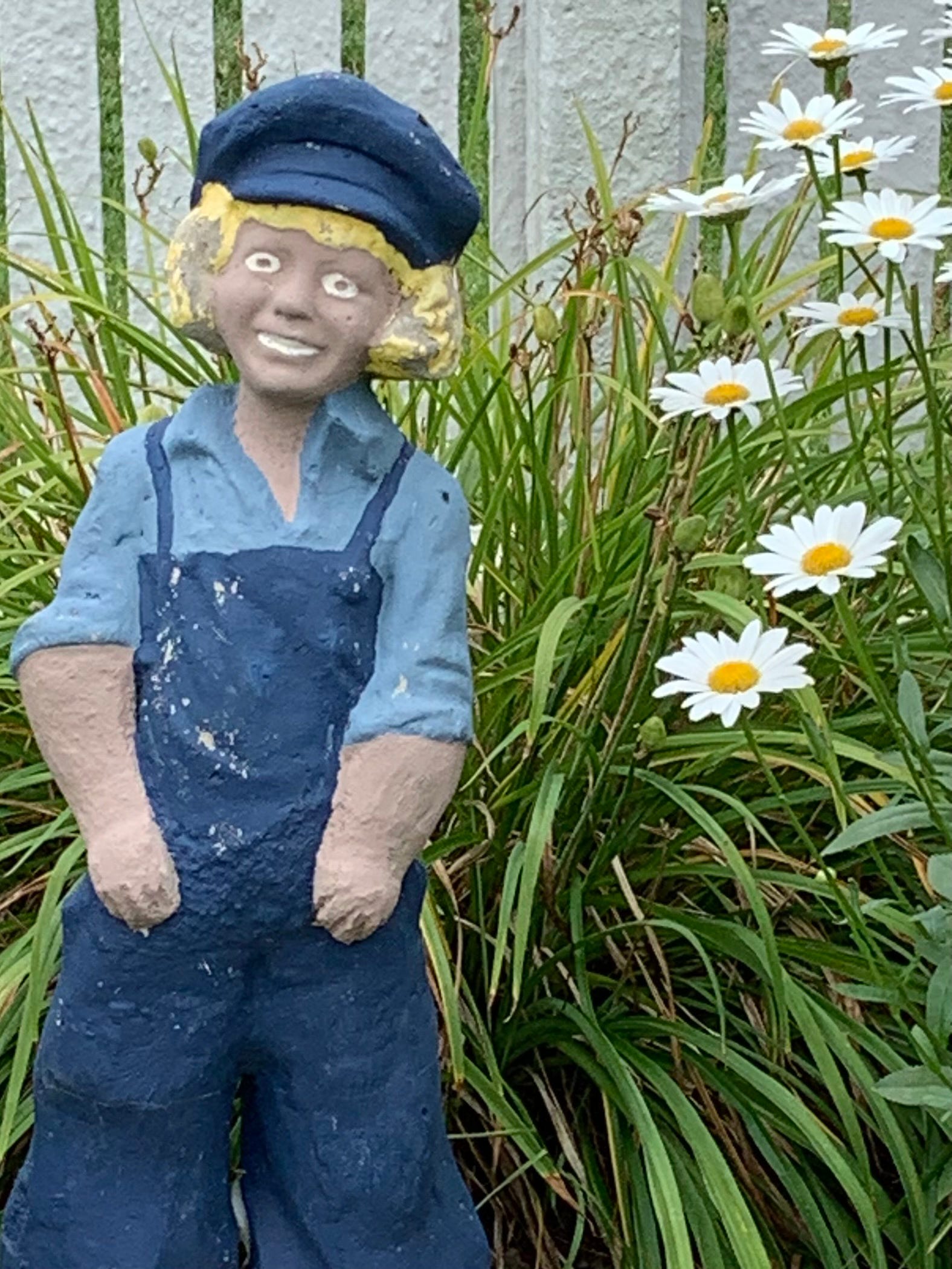
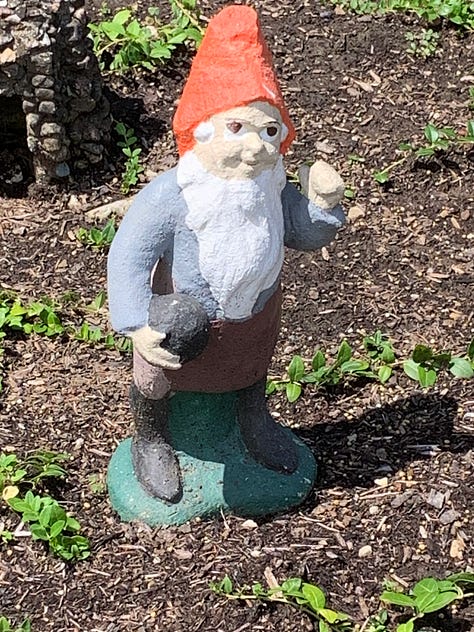
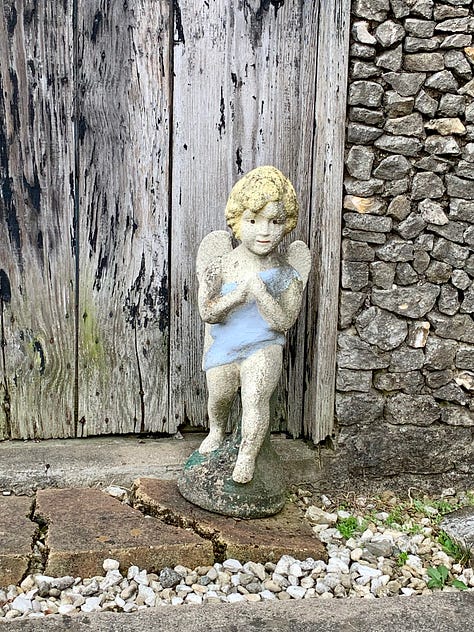
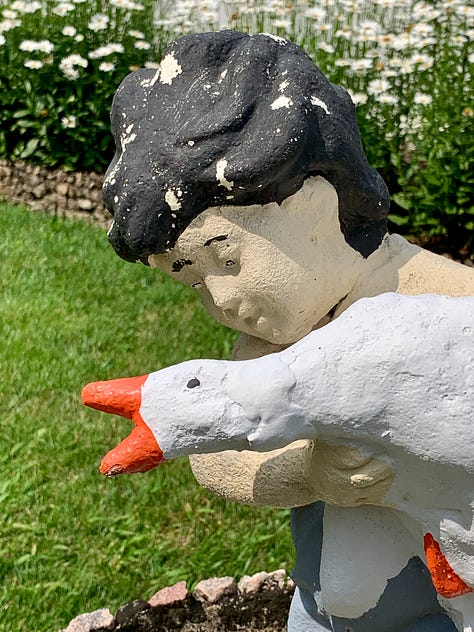
While touring the garden this summer, I met up with Rose, the director, who was hosting the garden’s annual “Tchotchke Palooza.” That’s when all the stone characters come out of storage for public display. That includes Peter Peter Pumpkin Eater, Jack and Jill, Charlie McCarthy, some dwarves and lots of pretty cherubs. Taken together, these objects and others make up a “visionary art experience,” according to Kevin.
That’s certainly one way of putting it.
“It’s so—so funky!” I exclaimed to Rose, who was wearing a bright red T-shirt that said “Springfield Rocks” on the front. He smiled patiently. He’d heard it all before: funky, weird, crazy, primitive. It’s Rocks Gone Wild.
“Funky’s a good word,” Rose said in a measured tone. “See, there are words we use and words we don’t use. We try to avoid anything that is too disparaging of Hartman. Some people call this ‘dementia concretia’ but this is the opposite of dementia, right? We try not to assign it terms like ‘outsider art’ or ‘art brut’. It’s art. Ben probably would not even have called it art. He would’ve just viewed it as his creations.”
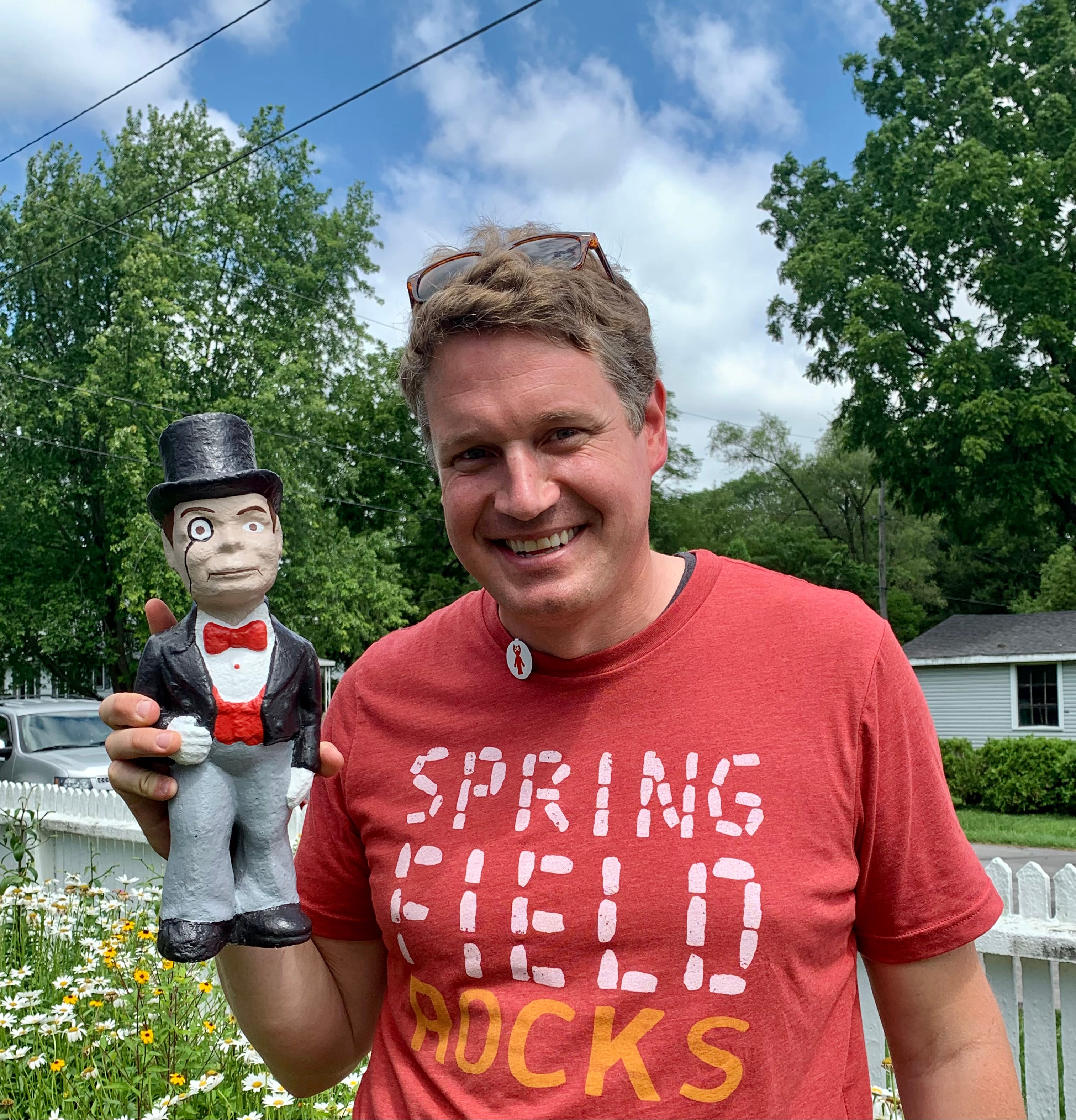
Seriously, though, what was Ben Hartman thinking? Wasn’t there anybody around to keep him from going off the deep end? To understand this eclectic, deeply personal space, you’ve got to know a little about Ben Hartman. Harry George “Ben” Hartman was born in 1882 in Edenville, Pennsylvania. He left home at the age of 16 to learn mold-making, then moved to Springfield in 1913, where he put his special skills to use as a molder at the Springfield Machine Tool Company foundry.
When his first wife Maggie died of cancer in 1928 (leaving behind a son, Roy), Ben Hartman befriended Mary Johns, an acquaintance with a young daughter who had been abandoned by her husband. Ben generously took them in. First Mary worked as his housekeeper, then they fell in love and got married, Rose said. Just like that, Hartman was a new dad again, with a smart five-year-old in his life. Ben and Ruth read books together—fairy tales, picture books, and historical accounts. Fatherhood redux! Who knew? Time with Ruth fueled his febrile imagination, just as it had with Roy.
In some ways, it seemed like Ben Hartman was living two lives. There was the life in the foundry—dirty, hot, dangerous, the air filled with toxic silica dust. And then there was his life with Mary and Ruth and Roy, and later, two more kids, Martha and Ben. They all lived in a modest yellow house in a quiet part of town, where they raised chickens, rabbits, and pigeons. They grew flowers, built flower beds and when those flowers multiplied, they built more. Greenhouses sprang up. Life was good.
However, when the Great Depression hit, there were challenges. Times were hard, money tight. Hartman, like millions of other Americans, was laid off from his job. Suddenly he had time on his hands. He took a good hard look at the backyard. Was something missing? A miniature fishing pond perchance? He built one out of concrete and grey dolostone and trimmed it with pink granite. He added live goldfish, grew waterlilies, and later, for good measure, included a lighthouse, a windmill, and a birdbath. (None one could ever accuse Ben Hartman of using restraint.)
Now he was hooked. The out-of-work factory worker turned into an ardent rockhound/architect/master builder. Fortunately, the raw materials were close at hand, just a stone’s throw from his house in a shallow stream bed. He started gathering the rocks, hauling them by hand, by bucket, by the kids’ wagons.
Rose said the first time he saw the site where Ben was getting all his rocks, he was flabbergasted. “It’s like when you first see the matrix in The Matrix,” he said in an interview with roadsideamerica.com, a website for off-beat travel destinations.
Besides the fact that he was unemployed, what was the impetus for such an undertaking? Rose said Ben did it to please Mary and the kids. Besides, constructing buildings was educational. When Ruth was learning about the construction of the Hoover Dam, guess who built a model of it in the backyard?
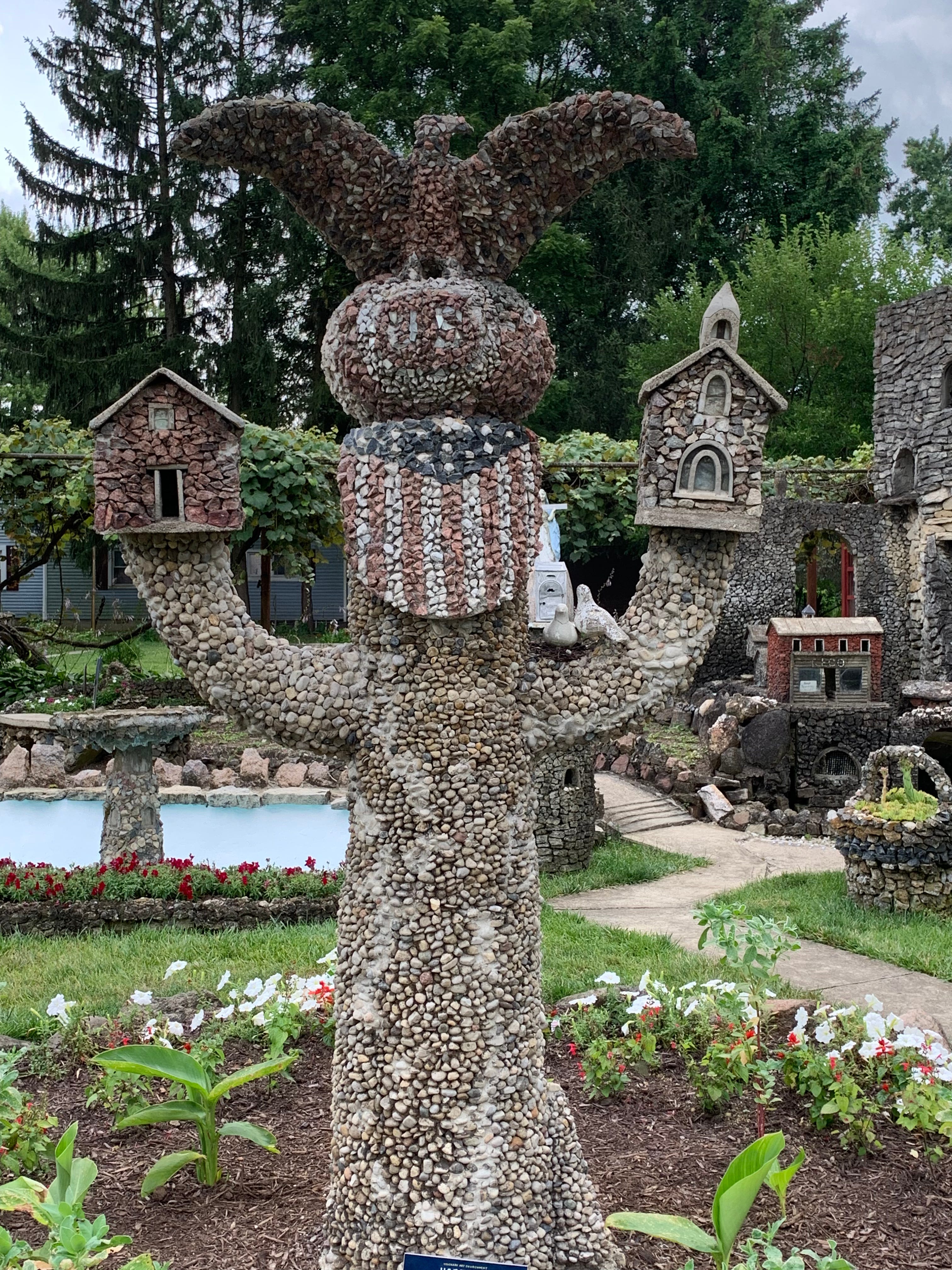
Rose’s favorite Hartman creation, “The Tree of Life,” reminds him a little bit of the ultra-patriotic, over-the-top opening credits of the Colbert Report, with those amped-up blue and red visuals and the screaming eagle. Hartman’s tree features a large bald eagle sitting atop a globe and the letters “USA” outlined on top. The creation dominates the garden, sticking out like a sci-fi visitor that took a spin through the galaxy and decided Ben Hartman’s backyard looked like was a good place to land.
Eventually, Ben was called back to work at the foundry. He worked there for several more years, then left the job because of declining health. (All that toxic dust he’d been breathing in for years killed him in 1944.) Mary stayed in the house on Russell Avenue for decades. She kept adding flowers and tried to preserve Ben’s monuments and buildings, but it was a huge undertaking. She died in 1997. The good news is that others, like the Friends of the Hartman Rock Garden, have stepped in to help.
Ben Hartman probably would’ve been astonished if he knew his creation would someday be a landmark, an actual tourist destination for lovers of folk art. People come from all over to see his garden. They lean over the fish pond, giggle at Mae West’s curvaceous form, and marvel at his elaborate castles.
Just how many tributes can you squeeze into a rock garden to celebrate America? Apparently, quite a few, if you’re Ben Hartman. I believe Ben got it right. In our country, there should be room for all. Sitting Bull, Jesus, Joe Lewis, and Betsy Ross—in Ben’s garden, everybody’s welcome.

__________________________________________________________________________
A note to my readers: My apologies for being away from “At the Dogpark” these past few weeks. I had pressing personal stuff I needed to take care of but now I’m back! Thank you for hanging in there with me, and thanks to all the new subscribers, both paid and unpaid, who read my newsletter. It means everything to me.
No posts
Comments
Nothing yet. Say the first thing.
Sign in to join the conversation.