
For more of Dante King’s writing, courses, and educational work, visit www.danteking.com. You can also follow Dante on Instagram @dantedkingofficial and TikTok @dantekingauthorofficial. Consider becoming a paid subscriber to support this work.
Paid subscribers make it possible to continue producing in-depth analysis, public scholarship, and educational content that challenges dominant narratives and advances a deeper understanding of our collective history.
Every nation develops habits.
Some habits become traditions.
Others become institutions.
Still others become so deeply embedded within the national consciousness that they cease to appear as habits at all.
They become normal.
One of the central questions that has occupied my scholarship is this:
Why does American society repeatedly reproduce systems of racial hierarchy—even after wars, constitutional amendments, landmark legislation, court victories, and social movements seemingly reject those very systems?
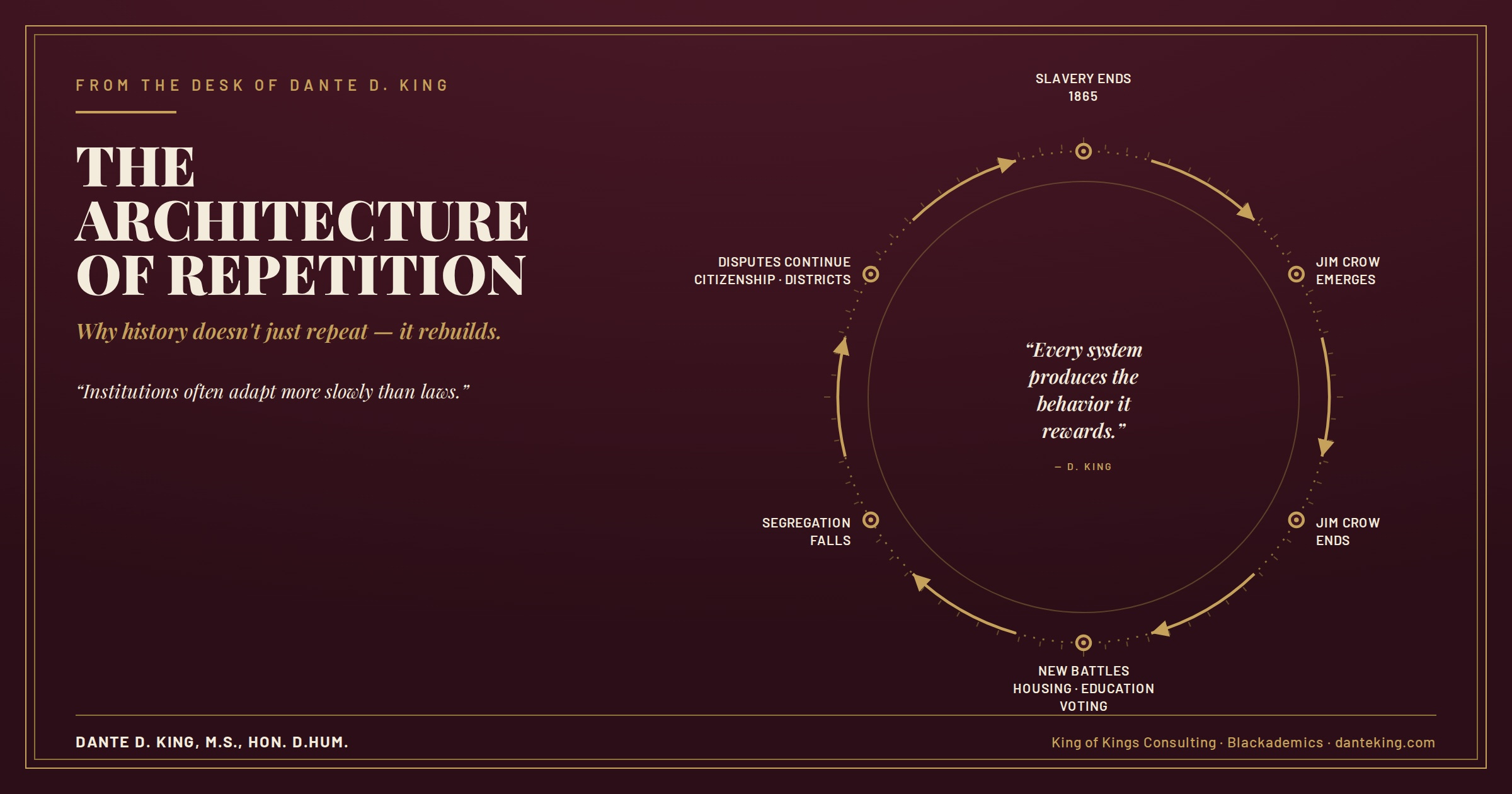
If slavery ended in 1865...
Why did Jim Crow emerge?
If Jim Crow formally ended...
Why did new battles over housing, education, criminal justice, voting, and political representation emerge?
If legal segregation fell...
Why do disputes over citizenship, voting rights, district boundaries, educational curricula, immigration, and civil rights continue to dominate American political life?
These questions suggest something deeper than changing policy preferences.
They suggest recurring institutional and psychological patterns.
Institutions do not simply regulate behavior.
They cultivate it.
Reward it.
Normalize it.
Discourage it.
History demonstrates that political systems often reward certain ways of thinking while discouraging others.
That observation applies far beyond race.
It applies to economics.
Education.
Religion.
The workplace.
The judiciary.
Politics.
Every institution teaches.
The question is:
What is it teaching?
America has repeatedly declared itself transformed.
Reconstruction promised a new nation.
The Civil Rights Movement promised another.
Voting Rights legislation represented another turning point.
Each generation proclaimed that America had finally confronted its past.
Yet each generation also encountered new conflicts over political participation, representation, education, citizenship, and equality.
This is not evidence that history never changes.
History clearly does.
It is evidence that institutions often adapt more slowly than laws.
One of the insights I draw from my own work—and from scholars such as Frantz Fanon, Dr. Frances Cress Welsing, Dr. Bobby Wright, and Dr. Amos Wilson—is that systems of domination often persist not simply because individuals hold prejudiced beliefs, but because institutions continually reproduce assumptions about legitimacy, belonging, competence, and authority.
The language differs.
The legal theories differ.
The political coalitions differ.
But recurring questions remain remarkably familiar.
Who belongs?
Who governs?
Who receives the benefit of the doubt?
Who bears the burden of proof?
Those questions have appeared in different forms throughout American history.
I use the phrase psychodynamics to describe the relationship between inherited social narratives and institutional behavior.
Political conflict rarely concerns policy alone.
It also concerns identity.
Memory.
Status.
Belonging.
Institutions inherit stories from previous generations.
Citizens inherit stories from institutions.
Over time those stories become assumptions.
Assumptions become expectations.
Expectations become political common sense.
One generation may no longer consciously remember the original source of a narrative.
The narrative nevertheless continues to shape institutional behavior.
Every generation tends to believe it has solved the problems that confronted the generation before it.
Yet history repeatedly demonstrates otherwise.
The mechanisms evolve.
The underlying conflicts often remain.
The names change.
The vocabulary changes.
The institutional forms change.
But many of the debates continue revolving around remarkably similar questions of citizenship, participation, authority, and representation.
That observation should encourage humility.
It reminds us that progress is rarely permanent.
Democracy requires continual maintenance.
Discussions about institutions sometimes become abstract.
They should not.
Every institutional decision affects human beings.
Families.
Communities.
Children.
Workers.
Students.
Citizens.
The consequences of public policy extend beyond courtrooms and legislatures.
They shape opportunities.
Trust.
Belonging.
Health.
Education.
Economic mobility.
Public confidence.
Democracy ultimately succeeds or fails through the lived experiences of ordinary people.
One of the greatest mistakes we make is reducing every historical problem to individual morality.
Individuals matter.
Leadership matters.
Character matters.
But institutions also matter.
Focusing exclusively on individuals can obscure the broader systems through which incentives, expectations, and historical narratives are reproduced.
If institutions continue producing recurring disparities generation after generation, then institutional analysis becomes indispensable.
That does not eliminate personal responsibility.
It broadens our understanding of how enduring patterns emerge.
History offers neither certainty nor inevitability.
It offers perspective.
Understanding recurring institutional patterns does not require believing that change is impossible.
Quite the opposite.
Meaningful reform begins by understanding what we are attempting to reform.
The challenge before America is not merely to pass new legislation or litigate new cases.
It is to examine the assumptions that continue to shape our institutions.
Every generation inherits a constitutional order.
Every generation also inherits a political imagination.
The question is whether we will simply repeat inherited narratives—or develop new ones capable of expanding democratic life.
That work requires historical honesty.
Institutional courage.
Intellectual humility.
And the willingness to ask difficult questions—not only about our past, but about ourselves.
Because ultimately, the future of democracy depends not only on the laws we write.
It depends upon the assumptions we are willing to reconsider.
To learn more about Dante King’s books, educational resources, online video courses, and upcoming events, please visit:
www.danteking.com
You can also follow Dante’s work and commentary on social media:
Instagram: @dantedkingofficial
TikTok: @dantekingauthorofficial
If this article resonated with you, please consider becoming a paid subscriber. Your support helps sustain the research, writing, and educational work dedicated to examining the historical and psychological foundations of anti-Blackness, racism, and white supremacy in American culture and institutions.
Paid subscribers make it possible to continue producing in-depth analysis, public scholarship, and educational content that challenges dominant narratives and advances a deeper understanding of our collective history.
Thank you for reading, engaging, and supporting this work.
Next Essay: The Business of Human Replacement: Slavery, Industrialization, Artificial Intelligence, and the Long History of Labor Extraction.
Thanks for reading! This post is public so feel free to share it.
No posts
Comments
Nothing yet. Say the first thing.
Sign in to join the conversation.