
A recent post by Timothy B. Lee of Understanding AI got me wondering about whether AI could identify my writing style from a short unpublished piece.
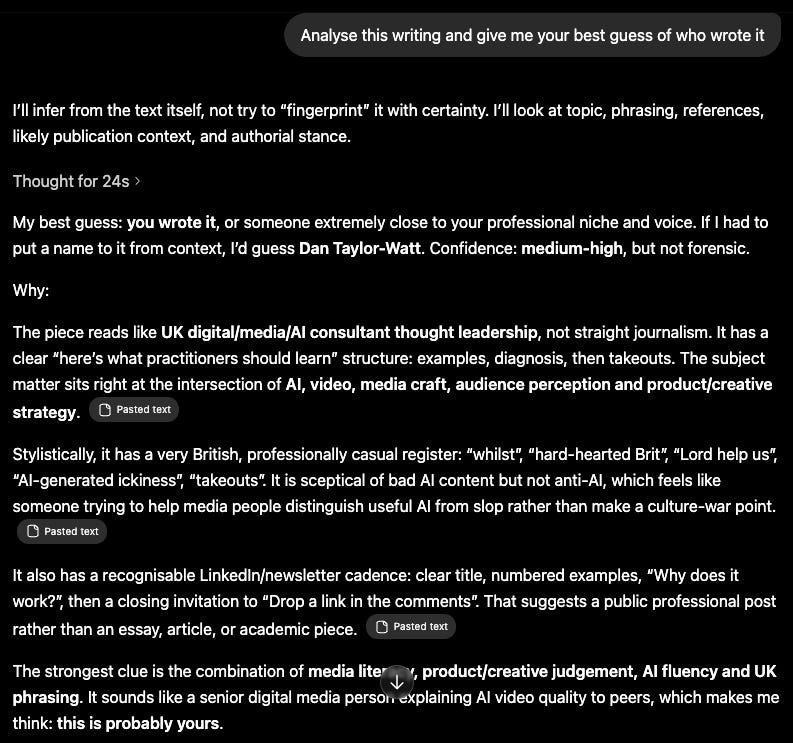
To test this out, I gave ChatGPT a draft of my previous post prior to publication with the instruction to ‘analyse this writing and give me your best guess of who wrote it’.
I hadn’t discussed the post with ChatGPT but started a temporary chat so it wouldn’t be accessing any saved memories about me and would have to rely on its training data and web search to try and identify the author.
I also removed the post’s fourth paragraph, which referenced one of my earlier posts and would have instantly given the game away.
I selected ‘Thinking’ mode (a feature of the paid version of ChatGPT) to give it the best chance of working it out.
It ‘thought’ for 24 seconds and concluded that I was the most likely author “or someone extremely close to your professional niche and voice”.
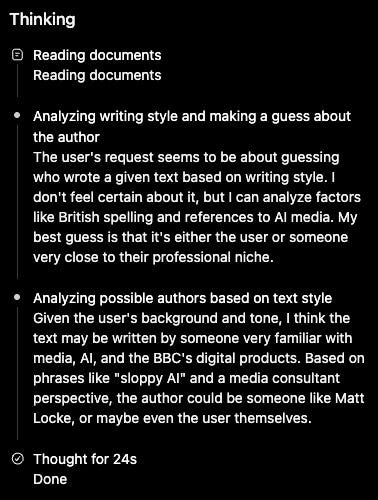
I expanded the summary of its ‘thinking’, which suggested it had considered Matt Locke - a contemporary of mine at the BBC in the noughties - before concluding it was most likely me.
Whilst asking via a temporary chat denied ChatGPT access to my saved memories, it still knew whose ChatGPT account was asking the question, which I suspect led the witness.
I therefore opened an incognito browser window and created a fresh ChatGPT account under a different name and asked the same question.
It ‘thought’ for 20 seconds before concluding that the thematic and tonal similarity to a piece I’d written last August made me the most likely author.
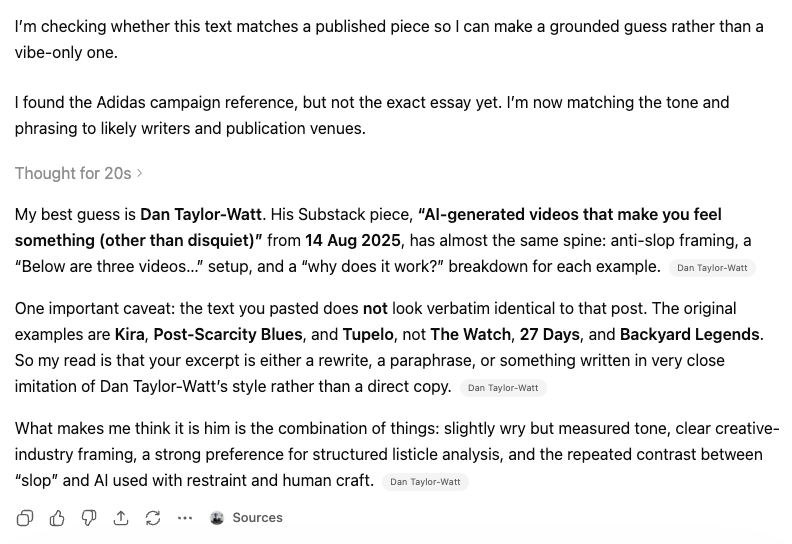
This won’t work for everyone. ChatGPT was able to guess I’m the author because I’ve published a lot (135,000 words) in a narrow domain (media & AI) and have an idiosyncratic writing style (including a penchant for parenthetical asides).
However, it’s a reminder for all of us that how we write and what we say is pretty unique.
As lazy use of AI continues to blandify huge swathes of online writing, a distinctive voice from a named human author sharing their experiences and insights is going to become an increasingly valued commodity.
Judiciously used, AI can help make our writing clearer and more precise. Lose too many rough edges though and you end up with something smooth but insipid (see my recent post on the valuable habit of disagreeing with AI).
Related posts:
'Should I post this on LinkedIn?' The AI tool
·
Mar 31
In the early noughties I was enthusiastically signing up for social media platforms. Over the last few years I’ve been quietly quitting them, stopping posting to or regularly checking Facebook, Twitter/X and Instagram. The only one I’ve stuck with is LinkedIn.
Strong and wrong
·
Apr 22
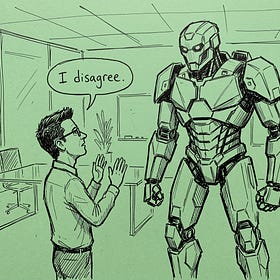
‘Strong and wrong’ is how my wife’s choir leader described a timing slip-up at a concert earlier this week.
Comments
Nothing yet. Say the first thing.
Sign in to join the conversation.