
Of late, I have become interested in quantum computers.
Perhaps the most simple way to think of a quantum computer is a reality simulator. We live, largely, in a quantum world. There are 10^90 quantum particles in the universe. The laws that govern them have proven to be generalizable to other fields of physics except to gravity.
So with the caveat of gravity, one could say we live in a quantum computer. Or, equivalently, that a quantum computer is largely a reality simulator. Certainly we can say, because the force of gravity is weak at the quantum scale, that a quantum computer is a quantum reality simulator.
The skeptic might frown at this point and say, a classical computer is good enough reality simulator. Mathematically, this is only the case for very small realities.
Consider a classical computer with n bits. Each bit can be 0 or 1. Each bit is implemented by the presence of one or several electrons in a 2-3nm transistor. This computer can hold 2^n states over time, and only one at a given moment. If this computer needed to brute force a 128 bit sequence, it would need to run through (2^128)/2 sequences on average and 2^128 in the worst case.
A quantum computer uses a quantum particle as a bit. A qubit. Like a classical bit, a qubit has an enforced binary state, made possible because quantum particles have quantized energy levels. Unlike a classical bit, the qubit exists in both states simultaneously because of the quantum principle of superposition. Also unlike classical bits, the qubits are entangled.
The net of this is that a quantum computer with n qubits exists in 2^n states simultaneously. In the brute force example, this means it instantly contains the correct 128 bit sequence along with all the incorrect ones. A quantum computing algorithm (Grover’s search, given the problem is properly encoded) can find this one sequence in roughly 2^64 steps, compared to the classical computer’s 2^128 steps.
That’s 18 billion billion fewer steps.
Perhaps you are now thinking of the most obvious implication of this computational efficiency: security. The rough consensus is that once quantum computers can hold 4,000 logical qubits (more on this later), modern forms of encrypting data will be obsolete. This is true but also overdramatized because classical computers can implement quantum-proof encryption. iMessage is already quantum proof and over the next few years everything else worth encrypting will be too.
More interesting than decrypting the secrets of humans is decrypting the secrets of nature.
Consider the field of quantum chemistry, which uses computer simulations to discover the molecular structure of new drugs. In theory, the most accurate way to do this is to model each electron orbital in a molecule. Caffeine for example (C₈H₁₀N₄O₂) has 24 atoms and 160 electron orbitals. In practice, an orbital-level model is too computationally intensive for a classical computer. Instead they use a variety of simplifications. These work for most molecules but not all, notably not for molecules that contain metals.
Modeling orbitals is not a problem for a quantum computer. It would roughly be able to model a molecule with orbitals scaling linearly with number of qubits. I am not a quantum chemist, but I would imagine this would significantly accelerate drug discovery.
Drugs are not the only high value molecules. The energy density of a battery, the efficiency of a catalyst, the critical temperature of a superconductor — these are all emergent properties derived from the quantum behavior of materials. Classical computers can’t model these properties from first principles because the electron interactions are too complex. A quantum computer could simulate candidate materials that today are discovered only by slow, expensive trial and error: higher-capacity battery chemistries, more efficient catalysts for industrial processes, or new superconducting compounds that work at higher temperatures. The quantum computer doesn’t build these things — it identifies what to build.
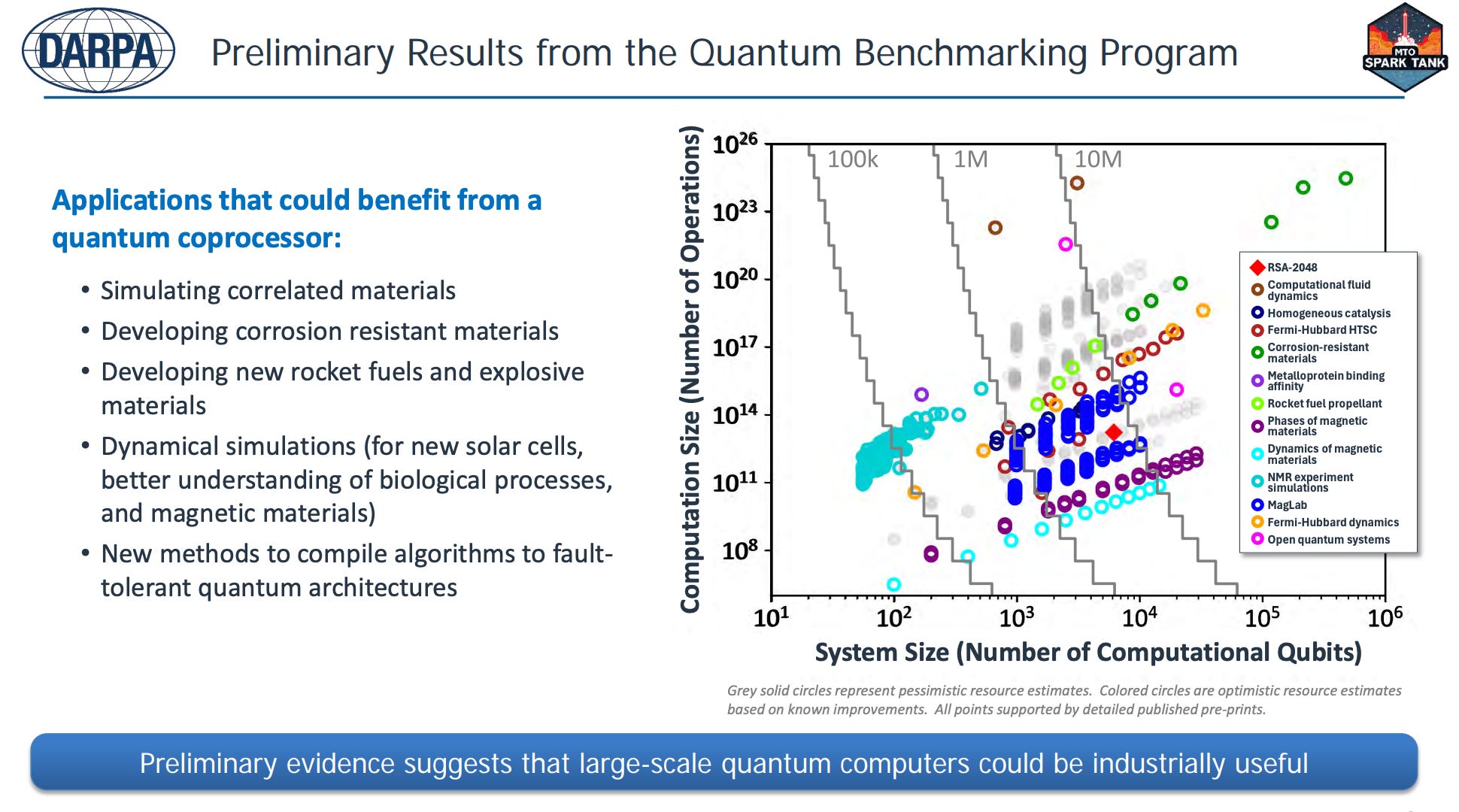
Here’s a DARPA slide on the potential applications.
To someone who says, “quantum computers won’t be able to create much economic value,” I’d say that people have been saying the same thing about every new computer technology for the last 65 years.
The economic value of quantum computers could very likely be far larger than anyone anticipates today.
So that’s the theoretical potential of quantum computers. When will we reach it?
The above DARPA slide suggests that quantum computers will start to provide economically useful results when they reach hundreds of logical qubits. More and more use cases unlock with more qubits and 10,000 logical qubits is when RSA encryption is solved.
I think it is therefore fair to think about 300-500 logical qubits as the first commercial gateway of quantum computers. At this point, a quantum computer could pay for itself.
There is an important nuance to understand here: the qubits in the DARPA chart are logical qubits rather than physical qubits. Building a quantum computer is uniquely challenging because the environment is full of noise — electromagnetic interference, vibrations, material defects. One architecture, superconducting circuits, needs to be cooled to 10 millikelvin. Another, trapped ions, must isolate individual atoms in a vacuum using precisely tuned electric fields. Every architecture faces the same fundamental problem: qubits are fragile. Today’s quantum computers maintain coherence (run without error) for 100 microseconds to ten seconds depending on the type of qubit.
This problem is solved, simply speaking, with redundant qubits. A group of physical qubits — 7, 17, or 49 or more depending on the code — will encode one logical state. A similar number of ancilla qubits will monitor them for errors. The overall group is called a code. Today’s computers require roughly 100-1,000 physical qubits per logical qubit, though this ratio is expected to improve with better architectures and error correction algorithms.
So the proximate milestone of 300 logical qubits translates roughly to 30,000 to 300,000 physical qubits.
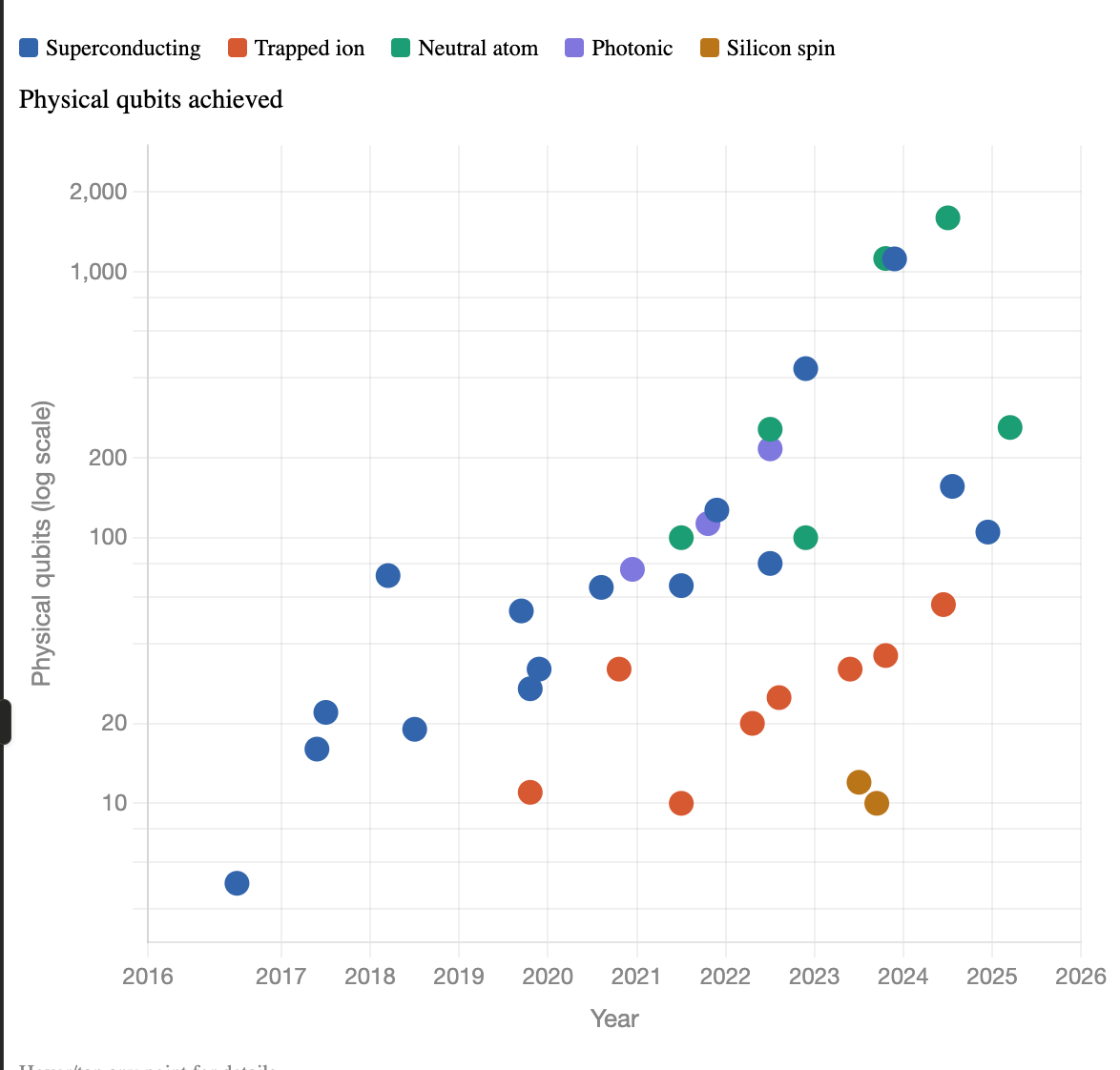
So…drum roll… here is how many physical qubits have been demonstrated over time by quantum architecture.
And here’s the corresponding logical qubit count.
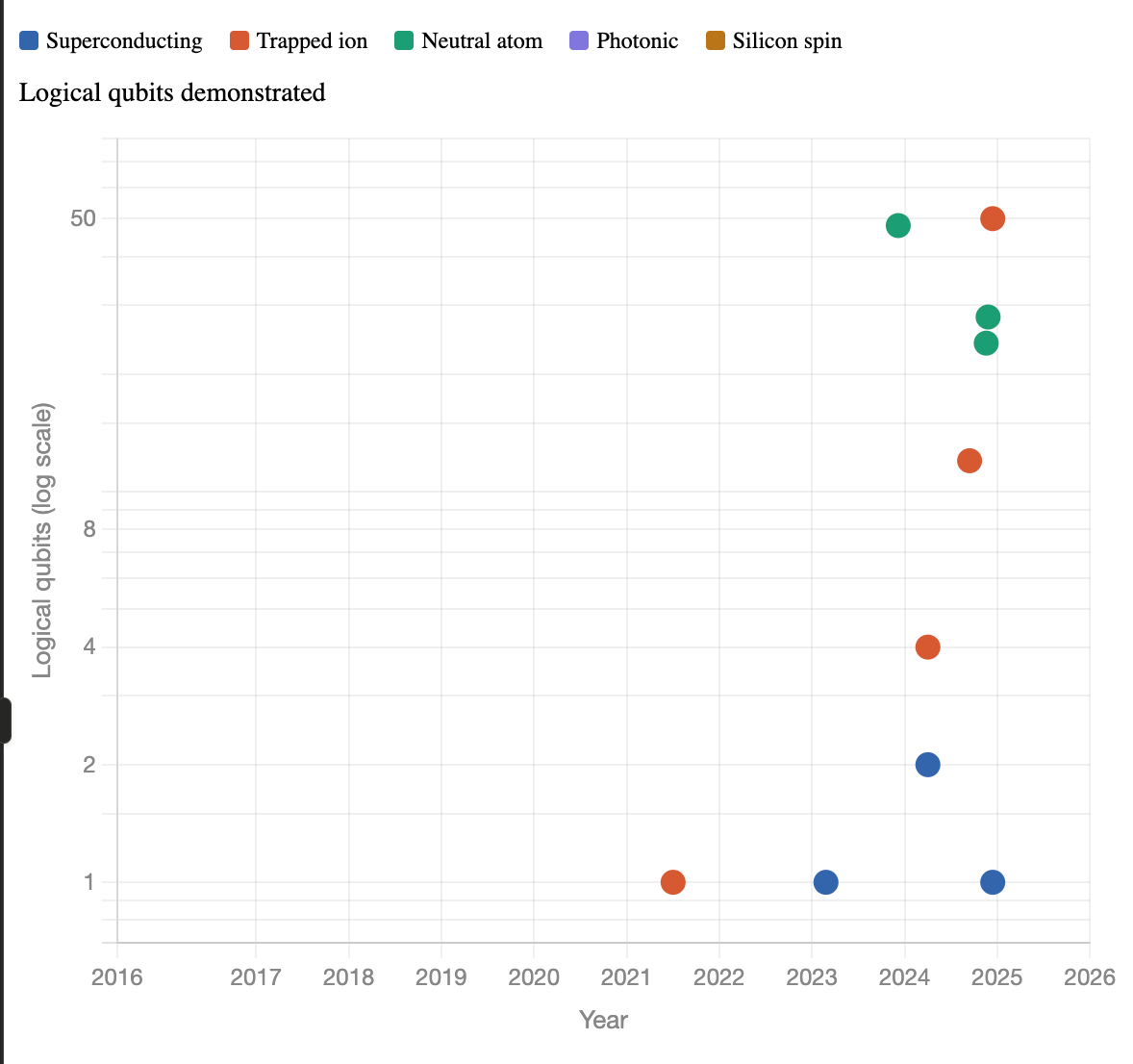
My first reaction to these charts is that they are largely unclear. Physical qubit counts alone don’t tell you much. A machine with 1,000 noisy qubits may be less useful than one with 100 high-fidelity qubits. What matters is error rates, gate fidelity, connectivity between qubits, and how well the architecture scales. Neutral atoms, for example, barely registered a few years ago and are now near the top of the physical qubit chart. The landscape can shift fast. Specifically:
Trapped ions have a promising logical qubit growth rate
Superconducting qubits are at the top of the physical qubit chart but not on the logical one. Why?
Photonic qubits are not on the logical chart at all. Why?
Two of my Physics TA’s from college are working on architectures not on the above plots. Why?
Suffice it to say there are lots of questions and there is no clear winner. To me, this is exciting. Quantum is a pre-consensus field with enormous economic potential nearing the 300 logical qubit commercialization milestone. And there is enough uncertainty about this statement and enough complexity inherent to quantum mechanics, that most capital and people are staying away from it. This is, I think, what a swell looks like.
No posts
Comments
Nothing yet. Say the first thing.
Sign in to join the conversation.