
In the space of a few hours, Trump did two crazy things that made the United States look — if this can be believed — even more unserious.
First, the president of the US shared a thought with Fox News. “If Oman gets in the way, we’ll bomb the shit out of them,” he declared. That language has become familiar when directed at Iran – but Oman, while causing trouble now and then, is a US ally. Is this kind of thing effective? Is it the new way of geopolitics? Has Trump become fully unhinged? As we navigate the damaging and embarrassing Persian Gulf quagmire, it’s time to talk more softly, but also more clearly.
Shecond, Trump spoke clearly but nonsensically in a social media post, claiming the Strait of Hormuz was now US territory. There are a number of problems with this, beginning with the fact that (as I explain above in a TV interview) the US cannot declare other countries’ territorial waters to be US territory.
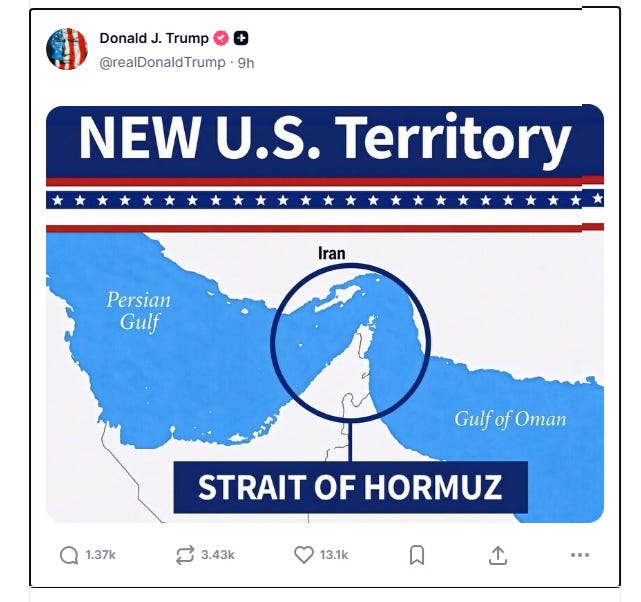
Moreover, it wouldn’t matter because the strait actually is Omani and Iranian territorial waters in totality, and yet international maritime law demands that passage be free without any conquests or annexations. Lastly, even if Iran wanted to hand over its territorial waters to the US, but then kept on firing at ships from its land, more or less as it threatens to do now, the result would be exactly the same as the current fiasco. Trump’s claim is gobbledygook and the Iranians rightly called it “delusional.” It is a sad spectacle when the Iranian regime, a criminal outfit if ever one there was, is put in a position where they have a point.
To unlock full access to Ask Questions Later consider an upgrade to a Paid Subscription.
As for Oman, it has spent decades perfecting a diplomatic trick. It has been a close friend of the United States, a partner of the Gulf monarchies and a useful intermediary among all of them, while preserving enough independence to talk to people Washington cannot. It was the first Gulf country to openly receive an Israeli leader, Yitzhak Rabin, in 1994 – yet has also not joined the Abraham Accords.
This balancing act, while annoying to many outsiders, has served Oman well, keeping the country stable and secure in one of the world’s most dangerous neighborhoods while giving successive US administrations a diplomatic channel into Tehran. And Oman – both under longtime Sultan Qaboos and his successor Sultan Haitham – was ultimately dependable.
That is what makes Oman’s current behavior peculiar. Muscat is apparently discussing with the tyrants of Tehran a mechanism for reopening the Strait of Hormuz, vital for global energy supplies, that could give Iran a role in regulating maritime traffic and would seemingly involve payments by commercial vessels. The details remain fluid and Oman may describe payments as service fees rather than tolls – a trick Iranian officials have already tried – but any version of this would upend global maritime trade.
The whole world would deal with inflation and supply chain concerns – Asia and Europe perhaps mainly – but in the longer term the concern is for the principle of freedom of navigation, which America has guaranteed. Copycat actions would emerge at other chokepoints – not only the Bab el-Mandeb, which Iran’s Houthi proxies have already messed with, but also the Bosporus, Strait of Malacca, Sunda Strait, the Strait of Gibraltar and more.
How, then, better to handle this?
The rest of this article is for Paid Subscribers
Comments
Nothing yet. Say the first thing.
Sign in to join the conversation.