
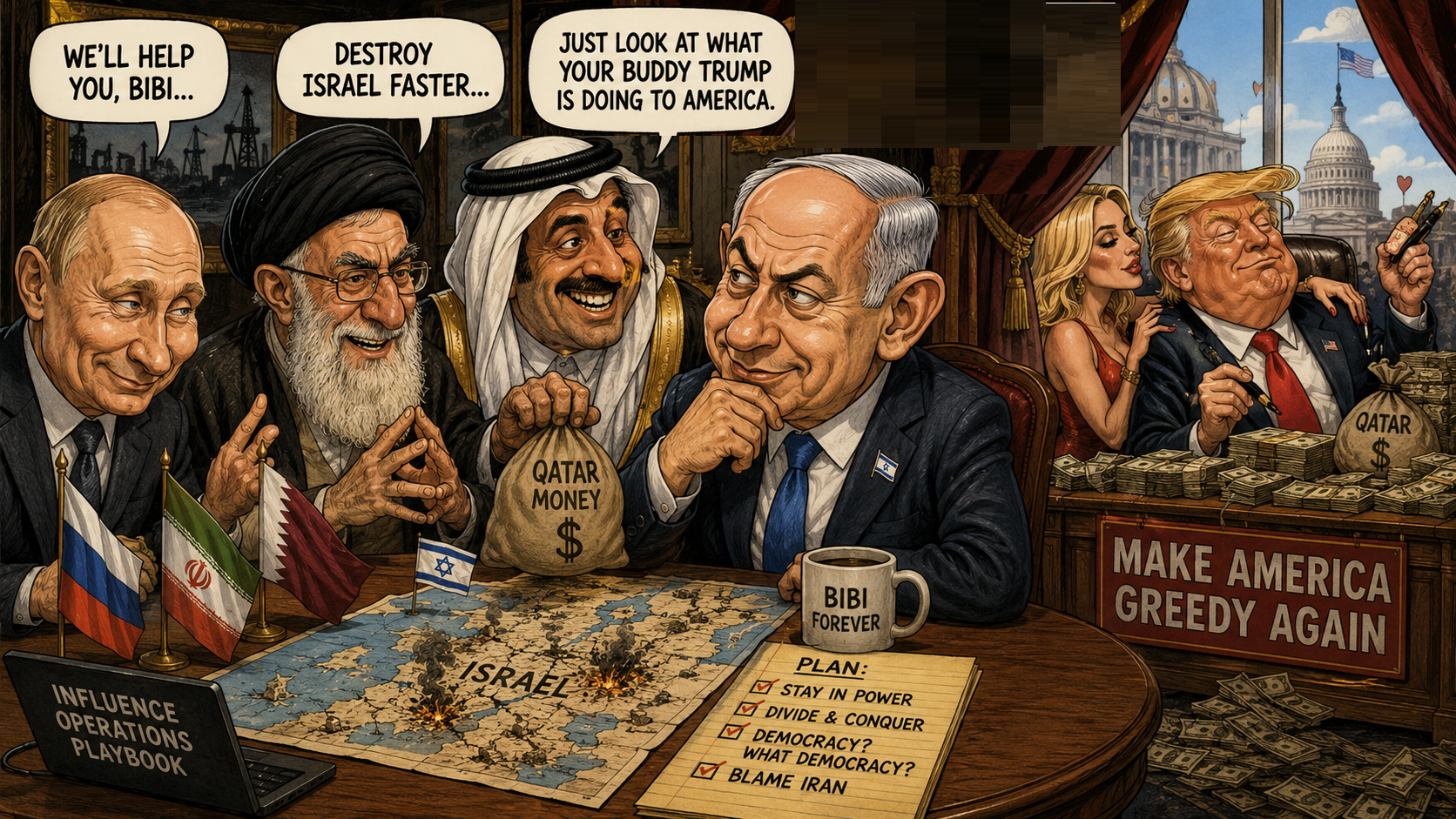
Vladimir Putin has made a specialty of using digital subterfuge to interfere with other countries’ elections. The objective is not necessarily to install politicians who love Russia but to empower forces that weaken the West from within — dividing democratic societies, discrediting their institutions and undermining the alliances that have constrained Moscow since World War II. Now it’s Israel’s turn.
To unlock full access to Ask Questions Later consider upgrading to a Paid Subscription. You’d be supporting independent analysis and a robust defense of the liberal, centrist, US-led world order that is currently beset from all sides, including the White House
The gold standard, of course, is Trump. US intelligence agencies concluded that Putin personally ordered the operation to influence the 2016 presidential election, that Moscow sought to damage Hillary Clinton and developed a clear preference for Trump. It is also widely believed to have interfered in 2024. This has paid extraordinary dividends (though if I were advising Putin I might recommend he also assist the woke left, which undermines the opposition to Trump).
Trump has spent years demeaning and attacking NATO allies (even threatening in January to invade Denmark), questioning US security commitments (last week in the Koreas), picking fights with friendly democracies and weakening confidence in the Western alliance. As a bonus he offers a harebrained fixation with tariffs, which harm and annoy both trading partners and the US consumers and importers who pay the actual costs. This is a rarified level of self-harm. If an actual Russian agent had somehow been installed in the White House, it is difficult to imagine what more Moscow could have hoped for.
The Trump grand slam is also only the most spectacular example of a much broader operation. Russia has repeatedly meddled in the politics of countries on the fault line between Moscow and the democratic West, generally favoring the candidates and movements most likely to weaken Western cohesion, halt their countries’ movement toward European integration, or damage them in general.
Viktor Orbán’s Hungary had been the Kremlin’s great success inside the European Union: an illiberal icon government that routinely obstructed European efforts to confront Russia and help Ukraine while trashing Hungary’s hard-won democracy. Moldova has been subjected to repeated Russian campaigns involving disinformation, illicit political financing and alleged vote-buying as Moscow tried to derail President Maia Sandu and the country’s pro-European trajectory. Romania initially looked like another spectacular success when a little-known far-right, NATO-skeptic candidate surged to first place in its 2024 presidential election amid evidence of a massive online influence campaign. And this year in Armenia, international observers accused Russia of undermining Prime Minister Nikol Pashinyan, whose government has been moving the country away from Moscow and toward the West.
The recent record, in fact, has not been good for Putin. Romania anulled the tained election and a liberal won in the rerun. Sandu and her pro-European allies survived the Russian onslaught in Moldova last fall. Orban was finally ousted in April. And in June, Pashinyan won a parliamentary majority despite Russian pressure. Things balance out, even for the wily and amoral Putin; the Ukraine war that he launched in 2022 is also a fiasco.
Which brings us to Israel, which on Oct. 27 will hold an election of enormous strategic importance — not only for Israelis, but for the region and for the future of one of the West’s most important and troubled alliances. And Israel’s new Shin Bet chief, David Zini, warns that foreign powers including Russia, China and Iran may attempt to interfere.
Zini is a Netanyahu lackey, so it is reasonable to ask what the angle might be. With polls showing the governing coalition headed toward defeat, it is difficult to avoid the suspicion that it is laying the groundwork to challenge the legitimacy of the outcome. As I’ve written before, Netanyahu may well attempt some version of Trump’s post-defeat 2020 strategy: flooding the public sphere with false claims of irregularities. Given the complexities of coalition-building in badly divided Israel, the goal would be to create enough political turmoil to deter the opposition bloc from forming a government that depends on an Arab party. That might somehow enabled Netanyahu to stay a factor or perhaps even hang on to his seat for a time.
Zini’s warning should nonetheless be taken seriously — largely because of the bigger question which has received far less attention: If Putin does interfere, whom would he back? Remember that Putin is closely aligned with Iran, Israel’s arch-enemy, which Netanyahu joined Trump in attacking earlier in this year — so you might be forgiven for thinking that Israel’s enemies would want him out. But you’d be missing a trick: Israel’s enemy want what’s bad for Israel, and democracy’s enemies in Moscow want what’s bad for democracy.
Liberal democracies everywhere have become prime targets for sophisticated electoral influence operations conducted through social media, artificial intelligence, coordinated networks of fake accounts, deepfakes, and the systematic amplification of existing political divisions. Israel’s paper-ballot system makes direct manipulation of vote counting extremely difficult — but manipulating public opinion is another matter entirely.
What would it look like? Well, interference from Russia, Iran, China and perhaps Qatar would certainly follow a well-established pattern: campaigns exploiting grievance and resentment, rewarding the most inflammatory voices, deepening mistrust, and intensifying polarization. The baseline objective is to make democratic societies more divided, harder to govern, and less capable of pursuing coherent policy. Strategically, the goal is to weaken target countries and separate them from their allies, leaving them isolated and vulnerable. For the autocracies of the world, this is far preferable to a strong, stable, united democratic bloc.
In Israel’s case, that logic points in only one direction, and this is where things become interesting. Across Europe and North America, Moscow has repeatedly backed populist right-wing movements — the champions of “the people” against “the elites.” Its bots, algorithms, and influence networks have consistently been deployed on behalf of political forces that weaken democratic institutions, undermine confidence in elections, challenge traditional alliances, attack independent media, and deepen domestic polarization. The individual cases differ, but the strategic pattern is remarkably consistent.
Viewed through that lens, Israel presents an especially straightforward case. From the perspective of Moscow — or its ally in Tehran — the current Israeli government bears responsibility for Israel’s deepest diplomatic isolation in generations. If it remains in power, Israel will face a genuine national emergency while its enemies rejoice.
The reasons are many, but one key element is that under Netanyahu, Israel’s relations with its allies have deteriorated dramatically. Across Western Europe, public opinion has turned sharply against Israel, especially among younger generations. In the US — without whose support Israel would face existential danger — an incredible 60 percent now hold an unfavorable view of Israel, compared with the broad support that existed only a few years ago.
There is the simple fact that Netanyahu failed to prevent the invasion of Israel by Hamas on Oct. 7, 2023, and the massacre of over 1,000 people — and then walked into Hamas’s trap and embroiled Israel in forever-wars that have achieved little, ignoring every off-ramp, forgoing any potential diplomatic gain, and saddling himself with an invitation to face war-crimes charges at The Hague.
Hostile states understand Israel’s internal fault lines as well. They recognize the intensity of disputes surrounding Netanyahu’s “reforms” mant to turn Israel into an elected autocracy, expansion of West Bank settlements, coddling of Jewish terrorists, and alienation of Israel’s Arab citizens. They also understand that the government has blocked necessary reforms concerning the ultra-Orthodox community in ways that pose an existential long-term threat to Israel. Net emigration is accelerating. One more Netanyahu term, and it will become a flood.
Together these developments constitute an enormous gift to Israel’s enemies — and since it is existential for Israel, this is in a way an even bigger win that hurting America via Trump. Even if one accepts the argument that this government’s policies weakened Hezbollah or Hamas, there is little doubt that Israel’s overall strategic position has deteriorated catastrophically.
Israel’s enemies have no reason to hope for a moderate government that rebuilds international alliances, restores domestic political stability, addresses the ultra-Orthodox challenge, combats organized crime, strengthens democratic institutions, and restores Israel’s international legitimacy. They want it even weaker, more divided, and increasingly isolated.
What about the Palestinians, you ask? Don’t Israel’s enemies worry that the Israeli right, should it remain, will seize more land and build more settlements? Not especially. They can do math, and so understand that continued settlement expansion brings Israel closer to an irreversible binational reality that ultimately will destroy the Zionist project of a Jewish-majority state. True, the fascist far right — which is somewhat more intelligent than Likud — dreams of mass expulsion. But that, too, would be welcome news for Israel’s cynical enemies: such a move would complete Israel’s global isolation, including from the United States.
In short, Bibi has friends among the haters of Israel.
How would such interference work? By now, the playbook is rather scientific.
Target populations are bombarded with false social media content that appears entirely authentic. Anonymous accounts, coordinated amplification, AI-generated images, emotionally manipulative videos, and precisely targeted algorithms create an online environment in which outrage — mainly videos distorting the words (or inventing them) of opposition candidates, especially former military chief Gadi Eisenkot, who leads in the polls. The objective will be to intensify polarization through relentless repetition, ensuring that every potential right-wing voter is angered enogh to bother to vote, convinced they’re fighting evil incarnate.
There are ways to counter this threat. Just ask the Romanians, who eventually uncovered what was happening in fairly sophisticated fashion. Israel’s integgigence agencies, among the best in the world, who on Feb. 28 know the exact location of Ali Khamenei, should be up to the task.
Indeed, the Shin Bet should thwart foreign influence operations regardless of whom they benefit politically — even if the foreign interference were helping parties aligned with the governing coalition. Ah, but that’s what happens in a democracy. That’s the very thing Netanyahu, just like Putin, seeks to destroy. Readers who may wish ill upon Israel would logically find themselves aligned with Putin and Iran on this one, wanting Netanyahu to pull it off somehow.
Comments
Nothing yet. Say the first thing.
Sign in to join the conversation.