
Students frequently feel like they have to leave essential parts of themselves at the classroom door in order to be successful in math class. Nasir, Martin and others have studied the implicit expectations imposed on Black students in math class. Boaler has studied the experience of girls in a similar way. I am writing here about the way fairly normal kids feel as though they have to become giant weirdos in order to succeed in math class. Here is an illustrative example that came to my attention recently.

In this problem, the student must first pretend that Carole is asking a sensible question about her book-reading habits. The kid has to suspend their disbelief at this idea that a) someone in 2026 is reading a book and b) they are tabulating their daily pages and pondering the difference between two days. Sure. Let’s pretend that any of that is normal.
Then the student has to find, not the actual difference between those two days, but “a reasonable answer” for the difference. Sure. Let’s go with that too.
Then the student has to somehow metabolize the fact that they are marked incorrect by their teacher for answering with the exact answer and not an inexact answer. Success in this problem requires imprecision even when precision is right there. You’re right if you’re wrong.
Math class asks kids to disassociate from their better selves and rational instincts hundreds of times throughout a school year. Kids realize quickly that there is zero upside in asking “okay but is there a situation where estimation is actually useful?” or “okay but I got a better answer than the one you wanted.”
I’m convinced the problem here is the problem, which is to say, the worldwide, timeless problems of treating people like objects and failing to imagine the world as others might see it. The teacher is rewarded for getting the kid to estimate, not for getting the kid to inhabit themselves more fully. The teacher then treats the kid as an object in service of that project, rather than their own subject. The teacher has also, perhaps, grown too familiar with estimation to imagine how this problem might appear to someone much less initiated.
We can meditate every day on the fact that others are not like us, that we cannot expect other people to care innately about the things we care about deeply. We can ask ourselves, “What is a situation where estimation might feel necessary and natural? If estimation is aspirin, then what is the headache?”
Those meditations helped my colleagues at Amplify create Moley Goalie, a fantastic free lesson from our PK-12 curriculum, Amplify Desmos Math.

You see how it works, right? It doesn’t even matter that the situation is contrived. The format of the problem makes estimation a natural and necessary option. A kid benefits from knowing the answer is a bit above 500. The kid can calculate exactly if that’s their thing, but precision isn’t profitable here. You can only answer in increments of 100.
This activity, like all others in our curriculum, comes from an ethic that says, “How can we take kids as they are and build from there, to build better versions of ourselves together?” The alternative is to ask kids daily to become somebody else, to invite them to choose daily between themselves and mathematics. Their choice shouldn’t surprise us.

In Florida and Arizona, I talked with supervisors of districts with hundreds of schools, listening as they described the challenges of taking teachers as they are and helping them grow, not just over one summer in the first year of a curriculum adoption, but over their career. Everything seems incredibly challenging at that scale—from getting visibility into teacher practice to securing facilities for professional learning. I plan to work a lot in this area in the upcoming school year.
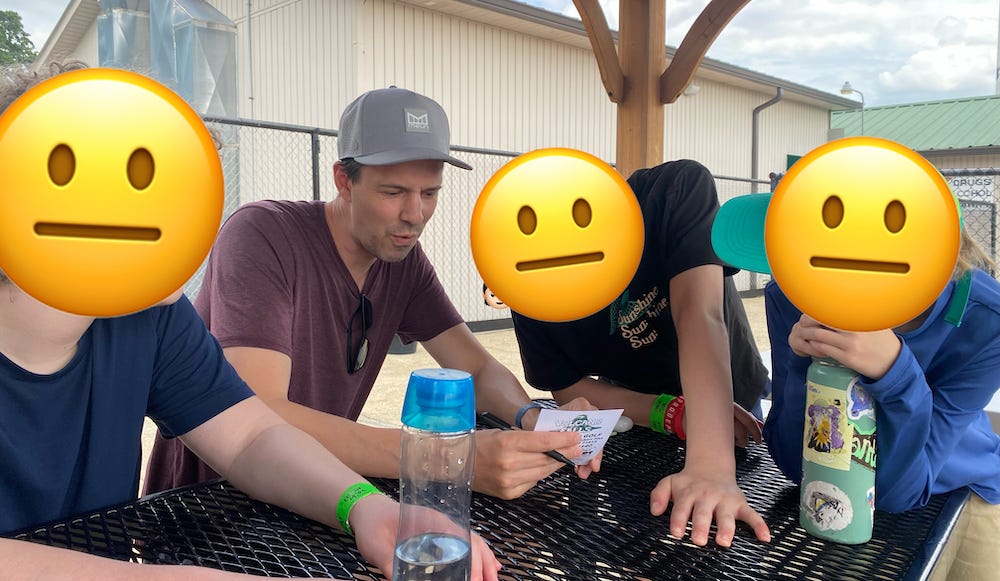
I also spent a week in Arkansas with my family and some friends. Math teacher dad makes everyone add up their own minigolf scores. Everyone is sick of me, booing, ready for school to start.
Chloe Zimmerman adds another test to decide if edtech is the baby or the bathwater:
This belonging test is harder to game than an evidence page. A dashboard can show progress while the classroom quietly becomes more solitary. The question I’d add is: after 30 minutes with the tool, does the teacher have more to notice and discuss with this student—or less?
¶ Local & alt news are absolutely romping with their AI coverage right now:
Oklahoma Watch covered Alpha School’s new school in Tulsa. The anecdote about preloaded Starbucks cards messed me up, man.
Eyeblack covered Colin Kaepernick’s AI storytelling site Lumi, including some documents obtained under Freedom of Information Act requests and, man, every screenshot gives you something to think about. The example dashboard. The example student output. The tight coordination between district and corporate officials.
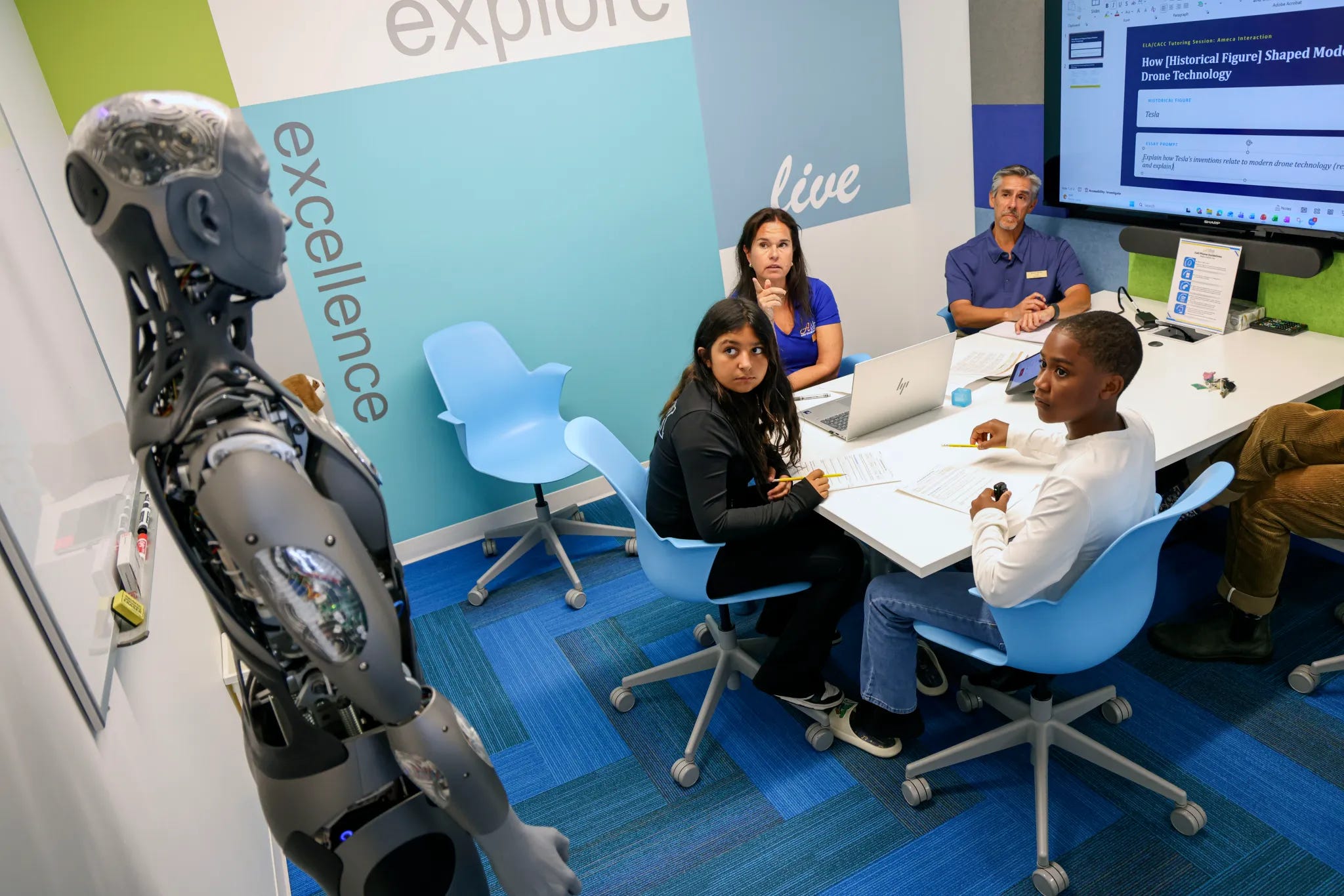
Voice of San Diego covered a charter school’s purchase of a $500k humanoid teacher robot. The quotes, man. Rambo’s quote about “breaking the poverty cycle.” Turkle’s quote about who is actually hallucinating here.
New York Focus covered a similar humanoid teacher robot in Western New York, an initiative which the district has now paused owing to national backlash. Man, the bit about students and their unique identification codes. You know what kind of teacher doesn’t need a unique identification code to identify their students?
That coverage is all quite fearless and much closer to the ground than most other edtech coverage right now. I love it.

¶ Anthropic released Claude for Teachers. I think it’s neat they’re coming to the scene with a bunch of edtech partners. I think it’s much less neat that they’re encouraging teachers to run around their IT departments and evaluate FERPA compliance on an individual basis. I loved this quote from Carter Moulton, responding to Anthropic’s promise to help teachers “focus on students instead of planning, prep, and paperwork.”
For many educators, and I’ll include myself here, “planning” is one of the most rewarding aspects of teaching, and is a primary site where we focus on our students. “Planning” can be that creative, anticipatory space where we envision and dream up meaningful learning experiences that we hope our students will remember down the road. “Prepping” is where we make a commitment to our students that we are there, truly present, ready to support their learning. “Paperwork” might be the exact moment where we gain new insight into our students’ breakthroughs, struggles, or souls. (I’ve been reading a lot of Parker Palmer lately, folks).
Doing a worse job of a thing I love doing myself is no gift at all. [ETA - Anthropic has now edited the text to remove the emphasis on “planning” and “prep.” Very interesting.]

¶ A fantastic bar graph for your students to ponder. Possible starter: “How much hotter do you think it felt on Thursday and Friday than during the rest of the week??”
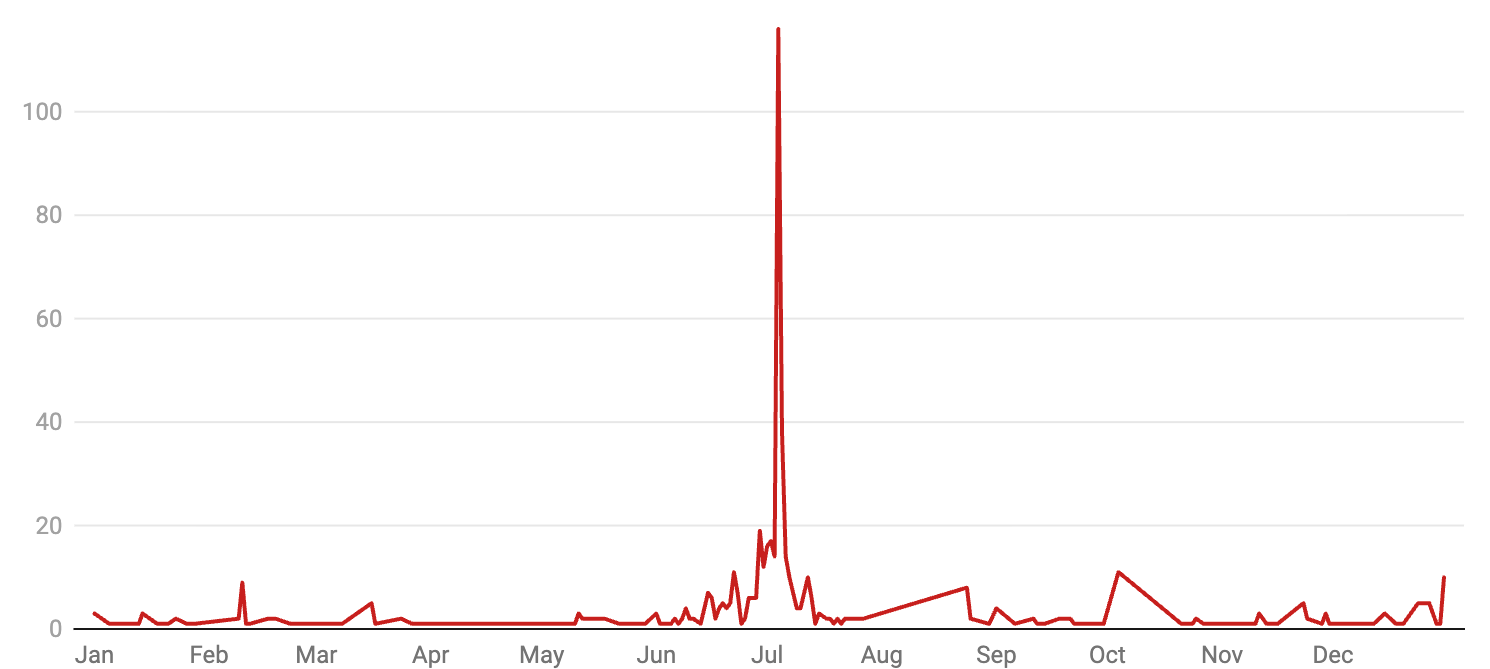
¶ Okay one more fantastic graph crossed my desk this month in my local alt newspaper. You can ask your students, as I’m asking you, “What do you think this graph is about?” Do it Slow Reveal Graph-style. And then show ‘em the answer.
“I just want to sort of help us all take a deep breath and not throw the baby out with the bathwater,” said Tracy Weeks, who leads education policy and strategy at the education technology company Instructure. [..] Instead, districts should prioritize ed tech that supports learning and show how they are keeping children safe, she added.
Everyone is begging the question “what’s the baby and what’s the bathwater?” but nobody seems all that interested in answering it ….
¶ … except Amplify’s Chief Product Officer Alexandra Walsh in The Hechinger Report who does a nice job describing how we use technology:
Digital tools can help students visualize and interact with math as it appears in the world, receive immediate feedback that deepens understanding and run a science simulation that a static page simply cannot replicate. [..] Done right, the result sounds nothing like the opening sentences of this piece — it’s louder, messier and more alive. With purposeful technology, a teacher can see in real time that 20 of her 30 students solved a problem one way, and 10 solved it differently. She can then ask each group to explain their thinking to the other, producing something better than anything a static lesson plan can offer.
No posts
Comments
Nothing yet. Say the first thing.
Sign in to join the conversation.