
Whenever global football or some prominent element of it arrives on the shores of the United States the same old question crops up. It was asked with the arrival of Pelé in the 1970s, and again with the hosting of the 1994 World Cup and Diana Ross’s penalty technique. It was asked with the 2023 arrival of Messi and with the hosting of the 2026 edition of the competition it’s once again on the lips of every talking head and content creator. ‘Will the US soccer craze grow from this point or simply recede to previous levels of interest?’.
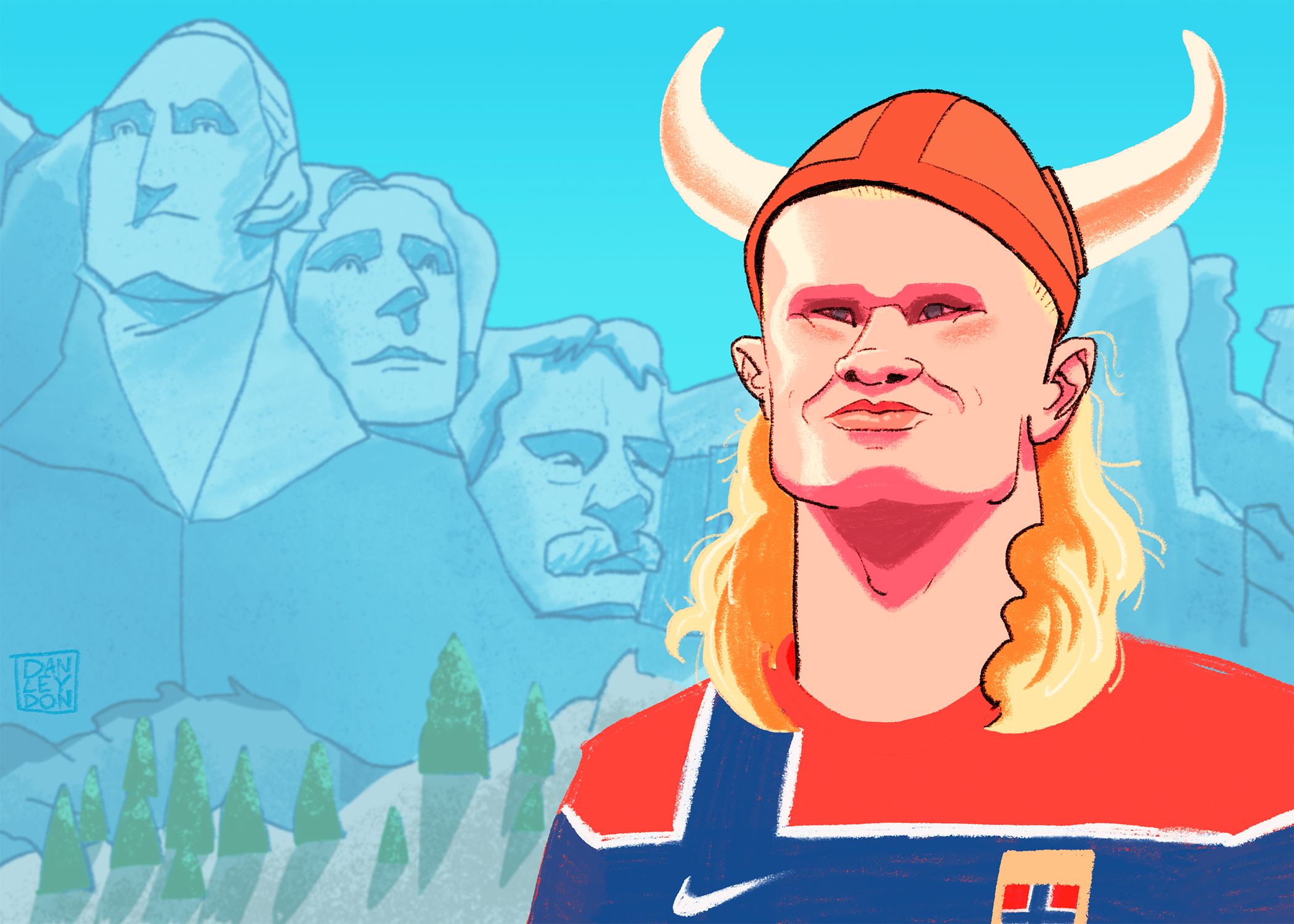
The fact the nation’s media generally frames it as a craze means the question contains the answer. When you call it a craze, you’re admitting you view it as a fad, a thing with a lifespan. However, this time one thing is different. There’s an element of soccer that American culture can’t resist. U.S. songwriter Tom Petty sang about blonde haired love interests and that seems to be as American as apple pie, which actually originated in England. Someone with blonde hair who originated in England would surely prove irresistible to the Land of the Free. Step forward, Erling Braut Haaland.
By a complete long shot Haaland has landed smack bang in the middle of the US cultural Venn diagram, a demographic activation God lighting up multiple cohorts at once. He’s a Gen Z meme machine, absolutely cleaning up across social media. He’s a once in a generation talent, so he actually backs everything up with goals. He’s an NFL style big guy so is more readily accepted by that fan base. He’s a member of noted rap group Flow Kingz so has an in with the most popular music in the country. He’s a nice guy so is mentioned as a role model for young men. He’s built like a body builder so is instantly appealing to the Manosphere. He’s into raw milk, bone marrow and steaks so the further reaches of the online diet grift world see him as one of their own and this also probably gets him in with the vaccine-sceptic crowd. He’s a blonde-haired, blue-eyed physical freak who’s been playing in a jersey with a giant cross on it so the current political administration would be more than amenable to his stature growth in the country. Soccer has never had such a perfectly placed messenger to shepherd the sport to new levels of popularity.
The 2026 World Cup has showcased the stars to a degree never seen before. This is perfectly illustrated by the golden boot race which is going blow for blow between the biggest names in the sport. Growing sections of the country have been enamoured with Messi since 2023 but now Haaland has entered the chat. While Messi relies on his on-pitch exploits to inspire adulation, Haaland combines his feats with a goofy good natured persona all delivered through reels and stories.
The main difference between the 1994 World Cup and the 2026 edition is social media. Now the sport can be injected into the public consciousness 24 hours a day through the most effective medium of our time; short form video content. In Haaland this medium has found the perfect protagonist. He’s unique in physicality and personality but crucially he’s a digital native with his own gargantuan online following. Since the tournament started he’s gained about 20 million followers on Instagram alone leaving him at 60 million as I type. He’s operating like a Trojan horse, people not totally bought into the sport find him entertaining and through this a slower more resilient interest in soccer is smuggled into their lives.
By all accounts the viewing numbers in the States have been off the charts, even breaking records for specific games. Concentrating on this side of things is intriguing to a point but the real barometer is the interest in the sport outside of the actual match. Do people seek more information about the topic when they’re not watching it? I’m a Liverpool fan and the smallest percentage of my time is spent actually watching them play. The rest is checking news, videos, subreddits, podcasts and reading newsletters and articles. If this side of being a fan grows in the States then football has a chance. And that is exactly what’s happening. Erling Haaland has become a social media phenomenon driving interest in the sport like no other subject.
During the World Cup fans have been spoiled with many sport media outlets suddenly turning their full production power to football. An avalanche of podcasts, YouTube clips and articles have been posted daily. As someone who loves to see other cultures experience the sport, this has been a treat. I’ve watched clips from more routine sources like Bill Simmons, Chris Ryan, Rich Eisen, Colin Cowherd and Mike Florio, and then commentators like F.D. Signifier and comedian Adam Friedland. It’s been interesting watching them react to the news of the day with takes ranging from coherent to laughable.
One clip in particular stood out to me. In it Colin Cowherd spoke about Erling Haaland being proof of how good the United States could be at football because… they have big guys too. Now obviously this is the opinion of someone who is new to having opinions about football, but he’s passionate about the sport and I love that. There’s also value in it, it contains the DNA of the American mindset; bigger is better. More scores! More commercials! More height! More width! More muscle! It’s the belief that everything should be MORE applied to human physiology; Vikings! Now with 30% extra!
It’s the internet obsession with protein and analytics applied to players and it’s obviously completely taking the wrong lesson from the Striking Viking. Haaland is memorably large and strong but the majority of his game relies on shrewdness not brute force. However this fascination with him is indicative of a section of US society that, through him, are actually buying into the sport.
Let’s say Haaland manages to win over every undecided fan in the States, how compatible is the country with the culture of the sport? There’s already a hardcore population of soccer fans but I’m talking about it converting people who usually sit down to watch NFL. I remember football writer Sid Lowe talking about the difference in reporting on Messi’s 2015 Copa Del Rey Final goal. The European articles described his amazing free flow run by using the emotion of the moment to paint a picture of what it meant to the sport. By contrast the U.S. articles were more concerned with numbers; how fast he ran, how quickly he accelerated, how many players he dribbled past and the top speed of the final shot.
My opinion at that time was that the sport is a younger thing in the US. In Europe the general knowledge is of a higher average level due to generations of interest from fans who’ve played the game. When they witness an act of genius they understand it in their bones without reading that someone reached 33km/h from a standing start. Obviously the numerical take is much more transactional, the moment boiled down to cold hard numbers, dissected. In this process of statistical harvest the magic is lost. Again I can refer to Colin Cowherd’s passionate analysis of Haaland:
‘He’s a finisher, he’s Harry Kane. Mbappé is the wing and a creator. Mbappé’s got 7 goals but on 243 touches. Erling Haaland has 7 on 99! He’s a knockout guy. Not a lot of finesse.’
It’s the opinion of one man but it’s indicative of the wider cultural interest in stats which began with Billy Beane introducing revolutionary statistical analysis to the Oakland As in the early 2000s. From there analytics spread to football itself and even encroached into dating, with app filters to weed out people who don’t meet certain physical criteria, and even self-help with the rise of Looksmaxxing, the warped pursuit of a type of anatomical golden ratio. This cultural dominance of the humble stat bodes well for the future of the sport in the US as soccer is a numbers game now. xG has gone mainstream.
If Haaland is a Trojan Horse for football, football itself is a Trojan Horse for other cultures. It’s the number one reason I love it; exposure to other cultures through the shared language of sport. To me this has been the potent undercurrent of the 2026 World Cup; locals sharing stories of heart warming cross-cultural bonding particularly Kansas city hosting Algeria.
The US has low levels of passport ownership so much less people embark on international tourism. It makes sense, their country is a diverse and scenic continent criss-crossed with roads. When this is on your doorstep why deal with long haul flights and jet lag? While not necessarily a bad thing it certainly limits the exposure of the general populace to other ways of life. International sport is one of the main ways I learned about other places and how they do things and it’s evident this is one big reason there’s been an uptick in soccer interest across the World Cup.
The US doesn’t really get to experience international men’s team sport in a meaningful way. Their most popular sport is American Football and that doesn’t have an international community of nations to compete against. Can you imagine the fervour a US Men’s team would inspire if there was a World Cup of American Football? So the sport loving American public has never really experienced the broad appeal of the ‘national team’ concept in a truly global sport. Basketball has an Olympic team every four years but I think the Olympics is so varied that the impact of any single sport is diluted. Women’s international soccer has achieved gargantuan results for a long time but men’s sport holds a more developed social foothold in the minds of the average sports fans. This is changing but for now it’s undeniable that there’s a stronger social interest in men’s sports and this can activate larger, previously unreached portions of the population. Nowhere was this more apparent than in the aftermath of the US triumphing over Australia in the Group Stage.
The win was a great moment but that wasn’t why it was memorable. It was the collective emotion of the crowd afterward. The players watched a packed stadium sing ‘Country Roads’ by John Denver. The early days of US fan culture allowed some truly odd chants to gain cult followings and I sometimes watch compilations of them and wonder at their slightly forced nature. This rendition of ‘Country Roads’ finally put them all to bed.
It’s testament to the power of the sport that moments like this happen. It was sentiment devoid of nationalistic fervour but vibrant with shared memory and an easy enjoyment of togetherness. As a diverse group of players stood together, an entire stadium sang ‘take me home, to the place I belong’ and it seemed like a mass remembrance of what people not only loved but cherished about their country.
So, will the US soccer craze grow from this point or simply recede to previous levels of interest? I’m now certain that it at least has a new high point.
Thanks for reading! This post is public so feel free to share with a fan who’d enjoy it
Further reading…
Comments
Nothing yet. Say the first thing.
Sign in to join the conversation.