
Name: The Burden of 1966
Period: 1966 - present
Team: England Men’s Team
Competition: World Cup, European Championships
Hark back, dear reader. Long ago, deep in the mists of time, before the age of the Premier League, before colour television, before radio phone-ins, the World Cup arrived on the shores of Britain. Teams from all over the globe came to participate and eventually the illustrious hosts, England, emerged victorious. On the 30th of July 1966, the Jules Rimet trophy gleamed as it was held aloft in front of a rapturous crowd. The world had found equilibrium, history could now end. Football had come home.
Until the 21st of June 1970 when it left again, and went to Brazil.
And it hasn’t been back since.
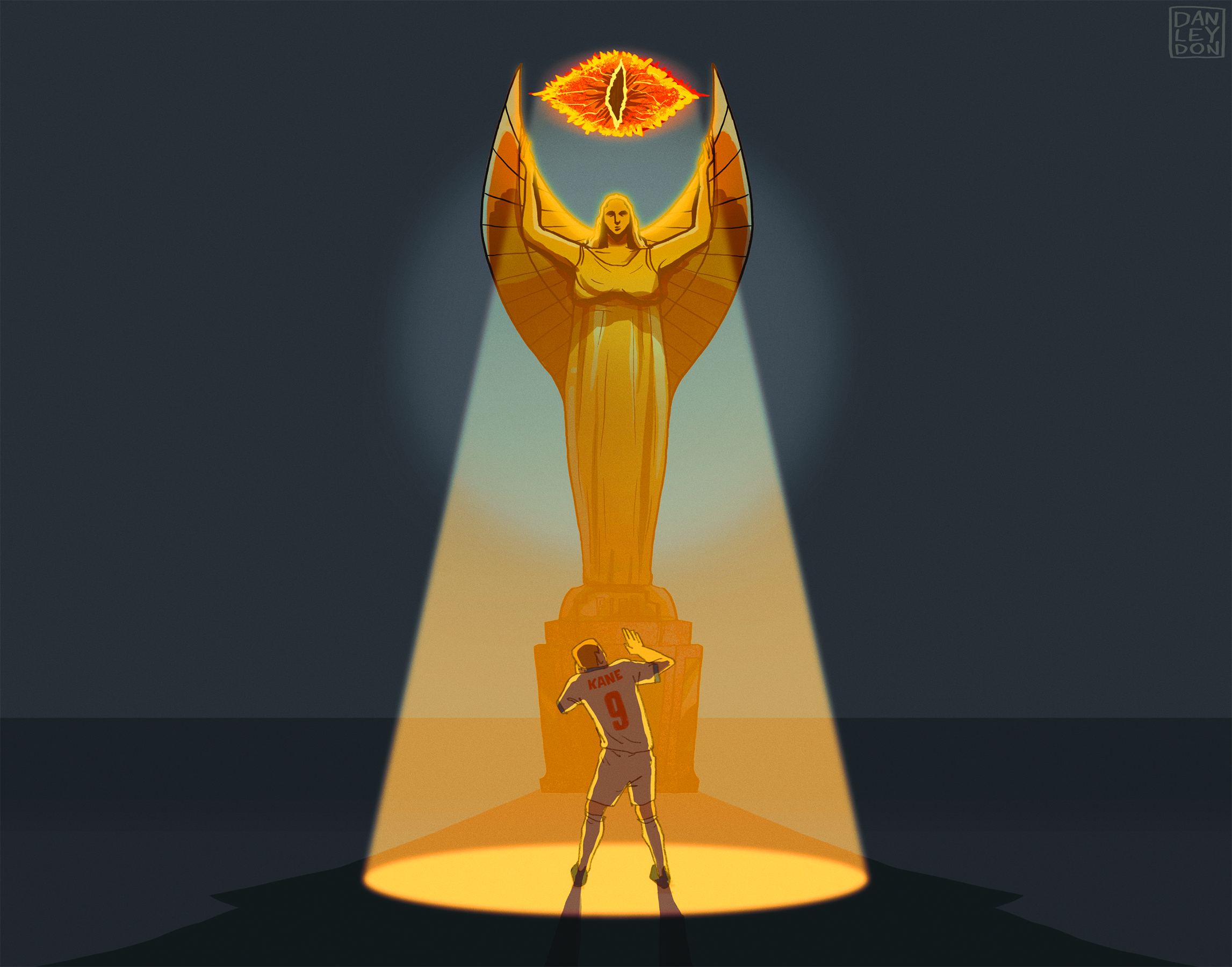
‘The Burden of 1966’ is a mood, an insidious general vibe. It’s how the country of England collectively deals with the pressure to repeat the achievement of winning a major international tournament. Every squad announcement, team lineup, press conference quote and friendly performance are hyper analysed. The weight of history dovetails with the intense football media to create a sense of overwhelming demand that restricts the freedom with which the players can approach important games.
1966 itself is now so far away it’s like a fable from a simpler time, completely removed from our modern sensibilities. Photographs of the final sometimes have that saturated look of basic colour that’s been applied to black and white artefacts after the fact. The protagonists collectively exhibiting multiple facets of human behaviour that have disappeared, all standing in ways no one does anymore, using facial expressions that have aged out of usage. Just to see them is to know they are from a different era.
Events that happened so far back always feel to me like fossils embedded in rock, compressed on all sides by the crushing weight of time, essentially unknowable. Black and white 1966 may as well be 1850 at this stage, it’s taken on the guise of something that happened before the modern age, like a footballing Industrial Revolution. With each passing year its vitality as something to connect with lessens but conversely its power as a cultural force only grows and gains heft.
That period between 1966 and 1970 (1422 days) acts as a bridge between the visual past of the sport and the first modern age. The 1970 tournament brought the innovation of global broadcast, so more fans were seeing the games, sometimes in full colour. This global dissemination of the action links it inextricably to our own modern world in a way that 1966 can’t rival. That these two tournaments bump up against each other in history feels odd to me, 66 feels ancient but 70 has a modern verve. It’s like seeing Abraham Lincoln posing for a photo with Sylvester Stallone.
1966 stands as the only moment of glory in the long history of English Men’s football. Since that transcendent event 60 years have passed. Counting World Cups and European Championships, that’s 29 tournaments without a follow up victory. With each failure it looms larger, a silhouette on the far horizon of history, a towering achievement casting a dark shadow that has swallowed up every squad so far.
With each new failure, 1966 has amplified in meaning, going from glorious past to gigantic burden. It’s cast the England team itself as something to be solved rather than a joyful expression of a country’s intense love of football. In the English football landscape it really does loom, with no colleagues to tower alongside, it totally dominates the culture.
The other source of pressure is the English media. This system acts like a great, all-seeing eye that surveils, magnifies and dissects every aspect of the team and its participation in any tournament. They endlessly analyse each new manager with a view to them being proclaimed the one who can finally deliver the win or a failure who must be hounded from the post. Every opinion and counter-opinion is embodied with vigour in every area available. With the constant need for copy and content, narratives that will accompany managers termination are prepared as they preside over their first press conference. With the current incumbent, Thomas Tuchel, there’s already many threads of discussion about his interpersonal skills and how this could become a flash point during an extended tournament camp with a team of bored, young millionaires. The fires are being stoked.
National mood is linked to the output of the media and it lurches wildly from ecstatic praise to morose introspection which in turn leads to the scapegoating of players. Everything is perpetually teetering on a knife edge and this environment of constant potential recrimination must sap players of enthusiasm, each match feeling like something to be endured rather than approached with zeal.
This 24 hour media spotlight, converting anything it passes over into a story for mass consumption, piles anxiety upon the crushing pressure already brought by history. It’s like an experiment to see how much expectation can be heaped upon players until they succumb to their own inevitable implication in the next great failure.
In HBO’s Succession, Greg, a naive but ruthless ladder-climber, is pleased he’s being left 5 million dollars in a will. To the multi-multi-millionaires he keeps company with, this is almost laughable, a source of problems as opposed to the means to financial freedom. By their standards, you now only have enough to know you don’t have enough. For the following snippet of the script I’ve cast England as Greg and Connor and Tom can interchangeably be Brazil or Italy.
Greg: I was just talkin’ to my mom, and she said, apparently, he’ll leave me five million anyway, so I’m golden, baby.
Connor: You can’t do anything with five, Greg. Five’s a nightmare.
Greg: Is it?
Connor: Oh, yeah. Can’t retire. Not worth it to work. Oh, yes, five will drive you un poco loco, my fine feathered friend.
Tom: The poorest rich person in America. The world’s tallest dwarf.
Connor: The weakest strong man at the circus.
The poorest rich person or in football terms; the least successful of the successful teams. Essentially you need one thing to remedy this failing; more.
Other countries with multiple wins don’t need to obsess over one particular triumph, they merely celebrate the most recent and the rest fade into history to be fondly remembered whenever the feeling arises. Brazil have five wins, Italy and Germany have four each. With these countries I’ve never seen any specific discourse about one particular year.
France have assumed their place in the modern game, winning in 1998, losing a final in 2006, winning in 2018 and losing a final in 2022. They’re consistently in the mix. They’re at ease with their chances and enter each tournament as favourites.
Uruguay have two but their wins are in 1930 and 1950 and to me they don’t feel like they count in the modern game. They’ve lost the lustre of recency, essentially going a bit stale so as to almost expire in terms of relevancy. But at least they have two.
Spain are in the same boat as England, although their major difference is their one win was recent and has been surrounded by three European Championship wins. They’re gleaming with modern relevance.
That’s why consistent victories, like Brazil and Italy who have spaced out their wins through the decades, feed into the image of a country as a superpower (although Italy have severely fallen off by not appearing at the last three World Cups).
As time passes England’s 1966 triumph gains a sense of staleness, feeling more like anomaly than achievement. There’s a countdown on that relevance, feeding into the pressure.
It currently feels like the England players are tiny scurrying figures, desperately trying to evade the roving media glare as they carry out their quest of bringing the trophy home. The towering presence of 1966 can only be toppled with a World Cup triumph.
On the upside, this means the national obsession with adding that crucial second triumph is temporary, even though it doesn’t seem it. The addition of a second trophy is the seal of approval that says ‘yes, you are now an undisputed football giant, you’ve shown you can do it twice. Relax’. When it happens the need for a third will be almost like a bonus, a pressure free pursuit.
When 1966 is eventually consigned to history it will revert to being less complex, less potent, simply remembered as something nice that happened a long time ago.
Thanks for reading! This post is public so feel free to share with a fan who’d enjoy it
Next in the series…
Comments
Nothing yet. Say the first thing.
Sign in to join the conversation.