
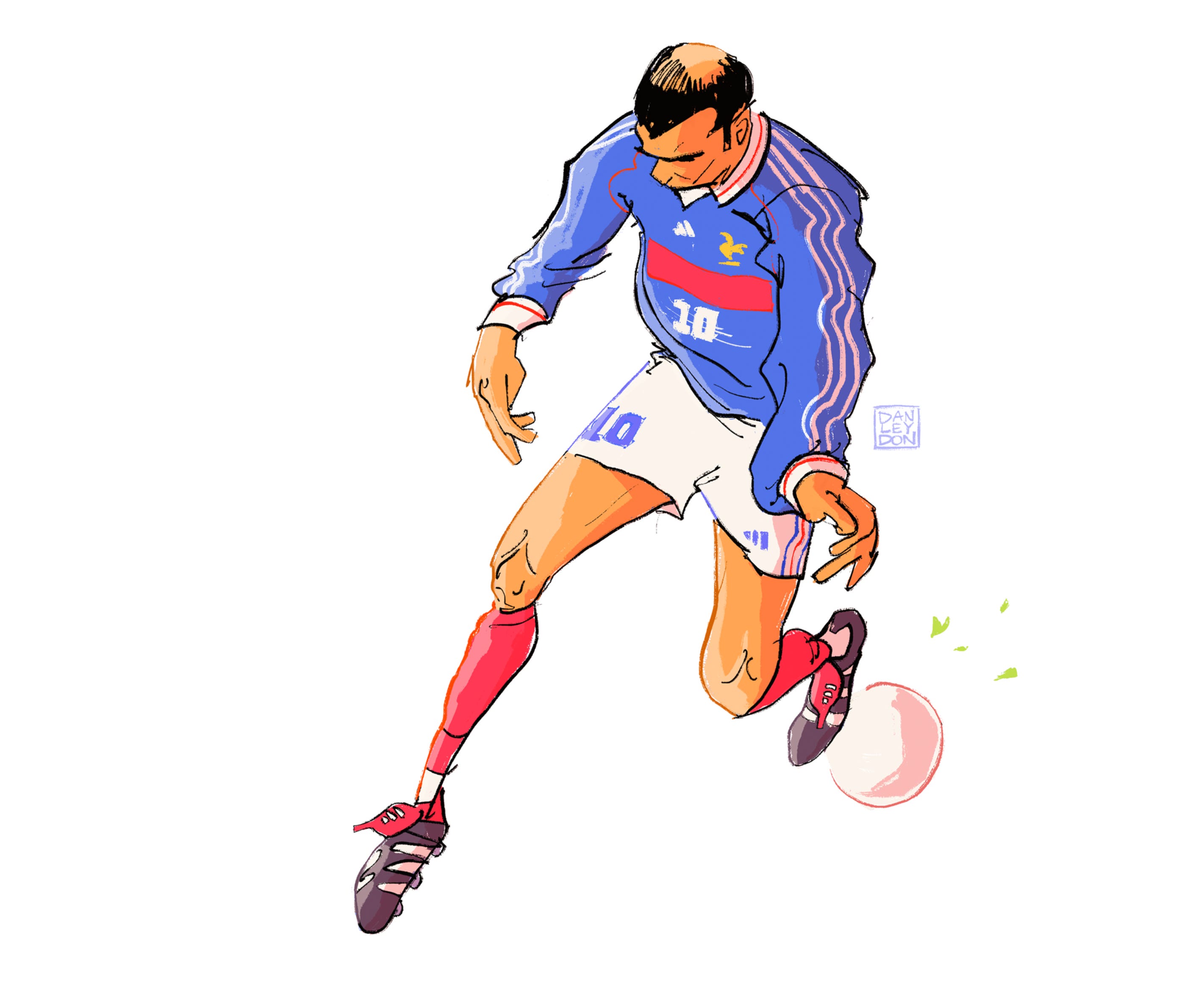
Name: The Zidane Roulette
Player: Zinedine Zidane
Period: 1989 - 2006
Teams: Cannes, Bordeaux, Juventus, Real Madrid, France
Zidane did not design and perfect this move but, like a croupier flicking cards to a host of hapless poker players, he dished it out with no apparent effort. Many players before him executed it to a high degree but people want to associate it with him and that’s solely down to his grace on the ball. As he spun, the red and black of his Adidas Predators mimicked the blurring colours of the roulette wheel leaving countless players, who gambled and lost, in his wake.
The Zidane Roulette happens in two parts. Essentially it’s a change of direction. The dribbler uses one foot, usually the one that is in opposition to the direction they want to be facing at the end of the move, to gently tap or roll the ball inwards across the body towards their other foot. As with most dribbling skills the first foot to be used is generally planted in the ground as ballast to push off and gain momentum in the opposite direction. The second foot will then rake the ball backwards, usually with the studs, if not 180 degrees then enough to rotate away from the close attentions of an opposition player. This pulls the ball away from the previous direction of travel and crucially turns the dribbler’s back to their marker using their own body as shield for the ball. When the second foot completes the backwards motion it plants in the ground leaving the player in a wide legged stance, which gives a low centre of gravity and allows for more strength on the ball. It’s an escape method that also sets up the player for their next move. It’s elegant, it’s functional, it’s shorthand for Zinedine Zidane.
Even in his own time Zidane he seemed like a man from another era. Iconic from the ground up, a combination of a curious bald spot hiding above the definitive v of his widow’s peak which sheltered shadowed searching eyes, his surly disposition at odds with the grace he was almost obligated to dole out during every game.
The Wes Anderson film ‘The Grand Budapest Hotel’ weaves a caper through memories of a fictionalised version of mid-century Eastern Europe. The story finds its heart in a nostalgia that aches for past days of grandeur and class purged by the cost effectiveness of the post-war world. These lost ideals are personified by the prim and proper Monsieur Gustave, the hotel concierge of the Grand Budapest. He epitomises this nostalgic era and his passing acts as the demarcation between past and present, which are the two time periods in which we are shown the titular hotel.
In the past the hotel is resplendent, filled with guests dressed like royalty with multiple scurrying staff fulfilling all manner of outlandish tasks. When we see it in the present it has decayed; subdued to a shrunken cost-effective skeleton tarnished by remnants of various charmless makeovers. The staff are now few and feckless, the decay of the establishment linked to a perceived decay in moral sensibility. Watching old highlights of Zidane rotating his way through games can feel like looking back and luxuriating in a lost old world class, exhibiting a grace since exorcised from the world. His roulette was one of only a few things that perfectly captures the late ‘90s to the mid ‘00s in European football. Watch the Elastico by Ronaldinho or a David Beckham ball strike, they all share a luxurious quality that has been sanded off the game in its current form.
Saying that, I’m not a fan who laments the modern game. I find enjoyment in all expressions of the sport. My point is that looking back on footage of Zidane can make you appreciate a lost past in the game. Crucially however, watching him in his own time also made you feel that. He had the air of the legendary about him, like an immigrant from a momentous past, come to class up our mundane modernity with his gallant roulettes, adorning matches like crystal chandeliers affixed to the ceilings of 2am takeaways. This laconic Frenchman pirouetted through the action with the audacity of colonial architecture; grand, imposing, resonant. He gave you undeniable value for money. You’d seen the roulette. It was cast iron, like a firm handshake. First he was facing that way, then he’d twirl, and then he was facing that way. The ball went with him, and he looked good doing it. What else could you want?
His effort was below the surface, his top half always easing between a variety of billowy shapes, arms like twin windsocks in a soft breeze. It was the bottom half that was all industry, a clanking piece of agricultural machinery, boots like crampons propelling him from leg extension to leg extension as he turned his back on bamboozled opponents in every corner of the pitch. The breezy upper-half body language was his trademark, that’s the mood we connected with and remembered. There’s a term in Italian, sprezzatura, which translates as something akin to effortless grace. Zidane was the physical embodiment of this. He prowled about the match, easing into a roulette one moment, a first touch Cruyff turn from a kick out the next. He would string these skills together with the simplicity of water circumventing a stone in a shallow riverbed - nonchalant athleticism at peak hum.
Writing anything about him is a thrill. Around the millennium he really was football’s answer to history. If you’re a fan you are subject to the nostalgia obsession the media around the sport deals in. Past players are now pundits and generally view the current crop as morally inferior or a pale imitation of what came before; it’s a well worn trope. As a result you can start to think like Tony Soprano in his first therapy session “Lately, I’m getting the feeling that I came in at the end. The best is over”. The previous generations were encased in the good old times. It takes strength of character to look with clear eyes and appreciate what you have in the moment. Zidane was his period’s answer to the weight of history, a talent that could be mentioned in conversations alongside Cruyff and Pele, reassurance to a young fan that what they’re getting to experience matters too.
At the end of ‘The Grand Budapest Hotel’ former lobby boy Zero Moustafa poignantly remembers his long passed friend, Monsieur Gustav. “There are still faint glimmers of civilisation left in this barbaric slaughterhouse that was once known as humanity. He was one of them. What more is there to say?”.
Thanks for reading! This post is public so feel free to share with a fan who’d enjoy it
More from this series…
Comments
Nothing yet. Say the first thing.
Sign in to join the conversation.