
Usually, if your product is 3x more popular than it was two years ago, your business is doing fine. Unfortunately, that’s not the case for Tailwind, the CSS framework.
Tailwind is more popular than it’s ever been (75m downloads/mo!!), in large part because every vibe coding tool uses it as a default. And yet, they just laid off 75% of their engineering team (3 out of 4 engineers).
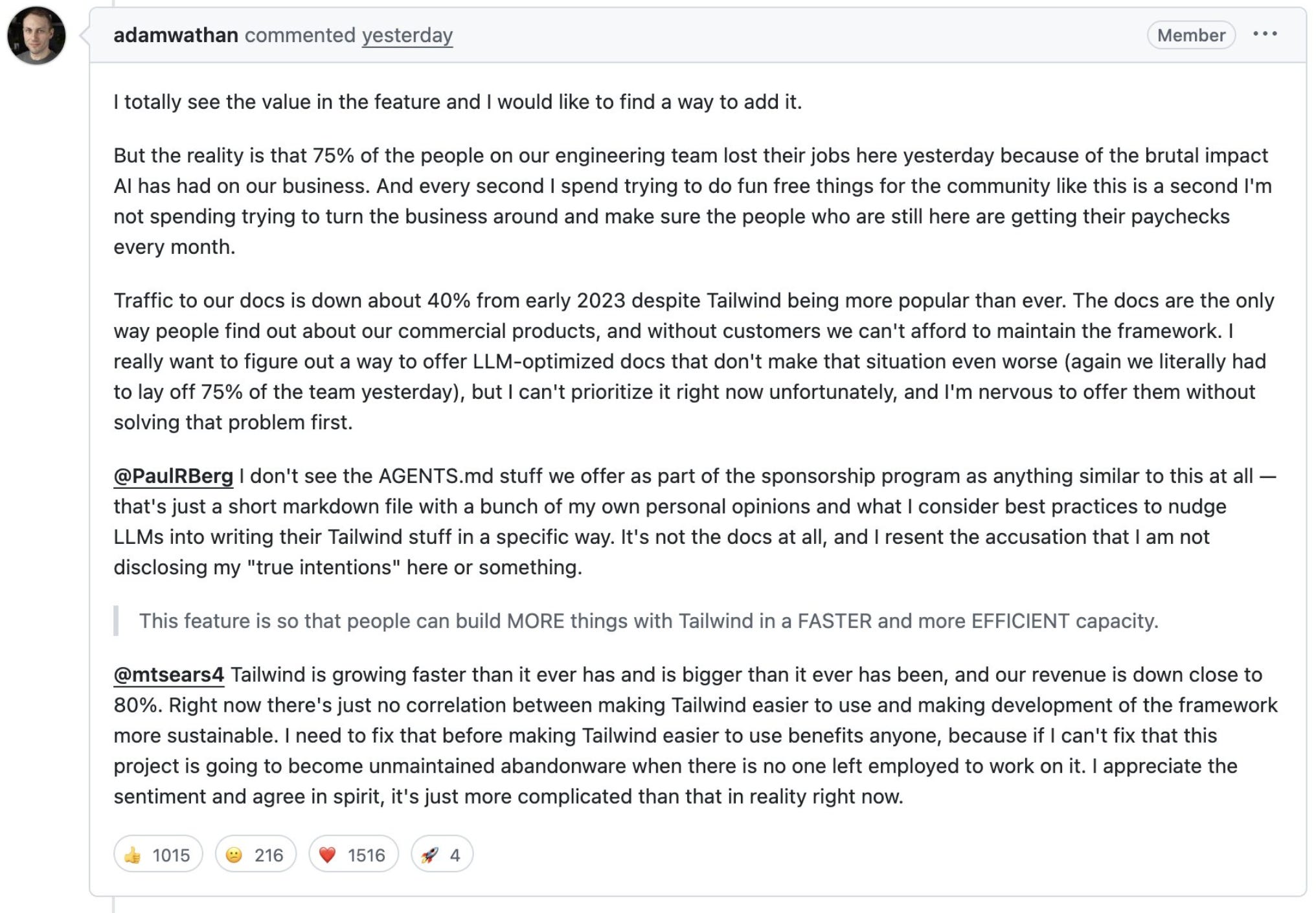
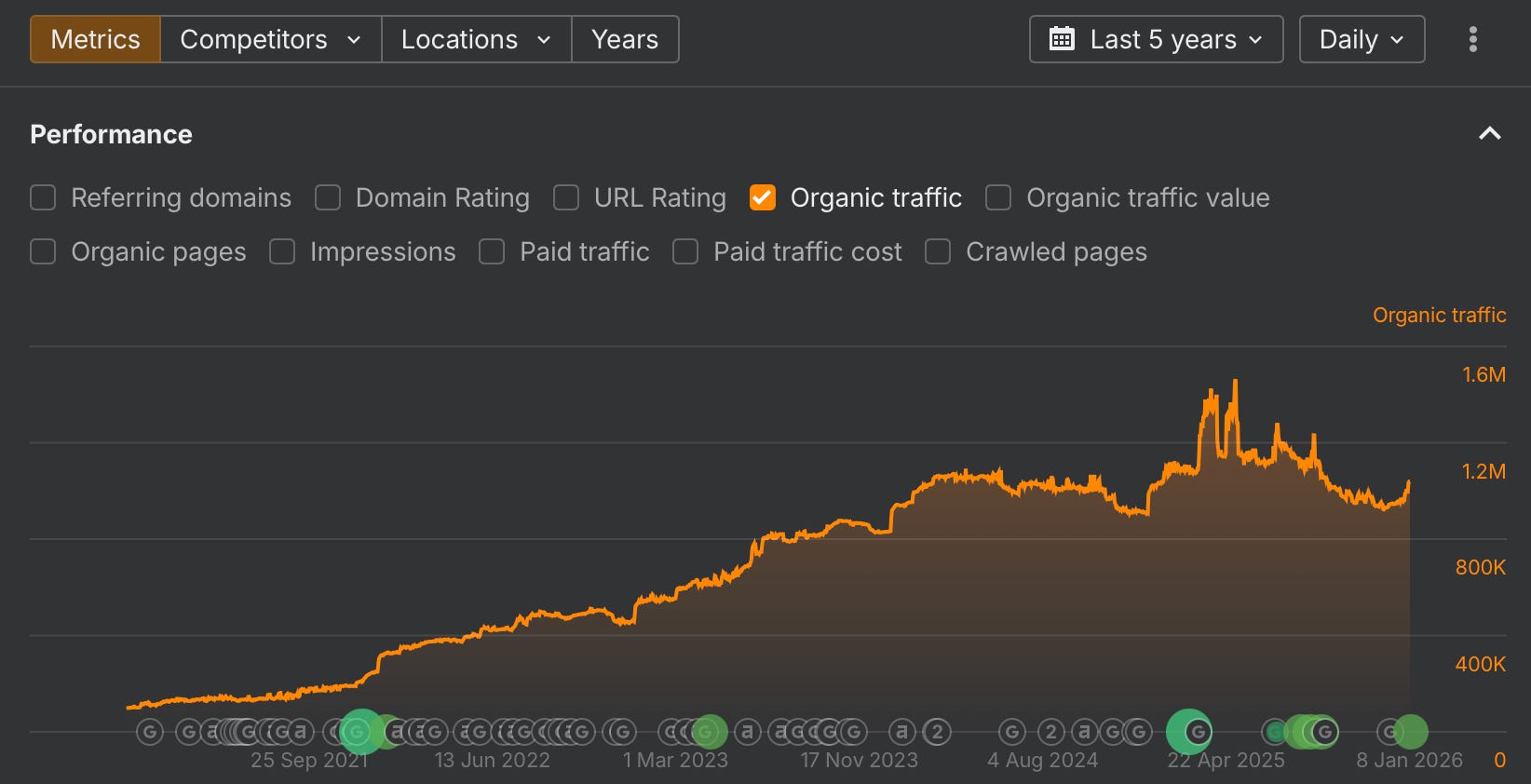
Over the past two years, Tailwind’s usage has gone up dramatically. At the same time, traffic to its documentation, the company’s primary channel for selling its two main products (more on this later), has dropped by roughly 30–40%. Revenue is down 80% from its peak. This culminated in layoffs this week.
This is a very concrete story about how AI is affecting the industry in unexpected ways, where a product can be at an all-time high in usage, but revenue can be declining.
All of this Tailwind attention really kicked off around a pull request proposing an LLM-optimized documentation endpoint. This would allow AI tools to ingest Tailwind’s docs directly in a clean markdown format. Obviously a nice feature to have, but their docs traffic correlates directly to revenue. Here’s Adam’s response.
Adam talks about all of this in his podcast below.
By most non-revenue metrics, Tailwind is winning (75m downloads/mo!!). It’s embedded in nearly every modern vibe coding workflow, and AI agents default to it. Tons of companies use it. Adoption and mindshare are at all-time highs.
But traffic to Tailwind’s documentation pages is down roughly 40% from its peak. That’s a major problem, because the docs are how people discover Tailwind’s commercial products, namely:
Refactoring UI: A book about UI and design fundamentals. I have a copy and would recommend
Tailwind Plus: A collection of components and templates. One-time purchase. We also bought this a few years ago.
Two forces combined to break this funnel:
Reduction in docs traffic, as users get UI/Tailwind-related answers directly in tools like ChatGPT (similar to what happened to Stack Overflow)
“Good enough” UI from LLM-powered coding tools, which reduces the need to buy prebuilt UI kits and templates.
Combined with free open-source alternatives like shadcn/ui, this has led Tailwind to where it is today: revenue is down 80%.
On one of Adam Wathan’s podcasts “The Tailwind business ain’t what it used to be” he noted that at its peak in Jan-Mar 2023, Tailwind was making ~$30k a day just from the book and Tailwind Plus. As of Nov 2025, that was down to $6k/day and decreasing.
The armchair founder reaction to Tailwind’s situation is usually some version of: “How could you not monetize something this popular?” or “What did they even try?” or “Why isn’t there a Tailwind vibe-coding design tool?”
Luckily, Adam detailed what they tried and what worked:
Raising prices
They increased the price of Tailwind Plus from $299 → $399. Conversion dropped enough to offset the increase. Revenue stayed flat, and when prices were reverted, revenue stayed flat again.
Video course
They launched a video course (“Build UI That Doesn’t Suck”), didn’t have much impact.
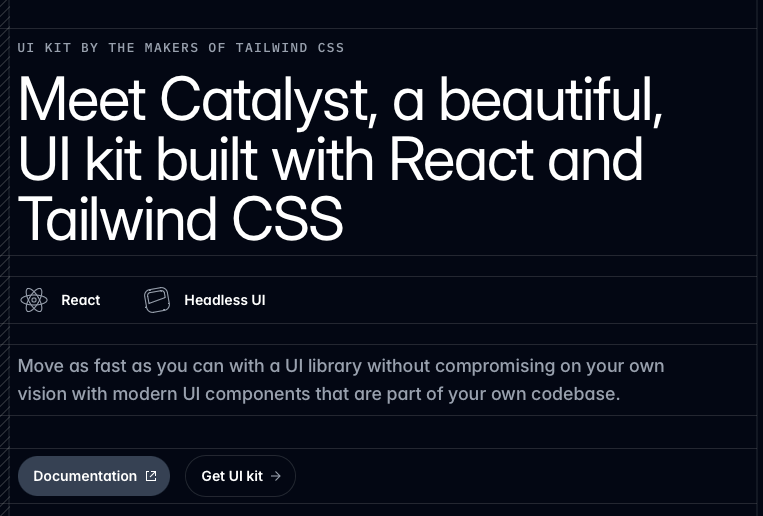
Catalyst UI
A more customizable React UI kit designed to be more than just components.
A Tailwind job board
The idea was to get companies to pay for job postings and leverage Tailwind’s massive audience. It didn’t work. In practice, companies don’t think they’re hiring “Tailwind developers.” They hire React developers, and Tailwind experience is assumed.
Focusing harder on monetization
Ironically, revenue historically increased most when the team focused on open-source releases (Tailwind v2 and v3), not on monetization itself. Tailwind v4 did not produce the same effect on revenue compared to previous version launches of Tailwind. Signaling more of an environmental change.
Sponsorships (the one thing that worked)
A sponsorship program offering access (Discord and Slack channels), visibility, and priority support brought in $1k–$5k per month per company sponsor and $120 per year per individual sponsor. As of late 2025, this totaled roughly $700k per year. I would imagine this has increased dramatically in the last 24 hours.
My first thought was to say this should have been a subscription business. Adam Wathan addressed this directly: because customers receive the full product upfront, most would simply subscribe for a month, download everything, and churn. A subscription model likely wouldn’t have generated more total revenue, it would just have introduced more friction and high churn.
The problem isn’t that Tailwind chose the wrong pricing model.
Unfortunately, Tailwind isn’t the only one in the camp of “extremely high usage that doesn’t translate into revenue.”
Any open-source project where documentation is the primary distribution channel and monetization comes from selling knowledge-adjacent products (templates, courses, consulting, or paid examples) is exposed to the same pressures.
Prettier, a widely adopted code formatter embedded in most modern JavaScript workflows, is another example. It’s used almost everywhere, yet funding long-term maintenance has always been difficult.
This is an “AI took our jobs” story, but not in the typical way. The engineers that were laid off weren’t replaced with Claude Code. They were let go because AI cut off a significant portion of Tailwind’s revenue, which was effectively redistributed to the vibe-coding tools and AI chatbots (ChatGPT).
AI didn’t eliminate the need for Tailwind. If anything, it made Tailwind more valuable and more widely used than ever. But it also helped destroy the business model Tailwind relied on to fund its development.
Times are changing, and we’ll continue to see what the downstream effects are.
No posts
Comments
Nothing yet. Say the first thing.
Sign in to join the conversation.