
In 1980, Mariner Books posthumously edited and published the collected lecture notes on European and Russian literature that Vladimir Nabokov had managed to compile during his twenty years of teaching these subjects at Wellesley College and Cornell University. One lecture tackles Kafka’s 1915 novella, Die Verwandlung, usually rendered in English as The Metamorphosis to evoke the biological transformations insects undergo in the course of their development. But the “insect” in The Metamorphosis is never overtly named.
Nabokov, who was not only a talented storyteller but an accomplished lepidopterist, brings his formidable entomological learning to bear on the story, concluding that the protagonist, a commercial traveler named Gregor Samsa, must have been transformed into a beetle, rather than a cockroach (as received opinion had it). To back up his claim, he points to the fact the insect moves on six jointed legs, suggesting it’s an arthropod. But the ventral and lateral carapaces are rounded. Cockroaches, Nabokov sniffs, are notoriously flat. If Samsa was indeed a beetle, he would be of the order Coleoptera and would have had wings to fly away with (a detail Nabokov dryly remarks that neither Kafka nor his fictional creation appeared to be aware of).
There are a few problems with Nabokov’s pronouncement, chief of which is the fact that, though he resided in Berlin from 1922 to 1927, and states in the essay that he lived near where Kafka died in 1924, the famous Russian expat never learned German well enough to read or speak it with any fluency. He himself admitted this in later years when giving interviews and discussing what he found to be the maddening process of reviewing the translations of his own novels from English and Russian into German. Brian Boyd reiterates this point in both volumes of his comprehensive biography of Nabokov.
Kafka chose every word he used in his unconventional novels and Märchen with care. He could have explicitly declared at any point in The Metamorphosis that the insect was a cockroach (Kakerlake) or a beetle (Käfer), but he didn’t. At one point, a charwoman derisively calls Samsa a “dung-beetle” (Mistkäfer); but this was a common pejorative, like calling someone a “louse” in early twentieth-century America. The German word Kafka uses is Ungeziefer, which means “vermin” or “pest” and is used exclusively for verminous or pestiferous insects. The word appears in the story’s opening sentence:
Als Gregor Samsa eines Morgens aus unruhigen Träumen erwachte, fand er sich in seinem Bett zu einem ungeheuren Ungeziefer verwandelt. (“When Gregor Samsa awoke one morning from troublesome dreams, he found that he had metamorphosed into a giant [or ‘monstrous’] pest.”)
By placing the adjective (ungeheur) next to the substantive (Ungeziefer), both of which begin with “unge-,” the sentence takes on a jaunty, pattering euphoniousness that ends on the grace-note of what in prosody is referred to as an “amphabrach”: verwandelt.
The word Ungeziefer was used as a slur in Adolf Hitler’s Mein Kampf (published in 1925 and 1926); and was the title of an election article that appeared in 1933 in the Nazi propagandist organ, Völkischer Beobachter, which equated the Jews with vermin.1 Is it possible that Kafka, who was born to German-speaking Ashkenazi Jews, added a layer of complexity to his narrative by incorporating a word, which he had heard bandied about as a term of abuse against his fellow coreligionists, into the text in order to strengthen its allegory of how swiftly one can become alienated among those one thought were friends, neighbors, and loved ones?
There is another kind of Ungeziefer that Samsa might have turned into. What if Kafka was pulling the reader’s leg by describing a man waking up “in bed” as a giant bedbug? After all, bedbugs (Bettwanzen) are six-legged arthropods with exoskeletons slightly rounded on the ventral and dorsal sides. Not only that, but they have formidable mandibles, which, in gigantic form might conceivably be powerful enough to turn a door handle. But the problem with any attempt to visualize the insect that Gregor Samsa was transformed into is that it ignores Kafka’s express wishes when he wrote the story in the first place.
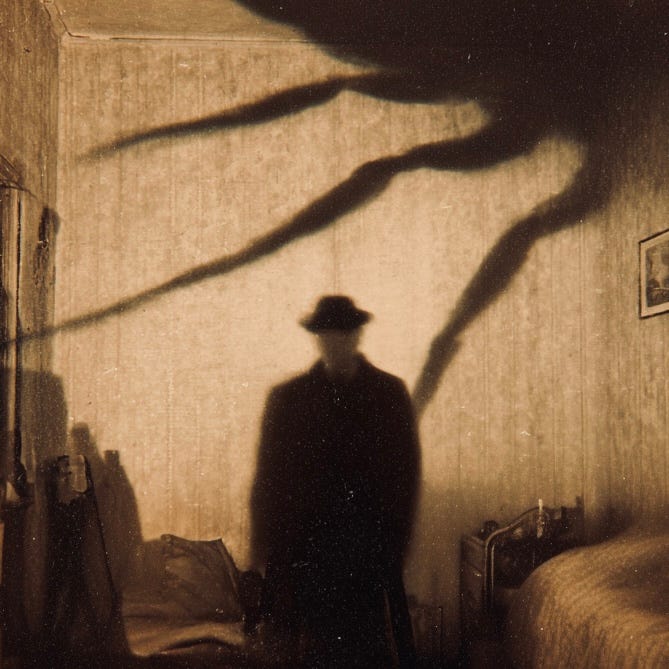
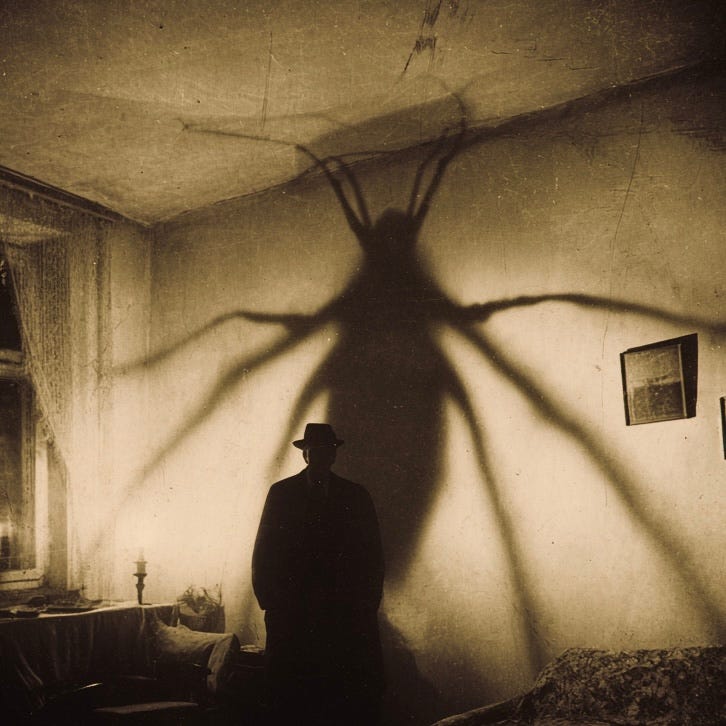
Kafka was adamant that the pest not be visually depicted—“even from a distance.” When he learned the first edition of the book was going to press with an illustration of the insect on the dust jacket, he frantically dashed off a letter of protest to the artist, urging that this not be done.2 Kafka did this because he wanted the ungeheuere Ungeziefer to remain a paradoxical mental abstraction, like the conceptually impossible square circle.
I am indebted to an archivist at the United States Holocaust Memorial Museum who referred me to a 1993 Jewish Telegraphic Agency article that mentions this piece of Nazi propaganda: https://www.jta.org/archive/nazi-leader-would-rid-germany-of-jewish-vermin
For more information on Kafka’s letter, see this article by Joseph Bates, which was written in 2013 to commemorate Kafka’s 130th birthday: https://www.joseph-bates.com/2013/07/kafkas-metamorphosis-gallery-of-book.html
No posts
Comments
Nothing yet. Say the first thing.
Sign in to join the conversation.