

“And when he had opened the seventh seal, there was silence in heaven about the space of half an hour.” (Revelation 8:1)
“Don’t wake me for the end of the world, unless it has very good special effects.” (Prince of Chaos, Roger Zelazny)
“People keep making apocalypse jokes like there’s no tomorrow.” (Anonymous)
Alvin Toffler’s Future Shock is as illuminating today as it was when released to popular acclaim and mixed academic reviews in 1970. In a little over five hundred pages of limpid and snappy prose, the author of this Vietnam-era potboiler conveys the excitement, awe and apprehension many felt at the time when considering the rapid social and technological changes taking place. The implications of these changes, many of which were either still in the bud or only beginning to put forth shoots, have in our own time come to unsettling fruition.
Here are four well-known quotes from the book, which, in gravity and diction, read as though cribbed from the works of Marx, Nietzsche or Spengler, but touch on topics of perennial concern that were are still mulling over today:
Technology feeds on itself. Technology makes more technology possible.
The illiterates of the twenty-first century will not be those who cannot read and write, but those who cannot learn, unlearn, and relearn.
People of the future may suffer not from an absence of choice but from a paralyzing surfeit of it.
The future always comes too fast and in the wrong order.
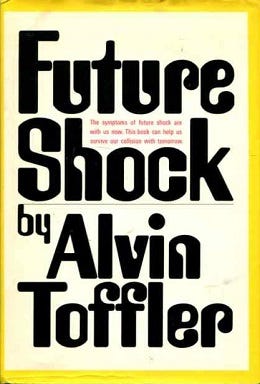
Not all of Toffler’s predictions came true. In his discussion on “mobile and variable physical enclosures” he imagined universities of the future having “classrooms built inside railroad cars” to whisk students from one end of a four-mile campus to the other, presumably so they could catch lunch at local eatery before returning to their mobile classroom for a lesson on Einstein’s train paradox. But in the next paragraph he mentions plans being drawn up for “air-inflated plastic bubbles” to serve as field command centers, an innovation that not only became a reality but is now a stock features in shows where a fear of contamination warrants their use (Outbreak, E.T. or The X-Files).1
I was too young in the ’70s to have understood Toffler’s book. But after finishing a rereading of it two weeks ago, I thought it would be a good jumping off point for a two-part essay on why contemporary doomsday and post-apocalyptic fiction doesn’t resonate with Gen-Xers like myself. At the root of the problem is the fact that “the end of the world as we knew it” happened sometime in the early aughts of this century; and (to paraphrase R.E.M. again) “we feel fine,” though mildly depressed and unmotivated in the wake of hormonal decline and the realization that we’re nearing the age our grandparents were when they started dropping like flies from obscure ailments like pertussis and Legionnaires’ disease.
Reading a dystopian novel written in the last twenty years that deploys every tired cliché in the book is akin to watching an object slip into a black hole’s event horizon: we know exactly where it’s heading, but it’s apparently going to take an eternity to get there.
What made pre-Y2K post-apocalyptic fiction so compelling was that it was, on the whole, cautionary. It described what might happen if we continued along the same trajectory. Today’s stories read like postmortems explaining how we got to where we are. It’s the difference between probability and statistics. In the former, the variables are known, but the outcome is not. In the latter, the outcome is known, but the variables that “caused” it are open to debate. And when sci-fi writers fixate on what those variables are or must have been, at the expense of plot or characterization, it can lead to some piss-poor storytelling.
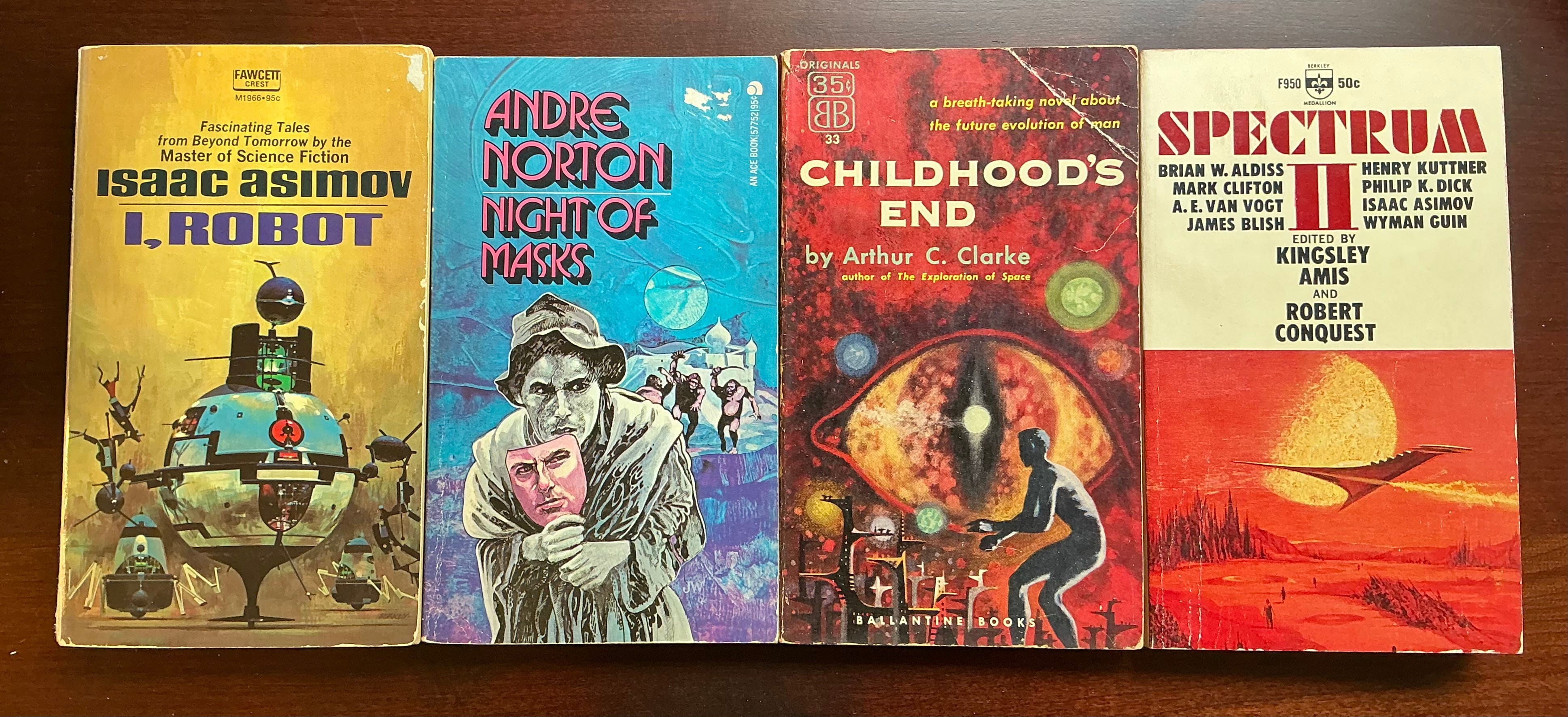
The bumper-sticker moralizing that runs like a crimson thread through much of today’s fiction—no matter the genre or style—is not only aesthetically off-putting but intellectually insulting. The one thing that the curly-haired Poindexters and jean-jacketed ne’er-do-wells I grew up with are almost universally agreed upon is that, when it comes to our pulps and popcorn fiction (which we still read in brittle Bantam and Del Rey editions), we would rather be entertained than spoon-fed answers to questions we never asked.
The supposed insights into the human condition that many of today’s Jeremiahs believe they’re imparting to their readers are often so risible and embarrassingly banal that it’s difficult to read their works without a sniff and crooked smile: “Yes, yes. We get it. The robots are taking over. Governments and corporations are bad. Materialism and consumerism have made us cruel. We’re killing Mother Earth (and ourselves in the process). And the combined effects of AI and social media are turning us into numb, dumb oafs and bug-eyed techno-zombies.”
I’ve been a fan of dystopian fiction all my life. But I can’t stand the gloomy-doomy slop that writers are lazily and almost somnolently dishing out today. Gone are the lighthearted passages of Douglas Adams’s Hitchhiker’s Guide to the Galaxy: “In the beginning the universe was created. This made many people angry and has been widely regarded as a bad move.” Or the sly asides one finds in Robert Heinlein’s Job: A Comedy of Justice: “Theology is never any help; it is searching in a dark cellar at midnight for a black cat that isn’t there.”
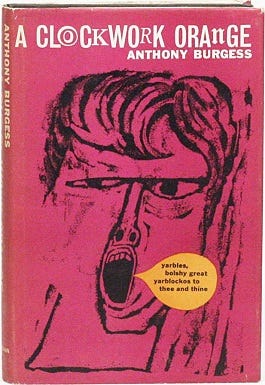
Instead, we get new spins on spun-out tropes and first-person narratives that emulate but never quite rise to the peculiar eloquence of Anthony Burgess in A Clockwork Orange. These authors’ idea of experimental prose is a jumble of apostrophic direct addresses, meandering sentence fragments, or tub-thumping clauses of onomatopoeic nonsense: “Me and the buds were on the beer-drenched stage, bangin’ out a rhythm with a bumpty-dump beat.”2
The immersive full-length dystopian novel, in all of its variegated splendor and parched ambience, is becoming a bird as rare as the Stresemann’s bristlefront. But we sure do have an embarrassment of riches when it comes to flash-fiction pieces written in ungrammatical “baby babble” (because the story’s supposed to be told from the POV of a bug, newt or single-celled organism); or rambling narratives packed full of impenetrable slang that fails to evoke the terse clarity and precision of the Lost Tribe’s dialect in Mad Max: Beyond Thunderdome: “You got to listen it and ’member. ’Cause what you hears today you gotta tell the newborn tomorrow.”3
When the flash-and-bang of these literary gimmicks fizzle out or no longer garner the attention the authors are so ambitiously angling for, they pull an e. e. cummings and alter the visual undergirding of their tales so that they stand out like stains on a white cloth. The make the text “visually” ragged and off-kilter, banishing all punctuation or framing the tale as a series of screenshots of social-media posts, online reviews, email threads, or <shudder> text messages, at the conclusion of which the voice of a sinister AI bot or perverted cyber-criminal intrudess to enforce whatever finger-wagging moral they’re trying to drive home.
It’s as if all the nihilistic Chicken Littles and doomsayers of the twenty-first century, having arrived late to the rave party on Megiddo Hill, sense they’re running out of fresh ways to imagine bleak futures that don’t already resemble (frame by frame) the etiolated present we’re all stuck in. And although many of them are undoubtedly bright, well-intentioned and still finding their footing and honing their craft, their output is being weighed in the balance and found wanting, primarily because better prophets beat them to the punch.
I’ll save my more pointed criticisms for the second half of the essay, which will not be entirely negative. I’m optimistic that “optimism” is around the bend; and that this venerable genre is standing on admittedly wobbly knees on the cusp of renewal; and will return next season at a new time (but hopefully not the “End Times”) with more to offer.
As for the specifics of why I and many other geriatric sci-fi aficionados have become bored with the Armageddon, vide infra. . .
But before doing so, take a gander at the following scene-setter, a trailer for the 1983 ABC made-for-television film, The Day After, which affected those who watched it when it first aired in a way that those who were not yet born will never be able to fully grasp. There were many viewers tuning in mid-broadcast who thought what they were watching was really happening and that WWIII was upon us. (Parallels that come to mind are Orson Welles’s 1938 Mercury Theater radio dramatization of War of the Worlds or the 1992 BBC Halloween special Ghostwatch, both of which caused similar stirs.)
Those of us who remember the heady decades of the mid- to late twentieth century, when filmmakers not only created but conventionalized most of the iconic visuals and emblematic scenes (shot through anamorphic lenses) that today’s writers continue to shamelessly reproduce in writing, find it hard to read a contemporary dystopian work of fiction without the sinking feeling that we’ve “seen” it before.
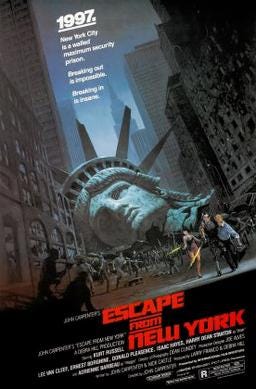
Th stories read (wholly or in part) like Blade Runner, like Escape From New York, like Total Recall, like Soylent Green, like Rollerball, like Kubrik’s A Clockwork Orange, like A Boy and His Dog, like Brainstorm, like Red Dawn, like Romero’s zombie films, like Logan’s Run, like Westworld, like Radford’s Nineteen Eighty-Four, like Threads, like The Terminator 1 and 2, like Brazil, like The Running Man, like the Mad Max trilogy, like Freejack, like Akira, like the first and second RoboCop, like Gattaca, like Battle Royale, like The Demolition Man, like Deep Impact, like Armageddon, like The Fifth Element, like The Truman Show, like The Matrix, like 12 Monkeys, like half the episodes of The Twilight Zone or The Outer Limits. And the list goes on. . .
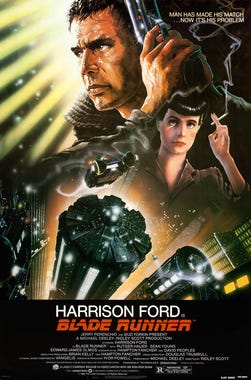
In other words, these supposedly new and original stories read “like” other creators’ works. But they do not read like anything the writers came up with on their own. At best, they’re pastiches, “fanfic” homages, or inept mashups of the comic books, movies, graphic novels, video games, TV shows, and other visual media that inspired them.
Even the last twenty-five-years’ worth of nostalgic reboots and cash-grab sequels of Eighties films and franchises—perhaps with the exception of Blade Runner 2049, Mad Max: Fury Road, or even Furiosa (which I personally enjoyed and think might have done better had it not been branded “a Mad Max Saga”)—feel as if they were written by MFA grads who haven’t the foggiest idea what made the originals a success the first go-around.
For example, the 1984 version of Red Dawn worked because a full-scale invasion of the south-central United States by the Soviet Union was not beyond the pale of imagination at that turning-point in history when three Soviet premiers (Andropov, Chernenko, and Gorbachev) succeeded one another within the space of eleven months. But the 2012 remake revolves around the barmy notion that North Korea could conduct a similar invasion on the same scale. That would be like Laos taking over Australia, which is the kind of absurdity that only happens in Parker Brothers’ Risk.
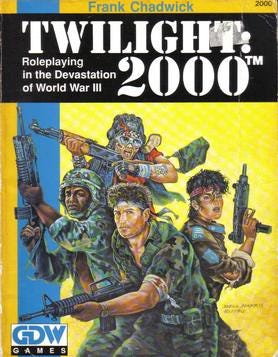
Lasciate ogne speranza, voi ch’intrate (“Abandon all hope, ye who enter”) is, according to Dante, the superscription written over the portal to Hell. And it seems to be the mantra and guiding star for many of today’s writers. Like John the Reveler, these harbingers of the Last Days are almost invariably humorless and a bit full of themselves. They eschew the term “sci-fi,” because it carries with it the taint of genre fiction. They insist that what they are writing is “social-science fiction,” and it’s very serious.
They are also overfond of calling their own stories “Orwellian,” an adjective that has become so abused since 9/11 that it’s all but lost its former weight and piquancy to become a kind of shorthand for anything the author perceives to be a bureaucratic nuisance or a prime example of government overreach—like receiving an envelope in the mail containing a speeding ticket and photographic evidence confirming a vehicle registered in one’s name committed an infraction two months prior.
I honestly believe most contemporary of these writers are blissfully unaware that they are indirectly plagiarizing Orwell when they fill their stories with (i.) fenced-in districts in which the oppressed and downtrodden work in factories and live hugger-mugger in crumbling tenement buildings; (ii.) goods are purchased by ration cards or acquired on the black market; (iii.) language has been “simplified” to serve the state and disseminate its propaganda; (iv.) two-way transmitters are located in everyone’s lodging to monitor what’s being said and issue directives; and (v.) shiftless functionaries in gray uniforms subject people to torture and blood-curdling interrogations, or summarily execute or “disappear” troublesome dissidents.
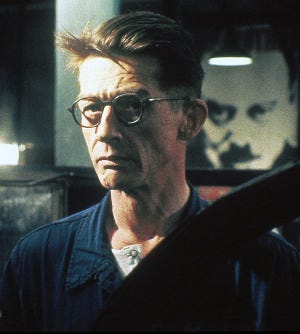
I suppose the authors might defend themselves by pointing to the ways in which their own stories differ from Nineteen Eighty-Four. “Mine doesn’t use ‘telescreens.’ Instead, I have loudspeakers mounted to telephone poles from which the Central Committee barks orders in a language peppered with German and Russian commands. And in order to torment the denizens of ‘Freedom Town,’ they are obliged to wear headphones after sunset that blare Wagnerian music so loudly that they can’t get a good night’s sleep or plot an uprising.” Yes, well, that only vaguely resembles Kurt Vonnegut’s “Harrison Bergeron.”
Authors who have no sense of history and have neither suffered genuine want nor borne witness to the horrors they so graphically and lovingly describe in their misery porn come across as only slightly less contemptible than those celebrities and influencers who engage in so-called slum tourism—riding cable cars up to Rio’s quaint favelas to sample the local cuisine, or parking their Porches along the side of the road from O.R. Tambo Airport to Johannesburg to photograph the brightly painted tin shanties.
Discriminating readers see through this dreck and can tell the writers are frauds, because the dirt on their characters’ faces has been applied with a cosmetic brush.
To be fair, twentieth century is a continuous record of brutality and the industrial-scale commission of crimes against humanity. But the memoirs of those who suffered in silence under these circumstances or endured unspeakable hardship (e.g. Elie Wiesel’s Night or Aksandr Solzhenitsyn’s The Gulag Archipelago) are more harrowing than the blackest page of Orwell’s sobering parable. So why don’t contemporary writers dip their buckets into these wells for inspiration, rather than rewriting the stories of Orwell, Kafka, and Huxley?
But returning to the subject of this essay, the reason that such derivative storytelling doesn’t appeal to people my age is that we read Nineteen Eighty-Four and Animal Farm long ago in high school; and, once we handed in our book reports, we cracked open a copy of something like The Hobbit or Rendezvous with Rama, because we had a hankering for lighter fare.
I can assure you that the last thing I want to listen to during an hour commute on the Beltway in the driving rain is an audiobook set in yet-another not-so-distant future in which an authoritarian government decides whose food stamps will be suspended (wink, wink), and who among the freethinking youth will be sent to die in the pointless war or televised gladiatorial event.
For some reason even seasoned writers seem to think this kind of rehashed cabbage still works as a powerful allegory for today’s world in which people are drowning in debt, losing government benefits, and being forced to live with roommates or get a minimum-wage job that barely covers the rent. I keep racking my brain but can’t think of a single person born before 1990 who ever had to deal with anything quite so traumatic as that.
Continue to Part 2
For the references above concerning “mobile and variable spaces,” see Alvin Toffler, Future Shock (Random House, 1970), 58.
This is a made-up sentence parodying the kind of infantilized gibberish that’s becoming more and more popular today.
Spoken by Savannah, played by Helen Buday.
No posts
Comments
Nothing yet. Say the first thing.
Sign in to join the conversation.