
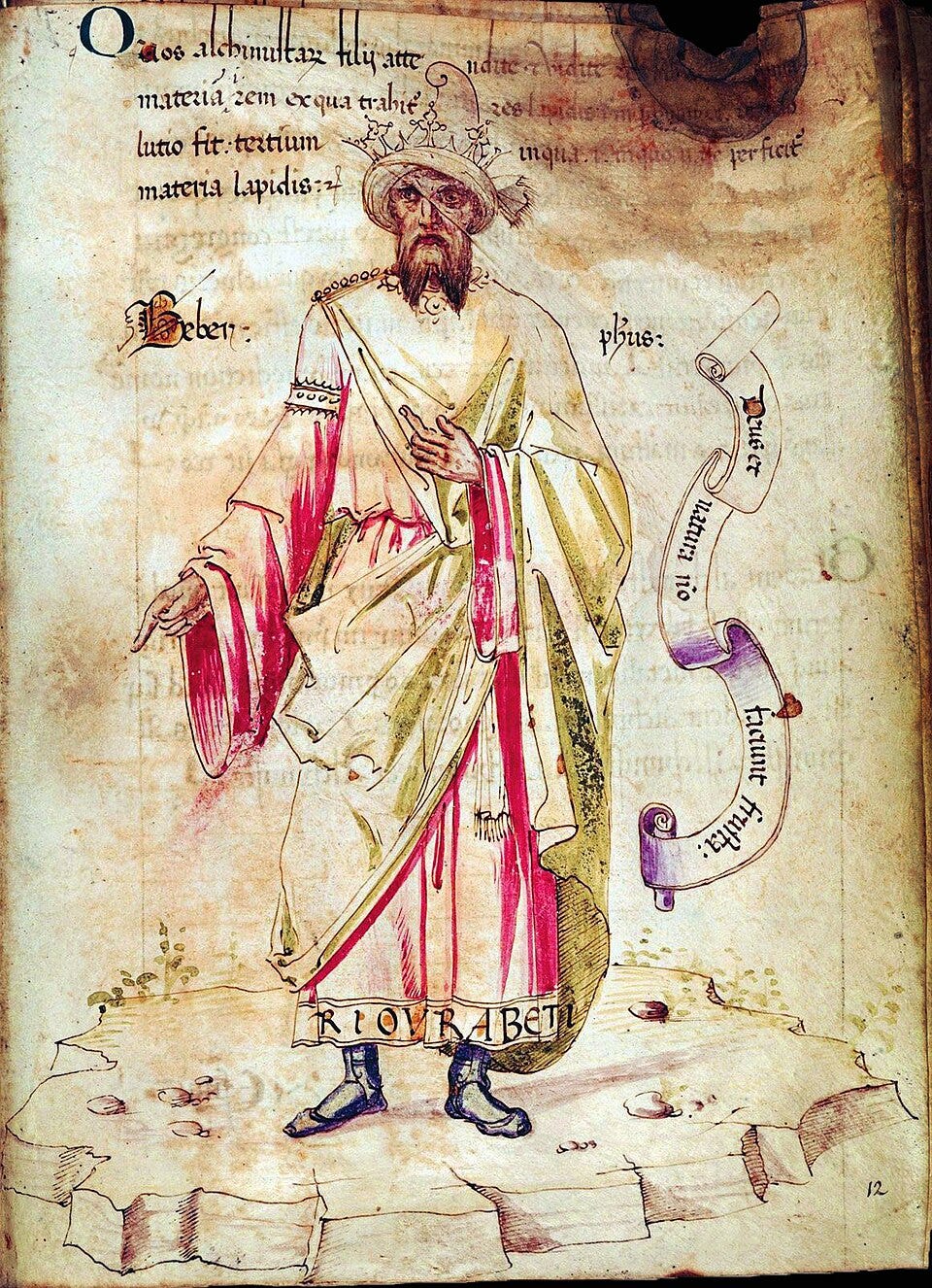
Gibberish: Cant; the private language of rogues; words without meaning. Etymology: Originally written as gebrish, it is believed to be derived from the unintelligible, mystical, and technical jargon used by the chemical writers of Geber’s tribe. (A Dictionary of the English Language, Samuel Johnson, 1755)
No one has ever been able to prove that the ninth-century Shi‘ite alchemist, Jābir ibn Ḥayyān (Latinized in the West as Geber), actually existed. During the High Middle Ages, a handful of hermetic treatises attributed to him were translated from Arabic into Latin. But it was a forgery in his name titled the Summa Perfectionis Magisterii (now simply called “Pseudo-Geber”) that may be the source and origin of the popular notion—later to become a trope—that scholars write and speak in gebrish. This is because Pseudo-Geber is chock-a-block with zodiacal signs, cyphers and chemical notation incomprehensible to all but the initiated.
To me the easiest way to spot when a contemporary writer is going through a fallow period (and likely using AI to pad out a word-count) is when he or she focuses more on how a story looks on the page than what the story is about. Front-loading a tale with an eye-splitting mathematical formula, or dribbling fifty lines of object-oriented programming code down a page, is neither clever nor innovative. It’s distracting and downright sophomoric. It makes the story look like a PennyPress puzzle or one of those inane social-media quizzes popular during the pandemic: “Answer these five questions to find out what flavor of ice-cream you are.”
Does anyone else find it odd that, at a time when more and more students are graduating from college without ever having been obliged to read a single novel cover to cover, we’re suddenly blessed with an abundance of young Thomas Pynchons who dabble almost exclusively in experimental modes of storytelling? These hyper-graphic, speed-reading prodigies (whose works fill the leaderboards) brand themselves as unassuming, salt-of-the-earth types, who’ve adopted a clear and unaffected style because, gosh darn it, that’s what their equally humble fanbase expects. Then they publish a story so pompous in tone and pretentious in execution that it reads like something filched from the leaves of Finnegans Wake.
If a story is worth telling, shouldn’t it be communicable in a way that doesn’t put undue cognitive strain on the reader?
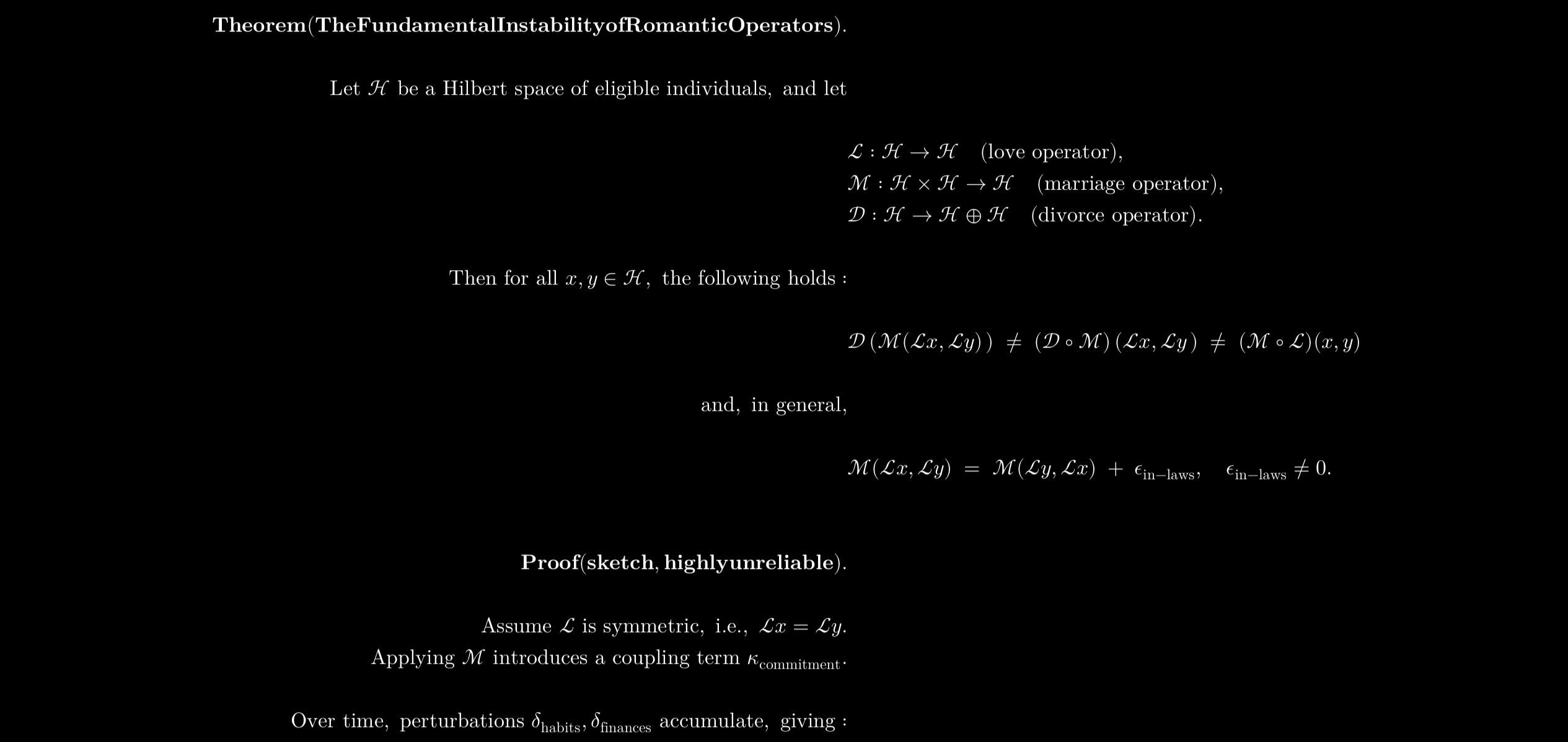
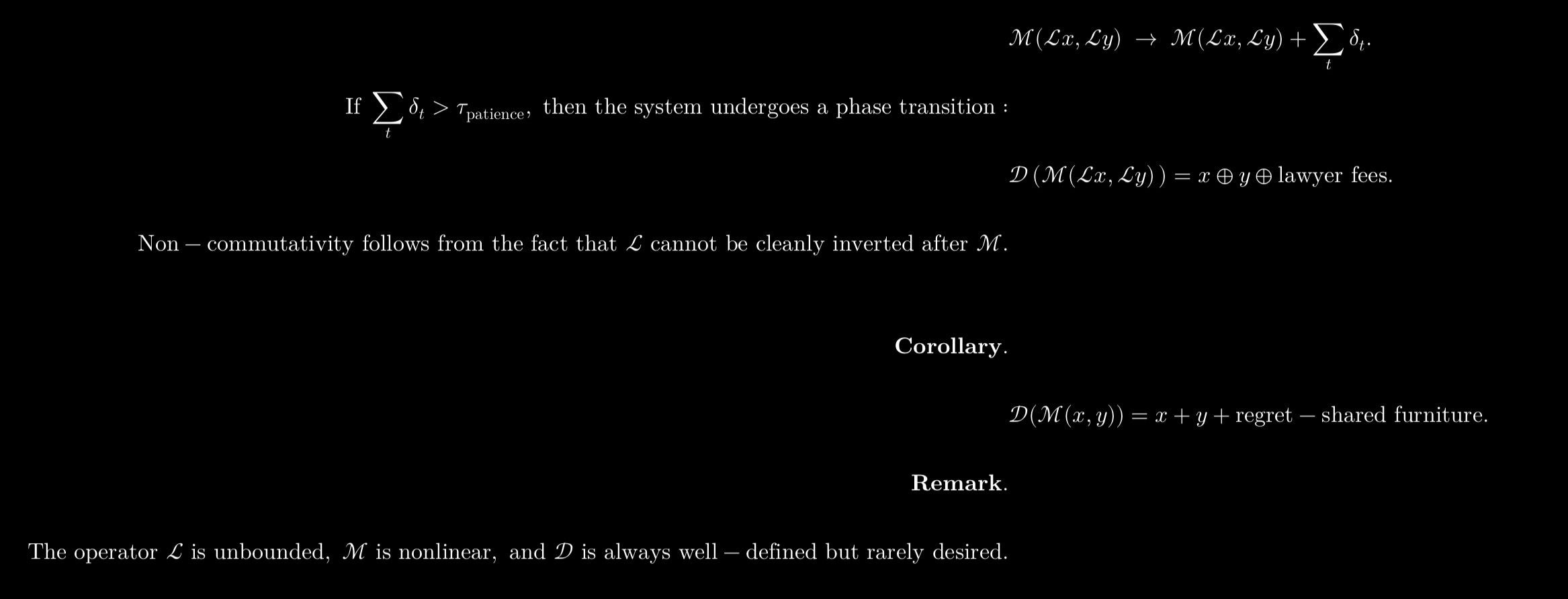
A parable written in the form of a C++ subroutine might have won praise had it appeared in the austere, cardstock pages of Granta quarterly circa 1995, but today it’s old hat. Anyone can do it with a little help from AI, so everyone does. In that regard, it’s no different from the fad of writing flash fiction in response to prompts, a topic I’ve taken up elsewhere.1 To show how effortless and automatic this sort of gimmickry has become, I asked ChatGPT to write a funny tale in the form of a math theorem that used “love,” “marriage” and “divorce” as operators. Not only did it spit out the following, it suggested making it more absurd by adding stochastic dating markets and quantum superpositions of relationships:
The German-American psychologist Eckhard Hess published a series of articles in Scientific American in the 1960s summarizing his pioneering work in the field of pupillometry, the study of how our pupils dilate and contract when experiencing fear, desire, and other such emotions. Today the medical industry uses it to study the effects of traumatic brain injury. I mention it because Philip K. Dick wove elements of Hess’s work into his 1968 novel, Do Androids Dream of Electric Sheep?, which the 1982 box-office flop, Blade Runner, is based on. In both the film and book, the protagonist, Rick Deckard, is a bounty hunter who “retires” androids unable to pass a so-called Voigt-Kampff test (spelled “Voight-Kampff” in the screenplay) that measures their pupillary responses to a series of questions he asks them.
The Voigt-Kampff test is an example of what writers and critics today call “technobabble,” a coarse and relatively new term that The Oxford English Dictionary traces back to a 1981 People’s Weekly article: “To separate technology from technobabble.” Although technobabble is not unique to sci-fi, it’s a common features of it (as any Star Trek fan will tell you).
In Marks Haddon’s 2003 novel, The Curious Incident of the Dog in the Night-Time, we’re introduced to Christopher Boone, a teenager with Asperger’s Syndrome who has memorized all of Sir Conan Doyle’s Sherlock Holmes stories.2 By using deductive reasoning, the boy sets out to solve the mystery of who murdered the neighbor’s dog, a poodle named Wellington. In a pivotal scene, Boone (as unreliable narrator) explains an abstruse veridical paradox known as the Monty Hall problem. The author has included this bit of “technobabble” in order to contrast the child’s phenomenal mathematical abilities with his apparent blindness to what has become obvious to us: his father is hiding a tragic secret only partly related to the dog’s death.
What differentiates technobabble from gibberish in fiction is that, when used with restraint (as in Haddon’s novel, or in Edwin Abbot’s 1884 mathematical fairy-tale, Flatland), technobabble contributes to a story’s plot and fleshes its characters out in unique ways that gibberish simply doesn’t. But it’s a two-edged sword, because an over-reliance on technobabble—i.e. technobabble squared and raised to the infinite power (x=technobabble; n=infinity; result = (x^2)^n)—defiles a tale and makes the symbols on the page look like nothing more than what the eighteenth-century lexicographer and Great Cham of Literature sneeringly dismissed as “the unintelligible, mystical, and technical jargon used by the chemical writers of Geber’s tribe.”

The title comes from the Sherlock Holmes mystery, “The Adventure of Silver Blaze,” about a racehorse called Silver Blaze whom someone has repeatedly drugged to prevent him from winning. Holmes and Watson overnight at the mansion where the horse is stabled. The next morning, they learn the culprit has struck again. Holmes alludes to the curious incident of the dog in the night-time. Watson remarks that the dog did nothing in the night-time, prompting Holmes to reply, “That was the curious incident.” The stable’s watchdog didn’t bark because it recognized whoever was sneaking in: Silver Blaze’s owner.
No posts
Comments
Nothing yet. Say the first thing.
Sign in to join the conversation.