
I’m offering a seminar with The New Centre on The Later Lukács on Social Ontology, Irrationalism & Marxist Reason. It starts on October 2nd and will meet for four sessions throughout October. Here are a selection of lectures and essays I've written on Lukács to help orient you to his thought and to explain why I believe it remains indispensable for understanding the present.
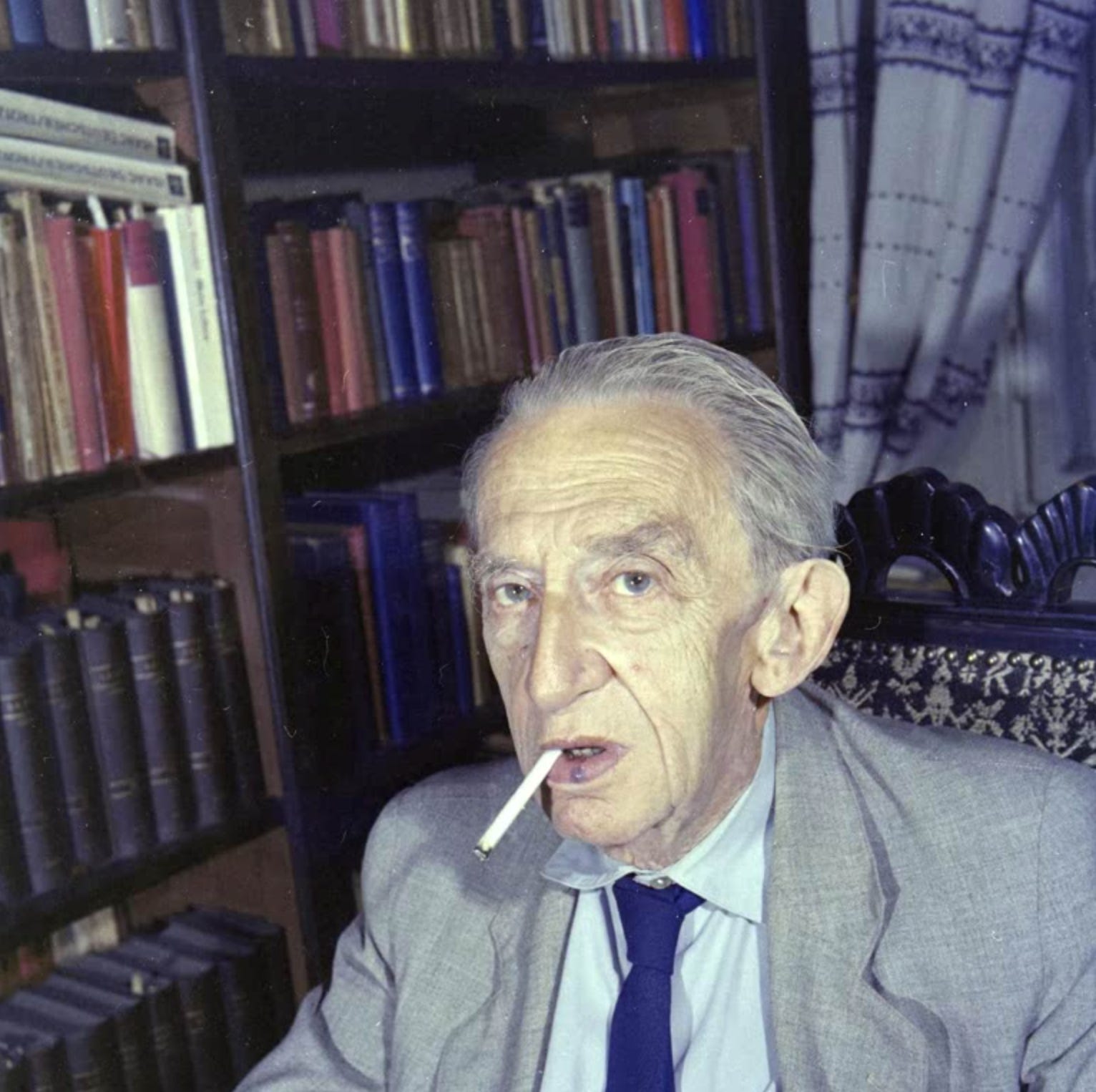
If you are new to the work of Georg Lukács, or if you’ve primarily encountered his work through his masterpiece History and Class Consciousness, I am offering a seminar on his more neglected bodies of work. Over the course of four sessions we will examine The Destruction of Reason, The Ontology of Social Being, his reflections on socialist strategy for a post-Leninist world, labor, ethics, and the critique of irrationalism.
First, in this discussion with Chris Satoor for the Young Idealist, I spoke about Lukács’ life and ideas, including a biographical portrait. If you have not yet read Lukács’s second great masterpiece The Destruction of Reason, a good place to start would be to ready my long review essay with Cosmonaut on why Lukács’ critique of irrationalism remains indispensable for Marxist practice today. And then read my interview with John Bellamy Foster, editor of the Monthly Review on how the critique of irrationalism remains important for Marxist and socialist practice in today’s time. This interview is published with Historical Materialism where I am serving as the co-editor of a new series on The Destruction of Reason which will include essays by Daniel Lopez, Ishay Landa, Tijana Okić, Carl Sachs, Mariana Teixeira as well as never before translated material by Henri Lefebvre on Lukács.
As part of this issue, Matthew Sharpe and I have written a long essay that situates the origin of The Destruction of Reason in Lukács’s thought and we have written a critical response to the 2022 Introduction to the book by Enzo Traverso. This special issue with the HM journal is slated be out later this year and has been in the works for the last four years since I organized the symposium Philosophy and the Rise of Fascism with Deakin University and Verso Books.
Last summer, I offered a keynote for the School of Materialist Research on Lukács’s History and Class Consciousness that reflects on the strengths and shortcomings in this work and how its insights can still guide socialist practice today. Many of these themes also inform my popular book, How to Read Like a Parasite: Why the Left Got High on Nietzsche, which develops a Lukácsian critique of Nietzsche’s place in contemporary left thought. I have also spoken to Michael Thompson about his extensive work on the later Lukács and critical social ontology. Finally, this video essay on some of the main ideas in Lukács’s critique of neo-Kantian thought and the concept of irrationalism and reason should help you get better acquainted with the work of the later Lukács.
For decades, the later work of Georg Lukács was largely neglected by academic philosophers. The 2021 republication of The Destruction of Reason, together with a renewed interest in Hegelian Marxism, has made it increasingly clear that this period of Lukács’s thought deserves renewed attention as one of the twentieth century’s most ambitious efforts to construct a systematic Marxist philosophical project.
In this Seminar, we will read major selections from Lukács’s later writings alongside works by his most significant interpreters. Our focus will be on his theory of the ontology of social being and his critique of irrationalism, examining them as attempts to break decisively with the lingering influence of neo-Kantian conceptions of reason in both philosophy and politics. Our aim is to clarify the distinct character of Marxist reason in contrast to neo-Kantian thought, while also revisiting the central debates introduced in History and Class Consciousness concerning alienation, reification and class consciousness. Far from disappearing in his later writings, these themes remain enduring concerns for Lukács, who develops a systematic Hegelian-Marxist framework intended to confront and overcome them.
Apply for a Scholarship to Attend
The Seminar aims at a deeper understanding of Lukács’s later philosophy and its significance for contemporary socialist practice, connecting it to neo-rationalism, speculative realism and current debates on humanism and transhumanism.
SESSION 1 — THE NEO-KANTIAN HOLE: TOTALITY AND HISTORY: In our first session, we will define Neo-Kantianism as a philosophical and political tendency that has remained pregnant in socialist and Marxist thought, and which brings up problems of immediacy, unknowability, and agnosticism. We will then assess Lukás’s own solution to this problem as well as the critics of Lukács that argue, despite his intentions, his work does not overcome neo-Kantianism, especially in History and Class Consciousness.
SESSION 2 — IRRATIONALISM AND MARXIST REASON: In our second session, we will turn to an analysis of irrationalism in Lukács’ work Destruction of Reason and pinpoint its other, namely a distinct type of reason that Lukács identifies in the wake of Hegel, a reason that is capable of relating to the social totality that overcomes the bourgeois cult of immediacy. We will build off the work of Tom Rockmore and Istvan Meszaros who argue Lukács’ theory of irrationalism is a philosophically rigorous theory based on his wider critique of the residues of neo-Kantianism. We will analyze what a distinct form of Marxist reason might look like and why it offers up a theory of knowledge and practice that requires the development of a far more robust system of practical reason, ontology and ethics.
SESSION 3 — WHY SOCIAL ONTOLOGY? SOCIAL CLASS AND ETHICS: In our third session, we will turn to a study of Lukács’s later turn to social ontology by asking what the aim of this project is all about. Building off the work of Michael Thompson and Meszaros, we will examine the ethical underpinnings involved in Lukács’s ontology and the ways that ontology might change Marxist practice.
SESSION 4 — THE ROLE OF LABOR AND TELEOLOGY: TOWARDS A RENEWED HUMANISM: In our final session, we will examine the third volume of Lukács’s social ontology and its unique focus on labor We will examine how “teleological positing” is developed out of Lukács’s study The Young Hegel and we will examine Lukács’s ontology in relation to Heidegger and phenomenology. Is Lukács proposing a renewal of Marxist humanism?
INSTRUCTOR BIO: Daniel Tutt, Ph.D., is a philosopher and critical theorist whose work focuses on capitalism, class struggle, and the Marxist tradition. He is the author of several books, including How to Read Like a Parasite: Why the Left Got High on Nietzsche and Psychoanalysis and the Politics of the Family. His writing has been featured in Jacobin, Current Affairs, Philosophy Now and Aeon Magazine and he lectures in philosophy at George Washington University, Marymount University, the District of Columbia Jail and the School of Materialist Research. Tutt is the host of the Emancipations podcast and study group collective, and he has degrees in philosophy from American University and the European Graduate School where he completed his Ph.D. with the French philosopher Alain Badiou.
Comments
Nothing yet. Say the first thing.
Sign in to join the conversation.