
As I prepare for our upcoming seminar, Magic, Prophecy, and the Creative Act, I keep thinking about the Aboriginal Dreaming — or the Dreamtime — and its connection to what we’re experiencing now with the accelerated breakdown of the United States, the central pillar of the liberal order over the last centuries. The speed of this process is extraordinary. As a self-willed process of self-annihilation — a civilizational seppuku — it has the quality of a mythological interregnum. Faced with this slow-motion catastrophe, people seem paralyzed and dissociated, lacking a language able to encompass it.
Of course, there are many recent historical precedents for democratic breakdown, authoritarian populism, imperial decline and institutional collapse. In many ways, Trump has followed the playbook developed in Russia, Georgia, Turkey, and elsewhere: attack the press, subordinate the civil service, reward personal loyalty, weaken independent institutions, and make corruption inseparable from governance. Yet the present situation in the U.S. retains an uncanny quality because of the country’s central place in the modern order. Despite its history of slavery, racism, indigenous genocide, hard wars and soft economic conquests, the U.S. became the principal guarantor as well as benefactor of a civilizational model where representational democracy, scientific knowledge, technological development and materialism seemed to reinforce one another. For much of the last century, America supplied the dominant symbol for human advancement.
Now the country is tearing itself apart, while a third of its citizens cheer on the ongoing desecration. We are seeing institutions that took decades or even centuries to build rapidly undermined or demolished, in a stage that feels like the prelude to something like the Cultural Revolution in China or the Fundamentalist takeover of Iran after 1979. These include the scientific and research establishments, the administrative state, universities, international alliances, as well as the norms that sustained constitutional democracy such as prohibitions against Executive Branch corruption and the separation of Church and State.
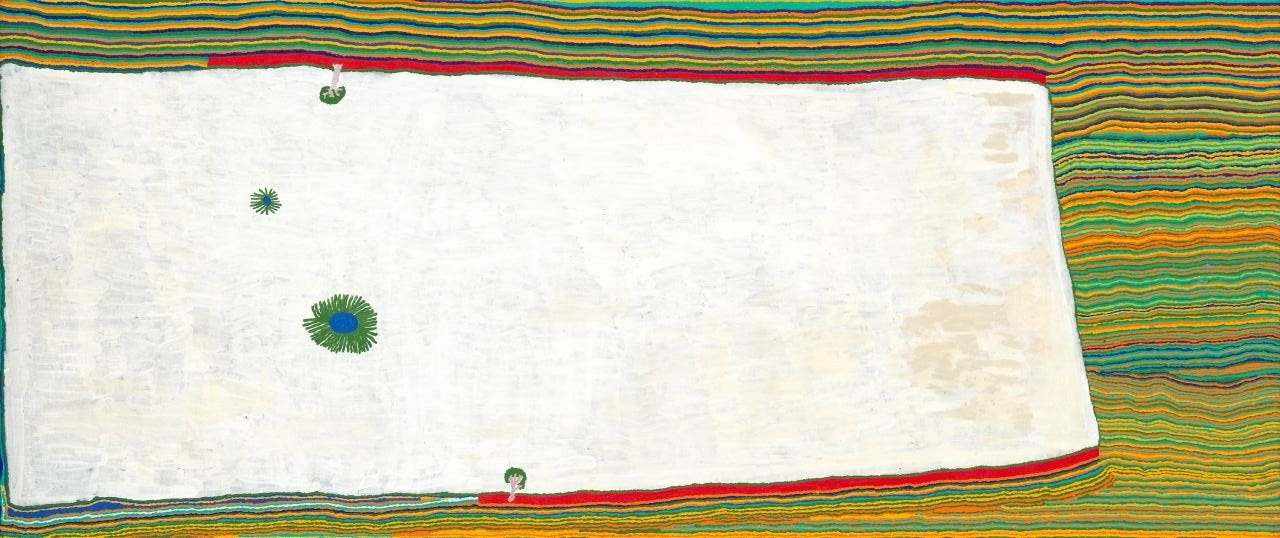
In what follows, I want to explore the Aboriginal dreaming as something that can help give us context for what’s underway, while acknowledging “the Dreaming” is an English umbrella term applied to many distinct traditions, laws, and relationships. I feel obscurely certain that one reason for this collapse is a metaphysical deficiency in Western thought and consciousness. The defect has been amplified by rapidly changing technological and ecological conditions. It is not easy to address this deficit, as it requires interrogating some of the basic beliefs that inform our Western way of being.
I first learned about Aboriginal ideas of the Dreamtime or the Dreaming via Bruce Chatwin’s wonderful little book, The Songlines. Traveling in Australia, Chatwin learned about a vast web of songs underlying the visible landscape which connected indigenous communities across the entire continent, even when their languages were entirely different. He realized that the intricate loom of the aboriginal songlines was probably humanity’s most complex cultural creation — and just as we were discovering this, Western colonialism was tearing it apart. Through the songlines, the aboriginals maintained creation and communed with the Ancestors in the Dreamtime who had sung the unmanifest world into physical existence. Chatwin writes: “By singing the world into existence... the Ancestors had been poets in the original sense of poesis, meaning ‘creation.’ No Aboriginal could conceive that the created world was in any way imperfect. His religious life had a single aim: to keep the land the way it was and should be. The man who went ‘Walkabout’ was making a ritual journey. He trod in the footprints of his Ancestor. He sang the Ancestor’s stanzas without changing a word or note – and so recreated the Creation.” Of course, Chatwin’s perspective has since been criticized for reflecting particular Western biases, as is almost always the case when we seek to translate other cultures into our modes of understanding.
A few stories I heard about the Aboriginals in different contexts always stayed with me, whether or not they are apocryphal. In one of these stories, an anthropologist visiting an Aboriginal group asked one of his hosts to explain the Dreaming. The aboriginal pointed to a plane flying across the sky. “White man Dreaming,” he said. According to the Aboriginal perspective, every living thing and created artifact — whether an axe or an LLM — first exists as a thought or imaginal construct of the Ancestors in the Dreamtime, before it is emanated into manifestation.
Later, Robert Lawlor’s book, Voices of the First Day, had a profound influence on me, even though it has also been subject to criticism from scholars for smuggling Vedantic and Eastern ideas into his efforts to define and convey the basic principles of Aboriginal thought. The historian Mitchell Rolls has argued that Lawlor manipulated sources and assembled an Aboriginal counterworld out of his own dissatisfaction with modernity. The peoples and cultures he portrayed became, in Rolls’s phrase, “products of his disillusionment.”
Lawlor tells a story in that book of working with Aboriginals on land rights issues (I don’t have the text in front of me and may be misquoting it to some degree). As I remember, he recalls going through a government building with an Aboriginal representative, walking quickly through long hallways, carrying the papers for the case under his arm. At some point, the Aboriginal asks him to stop. He points to the papers and asks: “What are those?” Lawlor answers that these are all of the important documents for their case. Then the Aboriginal points at a door and asks, “What is that?” Lawlor answers that it is the door they need to go through to get to their appointment. The Aboriginal thinks for a moment, and says: “No, these are trees. These are trees that you killed and now the trees, in revenge, have locked you into little boxes of time and space. Your white culture will always be a death culture until you learn the difference between a tree, which means life, and a door, which means survival.”
One more story: Years ago I studied with the anthropologist Mick Taussig at Columbia University. He told us about documentary filmmakers Alessandro Cavadini and Carolyn Strachan, who wanted to make a film about the Borroloola Aboriginal community in Australia’s Northern Territory — but decided to make a film with the Borroloola, instead. The filmmakers showed the Aboriginals a number of documentaries, and asked them how they would like to be represented. The Borroloola defined strict aesthetic rules for how the filmmakers could record them. They didn’t want there to be close ups in the film. A tight shot on a face or a speaking mouth strips the subject from land and community, isolating the speaker in a way they found false.
The Borroloola insisted that the entire community be present in almost every shot. To meet their demand, the directors shot Two Laws (Kanymarda Yuma, 1981) with a wide-angle lens. The expanded frame kept the entire community visible. Men and women sat apart, as custom demanded, yet drove the conversations together. This approach anchored the speakers firmly within the land, the rivers, and the mountains that defined their existence. We live in a diametrically opposed societal construct that constantly seeks to elevate the individual (celebrity, plutocrat, or “influencer”) over the community while ignoring the ecological substrate that forms us.
Lawlor explores the distinction in Aboriginal thought and language between the concept of the Dreaming or Dreamtime as the unmanifest and then the manifest or expressed aspect of creation, yuti, the tangible world. “In Pintupi the word for Dreamtime or Dreaming, tjukurrtjana, can be translated as the absolute ground of being or the fundamental universal continuum from which all differentiation arises,” he writes. But Lawlor’s definition sounds perhaps too similar to Vedantic terms.
In Sand Talk, the Aboriginal writer Tyson Yunkaporta calls the Dreamtime a “mistranslation and misinterpretation” of Indigenous concepts. He notes that greater precision would require him to repeat a cumbersome phrase such as “supra-rational interdimensional ontology endogenous to custodial ritual complexes” over and over again. Reluctantly, he continues to use the simpler word. (For me, the phrase “supra-rational interdimensional ontology” calls to mind experiences on psychedelics such as DMT and psilocybin.)
Lawlor notes that, unlike Western languages, Aboriginal language focuses on the specific and concrete, abjuring generalizations and abstractions:
Aboriginal languages reflect the cultural emphasis on experiential awareness, or yuti. For example, Aboriginal dialects have hundreds of names for each particular type of tree, and they have names for many individual trees. In the case of fish and animals, there are sometimes separate names for the same fish or animal at different stages of its breeding cycle. The vocabularies of Aboriginal dialects are so enormous that it has been virtually impossible for Western minds to master any of their languages. Linguistic studies prove that the richer a language is in names, the more it disposes the mind to observe and record ever finer distinctions. In spite of this linguistic power to distinguish each aspect and each individual plant, tree, or animal, Aboriginal languages have no words for abstract, generalized categories such as tree, plant, or animal… There is no word or concept for fiction, fantasy, or personal imagination—something that does not occur or is not perceived is a lie, pure and simple. Any story that does not directly refer to tangible perceptions or to the original Dreamtime stories is considered deceitful or just plain silly.
What the West calls “imagination” is understood by Aboriginal peoples as an extra-cognitive, sensory perception of the eternal, living ground of the Earth itself. The Dreaming is not a psychological fantasy: It can be conceived of as a highly disciplined, shared, and geographically anchored Imaginal reality.
Another way I have tried to approach the Aboriginal worldview, however limited by my own ideological programming, is through the Austrian philosopher Jean Gebser’s ideas about the evolution of mind in The Ever Present Origin. Jean Gebser described various structures of consciousness — archaic, magical, mythical, mental, and integral — which do not replace one another cleanly. The archaic-aboriginal structure has no idea of history or development – Aboriginal rituals seek to maintain the Creation in its proper order. The magic structure has a limited time sense; magic operations can influence the future to some extent. The mythic structure understands time as cyclical, with examples including the Yuga cycles of Hinduism and the Mesoamerican 5,100 year “long counts.”
Each structure poses a different way of relation to time and space, with new capabilities becoming accessible while old ones are lost. Each structure persists inside the later ones, and each possesses both an “efficient” and “deficient” mode. We are currently in the mental-rational structure, which started in the Renaissance and gave us linear time, perspective in painting, empirical science, and market economies. Writing in the 1950s, Gebser saw this structure was already in its deficient mode, which means a new revelation is forthcoming. He named the next structure of consciousness the “integral-aperspectival,” leading to a condition he called diaphaneity, in which all the past structures become simultaneously transparent and available to us as “veils” over the spaceless-timeless ultimate.
2.
We’re now in the accelerated stage of the collapse of the mental-rational structure, reflected by Artificial Intelligence and the fixation on quantification and purely technological progress divorced from qualities of being and experience, which are seen as ancillary and meaningless. As the mental-rational structure collapses, in some ways we are collapsing back into the earlier structures, but without the depth and weight that those structures possessed in their original form. We seem to have entered something like a depraved or evacuated version of a mythic consciousness, lost in its imaginal projections.
We’re currently experiencing a blinding implosion of the future into the present that suggests approaching catastrophe. What’s missing is any sense that the present continues from the past into a meaningful future, or that a successor generation will continue tradition and legacy. What remains when this is gone is pure extraction and spectacle: the burn-out society. Just to take one almost random example from the current news cycle, the U.S. government is currently using short-term U.S. Treasuries to buy up long-term U.S. Treasuries, to keep the Stock market and the bond market afloat for another few days, like using your credit card to pay your mortgage. The illusion is collapsing on itself.
Another example comes from the changing paradigm around visual representation. This is brilliantly explored in the artist Trevor Paglen’s new book, How to See like a Machine. Paglen argues that the status of the image is undergoing a shift comparable in importance to the discovery of perspective in the Renaissance. For roughly two centuries the photograph functioned as verification. A photograph provided empirical evidence that something had occurred — for instance, an image like a tortured man in Abu Ghraib or a bombed hospital in Gaza proved that these events had happened in reality. Generative imagery, produced via AI, dissolves the connection between image and verifiable reality. When any image can be produced without a corresponding event, the photograph stops being a witness.
What replaces verification, in his account, is something closer to “operation” or intervention. Images and narratives become activations or interventions that act directly on the nervous system rather than testify to a real event. The relevant question shifts from what an image attests to what it does: what happens neurologically and emotionally when a person encounters a violent image, or an erotic one, or one engineered to produce a particular affective state. This is a change in the fundamental role of the image, not something to be solved by better detection.
When we step back and consider our long history of image-making, we find that the image as evidence or verification was a recent innovation or anomaly rather than the norm. Palaeolithic cave images were never documentary. The animals at Lascaux were operational — an attempt at manifestation, a way to build manna, or make contact with divinity — and the same holds for Aboriginal image-making, where marks and designs carry law and sustain ancestral presence rather than depicting a scene. We can now see image-as-evidence to be a local arrangement within a culture based on a limited form of rationality and empiricism, lasting a few centuries, which we seem to be exiting now. A strange, or uncanny, feature of the present is that we have returned to operational images by a different road, through machines rather than through ceremony. The sense is of an evacuation of presence rather than a communion.
The collapse of the mental-rational structure does not deliver us back into the thick felt presence of the magical or mythical, or into anything beneficial or positive, unless we do the hard work to understand and assimilate what’s happening around and within us, and if we can rebuild our ontology based on new insights and information. I would propose that the Dreaming of the Ancestors still exists under our feet, just as it does for the Aboriginals. Perhaps that is a culturally inappropriate perspective. As a postmodern cosmopolitan, I view my “culture” as not one parochial mode but the ongoing, always incomplete effort to synthesize different cultures and build bridges between them.
The philosopher Yuk Hui argues that Western metaphysics has reached its end point. The West’s effort to define a universal and unifying logic able to explain any system — whether a machine, a biological cell, or human society — through the flow of information and feedback loops completed itself with cybernetics. Everything in the world is now reducible to calculability, data, and a “standing reserve” for exploitation (what Heidegger called Gestell or enframing). We’ve reduced language, art, music, and thought to detached logic and reproducible algorithms.
European philosophy exhausted its trajectory by actualizing itself through global cybernetics. It can no longer offer a way out of the totalizing trap it has created — this partly explains the fury of reactionary populists who embrace extreme forms of mythic identification to break the cybernetic machine. Hui argues, to envision a future that isn’t just a homogeneous, transhumanist machine-world, we must make a “decisive leap” into a “post-European” philosophy. This requires abandoning the pursuit of a single universal logic and instead embracing “technodiversity” and multiple “cosmovisions”—fragmenting the order of thought by allowing different local cultures and cosmologies to shape their local futures. While Hui focuses on Chinese thought as one “line of flight,” perhaps the multiplicity of indigenous cosmovisions offers something even deeper and more replenishing, If so, the current path of destruction could lead through catastrophe to something beautiful and necessary: a new Dreaming and a new creation.
Comments
Nothing yet. Say the first thing.
Sign in to join the conversation.