
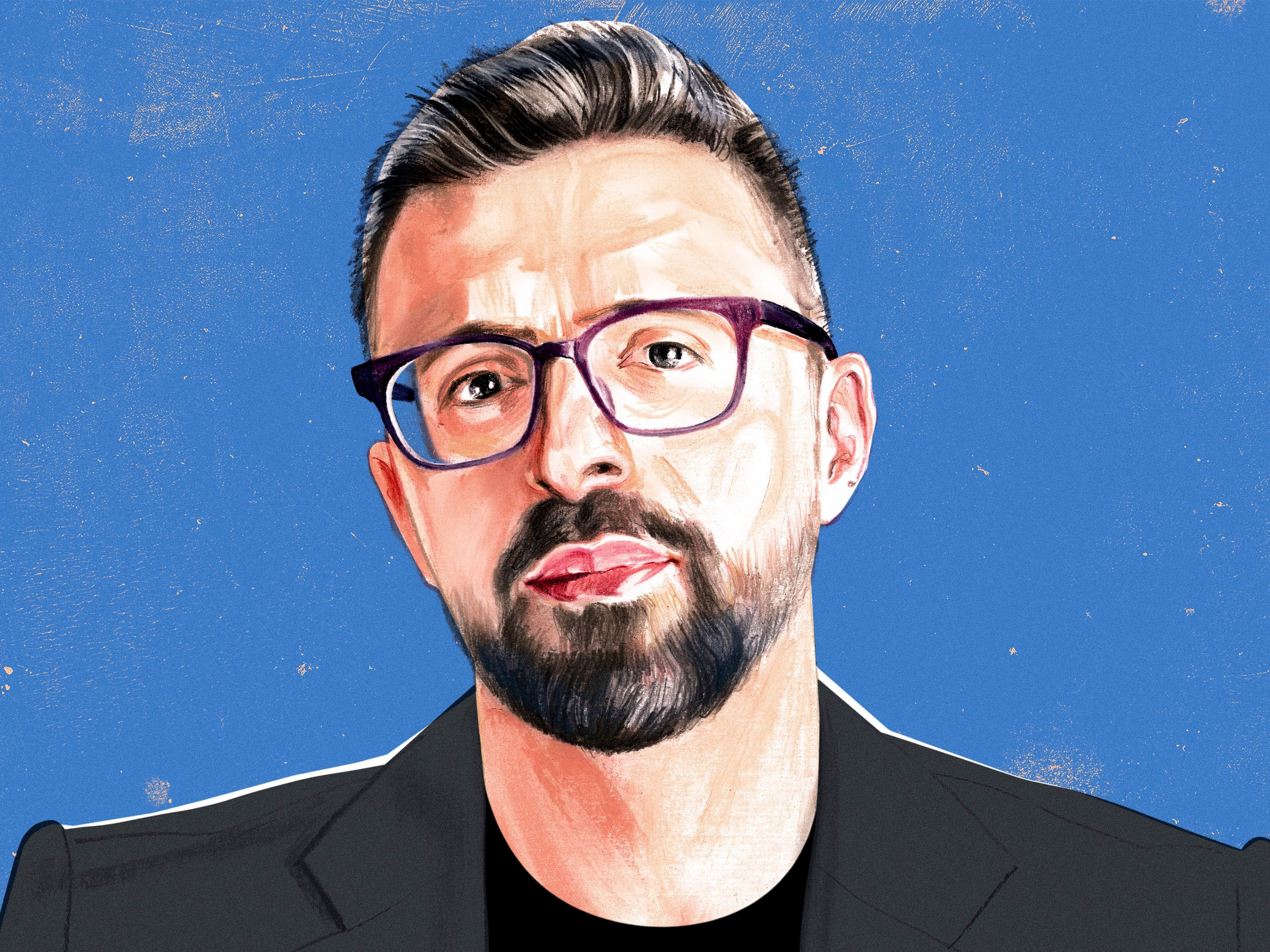
On a recent episode of Ezra Klein’s podcast, he reflects on what he thinks he got wrong during the period of peak wokeness in the late 2010s and early 2020s.
His perspective, which I’d grade as roughly 60% thoughtful and 40% avoidant, is a really useful example of two related phenomena. It’s an instance of what it looks like when a political establishment or tendency reflects on its errors of the past and meaningfully shifts from one position or disposition to another. It’s also a good example of why that reflection can be so frustrating to precisely those people toward whom the center (-left) of gravity has now shifted: they were voices in the wilderness, ignored or treated with contempt by the establishment, and now they’ve been vindicated globally but provided with insufficient emotional recompense for being too right too soon. It’s extra salt in the wound to see a figure like Klein receive praise, including from himself, for an incomplete and somewhat self-exonerating reckoning.
Here’s Klein:
Klein: I do think that the people who were arguing that the way that power is being deployed on platforms — and in spaces like colleges — that it was fundamentally illiberal and that it wasn’t going to be contained there, that it actually was going to leak into society: They had more of a point than I thought then.
This is a point Professor Jonathan Haidt had made, and we had a debate about it back in the Vox days. There were all these debates about college campuses, and a lot of my view was: Who cares? I just don’t want to hear that much about what happens at Yale.
And the view of Haidt and some other people was: It’s not going to stay at Yale. You’re training the next generation of staffers and leaders, and this is going to come out of there.
And I think, one, that was basically true — that the spillover effect was very real.
And two, the application of cultural power caused such backlash that it arguably more than wiped out the gains.
The number of people who I think were truly radicalized by just stuff that happened to them on Twitter, on Facebook, on Instagram, on places like that — in part because I always looked at those places as kind of cesspools, to just be blunt, I think I was just less concerned about what was happening there.
…But I always want to say this, because I think this other side of it is important: The reason I was sympathetic to what gets called wokeness — I actually still believe all that. I believe systemic racism is very real. I believe that our society is fundamentally unequal in very, very deep ways.
…One of the things that happens, when you begin to unearth the way we have settled into unjust structures in society, is you don’t always know how to change those structures in a way that will work. And I think a lot of things failed. I think a lot of things failed.
But the things people were trying to change were very real. I mean, the level of just overwhelming workplace and social harassment that primarily women faced — and face — it’s not gone. It’s real.
I think racism remains a problem we don’t really know how to deal with. I think that I actually have mostly the same views on what it is we’re trying to fix in society.
But I think I take more seriously the people who said that using illiberalism to create something more liberal, even if the illiberalism is not coming from the state, you’re imperiling more than you realize you’re imperiling.
…And I guess the only other thing I’ll say, and this was a very consistent theme for me back then, too: I think a lot of what went wrong then, and what is going wrong now, has to do with these fights taking place in fundamentally deranging spaces. Spaces that have only become more deranged after Elon Musk bought Twitter; become more deranged as they’ve all become much more algorithmic and less focused on your friends and the people you follow.
And I think if you go back to my work then, if you go to it now — I have an extremely clear through line of somebody who has been very, very concerned that attention is the fundamental capacity we bring to politics. What we pay attention to shapes what we see, it shapes how we act, it shapes what we believe about other people.
And if the way we pay attention — if the space that mediates our attention — deranges it and focuses it on the wrong things in the wrong ways, then our politics is not going to be good.
And the reason I think there were pretty bad excesses in a political movement I fundamentally agreed with — and now there are really bad excesses in a political movement I fundamentally disagree with — I think the fact that both were taking place primarily, first and foremost, on then-Twitter, now X, is inseparable from what has gone wrong.
It’s a big deal that Klein, the single most influential liberal pundit in America, is conceding that he was wrong in this way. That he believes this, and is willing to say it explicitly, is quite good evidence that the liberal establishment has begun to meaningfully integrate the recognition that the illiberalism of wokeness was both morally and strategically bad. It has moved significantly toward a baseline of defending and promoting liberalism.
So that’s one thing. The change is real. Another thing is that Klein is clearly, though I don’t think consciously, sidestepping the critiques of wokeness that have located the core problem of the movement in its core ideology itself rather than in its excesses or in the ways that technology amplified those excesses.
Klein doesn’t have to agree with those critiques — the best of which, it’s worth noting, come almost entirely from liberals and leftists — but when he says “there were pretty bad excesses in a political movement I fundamentally agreed with,” and “what gets called wokeness — I actually still believe all that,” he’s missing something profound. He’s assuming a close adjacency between liberalism and woke-ism that doesn’t scan if you’re versed in the history of illiberalism on the left.
Musa al-Gharbi, whose We Have Never Been Woke: The Cultural Contradictions of a New Elite is one of the key contemporary left-wing critiques of wokeness, put it this way in a recent Substack post:
What Congresswoman Alexandria Ocasio-Cortez (AOC) diminutively referred to as “Woke 1” was, in fact, “Woke 4” (with “Woke 5” bound to occur sooner or later).
As my book details at length, there were three previous “Great Awokenings” — periods of heightened contestation around “social justice” activism and the symbolic professions — since the beginning of the 20th century. The Democratic Party was radically transformed in the aftermath of each of these previous cases as well… for better or for worse.
In the aftermath of the first Great Awokening of the 1920 and 1930s, FDR took the wind out of socialist parties and movements in the U.S. by integrating their best policies into the New Deal. In the process, he successfully converted most American socialists into banal Democrats while also improving the lives of most Americans and significantly broadening the appeal of the Democratic Party with normie voters. In so doing, he established a political paradigm that led to enduring success for the party and even reshaped the GOP for a generation. Almost all politics until the 1960s occurred within the confines of the New Deal and Keynesian economics.
When Klein talks about Woke 1.0 as something he “fundamentally agreed with,” he’s not just missing the fact that Woke 1.0 was in fact Woke 4.0, he’s missing the fact that he himself is the latest incarnation of a type—we’ll call him Middlebrow Establishment Liberal (MEL)— the liberal anti-communists of the Woke 1.0 period mocked for believing that “communists are just liberals in a hurry.”
Like Klein now, the insufficiently wised up liberals of past eras failed to see that certain forms of leftism simply weren’t the same kind of political project that liberalism was. Some of their goals, framed abstractly enough, were the same. They wanted equality, fairness, justice, all the good things. But the methods for achieving those goals, and the deep principles underlying them, were so alien to liberalism’s DNA that it never made sense to cede power or defer rhetorically to these types of illiberal leftists within any kind of institution or campaign. The play instead, a la FDR, was to a) defang them by assimilating some of their issues and rhetoric, and b) at the same time jiu-jitsu their radical energies to scare corporate or state or right wing interests to compromise with the obviously-safe-by-comparison liberals.
The history is worth noting, here, for two reasons. One is that it’s precisely where Klein seems weakest. He doesn’t seem to have in his brain a clear narrative of the historical sins and contradictions of the left, nor of the ways in which liberalism, at its best, has negotiated with, fended off, and absorbed energies from the left. So when a political moment coalesces that should be recognizable as a new instance of a recurring historical dialectic, he can’t historicize it. It looks new to him, and so his response in the moment is mis-calibrated and his reflection in the aftermath is inadequate.
The other reason the history is worth noting is that it can remind us that the failures of Middlebrow Establishment Liberal to wholly reckon with the recent past doesn’t matter as much as people feel it does or should.
Real, positive change doesn’t depend on the MELs who got it wrong possessing a fully fleshed out understanding of why they got wrong what they got wrong. It doesn’t require a full mea culpa, or even a mea culpa at all. It simply requires that the center of gravity shift, and though that’s unlikely to happen without some number of people who see the full picture, that super savvy group can be a relatively thin slice of the larger pie of change. The rest of the pie can be, eg:
people who’ve changed their minds without admitting it or even being aware that they’ve changed;
people like Klein who see some but not all of what they got wrong;
people who capitulated to things they never actually believed, because they were scared, who now avow what they believed all along because it’s now safe to do so ;
and even people who continue to believe the old thing but stay silent because they don’t want to be out of step with the herd.
I don’t claim to know how successfully mainstream liberalism has integrated, or will integrate, the lessons of the recent past. Just because it’s been done well before doesn’t mean it will be done well again. It does seem clear to me, though, that what Klein’s doing in that episode, and how he’s been writing and podcasting in general since Trump’s victory in 2024, are at least isolated examples of what what victory looks like. It may not feel good, but it’s real.
Comments
Nothing yet. Say the first thing.
Sign in to join the conversation.