
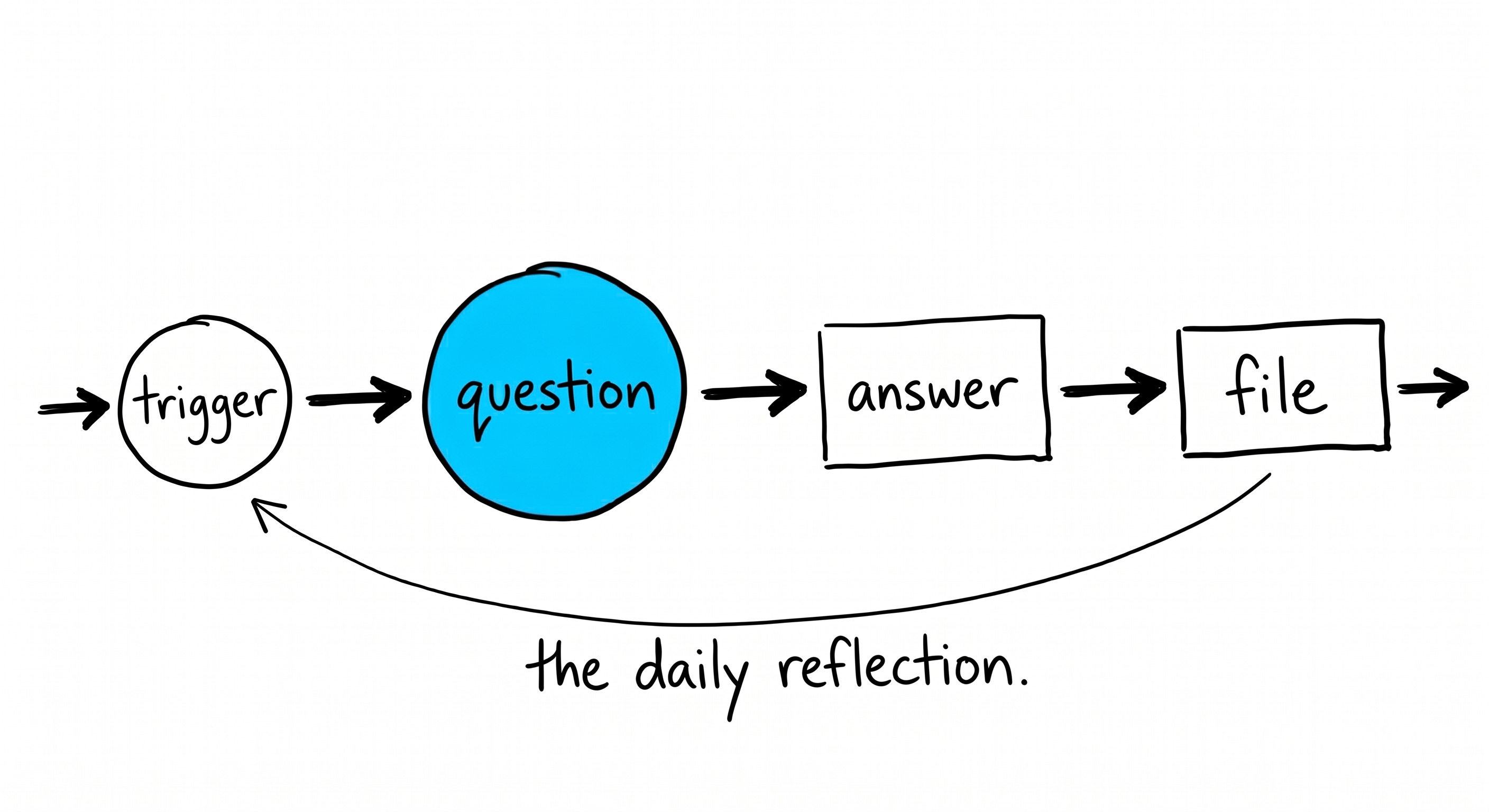
For three years I ran an evening reflection habit that actually worked. Most evenings, once the work was done, I opened the laptop, opened Obsidian (my note-taking tool), made a fresh daily note, and spent up to fifteen minutes on three questions: 1) What went well today?, 2) What do I do better tomorrow?, 3) What am I grateful for?. Then, my daughter was born, and within days the habit was gone, not to return.
The last time I tried, it was nearly 10pm. She’d finally gone down again. I stood in the living room with the laptop open and felt those fifteen minutes the way you feel a flight of stairs at the end of a long day. I left the laptop half-open without writing anything. I did the same the next night, and the night after, and then I stopped pretending I’d get back to it.
The habit hardly depended on willpower.
But it did depend on a kind of day I no longer had.
When Giada Di Stefano and her colleagues followed workers through a training programme, the ones who spent the last fifteen minutes of each day writing down what they’d learned ended up performing 23% better than the ones who used the same fifteen minutes to keep practising. The only difference was that one group stopped and put their day into words.
That is the entire mechanism, and it’s less mystical than it sounds. Saying what happened, out loud or on paper, forces you to interpret it, to decide what the day meant, instead of letting it slide past under the next thing. It’s also the easiest thing in the world to skip, because the moment you could do it is the moment you have the least left to do it with.
Everyone knows reflection helps; almost nobody keeps it up.
Systems are whatever make it happen on the night you have nothing left. I’ve argued before that durable behaviour comes from architecture rather than resolve, that a weekly cadence of accountability is what turns intentions into things you actually did, that fatherhood had already taught me focus is mostly a problem of constraints.
I won’t repeat those here. But this is what’s worth digging deeper into: if something matters, you build the conditions that produce it and stop staking it on the version of you that happens to feel like it.
Here’s what those earlier articles didn’t cover. They gave the impression that the systems you build to keep you focused are built once, carefully, to then live inside.
But you build for the life you have right now. And that life moves.
In the 1970s the architect Christopher Alexander spent a decade attacking the thing his profession was proudest of: the master plan. A town or a building set out completely in advance, he argued, comes out dead. Not for any lack of talent in the planners, but because no plan can anticipate the life that will actually be lived inside it. The places that feel alive are grown piece by piece by the people who live there, each small change repairing and extending the whole as needs surface. He called the alternative organic order: structure that is never finished, only ever adapted by its inhabitants.
He was writing about buildings. The point holds for the structures we build for our life. You are the inhabitant of your days, you can feel when what gave your days structure has stopped fitting, and you are entitled to knock out a wall.
Behavioural research says the same thing from a different perspective. Bas Verplanken and Wendy Wood have shown that habits are held up by stable context: the same time and place, the same surrounding routine. So the predictable thing about a move, a new job or a baby is that it dismantles whatever those cues were supporting. That same rupture is the best window you’ll get to intentionally install something new, before worse defaults set in. BJ Fogg’s model explains what every behaviour needs: a behaviour fires only when motivation, ability and a prompt line up. Become a parent and your ability craters. The old prompt, “it’s 9pm, open the laptop,” now asks for more than you’ve got, so nothing fires. You can read that as proof that you lack motivation or have gone soft, or as the building telling you a few walls are in the wrong place.
Owning the system is what gives you the standing to change it. Rent it from someone else, a guru’s morning routine or whatever a journaling app decides to ask you, and a bad week feels like letting them down. Build it yourself, and a couple of bad weeks stop being a verdict and become a renovation note.
When my reflection habit broke, my first instinct was the obvious one: try harder, find the discipline, put the ritual back as it was. It took me embarrassingly long to notice I was trying to rebuild the same wall in the same wrong place.
It helps to put any reflection habit on two axes. One is how easy it is to actually do on any given day. The other is reflective depth: whether the act makes you interpret the day or just records it. Cross the two and you get four kinds of reflection habit:
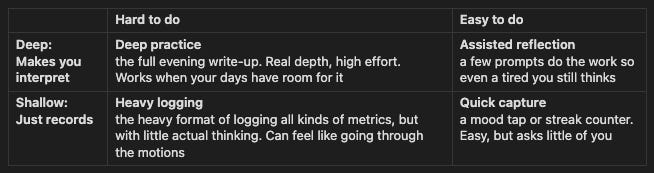
Most people assume the top-right corner is empty. They assume depth has to be paid for in friction, that the deep version worth doing is also the hard one. That assumption is exactly what kept me rebuilding the wrong wall. Depth doesn’t live in the laptop or the careful handwriting. It comes from the prompt forcing you to interpret. Leonie Jacob and colleagues, comparing how people learn by explaining aloud versus on paper, found the gains hold whether you speak the explanation or write it, and that speaking is often the stronger of the two for complex topics. And a day worth reflecting on is always complex, which is why a voice note muttered in the dark does the same work as the journal, at a fraction of the cost.
So I rebuilt my system lower to the ground. Underneath every version are the same four components: a trigger fires, a prompt asks, you answer, the answer lands somewhere - plus a fifth question of whether you ever look back. Everything else is yours to set. Pick one option per row and the system is authored by you.
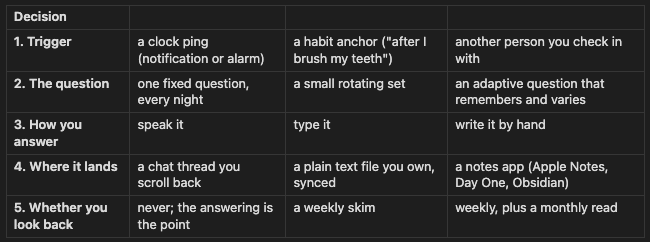
My own path through it: a phone notification at 6pm from Claude; an adaptive question that remembers what I said yesterday; answered by voice or thumb depending on how wrecked I am; auto-written into a plain text file I own that syncs between my phone and my desk; skimmed once a week. It took 1-2 hours of playing around with the set-up. But now it just asks little enough that a tired man will still do it (and a tired man I often am these days).
Note: the question does the real work. It has to make you interpret, not simply report. “What did I do today” gets you a log, a diary of a life. “What did I learn, and what would I change” gets you the 23%. Set that one wrong and the most beautifully engineered routine on earth slides straight into a heavy, but shallow, logging exercise.
If designing from a grid sounds like its own kind of friction, here are three routes through it, each adding one capability over the last. Whether you speak or type is your call in all three.
Build 1, the solo loop. A phone alarm, the same question every night, answered out loud into Voice Memos or typed into Notes, never read again. No second party, no syncing, no review. The whole return is the thirty seconds of answering. It’s the floor, and the floor already beats nothing by a mile.
Build 2, the chat loop. A scheduled ping from something ordinary: a repeating reminder, a message thread you keep with yourself on WhatsApp or Telegram, a basic check-in bot. You reply, and the replies stack up in the thread, so the conversation becomes the archive. The question never changes and nobody hands the patterns back to you, but every answer you’ve given sits there to scroll.
Build 3, the assisted loop. Claude pings me with a question that adapts to what I said before, and writes my words into a file I own and control, syncing across phone and desktop. It runs the weekly read-back for me too, surfacing the patterns instead of leaving me to dig. This is the one I run now.
Among the many larger things my daughter changed was one small one: the structure I trusted to make sense of my days and learn from them had been fitted to a man whose evenings were his own, and that man was gone.
Christopher Alexander’s objection to the master plan reaches past architecture. A structure the inhabitants can’t change stops serving them the day their life moves, and then it just stands there, a monument to a moment that’s passed. The systems you build to keep yourself honest and focused on what matters most are no different. Build the one that fits the life you have now. Hold it loosely. When life moves — and mine moved overnight, in a maternity ward — you’ll want a structure you can rebuild quickly and run at night, half-asleep, with one hand.
That’s the only kind that survives a real life. It’s also the only kind worth owning.
For subscribers: if you want to actually try out one of these reflection routines, I’ve added the setup for all three. Click on the “Get the latest tool/prompt” button below — direct steps for the first two, a prompt you paste into your AI for the third.
Comments
Nothing yet. Say the first thing.
Sign in to join the conversation.