
There is a dark, pervasive absurdity to our current political timeline. It makes you wonder if the cosmos itself has lost its internal compass. We find ourselves living in a culture where the cultural icons who anchor our collective humanity are snatched away, while the architects of political decay remain comfortably entrenched in power. When the Grim Reaper comes collecting, it feels like the universe is operating off a severely mismanaged ledger.
This sense of cosmic misdirection is not just a metaphor; it is the framing through which we must view our current socio-political reality. We are navigating a period marked by profound institutional rot, where the mechanisms of state power are increasingly deployed not for the public good, but for the preservation of fragile egos and ideological control.
The Purge of the Pentagon
Consider the structural hollowing out of America’s military leadership. Under the current defense apparatus, the Pentagon has been transformed into a staging ground for personal grievances and ideological purges. The systematic removal of battle-tested, nonpartisan senior officers—pushed out by political appointees with more television experience than strategic acumen—leaves the nation’s defense structure deeply compromised.
This is not merely administrative turnover; it is generational damage.
When military leadership is selected based on ideological loyalty rather than strategic competence, the foundational premise of an apolitical armed forces collapses. Officers who offer candid, objective advice are replaced by sycophants. Meanwhile, service members who stand on the steps of the Capitol to reassert their oath to the Constitution—rather than to an individual leader—face swift, punitive crackdowns. The message sent down the chain of command is unambiguous: the state demands fealty to the regime, not fidelity to the law.
Foreign Policy by Flattery
This internal politicization directly feeds into disaster on the global stage. When foreign policy decisions are driven by personal ego and susceptibility to foreign flattery rather than rigorous intelligence assessments, the consequences are immediate and disastrous:
Dismissal of Intelligence: Experienced national security advisors present clear assessments outlining the escalation risks of conflict in the Middle East.
Ego-Driven Strategy: Decisions are shaped by external actors exploiting leadership vulnerabilities rather than sound geopolitical strategy.
Predictable Escalation: Intelligence predictions unfold precisely as warned—closure of strategic waterways, destabilization of global energy markets, and strikes on domestic bases.
When a state’s foreign policy is dictated by the emotional needs of its leader rather than the sober analysis of its intelligence apparatus, national security becomes a secondary concern.
The Return of State Surveillance
Domestically, this logic extends into a familiar and dangerous historical pattern: the criminalization of dissent.
Recent disclosures revealing federal undercover agents infiltrating community groups, monitoring activists, and tracking everyday citizens under the guise of counter-terrorism mirror the most egregious overreaches of 20th-century state surveillance. By broadening the legal definitions of “domestic terrorism” to encompass peaceful protest and civic organizing, the state constructs a framework where political opposition itself is treated as an existential threat.
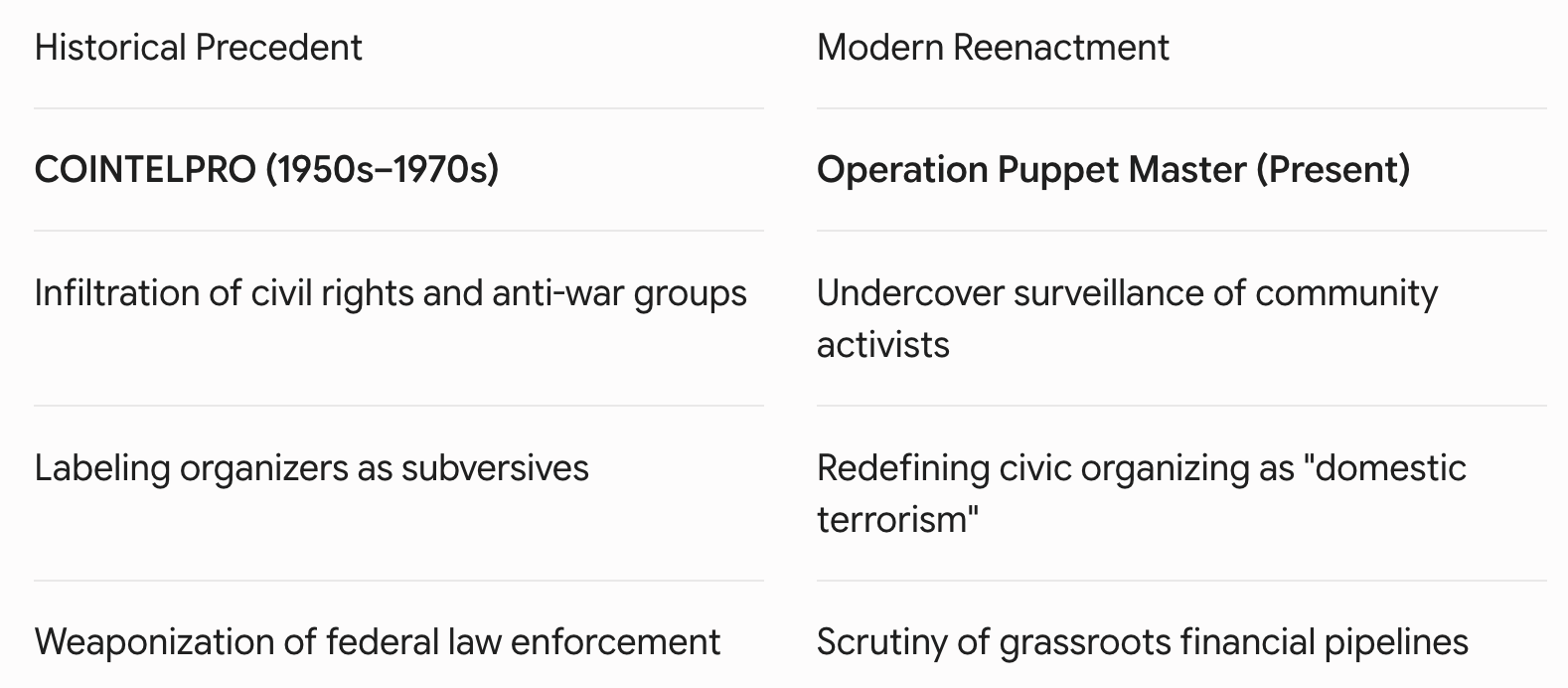
This is not a new playbook; it is the reactivation of old tools designed to preserve state power by suppressing constitutional rights.
The Path Ahead
We are witnessing a convergence of institutional hollowing, reckless foreign policy, and domestic authoritarianism. The challenge before us requires more than passive observation. Recognizing these patterns for what they are—systemic, deliberate, and deeply dangerous—is the first step toward confronting them.
The political ledger may be deeply corrupted, but the responsibility to demand accountability, defend constitutional norms, and resist the normalization of state-sponsored decay rests entirely with us.
Comments
Nothing yet. Say the first thing.
Sign in to join the conversation.