
In 1984, a single television program quietly transformed how Western society perceived wealth. Host Robin Leach stepped into living rooms across the country on Lifestyles of the Rich and Famous, bringing ordinary people inside the hyper-exclusive enclaves, private yachts, and sprawling estates of movie stars, professional athletes, and blue-blooded socialites.
We sat there and devoured every minute, harboring the quiet hope that if we worked hard enough, prayed hard enough, or caught the right break, we too might join their ranks.
What we failed to recognize in those early days was that this was not merely entertainment—it was early indoctrination. Over four decades, a continuous stream of reality series, influencer culture, and billionaire hagiography has conditioned us to believe that the ultra-wealthy are inherently superior, chosen, or uniquely deserving of power.
The core promise of modern democracy—and the foundational narrative of the American Dream—was horizontal mobility. It promised that your point of origin did not dictate your destination. Unlike traditional feudal systems or explicitly stratified social castes, a democratic society was built on the premise that honest labor within a functional middle class could yield security, dignity, and upward progress: a comfortable home, a stable pension, and a better life for the next generation.
For a period in the mid-twentieth century, institutional safety nets, labor protections, and expanding access to credit created the illusion of a sustainable, expanding middle class. Yet starting in the 1970s and acceleration throughout the 1980s, the economic framework began to pivot sharply.
Rather than strengthening the broad middle, society began re-architecting itself around capital extraction and the consolidation of massive personal fortunes.
       HISTORICAL ARCH OF WEALTH OBSESSION
   1980s: "Lifestyles of the Rich and Famous"
   ├── Mainstreamed passive admiration of wealth
   └── Dangling the "breadcrumb" of possibility
          │
   2000s: The Explosive Rise of Reality TV
   ├── Spectacle of average behavior for profit
   └── Glorification of notoriety over competence
          │
   2020s: The Creator Economy & AI Disruption
   ├── "Influencer" replacing traditional professions
   └── Systemic extraction and labor displacement
To keep the populace engaged while structural mobility diminished, media platforms introduced a series of carefully constructed carrots:
The Spectacle of Excess: Shows shifted from simple admiration of old money to celebrating sudden, ostentatious wealth.
The Monetization of Notoriety: Unscripted television proved that performing tricks, causing conflict, or exhibiting extreme behavior on camera could generate vast fortunes far quicker than traditional professions.
The Mirage of Accessibility: The advent of social media convinced millions that luxury was just one viral moment, endorsement deal, or content algorithm away.
This cultural evolution profoundly altered societal priorities. When high school students were asked in decades past about their future ambitions, the responses leaned toward cornerstone professions: doctors, engineers, educators, scientists, and public servants—careers requiring rigorous education that contributed directly to civic stability.
Ask a room of teenagers today, and a staggering number will offer a single answer: Influencer.
TRADITIONAL MOBILITY vs. THE INFLUENCER PARADOX
TRADITIONAL MODEL
Education / Skill  ──>  Entry-Level Career  ──>  Mid-Career Stability  ──>  Pension / Retirement
                                                                            (High systemic safety)
CURRENT PARADOX
Higher Education   ──>  6-Figure Debt       ──>  Vanishing Entry Roles ──>  Precarity
Influencer Track   ──>  Algorithm Dependency──>  Monetized Attention  ──>  Volatility
This pivot isn’t mere teenage superficiality; it is a rational, calculated reaction to a broken economic promise:
The Debt Trap: Young adults observe that acquiring higher education now requires incurring five or six figures of debt for entry-level positions that barely cover basic living costs.
The Erosion of Safety Nets: Corporate restructuring, algorithmic hiring, and shrinking benefits have made traditional career paths feel increasingly precarious.
The Illusion of Alternative Means: Operating a smartphone camera and broadcasting online appears to be one of the few remaining avenues to bypass systemic financial barriers.
While society celebrates rare breakthrough stories, the systemic reality remains unchanged: power and resources continue to concentrate at the top, while the average worker faces rising costs for healthcare, housing, and basic necessities.
To sustain an economic paradigm where a handful of individuals accumulate private fortunes larger than the GDPs of entire nations, public attention must remain fractured.
The modern culture wars serve as a primary mechanism of distraction. By keeping communities divided over manufactured grievances, the public’s focus is redirected away from the systematic extraction of wealth, the rollback of regulatory guardrails, and the erosion of public infrastructure.
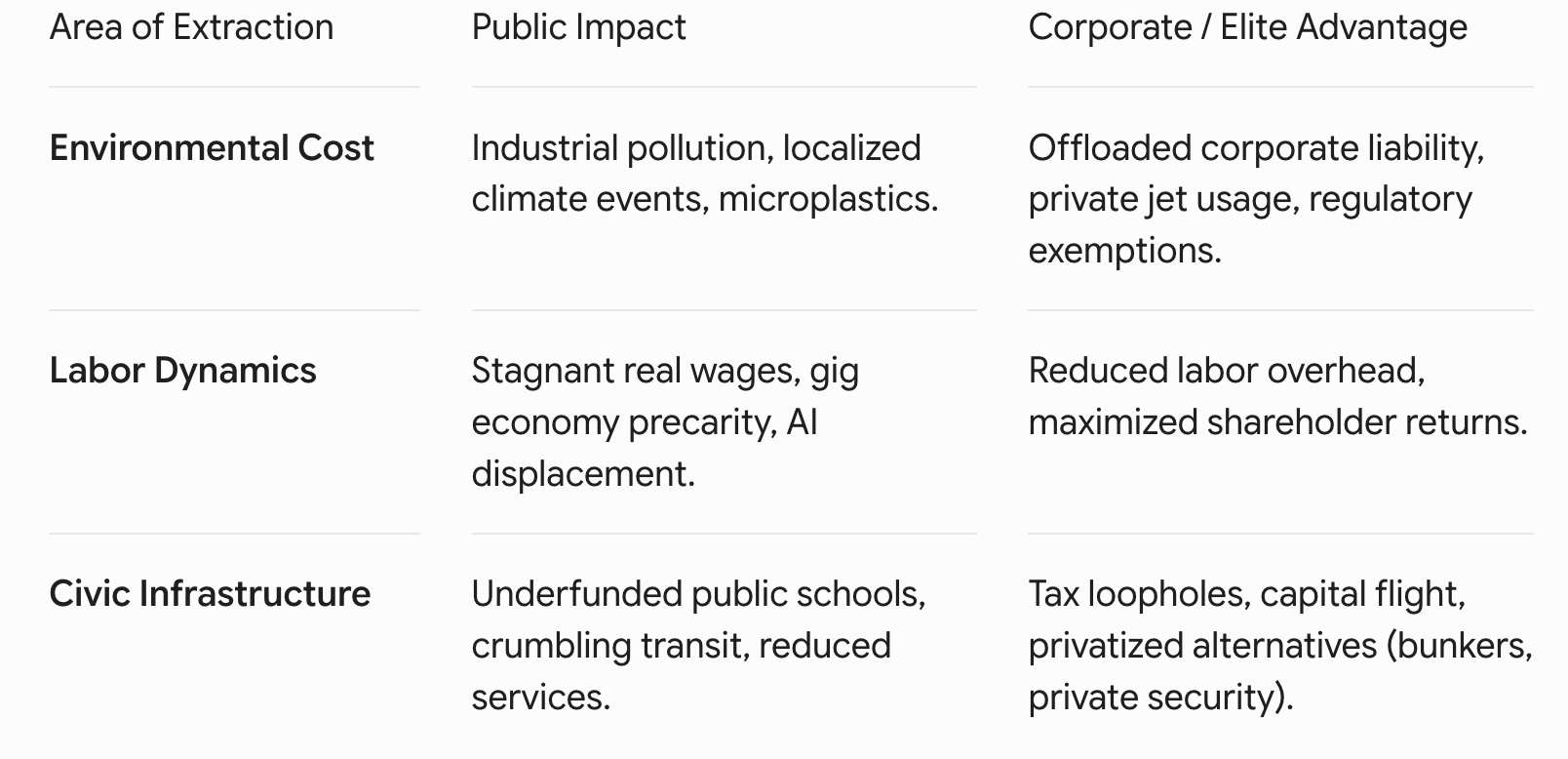
While the general public navigates inflation, food quality concerns, and economic volatility, the ultra-wealthy invest heavily in insulation strategies—from private security and elite enclaves to deep-underground bunkers and commercial space travel. The narrative of shared societal progress has been quietly replaced by an exit strategy for the hyper-elite.
The illusion that billionaire accumulation naturally translates into widespread public benefit is fraying. The promise that market deregulation and unchecked wealth concentration would eventually lift all boats has yielded an environment where essential human needs—healthcare, shelter, clean food, and stable employment—are increasingly out of reach for average families.
Stopping this cycle requires a fundamental shift in perspective:
Rejecting Wealth Worship: Cease evaluating human worth, genius, or leadership capability through the lens of net worth or social media reach.
Recognizing Structural Extraction: Understand that massive wealth concentration is rarely the result of pure individual effort, but rather the product of deliberate policy choices, tax structures, and systemic extraction.
Demanding Accountability: Redirect political and social energy away from divisive cultural battles and back toward structural reform—rebuilding labor protections, funding public goods, and establishing meaningful corporate and financial regulation.
The era of applauding the spectacle while our civic foundations crumble must come to an end. It is time to stop eating the breadcrumbs of celebrity culture and begin demanding a society designed for human flourishing rather than elite accumulation.
Comments
Nothing yet. Say the first thing.
Sign in to join the conversation.