
Greetings to all,
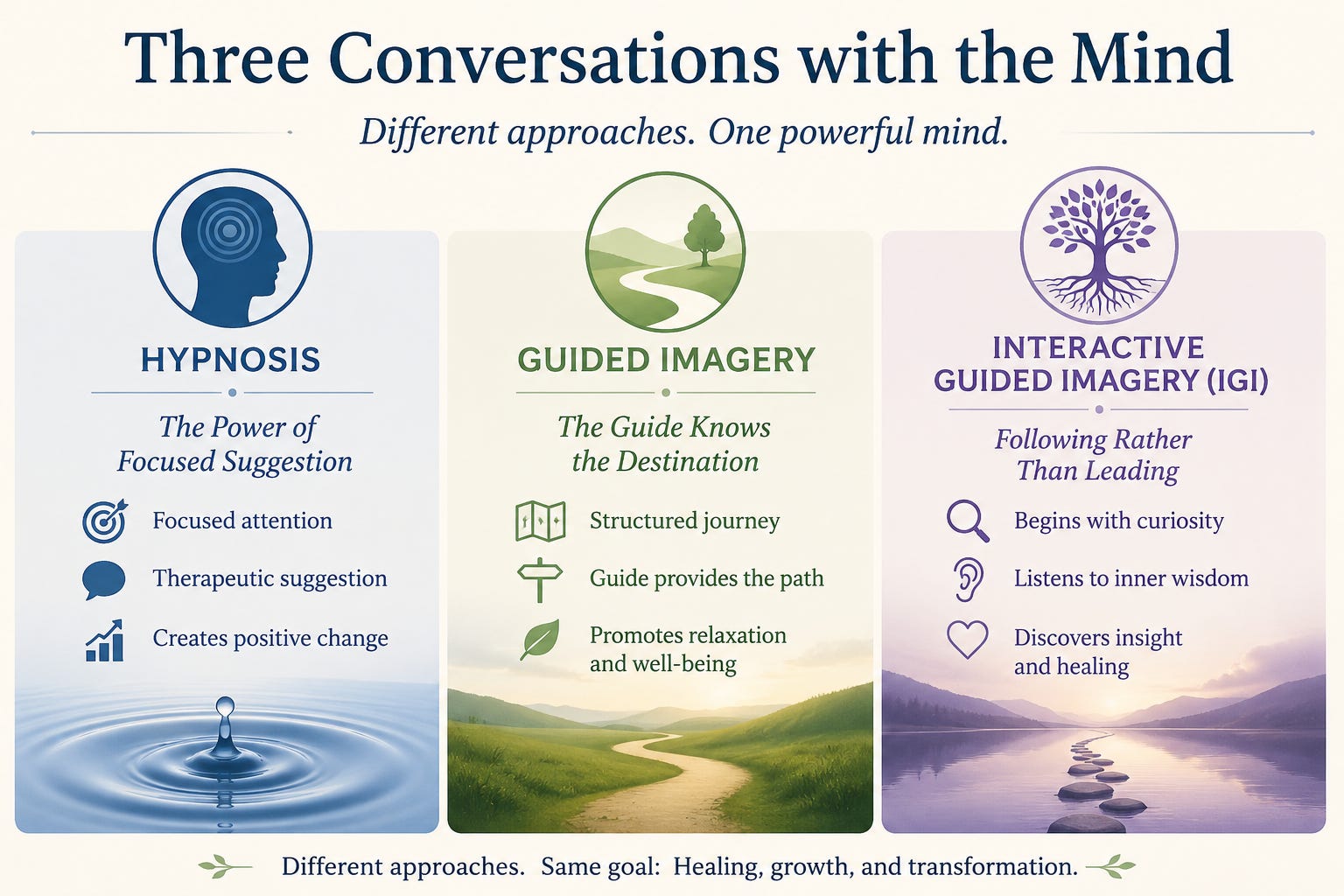
Hypnosis, Guided Imagery, and Interactive Guided Imagery all share several important characteristics.
They all:
• use relaxation
• involve the imagination
• can produce profound change
Yet after studying and practicing each of them over the years, I’ve come to see them as three distinct conversations with the mind.
One primarily suggests and directs.
One gently leads.
The third primarily listens.
Before talking about techniques, it’s worth remembering something fascinating:

Our minds naturally think in pictures.
Athletes mentally rehearse races.
Musicians imagine performing before walking onto the stage.
Architects visualize buildings before drawing them.
Children naturally create imaginary worlds.
Mental imagery is something we already do every day.
These approaches simply use that natural ability intentionally.
Hypnosis uses relaxation and imagination, and adds another important element:
Suggestion.
The hypnotist helps the mind become highly focused and receptive to new possibilities.
Suggestions may involve changing habits, reducing fears, increasing confidence, managing pain, or strengthening motivation.
Modern hypnosis has moved far beyond the myths of stage hypnosis.
In skilled hands, it can be an effective therapeutic tool.
The client remains an active participant rather than losing control.
Traditional guided imagery generally follows a prepared script.
The guide invites you to imagine peaceful places, healthy organs, successful performances, or desired outcomes.
The destination is known beforehand.
The guide provides the map.
This makes guided imagery especially useful for:
relaxation
stress reduction
performance enhancement
preparing for surgery
pain management
reinforcing healthy habits
Many excellent studies have demonstrated its effectiveness in these areas.
Interactive Guided Imagery takes yet another approach.
Instead of beginning with a destination, it begins with curiosity.
Rather than saying, “Imagine your pain disappearing,” we might ask, “If your pain could speak, what would it say?”
or
“If this symptom had a color... what color would it be?”
The guide doesn’t know where the journey will lead.
Neither does the client.
Together, they explore whatever unfolds.

When I began training with Dr. Martin Rossman and Dr. David Bresler in 1996—a journey that continues to this day—I was fascinated by one simple idea.
We didn’t need to assume we already knew the answer.
Sometimes the most powerful insights emerged from images neither the practitioner nor the client could have predicted.
Time after time, people uncovered symbols that reflected experiences uniquely their own.
That taught me something important.
The role of the practitioner isn’t always to provide answers.
Sometimes it’s simply to ask good questions.
Again and again I watched people discover insights that I never could have suggested.
Anxiety became an overworked guard dog.
Migraines became pressure cookers.
A stomachache became a frightened child.
Shoulder pain became someone carrying the weight of the world.
Were these literal?
No.
Did they often reveal something deeply meaningful?
Very often.
The unconscious mind has an extraordinary ability to communicate through images.
Beyond helping us understand what's going on, Interactive Guided Imagery often reveals a path toward healing—whether the challenge is physical, mental, emotional, or spiritual.
One of the greatest lessons Interactive Guided Imagery taught me was humility.
I learned that I didn’t have to be the expert with all the answers.
Often my role was simply to ask thoughtful questions...
...and trust that the client’s own mind knew where to go.
Sometimes the wisest guide is the one who speaks the least.
I sometimes think of them this way:
Hypnosis says,
“Let’s use focused attention to help create positive change.”
Guided Imagery says,
“Let me guide you toward a helpful experience.”
Interactive Guided Imagery says,
“Let’s discover what your own mind already knows.”
All three honor the imagination. They simply use it differently.
Modern neuroscience increasingly recognizes that the brain thinks in networks, patterns, memories, emotions, and imagery—not simply words.
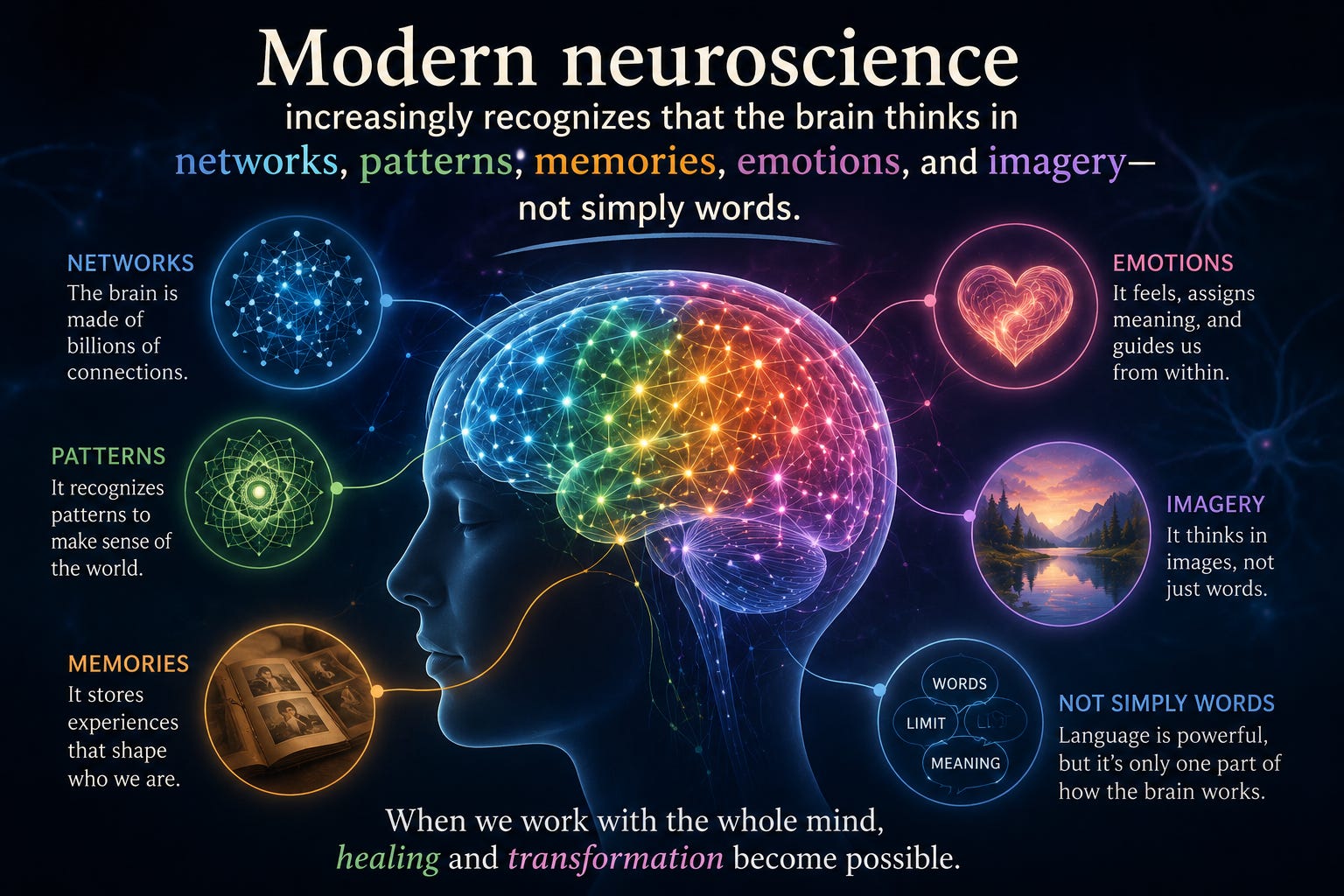
Images often reach parts of us that logic alone cannot.
That doesn’t mean every image has mystical significance.
Nor does it mean every symbol carries one universal meaning.
It means that each person’s inner world deserves to be explored with curiosity rather than assumptions
After decades of working with clients, I don’t see these methods as competitors.
I see them as different instruments in the same orchestra.
Sometimes people benefit from the calming structure of Guided Imagery.
Sometimes focused hypnotic suggestions are exactly what’s needed.
Sometimes the deepest transformation comes from allowing the unconscious mind to tell its own story.
The art lies in knowing which approach best serves the person sitting in front of you.
Perhaps that’s true outside the therapy room as well.
In a world where everyone seems eager to tell us what to think, there is something profoundly healing about learning to listen.
Maybe our minds have been trying to tell us something all along.
The question is:
Are we willing to hear what they have to say?
LIVE with PASSION, PURPOSE, and DELIGHT!
Danielle J. Duperret, ND/PhD — Bridging Science, Consciousness, and Human Resilience
📞Phone: 702-900-6730
📧 Email: danielle@healthwisdomacademy.com
🌐Website: Health Wisdom Academy
🎤Speaker Page: Speaking
📅Let’s Chat (Complimentary & Confidential): Schedule a Call
The Vault isn’t content. It’s mental fitness conditioning.
If you’d like to see what’s inside — and how it builds steadiness, resilience, and high-level mental clarity — you can
👉 Explore it here.
Paid Subscribers:
You should have received an email with instructions to access The Vault at no charge. Please check your inbox (and spam folder, just in case).
If you didn’t receive it, let me know and I’ll get you in right away.
Comments
Nothing yet. Say the first thing.
Sign in to join the conversation.