
Greetings to all,
We humans don’t particularly like “I don’t know.”
We prefer answers. Diagnoses. Labels. Explanations. Predictions. A clear cause followed by a clear solution.
We want to know what is going to happen tomorrow, next month, next year.
Certainty feels safe.
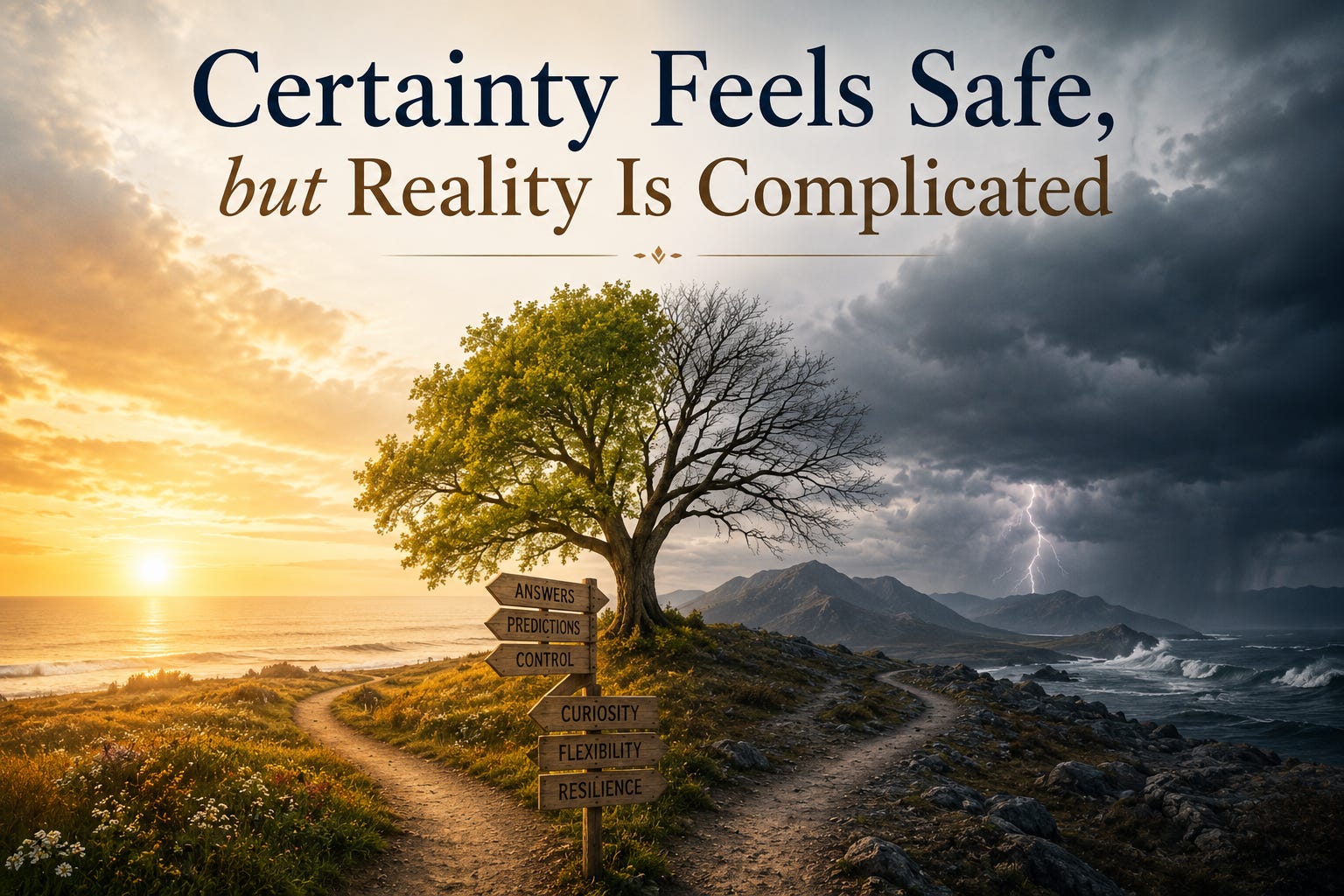
The problem is that life—and particularly the human body—is rarely that tidy.
Recently, I read a fascinating conversation between Dr. Pierre Kory and the writer known as A Midwestern Doctor. They were discussing something that went far beyond medicine:
Our difficulty tolerating uncertainty may push us toward rigid, black-and-white thinking.
That sentence stayed with me.
When I had my brick-and-mortar practice in California, I performed all kinds of tests with my clients: urine tests, zinc tests, saliva tests, stress tests, and others.
People loved them.
There was something reassuring about watching a color change or seeing a number appear on a piece of paper. Suddenly, something that had felt vague or subjective seemed measurable.
A number feels certain.
And medicine certainly shares our fascination with measurement. We test blood, urine, hormones, enzymes, antibodies, genes, heart rhythms, brain waves and just about anything else we can find a way to measure.
Sometimes those measurements are extremely valuable—even lifesaving.
But I learned something interesting from a nurse colleague of mine. Curious about the consistency of some of the tests we were using, she experimented on herself. She repeated the same tests at different times of the day and on different days.
The results changed.
Of course they did.
The human body isn’t a static object. Hormones fluctuate. Hydration changes. We eat. We sleep. We exercise. We become stressed and relax again. Our internal environment is constantly adjusting.
Then there is another layer: interpretation.
I remember a physician I worked with pointing out that even an apparently “objective” laboratory result might be interpreted differently depending on whether the physician looking at it had been trained in the United States or Germany.
The number may be objective.
What the number means is not always quite so objective.
That doesn’t make testing useless. Far from it.
It simply reminds us that measurement is information—not necessarily certainty.
And perhaps that is where some of our trouble begins.
We feel safer when something has been measured, named and placed inside a reference range. But the living human being sitting in front of us is considerably more complicated than the number printed beside their name.
There is actually a term for this: intolerance of uncertainty.
It describes the difficulty some of us experience when we don’t know what is going to happen—or when we don’t have enough information to reach a definite conclusion.
And perhaps there is a progression worth considering:
Uncertainty → discomfort → search for certainty → rigid thinking → black-and-white conclusions
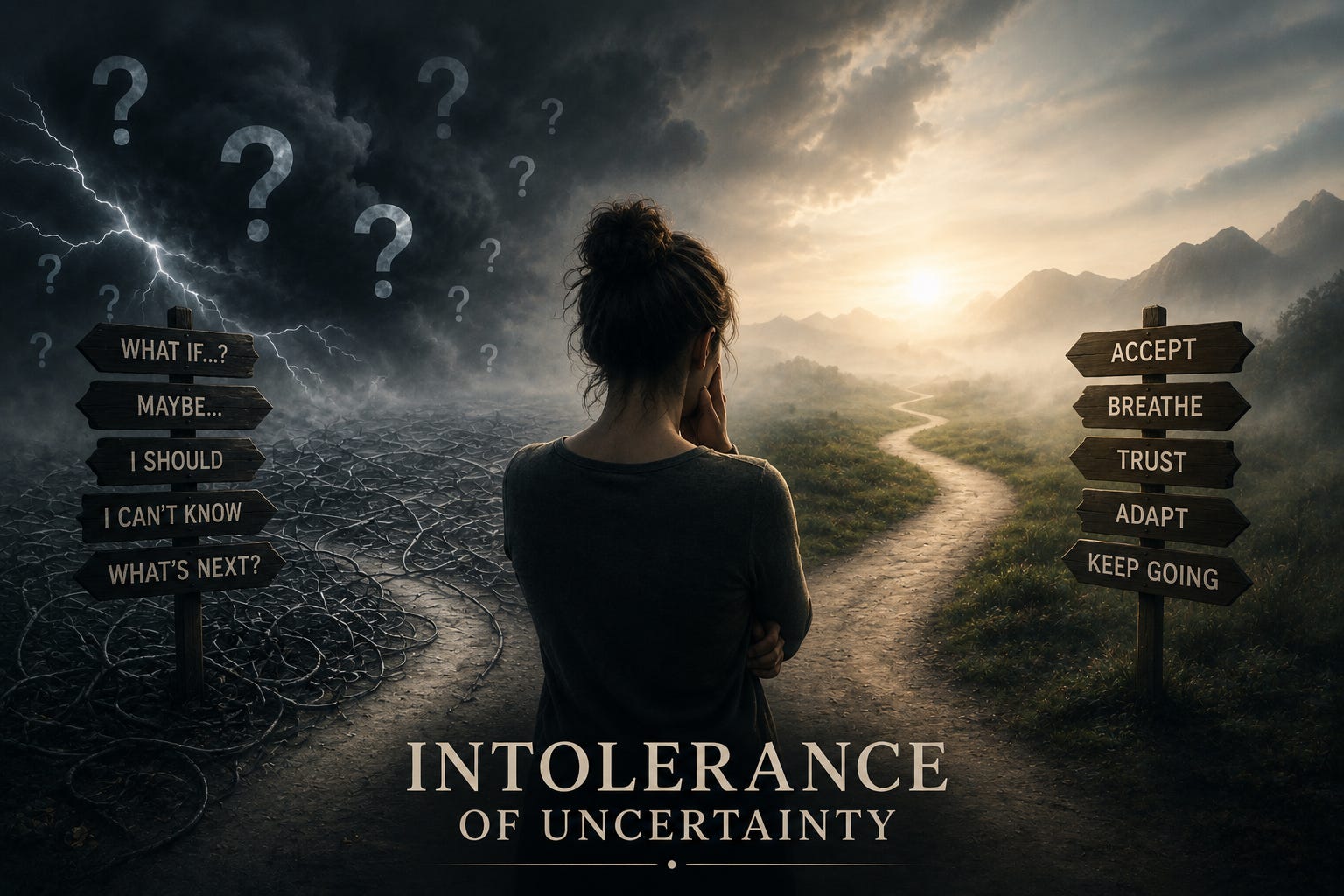
When uncertainty becomes intolerable, nuance itself can begin to feel threatening.
“I don’t know” sounds unacceptable.
“It depends” sounds evasive.
“Perhaps” sounds weak.
We want an answer.
And once we have chosen an answer, information that challenges it can feel threatening rather than interesting.
We begin dividing the world into categories:
Right or wrong.
Good or bad.
Safe or dangerous.
Conventional or alternative.
With us or against us.
But reality rarely cooperates with such neat divisions.
One story from the interview particularly caught my attention.
Dr. Kory described teaching physicians in the ICU. He told them that when he asked a question, they were allowed to answer:
“It depends.”
But there was a catch.
They then had to explain what it depended upon.
What variables mattered?
Why did they matter?
What might happen if they chose one intervention rather than another?
What information didn’t they have?
Suddenly, “It depends” wasn’t a way of avoiding an answer.
It was an invitation to think.
And isn’t that particularly important when dealing with the human body?
Two people can receive the same diagnosis and yet be very different people.
The same food may nourish one person and make another miserable.
A treatment may be lifesaving in one situation and inappropriate in another.
Conventional medicine can perform miracles in some circumstances and fail us badly in others.
Alternative approaches can offer valuable insights without every alternative claim being true.
Holding both sides of those statements requires something increasingly rare:
the ability to tolerate uncertainty.
This distinction is important.
Accepting uncertainty doesn’t mean sitting on the fence forever.
We still have to make decisions.
We gather the information available to us. We consider our experience. We listen to knowledgeable people. We listen to our own inner wisdom.
And then we make the best decision we can with what we know today.
Tomorrow, we may learn something new.
And if we do, we can change direction.
Changing our mind when new information becomes available isn’t necessarily weakness or inconsistency.
Sometimes, it is wisdom.
Living in the United States for many years, I have been fascinated by the emphasis placed on goal setting.
What are your goals?
Where do you want to be in one year?
Five years?
Ten years?
What is your plan?
Goals can certainly be useful. They give us direction. They can motivate us to take action.
But I sometimes wonder whether our fascination with goals also reflects our discomfort with uncertainty.
We don’t simply want a direction.
We want a map.
Preferably with the destination circled, the route highlighted, and an estimated time of arrival.
Life does not work that way.
Working for Omega, Switzerland
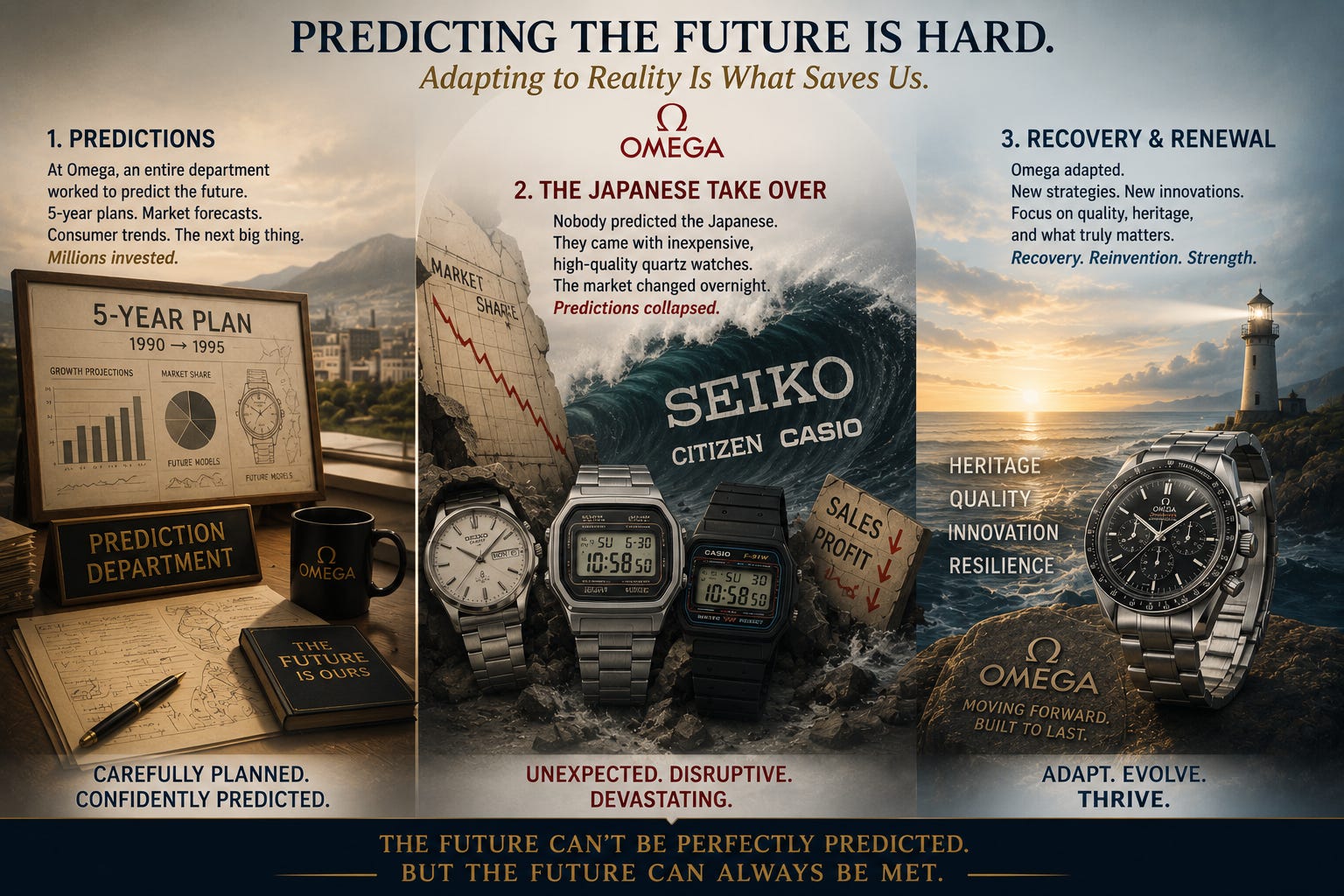
When I worked for Omega in Switzerland, the company had an entire department devoted to predictions.
Their job was to anticipate where the company would be five years into the future: what kinds of watches people would want, what the market would look like, where demand was heading, and how the company should prepare.
A tremendous amount of time, expertise and money went into those forecasts.
There was only one problem.
Nobody had predicted the Japanese.
Japanese manufacturers entered the market with inexpensive quartz watches, dramatically changing the watch industry and rendering many of those carefully constructed predictions obsolete.
Millions had been spent trying to predict the future.
But the variable that changed everything wasn’t in the model.
That’s the trouble with five-year plans. We make them using what we know today.
We can extrapolate trends. We can study consumer behavior. We can build sophisticated models.
But how do we put into our spreadsheet the invention that hasn’t been invented yet?
The war that hasn’t started?
The person we haven’t met?
The diagnosis we haven’t received?
The opportunity we don’t yet know exists?
Perhaps goals are useful as compasses rather than contracts with the future.
Omega survived that upheaval. The Swiss watch industry adapted. In other words, the prediction failed, but adaptation remained possible.
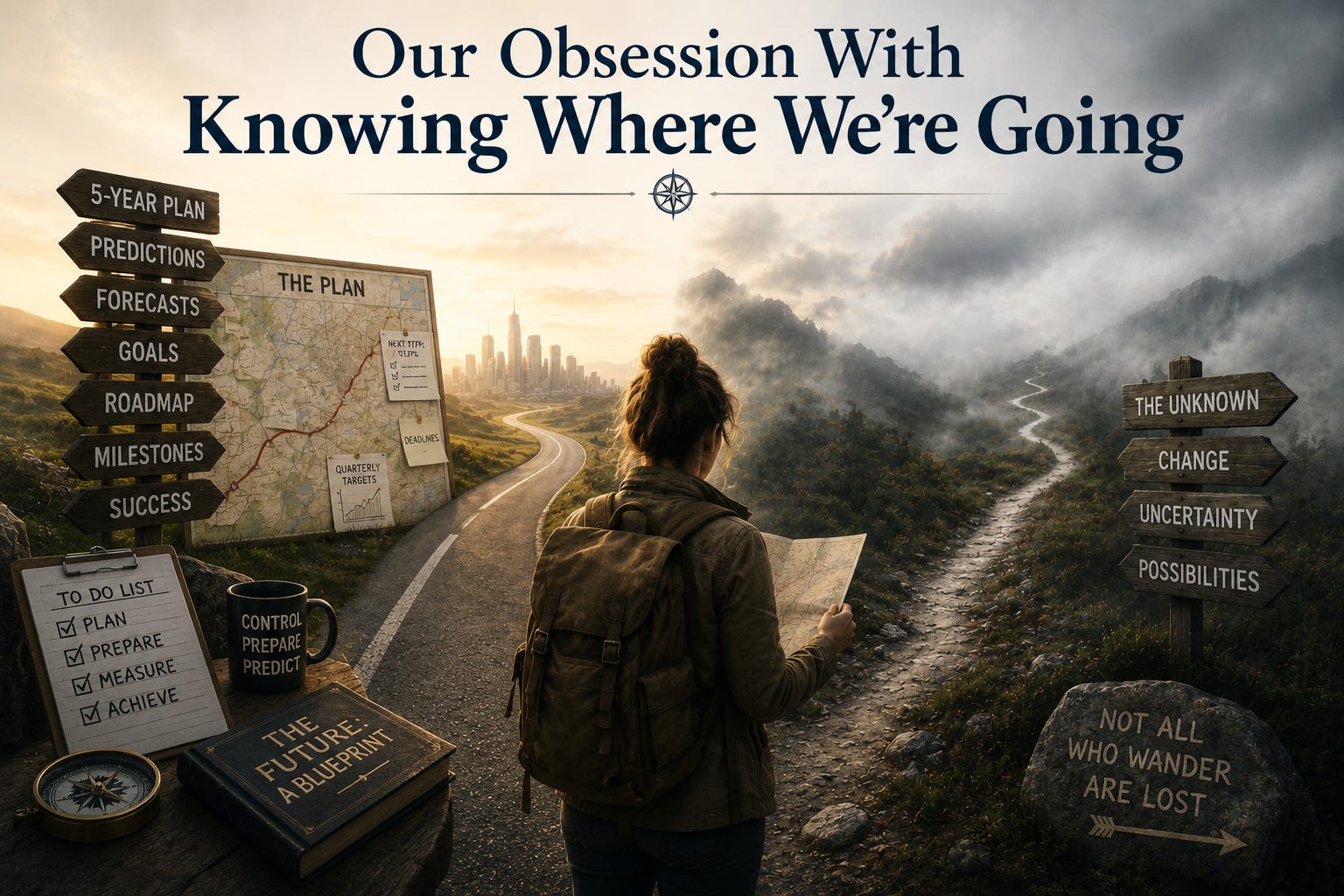
Perhaps there is a difference between having a direction and knowing the destination.
A mountain climber may know which mountain she wants to climb.
But the weather changes.
Trails wash out.
The body gets tired.
The planned route may become impossible.
Sometimes we have to turn around.
Sometimes another route appears.
And occasionally, we discover that the mountain we thought we needed to climb wasn’t our mountain after all.
I experienced uncertainty very differently recently.
Like hundreds of thousands of people around the world, I followed Jackie and Shadow, the famous bald eagle pair from Big Bear Valley.
When Jackie disappeared, we waited.
Was she simply somewhere out of camera range?
Was she injured?
Would she return?
Was she still alive?
For days, people searched for clues.
We wanted an answer because not knowing was painful.

Then we learned that Jackie had been injured. She was rescued and transferred to the Ojai Raptor Center in Ventura County, where she received specialized, round-the-clock veterinary care.
And so began another period of uncertainty.
She was sick.
She improved.
Then she declined.
Then there was hope again.
We watched. We waited. We hoped.
Eventually, we received the answer none of us wanted.
Jackie was gone.
And now another uncertainty has begun.
What will Shadow do?
Will he remain in the area?
How long will he grieve?
Will another female eventually appear?
Will he accept her?
We don’t know.
And perhaps that is one of the lessons nature continually offers us.
We want to know the next chapter before nature has written it.
But nature doesn’t operate according to our timetable.
Neither does life.
Look around us.
Will another war begin—or end?
What will happen to fuel prices?
Will food prices continue rising?
Will there be shortages?
What will artificial intelligence change?
What will happen politically?
What will happen economically?
What will happen to our health?
We can spend hours reading predictions.
And remarkably, many people making those predictions speak with absolute certainty.
One expert tells us disaster is coming.
Another assures us everything will be fine.
Perhaps neither knows.
Yet uncertainty makes us uncomfortable, so we may gravitate toward whoever sounds most certain.
And that may be precisely when we need to be most careful.
Confidence is not the same thing as accuracy.
Maybe our challenge isn’t to create a world in which uncertainty disappears.
We can’t.
And perhaps our challenge isn’t to predict everything that will happen so that nothing can surprise us.
We can’t do that either.
Maybe we need to move the source of our security.
Instead of asking:
“How can I know what is going to happen?”
perhaps we can begin asking:
“How can I become better able to meet whatever happens?”
That is a very different question.
We cannot be certain what governments will do.
We cannot be certain what markets will do.
We cannot be certain what our bodies will do.
We cannot be certain what Shadow will do.
But we can develop greater confidence in our capacity to meet what comes.
That isn’t the same as saying:
“Everything will be fine.”
We don’t know that.
It means:
Whatever comes, I will meet it with the resources I have. And if those aren’t enough, I will learn, adapt, reach for help, change direction, and keep going.
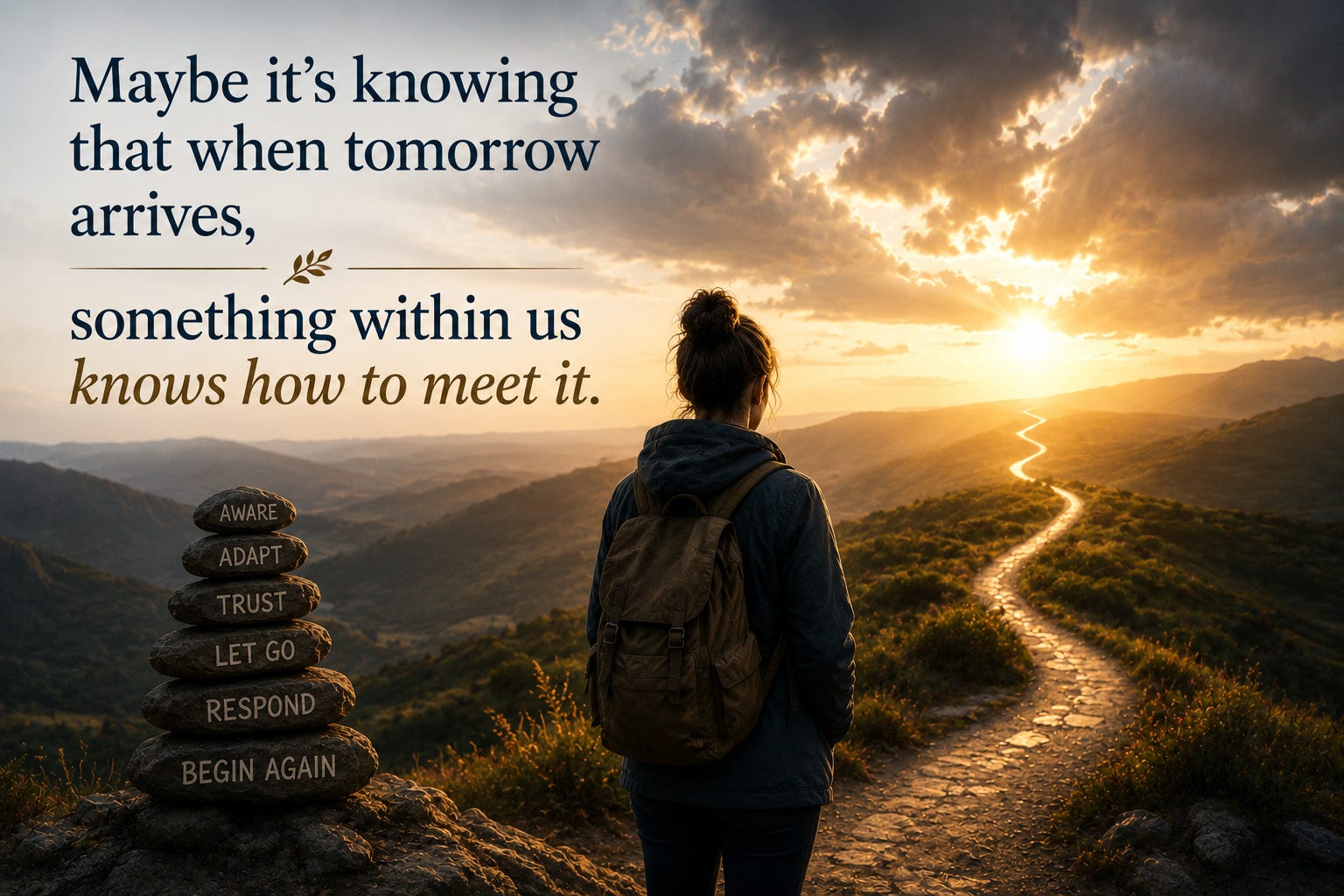
That is resilience.
Human beings have survived wars, migrations, bereavement, illness, lost fortunes, shattered dreams and enormous cultural upheavals.
We grieve.
We adapt.
We learn.
We change direction.
We begin again.
Perhaps that is where our real security lies.
Maybe the certainty we need isn’t knowing what tomorrow will bring.
Maybe it’s knowing that when tomorrow arrives, something within us knows how to meet it.
LIVE with PASSION, PURPOSE, and DELIGHT!
Danielle J. Duperret, ND/PhD — Bridging Science, Consciousness, and Human Resilience
📞Phone: 702-900-6730
📧 Email: danielle@healthwisdomacademy.com
🌐Website: Health Wisdom Academy
🎤Speaker Page: Speaking
📅Let’s Chat (Complimentary & Confidential): Schedule a Call
The Vault isn’t content. It’s mental fitness conditioning.
If you’d like to see what’s inside — and how it builds steadiness, resilience, and high-level mental clarity — you can
👉 Explore it here.
Paid Subscribers:
You should have received an email with instructions to access The Vault at no charge. Please check your inbox (and spam folder, just in case).
If you didn’t receive it, let me know and I’ll get you in right away.
Comments
Nothing yet. Say the first thing.
Sign in to join the conversation.