
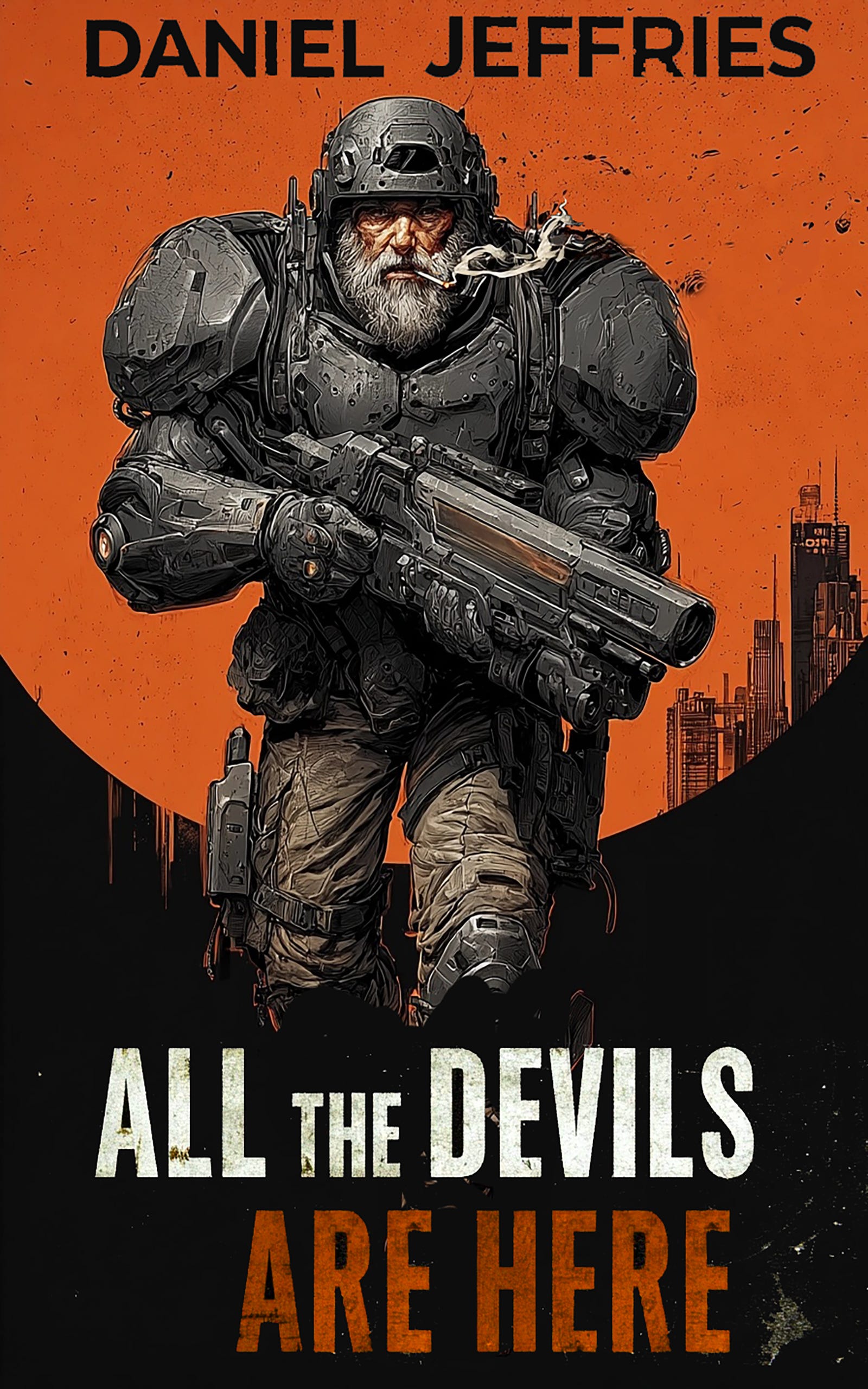
I wrote a near-future sci-fi action thriller last year. Haven't had a second to talk about it because I've been so busy but I figured it was high time to get to sharing. You’ll find the first few chapters free below. If you like it, I hope you’ll snag a copy on Amazon.
TLDR?
It's called "All the Devils Are Here" and here's the jacket blurb:
It's 2056 and Commander Johnston Richter is the head of the last remaining spy agency in an America shattered by a second civil war, charged with keeping the country safe from the worst extremists. He leads a motley band of hackers, AI whisperers and former black ops soldiers gathered from around the world. Now a terrifying and charismatic madman and former preacher wants to finish America off with biblical fire. But in the race against time, with advanced AI accelerating both the hunt and the madman's dreams, is it already too late to stop the apocalypse?
It's a book that looks more and more like our new reality every day: Drone warfare. Powerful AI. Populism. The death of the Pax Americana at the time when it's needed more than ever. Polarization that rips countries apart and the aftermath of it all.
And it's about how AI will save us and fail us at the exactly the same time.
I hope you enjoy it.
############################################################################
“Hell is empty and all the devils are here.”
William Shakespeare, The Tempest, Act 1, Scene 2
Year 2056
Free Republic of Texas
“I want answers!” said Commander Johnston Richter.
He didn’t shout, but the force of a tsunami powered his every word.
He was a big, intense man, a cattle rancher, with a rough-hewn face, a giant black hat like in old movies, and a usually tightly trimmed beard that had gone wild over the last few weeks. He glared at his team with fierce blue-grey eyes that sliced through people like a saber.
“Do you understand me? Find me something!” he said. “Find me something before someone shoots up a protest rally with explosive tipped rounds or poisons a bunch of schoolchildren just because God Himself came down from heaven and told him that was the best way to stop anyone ever getting an abortion again. Get moving.”
“Yes, sir,” came back a chorus of voices, their faces floating in holographic light.
Richter rubbed his eyes. He hadn’t slept in days. He was worn out, angry, and on edge. He almost didn’t recognize the haunted, hunted-looking face that reflected back at him in his big living room window. But he wouldn’t let it stop him.
“We have five goddamn days left. Five days before an attack is supposed to happen. We are running out of time.”
“Sir, the leads are where we need to keep looking. Bertha is right,” said Michael Watson, his top analyst and AI whisperer. The thin, dark-skinned man with the big glasses could take even the most obscure and incomplete output from one of their prediction clusters and make sense of it when few others could.
“We’ve been over the leads already. They’re getting us nowhere. Get us new leads. That’s your job, ain’t it?”
“The X-55-X thinks that these leads are the heaviest probability to lead to the attack—”
“I don’t care what Big Bertha thinks because so far, what she’s given us is garbage. So look somewhere else. Get creative. Find something that goddamn AI soothsayer missed. We’re talking a level five attack here. That means big. Very big. Lots of people hurt or dead. Level five. As in, gas attack, germ warfare, nuclear, biological. Power grid out for months. Food supply sabotaged so 100 million people starve. Level five. Get it through your heads.”
Big Bertha, aka the X-55-X, was their biggest prediction supercluster, able to see major societal-level events like riots, wars, political upheavals, and terror attacks weeks in advance. Bertha caught things their smaller clusters missed. It found needles in a haystack. It was running on a massive array of 1,024,000 top secret customized neuro procs, designed and manufactured in secret by a collaboration between the top three private chip makers. The cluster was classified, so it didn’t appear on any list. If it were allowed on the international supercomputing top 100, it would have smashed the competition, coming in just behind whatever monstrous surveillance and population control clusters China had buried under the sands of the Gobi Desert in massive, secret mega-datacenters that helped them keep their boots on the throats of their billion plus people.
There was just one problem. Big Bertha didn’t say: “Here’s where everything is going to happen, go arrest these people or put sandbags on this dam, or make sure the manhole covers are taped real good when Senator So and So comes to town.” It gave a probability of an event, the likely range of when it would happen, sometimes the generalized area, and a partial list of potential suspects to chase down, but not what they were suspected of and what they were planning to do. Sometimes it had sharper predictions and suspect profiles as it called out hyper-specific events like a rally, demonstration, or war with a clear buildup of troops on the border of a country. But terror events were harder to pin down to exact predictions, and that left Richter and his team hunting down leads while simultaneously trying to figure out what the hell they were looking for in the first place.
“We’re chasing ghosts here. Again,” said Desmond J.T. Dodd, a heavily tattooed ex-Navy SEAL gearhead, and also Richter’s tech lead and top drone operator. He looked exhausted, and if he was exhausted, everyone else was running on fumes because Dodd was in the best shape of any fifty-year-old Richter had ever seen. Richter looked around at all their faces and saw baggy skin, puffy eyes, people wearing the same clothes that they were wearing who knows how many days ago, faces that hadn’t seen a razor in weeks, and hair that hadn’t touched a brush in just as long.
Richter let out a deep breath. “Look, I know we’re all tired. I’m tired. But this is the job. It’s what we do. If we don’t do it, it doesn’t get done, and nobody here wants another Black Thursday because we all need to sleep.”
Everyone groaned.
Black Thursday almost broke Richter’s team. His org, the ISRRO, or International Special Reconnaissance and Response Organization, was built to do one thing: stop attacks and disasters before they happened. It was an impossible task, and Black Thursday came at the end of a series of ISRRO screwups and missed attacks, including a massive riot that got a senator killed along with six police officers, a school massacre that saw seventeen teens dead, and a mass candy poisoning campaign that killed fifty-seven children on Halloween.
Black Thursday was the icing on the cake. It burned bright in all their minds. A homegrown terror cell managed to unleash dirty bombs on New York, Texas, and Florida that contained a weaponized COVID that had a thirty percent fatality rate. People called for their heads, and multiple congresses tried to shut them down and pull their funding. Even worse, their predictive clusters had flagged five of the attackers as potential threats. The team had investigated them, sometimes two or even three times, and found nothing.
They’d put Richter on an inter-congress show trial and nearly put him in jail.
The only thing that saved the ISRRO was the COVID bomb failing to trigger properly in Florida and a genetic quirk that saved the outbreak from going worldwide. Mutations in the virus made it highly contagious but also more likely to die out in a flash. It made people bleed out of their eyes and nose too, so sick people were easy to spot, which meant everyone stayed the hell away from them, which kept the virus from spreading like wildfire. If it had become a major pandemic that swept the globe, they wouldn’t have arrested Richter: They would have put his head on a pike in the town square like justice in the ancient world. Mass death and destruction had a way of reverting people to their roots.
In other words, they got lucky after fucking up bad.
Politicians preferred to sweep it under the rug rather than keep the show trial going once the rage fizzled out on social media and the news streams. In the end, the furor died down to a low drone, and Congress secretly beefed up ISRRO funding with black budgets, but the event had scarred everyone on the team, Richter most of all.
“Everyone get some sleep,” said Richter. “We need to be fresh. We all look like shit, and we’re not thinking clearly. Sleep in rotations. I’ll take the last shift. I want you ready to find me something new in the morning. Find something we missed. We need answers. I know you can find them. You will find them. That’s all.”
He ended the meeting, and everyone looked relieved as he swept the holographic feeds away.
And suddenly, he was alone on his ranch. He fixed himself a drink from his old hand-carved bar to calm down. It was the first drink he’d let himself have in three weeks.
He walked to his window and looked out over his cattle fields as the sun died in a spasm of red, orange, and gold over the Davis Mountains. His twenty-acre ranch sat right in the middle of a rolling green and gold valley between the big bosom of the craggy mountain range in Withers, a small village in Jeff Davis County, in the great and free Republic of Texas, population 2,312.
Actually, 2,311 since old Doc Jameson had died last year, age 103, fitter than any man had any right to be up until the moment he died.
Richter swirled his whiskey slow and sipped it. The Lagavulin had a deep, peaty scent that saturated his throat as it went down smooth and clean with the faintest hint of burn. Off in the distance, a swarm of shepherd drones were rounding up the last of the cattle and putting them in their pens for the night. Three of the dog-like machines raced around one of the animals, and he didn’t even need to zoom in with his augged eyes to know which one it was.
Betty Lou Benson, aka X19923100678 in the international Wagyu blockchain property registry. His favorite cow and the most stubborn. Maybe that’s why he liked her so much. She didn’t always do exactly what she was told. He’d had her imported from one of the four Japanese lines that had come from mixing indigenous breeds with European cattle in the 1940s.
His eyes zoomed to 10x magnification, and he watched as she battled away two of the dogs with her snout and kept right on grazing on the genetically engineered feed grass that gave her perfect nutrition. The dogs galloped around her, their “heads” flashing with calming lights. She ignored them and finished eating.
“Always causing trouble, girl,” he said with a little smile.
He took another long and slow sip and checked the glass to make sure he wasn’t going too fast. He’d kept to a strict one drink a week maximum for the last decade, and he intended to keep it that way. After the war, he used to hit the drink hard until it got out of control and he’d almost lost the ranch and everything else. He knew he’d have to chase the damn drink with coffee, but for the next half hour, at least he could enjoy it. All he had to do was make it last.
Doctor Jameson had owned the ranch next door. One of the old man’s emergency security drones spotted an alcoholic Richter face down in his fields a decade back, and it swooped down and airlifted him to one of the old man’s medical pods. The pod nursed him back to health with three automatic IVs, smoothly swapping in one after the other with its robotic arm, its needle insertion routine faster and gentler than any human phlebotomist could hope for with twenty years’ practice. Richter woke up in a surgery bay at the back of the good doctor’s property, wondering how he got there.
The old man had built a fully functioning private hospital with his own hands, assembling it from parts and bringing in top-of-the-line machine learning–driven med machines. He even had a fully automated surgery pod that could perform over 200 different kinds of basic surgery and adjust to emergencies. It wasn’t good enough to trust on its own yet, but with a real doctor close by or via redundant satellite and fiber feeds, it was an amazing machine that took most of the danger out of routine procedures. The robot had a steadier hand than ninety-nine percent of the surgeons on the planet and with a small nuclear battery it could stay online for fifty years. The doc had it in his house before the local hospital, which had caused some consternation down there and led to it receiving some emergency funding to catch up to the embarrassment of a private citizen with better equipment.
“Son, it’s time you listened to me,” Doc Jameson said after Richter woke up, bleary-eyed and hurting everywhere. The doctor’s intense eyes glared at him from his onyx-black face covered with a brilliant white beard. “If the drone done take you to state hospital, you wouldn’t’ve made it. You’d a died on the way. You understand what I’m saying to ya? Because I’m not messing around here.”
“Yes, sir.”
“You keep this up, and I’ll have your body hung out back in the freezer next to one of your fantastic steaks inside of a few months. That what you want?”
“No, sir.”
“Then get your goddamn act together, boy. I ain’t got time to be saving everyone, and you’re better than this.”
And that’s exactly what Richter did. He woke up and changed his life.
Richter raised his glass to the old man as the drone swarm managed to wrangle Betsy back into her stable.
“Thanks, Doc, for showing me what I couldn’t see myself.”
The sky turned a shade of red and gold that was primordial and almost divine, but he couldn’t enjoy it. Despite the beauty of this place, the riptide of anxiety threatened to pull him under. What if you miss it again? What if it’s not even real and we’re all just chasing nonsense? Chasing shadows? Don’t even know what to believe anymore.
Big Bertha had popped out a series of 376 possible leads for his team to track down, and they’d spent every day working around the clock to get to all of them. They were everything from shell companies, to strange banking and blockchain transactions, to entire encrypted chat and dark web logs, to suspects to interrogate.
And they were all absolutely nothing but dead ends with five days to go before the attack was supposed to hit, and maybe not even that because the attack dates were always the weakest part of Bertha’s predictions. It could be in three weeks, three days, or three months. They wouldn’t know until they caught someone and stopped an attack dead in its tracks or if the attack happened and they saw it on the news like everyone else.
Watson and his analysts hadn’t found anything in the transactions, the shell companies, or the messages, even with ambient helper AI working with them side by side. Both human and computer intuition were failing him.
When it came to suspects, half of the leads were nothing but the usual suspects that Richter wished he could rendition and take off the board for good, but who were still out there making his and everyone else’s life miserable: former criminals, skinheads, killers, hackers, cult leaders, disinformation psychotics who believed their own insanity, activists, and some rogue raging journalists.
But the other half was worse. They were a waste of time. Time he didn’t have.
There was the baker out of Alabama whose only problem, as far as Richter could tell, was smoking too much dope while he baked brownies all day and sold them out of the back of his truck. There was the second-rate author churning out an action novel about terrorism that somehow got scooped up with real threats, even though he was writing fiction. The damn large thinking models, LTMs, sometimes didn’t understand context or nuance all that well. The worst was an old lady, ninety-three years old, ninety-freaking-three, who Bertha flagged as a threat despite the fact that she was partially blind, was on at least a dozen medications, had a robotic seeing eye dog, and robotic leg braces to help her walk.
Is that damn machine even working anymore?
Watson told him Big Bertha was constantly retraining on new data. It was a “continual learner.” There was a possibility that corrupt data or a bad update from the algorithm team made it a little crazy and a lot less reliable, but they could always roll back its mind state. Watson only put it at a three percent possibility that Bertha was having a serious breakdown after reviewing all the logs with his own AI, automated recursion tests, and some brute force checks. And the other AIs said it was still functioning right. AI monitoring AI. Richter shook his head. They couldn’t be sure of anything anymore. The models were too complex and had too many parameters to interrogate fully, even with explainability submodules. Most of the top models had hit 100 quadrillion parameters with quintillions of connections. Then again, what person could explain what they did or why? We expect more from machines than we do from ourselves. But if Bertha wasn’t crazy and he missed something again, a level five no less, it would be the end for his team.
He didn’t want the team broken up, not because he was afraid of losing his job or even going to jail. It was that the world was a lot better with them in it. Regular people led better lives because of all the horrors his team stopped before they ever happened. They went about their days having narrowly dodged death or getting mangled by a fanatic’s bomb, and they didn’t even know it. Ignorance was bliss. For every incident they’d missed over the years, they’d caught dozens of hijackings, bombings, murders for hire, mass white-collar fraud and robberies, riots, and assassinations, stopping them cold.
He envied regular people. Envied not knowing about the hidden underbelly of horror in the world.
What we do matters. It does, goddamn it. Even if we’re the only ones who know it. And that was the problem sometimes. Nobody knew it. The public only saw their failures. Nobody notices when we do it right. The bad guys only had to score once, and he had to play perfect defense every time. The wins were classified. The losses were public fiascos.
It was Richter’s team’s job to stop bad things from happening, and if they were gone, there was nothing. The average person didn’t know just how thin the wall was around their happy little lives.
The ISRRO were the only ones who could stop something from happening because they were the only organization with the legal right to operate in any of the countries that made up the shattered United States. After the second Civil War, the US had broken into a series of smaller substates with a loose affiliation, still nominally called the United States but united in name only. The US was a ghost of its old self. Some folks called it the US, but just like many smaller empires took the name Rome after its fall, it wasn’t really the Rome of old.
Instead of a strong central government, they were now nothing but a loosely knit confederacy of smaller countries who could veto any centralized dictums and decrees. But that left a lot of overseas bases, military equipment, nuclear material, and more up for grabs. With no central authority to effectively maintain it all, everything started falling into the hands of foreign governments and nasty groups across the US that wanted to do some damage, now had the means to do it.
They’d failed to get a proper alliance going for two years after the Civil War, even as China, along with Russia, an Egyptian junta, the Democratic Republic of the Congo, and half the fractured nation-states of Africa, annexed dozens of overseas US airbases, but an attack at home was the catalyst they needed to take action. A failed uprising of southern farmers and autonomous truck operators was put down only because the territories found a way to work together. It still left 5,000 people dead. But they’d gotten lucky. The pain led them to form the ISRRO.
A treaty authorized the ISRRO to legally conduct surveillance, arrests, and detainment, use lethal force, and conduct full-fledged military operations overseas and domestically—unlike the CIA of old-—under the banner of the United States, as well as in the Republic of Texas, the Coastal Republics (including the former states of California, Arizona, New York, Washington State, New Jersey, and Pennsylvania), the Confederate States with Virginia through Kentucky, out to Oklahoma, and on down to Louisiana and Florida, and to the great wasteland of former Midwestern states that had gotten decimated during the war and now had only a nominally working government of loose-knit tribal warlords fighting it out in the radioactive dust. All of them agreed that the ISRRO could operate with impunity across borders. It was the only organization that could in all the jurisdictions.
Richter gulped the last of his whiskey and was just about to go over reports from Big Bertha again when Michael Watson’s avatar appeared in the corner of his eye.
Richter blinked the call through.
“Tell me you got something, Watson.”
“I got something,” said Watson. The man’s cocoa-brown skin and soft eyes stared back at him, floating out in space in front of him, projected from Richter’s augged irises.
“And? Spit it out.”
“Well, I’m not sure if it’s what we’re looking for.”
Richter ground his teeth. The man was brilliant but overly cautious.
“I’m not asking you for a guarantee. I’m asking you if you got something actionable.”
“Yes, sir.”
“Well? What is it?”
“I think we want to look at these fifteen people again.”
An array of faces floated up across Richter’s inner vision. He squinted at them.
They were people they’d already checked out, some of them twice.
“Why? You got some new data? Something your ambients pulled up? Something in their files we missed?”
“No.”
“What then?”
“I’ve just got a feeling about it.”
It took Richter a second to get his head around that. Watson was as coldly data-driven as any person he’d ever met. He didn’t get hunches or feelings or sudden instinctual leaps of intuition. But one thing Richter never doubted was human ingenuity. Go with it. We need any chance we can get.
“Alright. Good enough for me. Let’s get it.”
Major Juanita María Álvarez stepped out of their car first, checking all around for threats the way she always did. Her wraparound, gold mirror shades glittered in the Detroit sun. The late summer heat hung heavy on her body, but it was already dipping as the sun came down. Like everywhere else, it had gotten hot in recent years, even in cold places like Detroit, the temperatures spiking to as high as ninety-five in July and August.
Two low-profile combat drones lifted off from the car’s roof like black manta rays and spread out, sweeping down the desolate West Side Industrial Park streets looking for danger.
Alvarez wore full skin armor under her sharply pressed, vintage 1940s-style blue pants and starched white shirt. The shirt’s built-in ribbon fluttered in the wind, making her look softer, elegant, and unthreatening.
But she was a hard, dangerous woman. The wind whipped her weather-beaten face, and she unconsciously flexed fists bigger than most professional cruiserweight boxers. One of her arms was full prosthetic, titanium and Kevlar. At five feet, two inches, she was a bulldog, stocky but powerful. Her wrist rifle looked like dark Mayan jewelry, but it fired smart rounds that could make minute adjustments in midair like miniaturized smart missiles.
She’d come to the team out of Mexico City, on permanent loan from the Grupo de Operaciones Especiales, the special police tactical unit of the Federal Police of Mexico. She’d come up battling cartels and street gangs who had no problem torturing and slaughtering an entire suburb to make the point that it was best to stay the hell out of their business.
“Clear,” she said.
“One minute. Finishing sweep,” said Master Sergeant Desmond J.T. Dodd, their drone master. The machines flew autonomously, but he could intercede if they did something wrong, like fly too close to a wire or get confused by strange terrain. The drones 3D-mapped the area as they went and fed back video of Labrosse Street and around the corners, down 8th, and all the way to Turnbull Street. It was a lot of old tract houses, half of them boarded up, abandoned, and falling down. It was getting late, and the street was dark.
The smell of burning gas saturated the air as generators hummed, working hard to give power to the houses that still had people living in them. This part of the city hadn’t had power in three weeks after a failure of the local power grid from dark red clouds descending on the city, filled with sand from the battered heartland. Rumors were running hot on the social streams that it was an attack by Russia or China, but Richter knew it was nothing but horribly aging infrastructure and nobody to run it. Since this was the West Side Industrial Park where only poor people lived, nobody was exactly scrambling to get it back online.
“Clear,” said Dodd, as the drones fed back maps to their virtual vision.
Richter stepped out of the car impatiently, wearing a dark blue suit with a soft pinstripe. Under it he wore a heavier but dynamically flexible ceramic vest made of reaction-bonded boron carbide and silicon carbide and bulletproof pants, but not full skin armor. This was the fourteenth suspect on the list. They’d interviewed the other thirteen again over the last day and a half, and he was tired and grumpy and on his third cup of coffee. He felt like the coffee must be some kind of trick coffee that evaporated before you ingested it because it didn’t seem to have any effect on him.
When he looked at who they were going to see a second time, he nearly turned and got back into the car.
It was Ma Bell Hunt, the ninety-three-year-old granny.
“You’ve got to be fucking kidding me,” said Richter.
“You want to skip this one?” said Álvarez. “¿Una pérdida de tiempo?”
His augged eyes translated the Spanish, but he blinked it off. Didn’t need it. He’d lived around Mexicans most of his life and spent some time fighting narcos in Mexico early in his career before the official end of the drug war. He closed his eyes for a second and then shook his head. “Yes, but we’re not going to. A la chingada. Vamos a ver.”
And two minutes later, they were knocking on Ma Bell’s door. Her medical drone ushered them into her living room for tea. The place was covered in tchotchkes of old windmills and owls. Doilies covered the windows and acted as coasters on old furniture that looked like it was on loan from the 1970s. The couch, covered in plastic wrap, was orange with a hideous green flower pattern. Richter sat down on the plastic, and it crinkled under him. Álvarez took up her post in the corner of the room, her back to the wall, away from windows, so she could see it from every angle.
“We’re sorry to bother you again,” said Richter. “We just have a few more questions.”
“Oh, it’s alright,” said Ma Bell. “It’s nice to have a gentleman caller. I don’t get many these days.”
Richter smiled but remembered she couldn’t see. She wore giant, Coke bottle–looking medical shades, with wires streaking back under her paper-thin skin. He wasn’t sure how much they gave her back her vision. Her robotic seeing eye dog was big and powerful but designed to look soft and gentle, a cartoonish imitation of a dog with big light-up eyes and floppy ears.
“And a nice smile too,” she said.
“I didn’t realize you could see that,” he said, grinning again.
“I see a lot of things. You don’t need eyes if you know where to look. But yes, I can see most shapes and some details.”
“That’s amazing. We’ve come a long way.”
“And not so far at all. But medically, it’s something I could have only dreamed about when I was a youngster. And that’s something, in’it?”
“Sure is.”
“How about some tea?” she said.
“Oh, that’s alright. I don’t want to put you out.”
“You’ll only put me out if you say no.”
“Well, then how can I?”
She got up slowly, as if she would topple over.
“Oh, I can fix it,” said Richter. “Just tell me where it is.”
“Nonsense. We’re meant to move in this life. You don’t have a reason to move, then life doesn’t have a reason for you to keep on living. I’ll get it just fine.”
It seemed like it took her a few minutes to stand, and she waved off his help. She doddered off to the kitchen. He could practically hear her legs creaking. He thought she might just go down right there, but somehow she made it to the kitchen, and he could hear plates and dishes moving around and cabinets opening and closing. A few minutes later he could smell the tea, and she brought it out one cup at a time, one for him, one for Álvarez, and one for herself.
He sipped the Earl Grey slowly, taking a moment to be thankful for it. It was weak, dust tea, the kind of crap they put in shitty Lipton bags, but it was good to have a brief moment of calm.
“This is excellent tea,” he said, smiling again.
“Thank you. I can’t take the stronger stuff anymore.”
A sheet of questions Watson and his team had designed popped up on Richter’s innervision. They were made to tease out answers they’d missed the first few times, as codesigned by his analyst team and Watson’s ambient AI that studied natural language and negotiation in tandem. But Richter looked at the questions and frowned. The sheet hadn’t given him anything as he questioned the last thirteen suspects, and he didn’t think it’d give him anything now, so he decided to go off-script.
“Tell me about your work before you retired,” said Richter.
“What are you doing?” whispered Watson in his ear.
He blinked back an answer with an eye gesture shorthand. “Trying something different.”
“Sir, we should keep to the script. It gives the pattern matchers a better baseline.”
Richter ignored him for now.
“Oh, me?” said Ma Bell, smoothing her dress over her legs, the legs encased in an exoskeleton that helped her walk. “I was a lot of things. When I was young, I was the secretary at my son’s school, and after that, I stayed home for a while as he was growing up. Later, I was an insurance analyst.”
“Interesting,” said Richter. “An analyst?”
“Yes, it was fulfilling work, if a bit tedious. My job was to figure out who was lying about their claims. When I started, I had very few things to go on but instinct. But later we had a lot of data from the machines. Too much, maybe, but I learned how to sift through it all, and it taught me things. I learned how to read people pretty good. There’s an art to it.”
“That’s impressive,” said Richter, taking another sip of the horrible tea.
“I was proud of it. I saved the company a lot of money, and they promoted me twice and gave me the president’s award too.”
“So you stopped fraud?”
“Yes, that’s right,” she said, smiling sweetly. Her hair was done perfectly, like she’d just been to the hairdresser. It was colored a light reddish blonde.
“What kinds of things did you look for to stop the bad guys?”
“Well, I’m betting you know a bit more about that than me in your line of work, young man. But I did learn a thing or two. You just sorta put together all kinds of things in your mind if you pay attention, and that gave me a little map in my head of what people were like. I can’t say for sure that it was this or that, but my brain just kind of put it all together, and I was good at it.”
“Instinct,” he said.
“Yes, you might call it that. As good a word for it as any.”
“A bit like me. I spot patterns too. Now we have machines that supposedly do it better.”
“Maybe,” she said. “Though I’m not so sure.”
“Maybe indeed. I wonder that myself sometimes. Always a little something missing, though.”
“Takes a little human intuition to really put it all together, I think. But what do I know? Now my car drives better than I could drive when I was in my thirties, and maybe it’s putting us old pattern hunters out of business now too?”
“Probably won’t be anything they’re not better at soon enough, but for now I still got a job, so that’s something.”
“Yes,” she said. “That’s something.”
Her dog got up and circled the house in a mechanical way, checking corners, moving in lines like a vacuum cleaner, probably following some house security protocol.
They talked for the next half hour, covering everything from her politics to where she’d lived and her medical payments that had gotten spottier since they’d digitized the eUSD.
Richter was about to get up to leave when another question popped into his mind.
“What can you tell me about me?” he said.
“I’m sorry?” she said.
“What can you tell about me? You were always good at reading people. What do you see when you look at me?”
“Oh, it’s been a long time,” she said, chuckling, a little flushed.
“Oh, just for old time’s sake. Besides, I’m always looking for good analysts. Maybe we could hire you?”
“Ha,” she said. “Well, okay. I can try.”
Her glasses corkscrewed and shifted a bit, and she looked off into the distance as if he were far away. “Well, you’re most likely a cattle rancher. I don’t need great eyes to see it because I can smell it. The smell never leaves you. And you used to drink a lot. Maybe too much? Yes. Drank too much.”
Álvarez and Richter exchanged glances.
The old lady continued, finding a rhythm. “You stopped drinking. Maybe found Jesus or some other reason to give up the bottle, and that’s good because it probably saved your life. But you were drinking for a reason.” She paused, going inward for a moment. “Something you never got over. Probably your dad’s death. Not just death. Suicide.”
Richter gulped. Álvarez cast him a nervous glance.
“And you never got married, but you came close. You realized you couldn’t love anyone except on your own terms, and that wasn’t good enough for her, so you let her go. That was smart, son. Very smart, as it probably wouldn’t’ve worked out. But it’s left you with a reservoir of vulnerability. And you wonder if you’ll ever be good enough for anyone and what that would even look like, and maybe, you think, you’re running out of time.”
When she was done, she just had that smile, but there was an extra lift to it. The right edge curled up just a bit more than it had.
“But those are just some guesses,” she said. “Educated ones. But guesses all the same. Just the ravings of an old woman past her prime.” She laughed.
“Well, thank you for that. I think we got all we need,” said Richter, standing up.
Álvarez looked unsure for a fleeting second, and she never looked unsure. He nodded to her to let her know he meant it. They were leaving. The old lady’s dog settled by her side again, and she patted it like it was a real dog.
“Oh. Alright,” she said. “Are you sure? I’ve got all the time in the world. Like I said, not many visitors these days.”
“Thank you so much. We wouldn’t want to waste any more of your time.”
“Well, thank you for giving an old woman a thrill.”
Richter stepped to the door and turned back at the last second. “Just one thing you got wrong.”
“Oh, what’s that?” said the old woman.
“It was my mother. Not my father.”
“Well, I’m very sorry to hear that,” she said. “Hard to lose a mother. It’s the kind of thing that sticks with you, leaves a scar. I lost my son when I was young, and not a month goes by I don’t think about him at least once, even now. Lost two husbands, a twin sister, and everyone else I ever knew along the way. The older you get, the more people go and disappear on you forever.”
“Thank you for your time, ma’am.”
He tipped his hat and they went out.
“Sorry to hear that,” said Álvarez quietly when they were down the path and the car pulled up alongside them. “I didn’t know.”
“Not something I share much, though not something I need to hide anymore.”
“I lost my mother to cancer, and my father went not long after. He wasn’t ever the same after she went. He just lay down one day and gave up, I think. I think it’s why I hate giving up so much. Like the old woman said. Leaves a scar.”
“Yeah.”
Richter opened the car door and stopped, suddenly lost in thought. The woman’s face flickered into his mind. He could see that smile of hers so clearly, the smile she had when she was cold reading him. There was passion there. Her other smiles were practiced. Just the automatic reflex of an old lady who grew up in an era when a woman’s smile was her best defense in all situations. But that one was real. And there was something else there.
“Pride,” he said.
“What, sir?”
Pride.
“Dodd, send the drones round back of the old lady’s house. Give me scans in every spectrum.”
“Yes, sir.”
The manta drones took off again, rising up from the roof of the car, and swept around the back of the decaying house. The door to the car was still open, waiting for them to get in. The wind picked up, followed by a blast of heat as it suddenly died. He squinted at the house. He could hear his breath low and rhythmic in his ears. Nothing. No movement. It was suddenly silent, and all they could hear was the hum of the drones as they slowly circled.
“Sir, there’s something. I’m getting a heat signature,” said Dodd over the comms.
“Show me.”
The feeds started to tile across his eyes.
That’s when Richter saw the big, ugly curtains in the old lady’s window flicker. The back of his neck tensed up in an instant.
He had just enough time to shout “Get down!” before a small door popped open in the wall.
A swarm of drones burst through the hole and came at them like crazed hummingbirds.
The old lady’s dog came roaring out of the front door too, no longer friendly, its face a black sheen and its back bristling with stun weapons.
Álvarez was lightning fast and already firing as the drones swooped at them, coming like WWII dive-bombers. She caught one, two, four, six with her wrist cannon, and they shattered as the explosive rounds ripped through them. Richter saw one coming in slow motion, like an old horror flick, and it exploded, throwing them both back against the car as the blast wave hit them.
Richter’s next few seconds or minutes were jumbled, choppy. He saw flickering flashes as he went over the car and landed in the street somewhere. A foot. The car shuddering, rocking to one side. The sound of another car stretching, swerving around him, its electronic voice berating him to watch out and “look both ways before crossing the street.” Lights flashing. An arm at a weird angle. More dark birds dive-bombing him and the car, the car on fire but its armor holding.
And then the paint on the car suddenly boiling and peeling.
Get away from it, was all he could think. He staggered up, everything still coming at him in short, choppy frames.
The car engine was on fire, and the fire was getting bigger, the flames crawling up higher and higher. He was stumbling, falling, getting up again.
He was conscious of flying through the air and hitting a tree in the yard across the street.
And then he was lucid for a moment again, trying to get to his feet and staggering. He saw Álvarez wrestling with the dog on the ground, the dog trying to crush her under its weight and stun her with its tasers, but she hurled it off, crushing its skull with her mechanized fist and then unloading a blast into its body. It shook once and stopped moving, and Álvarez charged at the front door with a smart rifle she’d somehow grabbed from the secret compartment in the car’s side before it exploded. She raced forward, firing as she went, the tripartite muzzle blast lighting up the night sky.
As Álvarez reloaded, the old woman appeared in the doorway, a scattergun in her hands. She was moving too fast for anyone her age, no longer a broken old woman doddering around. Her robotic legs set her in a cat stance, and the gun rocked against her shoulder as she fired. Álvarez just managed to get her arms up in time, her skin armor taking the force of the blow, but it still knocked her back. Her rifle came loose, clattering across the lawn.
The old woman got off another shot but missed, and now Álvarez was back on her feet, dodging to the left, the old lady’s shot going wide. Álvarez fired her wrist cannon.
The old woman went flying back into her living room.
After that, Richter lost consciousness.
***
Richter woke in the belly of an autonomous med copter that had landed on the front lawn. There were detectives there now and police cars blazing light into the late evening sky.
A med bot flashed next to him, its six arms retracting like a Hindu god in repose.
“Take it easy, you lost consciousness from a concussion. You may feel dizzy,” said the bot.
He ignored the bot, stood up, and pushed open the door of the flying ambulance.
“Please wait, you have some forms to sign—”
He stepped out into the glare of the lights. Álvarez was standing guard outside the copter.
“What’s the situation?”
“Good to have you back, sir.”
He saw she had some deep abrasions on her face that had turned purple. The rest of her body was probably one big bruise under her suit. The kinetic armor dispersed the energy of a blast and spread it out, but the energy still had to go somewhere.
“You alright?” he said.
“Never better,” she said with a smile. “I mean, I look like a rotten banana everywhere, but I could be in a bag right now.”
“Any day above ground is a good day.”
“Yeah, well, it’s going to hurt tomorrow. Any one of those drones had gotten a few feet closer, and they would have ripped right through me like I was paper. But I’m still here, and the doc bot doped me up nice on painkillers, so it’s not all bad. I can feel like shit later. We got work to do.”
“Right. What do we got? What do we know?”
“See for yourself.”
She handed him an ISRRO jacket with a built-in digital badge, and he pulled it on. She was already wearing hers.
She led him toward the house, favoring her right leg. They passed through the digital police barricade that surrounded the scene in holographic light.
Burns pockmarked the lawn where the drones had gone down in fiery crashes. Pieces of the nasty machines were scattered across the grass. They were attack drones with small explosive charges. They didn’t have a lot of smarts, but they didn’t need much beyond a little facial recognition and some basic evasion software as they dove at your face and blew up, taking your head with them. They were both lucky to still have their brains in their skulls. Drones were cheap and ubiquitous in war now, and they’d filtered onto the streets as surplus.
The dog lay still at the edge of the lawn, its head bashed in, its legs mangled.
“I want that thing’s memory,” said Richter.
“Watson already had a spider dump it,” said Álvarez.
“Good.”
A few cops were scattered along the pathway, doing what local cops did best: stand around looking stupid. They at least had the wherewithal to get the fuck out of the way when they saw Richter’s ISRRO badge blazing over his head in blue and white holographic light.
A big, hairy cop with a fat face stood at the front door. Richter pegged him for the officer in charge. Richter expected the territorial bullshit he got from local cops, but there was none of it. The guy looked out of his depth and relieved to see him.
“Good to have the ISRRO here. ‘Cause I don’t know what I’m looking at, Commander,” said the cop.
“That’s fine, Sergeant. We’ll take it from here. Just make sure your folks aren’t going through everything like a bull in a china shop. Let our forensics team handle it.”
“You don’t got to tell me twice. I don’t want them touching nothing. All yours.”
Richter and Álvarez pushed inside. The old lady’s body lay sprawled across the floor, her stomach ripped open by Álvarez’s wrist cannon. A few forensics spiders crawled the scene.
“Guess the old lady wasn’t blind after all,” said Richter.
“No, she could see pretty damn good,” said Álvarez. She shook her head. “Puta madre.”
“And the old gal didn’t seem all that crippled neither.”
Álvarez connected to his virtual vision and highlighted Ma Bell’s robotic legs. A series of stats floated in the air next to them: make, model, damage assessments.
“That’s no civilian med skeleton to help old ladies walk around the house,” said Richter. “I should have seen it earlier. Those are XV-67s made by Raytheon for Green Beret recon units so they can run all day without getting tired. That’s why she moved like a ninja.”
“I seen ‘em in Mexico City once. Sinaloa sicaros that shot up a nightclub and then ran out of there on two legs faster than a car. Looks like we both missed it, sir.”
“What the hell? How did she get her hands on that?”
“Don’t know. It’s not surplus tech. It’s still in service, and they don’t even sell it to police units. It’s strictly mil.”
He looked down at the old lady’s face. She was still wearing the Coke-bottle glasses, the edges disappearing under her skin, the specs sewn in.
“Seems you were full of surprises,” he said, shaking his head.
Richter stepped around her and the shattered glass of a coffee table and headed past a thousand porcelain owls looking at him from the shelves.
In the back room where the drones had spotted the heat signature, the room was stuffed with clusters of Titan neurochips, 25 million cores a piece, knit together in tightly coupled supercomputing arrays in a liquid-cooled bath.
“Seems the old lady had a supercomputing cluster, tuned for ML inference,” said Álvarez.
He squinted at her; she wasn’t much of a tech head. “How’d you figure that?”
“You know me. I just shoot things. But Watson’s been geeking out on it all day.”
“Ah.”
“Watson, what do we got? What was she using it for?”
Watson’s face flared upon his virtual vision. He was talking, but Richter couldn’t hear him. “Can’t hear you.”
Watson mouthed something and then flickered away. Richter waited impatiently until Watson popped back up.
“Can you hear me now?”
“Yeah. What am I looking at?”
“Well, she wiped part of it before we got here, but she didn’t get far before we iced the deletion. Looks like she was crunching people profiles scraped from a lot of different sources. Social media. Underground lists. Dark web dumps from hacked DBs. She’s running a custom OCTO, multimodal, stacked Metaformer neural net—”
“A what?”
“Open source build of a multifunction LTM. But heavily modded with proprietary code and plugins, most of it pirated as far as I can see. The thing can learn anything. Good at lots of tasks. Visual. Reading and understanding. Relationship graphs. Video recognition.”
“Got it. So what’s it doing?”
“It’s tuned to track people. A few graph layers with enhanced relationship detection, lots of facial rec, personality profiling. It can pull up any life recorder and parse through the video and summarize it and—”
“So she can find anyone and get their whole life history, psyche profile, who they know, and where they go.”
“Yeah, that’s right.”
“It fits,” said Richter.
“Fits what?” said Watson.
“What I thought. She’s a Linker.”
“Thought those were a myth,” said Watson.
“Well, you’re looking at one, so obviously not. Good work. Get it all. I want to know who she was looking at most recently and over the last few months. Go back at least a year. Maybe two.”
“Yes, sir,” said Watson and disappeared.
“What’s a Linker?” said Álvarez.
“She finds people for people who want to do bad things. Like if you’re looking for new girls to kidnap out of the Czech Republic or Vietnam so you can turn them into hookers, she’ll find the ones who have no family and who got beat hard enough by their alcoholic fathers to give them low self-esteem.”
“¡Puta madre! The cartels have people like that—we called ‘em rastreadores, trackers, but they were a little more low tech and not—” She waved her hand. “—this fancy. They just go to poor parts of town and buy little girls from shitty fathers or grab the girls right there, and you never see them again until they show up at the bottom of a river after they got pounded on by dirtbags for two years in a back room.”
“This is more than that. That’s just brute force. This is surgical. The old lady could find you someone that’s almost guaranteed to be a nobody so no one comes looking for them if some John stabs her and they find her dead in a back room at some rat-infested hotel. But it’s more than that too. I had an old friend in the FBI, when it was still around. He tracked a Linker that found people to kidnap but whose families had a lot of dirty secrets so that they never called the cops. They just paid. He never caught the guy. Just found traces and rumors. A good Linker will know more about you than you know yourself. They can read people in an instant. Give them ten minutes, and they’ll be sure. They read all the little things everyone else misses. Pure sociopaths. To them, everyone’s a construct, a program that they can take over like a virus and control. They can pick out that big undercurrent of insecurity behind a thin veil of confidence or flaws in people’s beliefs that makes them prone to following orders and believing whatever counternarrative you want them to believe like it’s the only truth there is.”
“So what the hell was this one doing?”
“If I’m right, then we just found the key to the whole damn thing. I’m betting someone hired her to track down young, pissed-off kids who got nothing to live for and who are just violent and suicidal enough to fall into the waiting hands of a terror cell, looking to hurt a lot of people and needing some impressionable, disposable fanatics to do it.”
“Dios mío,” Álvarez said and made a quick sign of the cross.
“Now we just got to figure out who hired her. And we need to find them before they do whatever it is they’re going to do.”
You can grab the rest of it right here on Amazon.
Thanks for reading.
No posts
Comments
Nothing yet. Say the first thing.
Sign in to join the conversation.