
NRF is the biggest retail event in the world, where the latest trends shaping the industry are announced and validated. I used to attend in person in New York at the Javits Center, and every time it was a great experience.
It was the perfect place to discover emerging trends, meet potential partners and clients, and understand where retail is heading next.
NRF happens every year, and I’ve made it a tradition to summarize the key highlights.
Here are the 5 highlights that stood out the most at NRF 2026 and a final remark on what I found to be one of the most remarkable part of this year’s NRF: Gemini Enterprise for Customer Experience and Customer Experience Agent Studio.
AI has been in retail for years, mostly in forecasting and supply chain optimization.
However, from this year things are changing and AI is now becoming the consumer-facing interface. Shoppers are slowly transitioning away from traditional search bars and toward AI assistants to discover products, generate recipes, and build dynamic shopping lists.
One example of this is Kroger, an early adopter of Google’s Gemini-powered shopping solutions. Kroger is deploying a personal shopping assistant using AI to bridge the gap between “I want to cook this tonight” and “Here is what’s actually on the shelf right now.”
More Information: Kroger
This year, one of the biggest trend was agentic commerce. In other words, AI that can take action and complete purchases.
The strongest example was the Walmart + Google partnership, which will allow users to discover Walmart and Sam’s Club products directly inside Gemini, including real-time availability and pricing. Loyalty accounts can even be linked for personalized recommendations.
More information: Walmart

mThe industry has officially moved past “Online vs. Offline.” The trend is now Unified Commerce, where inventory, payments, and customer data exist in a single, fluid pool.
Endless Aisle: Retailers like Target and Wayfair are using “endless aisle” technology to let customers scan a floor sample in-store and have it sent to their home immediately, ensuring they never lose a sale due to floor space constraints.
Smarter Pricing: The value strategy is shifting. Companies like Revionics demonstrated how retailers are using analytics to decide exactly which products need competitive pricing and which promotions are actually driving profitable growth.
While high-tech consumer AI gets the headlines, many retailers at NRF 2026 focused on “operationalizing” the physical store. The goal is to make the in-store experience as data-driven as a website.
Bite-Sized Training: Sprouts Farmers Market showcased how they’ve gamified employee training. By replacing long manuals with 3-minute “daily reinforcement” games on mobile devices, they’ve seen a 94% engagement rate. Better-prepared staff leads to smoother execution on the floor.
Computer Vision (CV): Retailers are increasingly using ceiling-mounted CV to detect out-of-stocks in real-time, ensuring that the digital inventory matches the physical shelf perfectly.
With consumers still price-sensitive, value was a major topic. But NRF 2026 showed retailers don’t want a race to the bottom. Instead, they’re becoming more surgical with pricing, promotions, and private label strategy.
An example discussed widely was Revionics, highlighting how retailers can use analytics to decide which products must be competitively priced, and which promotions actually drive profitable growth.
One of the biggest announcement at NRF 2026 came from Google.
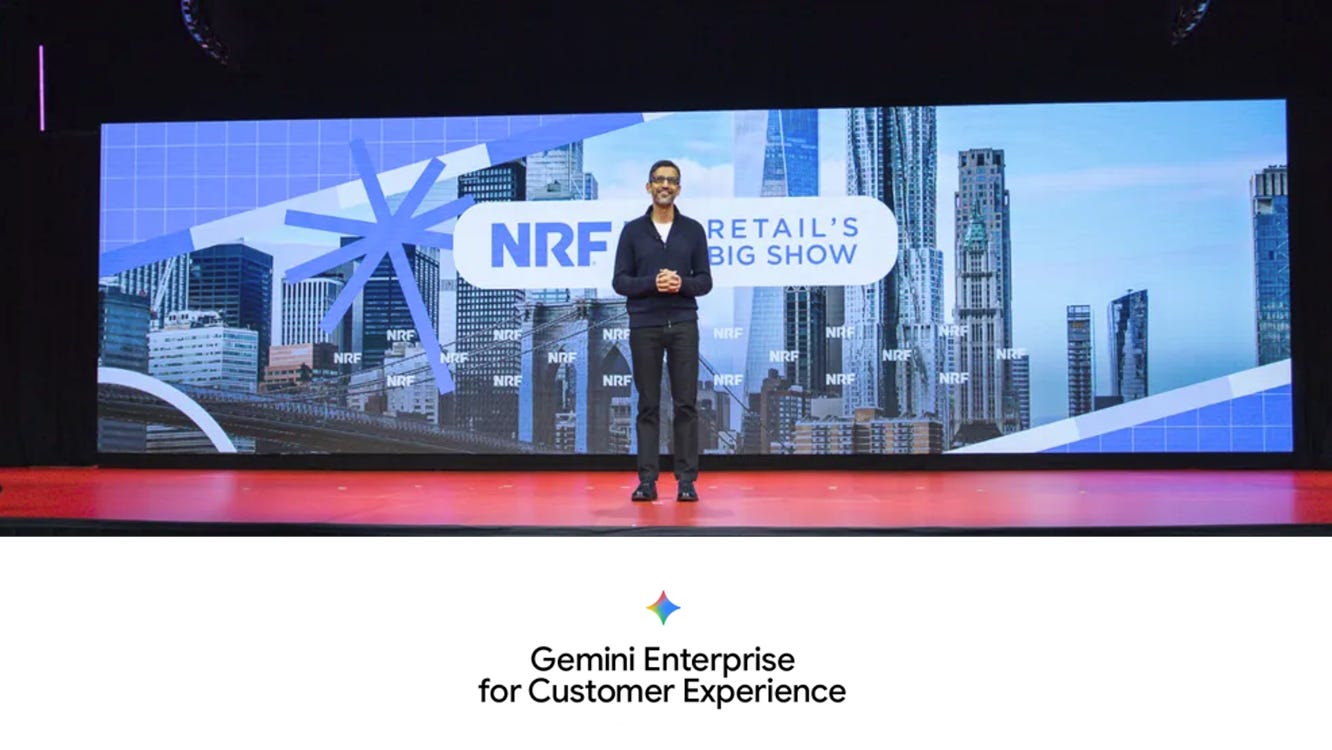
Google launched Gemini Enterprise for Customer Experience, designed to unify shopping and customer service into one AI-driven experience. It also introduced Customer Experience Agent Studio, allowing companies to build and deploy AI agents that can take autonomous action.
But the true breakthrough was the launch of the Universal Commerce Protocol (UCP), developed with major partners like Shopify, Walmart, Target, Etsy, and Wayfair.
UCP is meant to standardize agentic commerce, enabling AI assistants to guide consumers from discovery all the way to checkout, without forcing them to jump between apps. It also ensures retailers can keep control of the customer relationship while still benefiting from Google’s AI ecosystem.
In other words, Google is trying to build the “infrastructure layer” for AI-powered commerce.
Comments
Nothing yet. Say the first thing.
Sign in to join the conversation.