
Since I have a zillion projects on the horizon, I’ve been working intensely to prepare podcast episodes well ahead of time, so that looming deadlines won’t find me unprepared. I’m close to finishing all the work for History on Fire in 2027, and I’m three-quarters of the way through writing the material for the first year of the upcoming Roman history podcast.
Since some of the material I’m working on won’t be released for a long time, I’d love to share with you here some snippets of what has been occupying my days lately. In particular, I’ll share with you a few lines from two different episodes that will come out in 2027.
The first is from a research project on the great last stands in history, and in particular on why so many people seem to love the mythology surrounding the Last Stand, which is usually taken to mean a battle in which a small force continues fighting despite facing overwhelming odds and little or no chance of victory. The following is the very end of the episode, when, after covering plenty of case studies, I attempt to draw some more philosophical conclusions.
Here we go:
“So, let’s now go back to where we started: to the philosophical implications of it all, to why Last Stands are remembered all over the world, throughout history. We have gone from the Middle East to Japan, from the heart of Rome to the Great Plains in the United States, from Mexico to Poland and Ancient Greece. We have seen examples from Christians, Muslims, Jews, Hindus, Buddhists, Shintoists, worshippers of Zeus, practitioners of tribal religions, and probably quite a few atheists too. We have spanned a period from 2,500 years ago up to WWII. The theme clearly resonates across most cultures and most ages. Why? The first logical answer is that everyone admires courage, and not many things embody courage more clearly than people fighting against impossible odds.
But this answer is as true as it is painfully obvious. I’d argue that there’s more to the story. On some level, I’d venture to argue that the last stand isn’t simply some epic military engagement or just a historical event. It’s the fundamental human condition. Clearly, odds are that none of us will fight thousands of enemies with a spear. When I say the last stand is the fundamental human condition, I don’t mean it literally. I’m not talking about the battlefield.
To me, the last stands are not the monopoly of ancient heroes, nor modern ones for that matter. The last stands show up in the lives of every single one of us. It’s not a possibility. It’s a guarantee. For most of us, it’s a loved one dying of an incurable illness, and you have to be there for them even though you both know it’s a hopeless battle. It’s your own eventual demise. It’s all the times when life will put you in an absolutely desperate situation, in which a good outcome is not in the cards. This is something that we have all faced, are facing, or will face. So, it speaks to us on a deep level. Because at an existential level, it’s what life is about. In admiring the examples of those who faced doom with defiance and insane bravery, we are drawing inspiration for our own fights. Our own Thermopylae doesn’t wait for us in history books. It awaits us in daily life. And the question that all the examples of last stands invite us to ask ourselves is how will we carry ourselves in the face of hopelessness?”
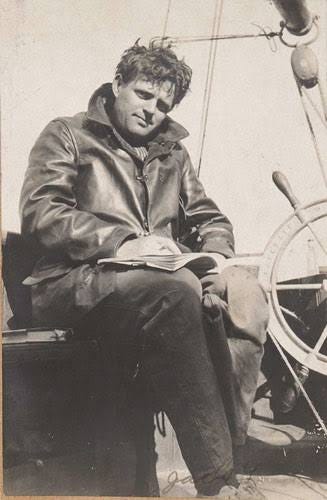
For the second selection, I’ll share the beginning and end of the first episode of a two-part series about the life of a true rockstar of American literature, Jack London.
“The renowned poet Walt Whitman once wrote, “Do I contradict myself? / Very well then I contradict myself, / I am large, I contain multitudes.” No truer words could be used to describe the life of Jack London. Because there’s a difference between a paradox and a contradiction. A paradoxical approach usually ends in holding harmoniously two apparently conflicting ideas. Someone contradicting themselves is arguing for one thing and then for its very opposite without offering a path to bring the two together, and with little justification to explain doing a 180. Jack London tends to fit the latter. He was everything and its opposite in a way that puzzles people who crave reducing his ideas and his existence to simple, neat, logical conclusions. It kind of reminds me of one of London’s literary idols, Friedrich Nietzsche. Were there sparks of absolute genius in both London’s and Nietzsche’s writings? 100%. But if you approached either looking for a clear, coherent system of thought, you’d be barking up the wrong tree.
London was loved by Silicon Valley venture capitalists and by socialists like George Orwell and Upton Sinclair, by proud imperialists like Theodore Roosevelt and communists like Che Guevara. This should tell you that people from all walks of life found something that spoke to them in London’s writings. He was a tough guy ready to fight at the drop of a dime, and a nerdy intellectual who cried if he saw an animal hurt. He deeply loved his family and bent over backwards to take care of those close to him, and was far from a good father. He gained a devoted following for his emphasis on rugged individualism, but was also a socialist. He endorsed some blatantly racist ideas, and at the same time he wrote heartfelt stories starring ethnic heroes fighting against colonization. He loved the teachings of Jesus, and he was an atheist. He was considered a prototype of heterosexual masculinity, and at the same time he’d go off camping with his best friend, write ultra-affectionate letters to each other, and take naked pictures of one another.
If this summary leaves you confused, you are not alone. Jack London was many things. Over the years, he was a child laborer, a pirate, a hobo, a convict, a gold-seeker, a sailor, a war correspondent, a rancher, one of the most successful novelists ever, and probably a thousand other things. As literary critic Alfred Kazin once said, the “greatest story Jack London ever wrote was the story he lived.”
So, keeping in mind the warning that we should probably resist the urge to oversimplify and pigeonhole him under any one label or its opposite, let’s go explore the many lives of Jack London.”
“There was a point when London’s literary career was going nowhere. And the alternative was working jobs that regularly wrecked most of those who took them. Not much else was available to him. After an impossible number of rejections of his submissions, London was very much at the end of his rope, when a publisher finally bought a short story from him. The acceptance letter gave oxygen to a drowning London. Sometimes, things truly turn on a dime.
Just as he was celebrating his first real professional success, London received a call from the Oakland postmaster informing him that he had passed the civil service examination and could be hired as a mailman. Jack asked if the postmaster would be willing to give the job to someone else, but save his spot for the next available vacancy. In the meantime, he explained, he wanted to give writing a try. The postmaster wasn’t in the mood to negotiate. His message was “You can either take the job now or you can kiss it goodbye.”
Talk about a hard choice: the pay was decent, and the job security, benefits and potential for advancement were excellent. Had this offer arrived just a couple of weeks earlier, Jack would have accepted in a heartbeat. Now, though, with his first, albeit modest, taste of literary success, the choice was between taking a safe job that would require giving up being a writer or gamble it all on the dream that writing could work for him. In my own life, I never had to make that choice. I found a way to teach college to pay the bills while using free time to write books and create podcasts. Having to split my energy certainly slowed down my creative output, but it allowed me to support my family and still be able to create something, without panicking every time rent was due. London didn’t have the luxury of a more cautious approach. For him, it was all or nothing. And his answer was ‘all’. With his usual reckless abandon, he took the big gamble. The result of that choice was that American literature would never be the same.”
Infinite thanks for your attention and support!
Daniele
Comments
Nothing yet. Say the first thing.
Sign in to join the conversation.