

Disappointment, wounded pride, vague resentment: these were originally the starting points for what I’m writing here. Best efforts, good faith, generosity and support: these were my alternatives. Pit those sets of qualities against one another and you get enough conflict for low-level drama. On reflection, though, I’ve decided to keep things undramatic; I’ll just lay out a few numbers and notes on my process and speak to their implications.
I’m referring generally to the closure of the latest submissions window for fiction at 3:AM Magazine. Submissions were open from December 1, 2025 until January 31, 2026. During that period, I received 654 submissions. Given that the annual publication schedule allows for forty acceptances at most, this intake guarantees 614 rejections and leads to an acceptance rate of 6%.
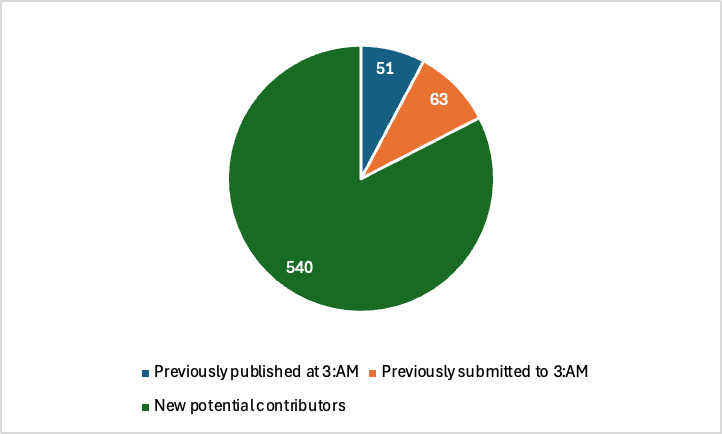
Of the total number of submissions, 114 came from writers who have submitted to 3:AM on previous occasions, and fifty-one of those came from writers who have previously published their work at 3:AM. This means that even if I were to favour previous contributors and accept only their submissions—because they have a pre-existing relationship with 3:AM, because they’ve proven themselves to be on its wavelength—I’d still need to send out eleven rejection notices. That’s painful to do, especially when I feel that their work probably does deserve publication, and it gestures towards the constraint I’m always agitating against: capacity.
When I’m talking about capacity, I’m talking partly about the limited number of publication slots and partly about time. I’ll say something more about time first of all. Think of it this way: if I receive 654 submissions and I spend just one minute on the basics—opening the submission email, skimming the text for the title and word count, and downloading the attached document—that’s almost eleven hours devoted solely to admin tasks. Now consider a few extra details that come down to my wish to treat every contributor fairly and with respect. I send an email response to every submission I receive, largely consisting of template text, lightly tailored to acknowledge the contributor’s introductory remarks. Then, once I’ve sent an initial response, I add the contributor’s name and the title of their work to a spreadsheet and I remove their name from the work itself. That’s right: although I don’t ask contributors to send anonymised texts, I do read all submissions blind because I want to judge each submission primarily on its merits. But that extra administrative labour takes about three minutes per submission. With 654 submissions received, those three minutes add up to another thirty-three hours of work, for a total of forty-four hours so far, and none of this yet involves reading submissions or making any editorial interventions.
The time I spend reading is difficult to quantify, but I’d guess that it averages out to three minutes per submission on the first pass. Some submissions take less time to assess, because at a glance I can see they’re not right for 3:AM. They might be works of boilerplate sci-fi, for instance, or their rhetorical competency might not approach a reasonable standard for publication. I’ll mark them for rejection in a minute or so, on the basis that the writers who’ve submitted them clearly aren’t familiar with the material published at 3:AM. Other submissions take longer to assess, because I need more time to confirm my page-one feeling that there’s skill, purpose, and design behind the work as a whole. Really, then, an average is all I can use when I’m trying to make my reading time conform to some kind of metric, and an average of three minutes feels right to me. I’m now up to seventy-seven hours of labour and I’ve done some initial reading—but, at this stage, I still haven’t made any decisions or had any further engagement with individual writers.
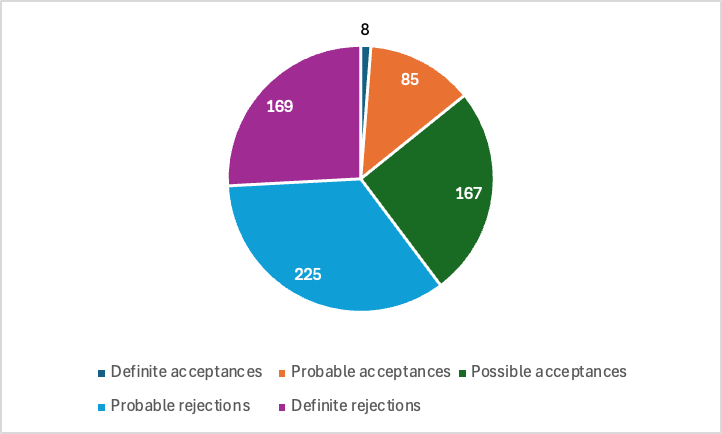
I’ll need to pause here to explain something about my reading system. After all, reasonable people will wonder: how could I have spent thirty-three hours reading all these submissions if the submissions window closed only forty-eight hours ago? I do sleep; I do have a life outside of editing fiction. The truth is, I read submissions weekly as they’re coming in. At the end of each week of the submissions period, I take that week’s submissions and I sort them into five categories: (1) definite acceptances, (2) probable acceptances, (3) possible acceptances, (4) probable rejections, and (5) definite rejections.
The first and last of those categories are easy to account for. I might come across one submission per week that warrants a definite acceptance. In that case, I’ll accept it immediately for fear that it’ll get snapped up by another publication. Comparatively, though, I encounter many more submissions that I know I can’t accept and I’ll flag them for rejection. I don’t send out the rejections immediately, however, because I used to send them and I learned the hard way that writers who receive rejections while a submissions window is still open will simply send me another submission, equally ill-suited to 3:AM.
Somewhat harder to identify are the probable rejections. As I’m naturally prone to self-doubt, I often question my own first response to submissions that seem well-written. With these submissions, although my gut reaction is to say “No,” I don’t come away with an intellectual basis for declining to take them. As a result, I’m not sure straightaway that a rejection is quite right, so I need to reassess these submissions before I’m sure that I can’t accept them.
Much harder to identify are the probable and possible acceptances. These are, respectively, the submissions I like a lot despite a few minor reservations, and the submissions in which I see creative potential that’ll take some elbow grease to develop. They open up difficult questions about how to prioritise acceptances within the constrained capacity of the available publication slots, as well as how much more time I’m willing to spend with a not-quite-publishable submission in order to make it publishable after all.
Here’s how this year’s 654 submissions fell into those five categories:
Now, you might think that it can’t be too hard to fill the available publication slots for 2026. All I need to do is identify the forty best submissions and publish those: easy! But, no, it’s not quite so simple. The problem is that editorial judgment doesn’t just boil down to backing “the best” and leaving the rest aside. Like it or not, there are other considerations that impose constraints on what can justifiably be published—or on how often to publish a certain type of publishable thing, to the exclusion of alternative types.
I’ll try to illustrate these considerations in more practical terms. Last year, I wrote that one of my favourite types of fiction is a sort of monologue delivered by an irrepressible voice: Beckettian, Bernhardian, or Steinian. This year, I received a dozen submissions in this vein and each one was, in its own way, fantastic. But if I have only forty available slots in the publication schedule, I can’t justifiably give twelve of them to one type of fiction and leave alternative types of fiction to fight over the remainder. Even if, say, the median monologue I received was better than the very best instance of every other type of fiction—so that I ended up with a preference for the top six monologues over and above the next 648 submissions—I don’t think I could really defend publishing six variations on the same type of publishable thing, rather than freeing up a few more slots to publish a more varied annual slate.
Additionally, I think it’s important to develop variety at 3:AM in areas other than literary form. For this reason, it’s important for me to run an open submissions process that exposes me to the work of so-called “emerging writers.” I’m speaking specifically about writers who mightn’t have much of a publication history, despite their evident talent on the page, who therefore need someone with editorial authority to put faith in them and help them develop. It’s also important for me to run open submissions for more ethical reasons. I feel that a position of editorial authority, like mine, comes with a responsibility to take a gamble on some of these writers and provide them with support as much as it’s possible to do so. For my part, I try to ringfence about 10% of my editorial capacity specifically to work more intensively with emerging writers. To meet the demands of this portion of my capacity, I trade off a reduction in the demands of working with those writers whose submissions are already polished enough to receive a definite acceptance.
Finally, on top of all this, I also try to aim for variety—if not outright parity—in gender representation. I’ll be up-front and admit that I often miss the mark. For one thing, it’s impossible to ensure gender parity when you’re reading submissions blind. For another thing, it’s impossible to adequately control for the gender split at the level of submissions received. In other words, since the 654 submissions I received this year were split roughly two-thirds/one-third to the advantage of male writers, a blind reading process was always likely to yield an acceptance rate with a similar split to the advantage of male writers. As it happens, the split is likely to end up a little closer to parity—let’s say sixty/forty—but whatever the end result, gender is on my mind as I read. Although I’m reading blind, I’m reading with an ear for the writer’s voice, listening out for its potential gender implications or connotations, and those are also things I’m thinking about when I’m selecting which submissions to accept. They alone won’t determine whether I accept or reject a particular submission, but will sit alongside quality, variety, and evident talent as factors that influence my editorial judgments. If this displeases some male writers—and I know it does—then so be it. I’d contend that if 3:AM ended up with a publication schedule with men receiving almost thirty out of the forty slots, that’d be as deleterious to variety as a schedule dominated by monologues.
Okay, then: let’s return to the process, bearing in mind the constraints and considerations I’ve just elaborated on. I’m at the stage in the process where I’m ready to make some editorial decisions. I’ve got forty available slots to fill. This year, eight of those went to my definite acceptances: one per week, on average, over an eight-week period of open submissions. Twenty-eight went go to probable acceptances, which I knew would each require some editorial input to one degree or another. Four went to submissions I’d flagged as possible acceptances, given my commitment to supporting emerging writers, and, as above, these will require more intensive editorial input. As you can imagine, such numbers are difficult to work with and have difficult consequences for submissions of similar value to the ones I’ve accepted. Since I’ve flagged eighty-five probable acceptances this year, and accepted only twenty-eight, I have to deliver unwelcome news to the writers of fifty-seven submissions that I could easily imagine publishing. In this sort of situation, what’s the right and responsible thing for an editor to do?
If you’ve read this far, and you’ve taken in what I’ve said about my commitment to emerging writers, then you won’t be surprised by how I prefer to proceed. I try do as much as I can, within the constraints on my time, to provide rejected writers with encouragement and support. I try to do this purely for the good of it, out of respect for the effort and energy that goes into writing fiction, even when I’m turning down someone’s submission, even when there’s no gain in it for me. So: while everyone who receives an acceptance notice enters into correspondence with me, a sustained back-and-forth that runs over a period of several weeks or months, I also send a personalised note to everyone who submitted work I flagged as a probable acceptance: that is, everyone who would’ve received an acceptance notice if only I had greater capacity. Briefly, in two or three lines, I try to call attention to what I appreciated most about their submission. Even just a few remarks, pointing out a submission’s best qualities, can be helpful to the recipient: they can give a writer the confidence to submit their work elsewhere, to reassert its value and keep writing in spite of setbacks. That being said, it takes me seven minutes on average to write each one of these notices—time for reflection as much as typing up my thoughts—which means I’ve now spent four-and-a-half hours sending out forty acceptances, plus six-and-a-half hours on fifty-seven personalised rejections. This amounts to establishing individualised contact with 15% of all writers who submitted to 3:AM.
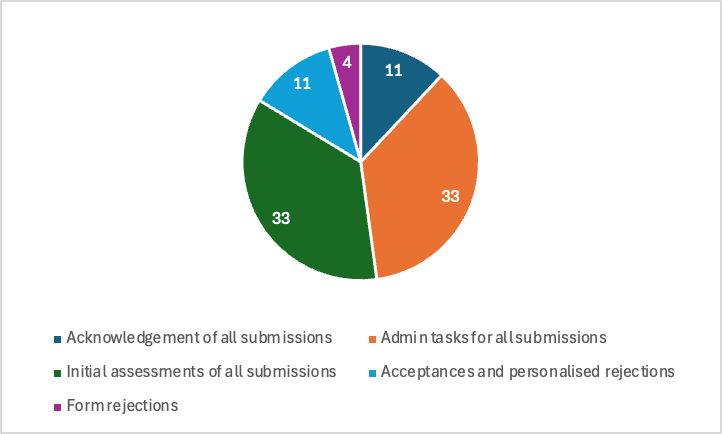
Unfortunately, purely because of the limitations on time thereafter, I send a form rejection to everyone else. This year, those notices went out in response to the 167 submissions I flagged as possible acceptances, to the 225 probable rejections, and to the 169 definite rejections. It takes about four hours to prepare these and distribute them, de-anonymising each one and matching it with the contact details stored in the submissions spreadsheet. Combined with the eleven hours it takes to send the acceptances and personalised rejections, that comes to fifteen hours I’ve spent on communications over the last few days. Combined with the seventy-seven hours of administration and correspondence that preceded making editorial decisions, I’ve spent about ninety-two hours on identifying the fictions that’ll appear at 3:AM in 2026.
Here’s how the admin and communications broke down this year, prior to any hands-on editing, over the course of those ninety-two hours:
As above, this still doesn’t include the time I’ll spend actually editing the submissions I’ve accepted. How to calculate that? Each individual submission requires editorial labour at an average of one hour for every 1,000 words. Since the forty acceptances have an average length of 3,000 words, the labour of editing should require approximately 120 additional hours. On that basis, here’s the best-case scenario by the end of the year: a grand total of 212 hours devoted to 3:AM, more than six weeks of full-time equivalent work.
In light of all the above, the question I always end up asking myself is: how much time is enough time spent on this? I believe wholeheartedly in the value of literature; I believe in the worth of cultivating a vibrant literary culture; I believe in the importance of encouraging worthy writers to write. I believe in the vision of 3:AM and the significance of its legacy over the last quarter-century. These are the beliefs I’m acting on, ultimately, by giving my time to 3:AM. The time is a gift—I’m not paid for any of this; I do it for the sake of what I believe in—but I do have to draw the line somewhere, and at that point I can only hope for understanding from those who are disadvantaged by it.
Disappointment, wounded pride, vague resentment: these are, unfortunately, sometimes the responses I see in writers who receive rejection notices. I’m sure they arise mostly from misconceptions about the editorial process—on the assumption that I operate a system of favour rather than reading blind, or that the number of submissions I receive isn’t so incommensurate to the available slots for publication, or that some abstract notion of “quality” is or ought to be the sole criterion for an acceptance—but even so, I wrestle with how to engage with them constructively, especially when I have to give so many more hours to hands-on editing. Best efforts, good faith, generosity, and support: when a writer I’ve turned down presses me for more details on why, these are my go-to ways of protesting that I’m doing the best I’m able to do, for as many writers as possible, with the resources I’ve got. I’m trying to be egalitarian with my total capacity, distributing it among many stakeholders while also meeting the obligations of this enterprise.
I do offer all writers the chance to purchase detailed feedback on their work at a rate that I hope is affordable. I know that this isn’t ideal—it favours those in a position to pay, and it takes even more bites out of my time—but I am so often asked for it, and so loath to cut off the possibility of closer engagement, that I’m reluctant to not make the offer at all. And since I channel the income from manuscript assessments directly into running Splice, keeping books in print, commissioning new work, I’m still able use it to serve my broader aims: serving literature, and literary culture, and a range of worthy writers.
And after having said so much already, I’ll leave it at that. But I’m aware that some readers might have questions about parts of this, so I’ll open up the comments to everyone and try to provide transparent answers. Ask away!
No posts
Comments
Nothing yet. Say the first thing.
Sign in to join the conversation.