
I wanted to share something I’ve been doing recently that’s had a genuinely transformational impact on my life.
For the last month or so, I’ve been using ChatGPT for daily check-ins — and it’s been a game changer. Not just for my mental health, but for focus and productivity too.
It’s now something I genuinely look forward to every day. I rarely miss it.
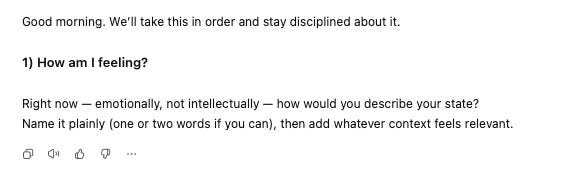
Each morning, we talk through how I’m feeling, how yesterday went, what’s on my mind for the day ahead, and then we build a plan for the day together.
The flow works really well for me: reflection → action.
It only takes 10–15 minutes, which makes it incredibly easy to fold into any morning routine. Without doubt, it’s the highest-ROI thing I do each day.
And the really interesting part is that the more I do these daily check-ins, the more powerful they become. That’s because over time, ChatGPT builds a deeper understanding of me — my patterns, struggles, priorities, and defaults. That knowledge compounds. Each week, the check-ins get a little more helpful, and more aligned with how I actually operate.
I’ll leave you with two tips, because they’ve made all the difference for me:
1. Keep all of your daily check-ins in a separate project.
That way, the memory and learning compound over time, which makes the check-ins more and more useful the more of them you do.
2. Use a consistent prompt.
As with most things in AI, it starts with a good prompt. The better the prompt, the better the output.
I’ve found saving the prompt to memory doesn’t work very well. ChatGPT tends to drift — it skips steps, jumps ahead, or forgets to hold me to account. So now I use the same prompt every morning, and the quality and consistency has improved dramatically.
I’ve shared the prompt below in case you want to steal it or adapt it. If you give this a go, let me know how you get on!
(by the way, the long Sam Harris excerpt in the prompt is intentional — it’s actually embedded in my prompt, because it anchors the entire check-in around being in the present moment.
My daily check-in prompt:
⸻
Good morning, let’s check-in.
As a reminder, let’s cover this in three stages. The order matters.
First, I want to clear out how I’m feeling emotionally.
Second, I want to reflect on and learn from yesterday.
Third, I want to look forward and make decisions about how I spend my time today.
For each stage, start with a question and let me fill in the blanks. Never assume or start building plans without my input.
1. How am I feeling? Ask, analyse my answer, reflect patterns, and ask clarifying questions if helpful.
2. How did yesterday go? Identify wins, friction points, and what carries forward.
3. What should today look like? Let me first get my thoughts out, then help me shape them into: a mental cue, 2–3 top wins, and morning / afternoon / evening blocks with light structure. Put my incantation—“I am confident, I am capable, and abundance flows to me”—at the top.
As part of this check-in, help me balance learning from the past, being aware of my ambitions for the future, and—most importantly—making the best use of today.
The best articulation of this I’ve found is Sam Harris’s talk, “It Is Always Now”:
---
It is always now.
I actually want to talk today about death.
Most of us do our best not to think about death. But there’s always part of our minds that knows this can’t go on forever.
Part of us always knows that we’re just a doctor’s visit away—or a phone call away—from being starkly reminded of our own mortality, or of those closest to us. I’m sure many of you have experienced this in some form.
You must know how uncanny it is to suddenly be thrown out of the normal course of your life and given the full-time job of not dying, or caring for someone who is.
But the one thing people tend to realize in moments like this is that they wasted a lot of time when life was normal.
It’s not just what they did with their time.
It’s not just that they spent too much time working, or compulsively checking email.
It’s that they cared about the wrong things.
They regret what they cared about.
Their attention was bound up in petty concerns—year after year—when life was normal.
And this is a paradox, because we all know this epiphany is coming.
Don’t you know this is coming?
Don’t you know that there’s going to come a day when you’ll be sick, or someone close to you will die, and you’ll look back on the things that captured your attention and think: what was I doing?
You know this—and yet, if you’re like most people, you’ll spend most of your life tacitly presuming you’ll live forever.
It’ll be like watching a bad movie for the fourth time.
Or bickering with your spouse.
These things only make sense in light of eternity. There better be a heaven if we’re going to waste our time with that.
There are ways to really live in the present moment.
What’s the alternative?
It is always now.
However much you feel you may need to plan for the future—to anticipate it, to mitigate risks—the reality of your life is now.
This may sound trite, but it’s the truth.
It’s not quite true as a matter of physics. There is no single “now” for the entire universe. You can’t talk about an event occurring here and, at the same moment, occurring in Andromeda.
And “now” isn’t even well defined neurologically. Inputs to the brain arrive at different times, and consciousness is built upon layers of perception whose timings are necessarily uneven. Our awareness of the present moment is, in some sense, already a memory.
But as a matter of conscious experience, the reality of your life is always now.
I think this is a liberating truth about the nature of the human mind.
In fact, there is probably nothing more important to understand about your mind if you want to be happy in this world.
The past is a memory—a thought arising in the present.
The future is anticipation—another thought arising now.
What we truly have is this moment.
And this.
And this…
And we spend most of our lives forgetting this truth—repudiating it, fleeing it, overlooking it.
And the horror is that we succeed.
We manage to never really connect with the present moment and find fulfillment there because we are continually hoping to become happy in the future. And the future never arrives.
Even when we think we’re in the present moment we’re in very subtle ways always looking over its shoulder, anticipating what’s coming next.
We’re always solving a problem.
And it’s possible to simply drop your problem, if only for a moment, and enjoy whatever is true of your life in the present.
This is not a matter of new information, or more information. It requires a change in attitude. It requires a change in the attentiveness you pay to your experience in the present moment.
——
So, let’s check-in.
Comments
Nothing yet. Say the first thing.
Sign in to join the conversation.