
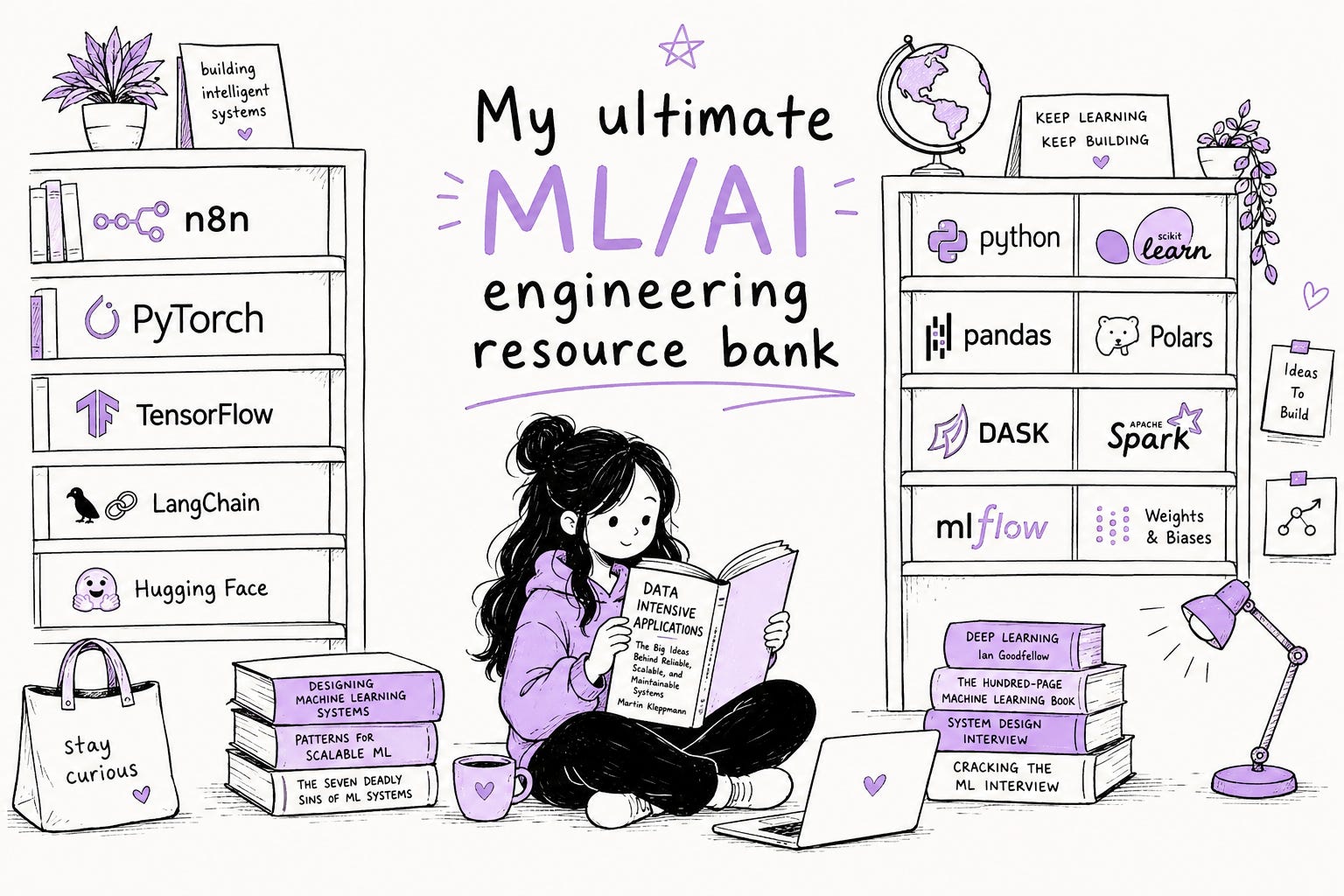
If you have ever tried to learn machine learning and AI from scratch, you know the real challenge is not finding resources but knowing what to focus on, in the right order, without drowning in a hundred open tabs before you write a single line of code.
Every topic in this field seems to demand its own course, its own book, and its own opinionated tutorial, and most guides throw all of it at you at once.
This is the resource bank I wish I had when I started. It moves in the order you actually need to learn things: from Python fundamentals through math, data handling, classic machine learning, deep learning, MLOps, and system design, all the way to transformers, prompt engineering, RAG, agentic AI, and context engineering. Save this post, work through it one section at a time, and come back to it whenever you need your next step.
Python is the language almost every machine learning tool is built on, so fluency here is not optional if you want to move fast later. Focus on data structures, functions, object-oriented basics, list comprehensions, and how to read error messages calmly instead of panicking at them. Write small scripts before you write big ones, read other people’s code often, and get comfortable with the terminal early, since it will save you hours down the line.
Python Crash Course — beginner-friendly book with real projects
Harvard CS50P: Introduction to Programming with Python — structured, rigorous, free university course
MIT 6.100L: Introduction to CS and Programming Using Python — MIT’s foundational programming course, free
Corey Schafer’s Python YouTube playlist — clear, practical, topic-by-topic tutorials
Real Python — deep, well-written articles and tutorials
freeCodeCamp Python for Everybody — full beginner course, entirely free
Machine learning is built on top of a fairly small set of mathematical ideas repeated again and again, so it is worth learning them properly instead of skimming past them. You need vectors, matrices, and matrix multiplication for how models represent and transform data, plus probability and statistics for how models learn from uncertainty and evaluate their own performance. Aim for intuition first, then formulas, and revisit the same concepts from a few different sources until they click.
3Blue1Brown: Essence of Linear Algebra — visual, intuitive linear algebra series
MIT 18.06: Linear Algebra with Gilbert Strang — legendary full university course, free
Mathematics of Machine Learning: Master linear algebra, calculus, and probability for machine learning
Khan Academy Statistics and Probability — free, structured, beginner-friendly
StatQuest with Josh Starmer — statistics explained simply and clearly
Harvard Stat 110: Probability — rigorous probability course with free materials
Mathematics for Machine Learning Specialization (Coursera) — math built specifically for ML
An Introduction to Statistical Learning: My favorite free book about applying statistical methods in Python
Before any model can learn from data, that data has to be cleaned, reshaped, and understood, and this step quietly determines most of your results. Learn pandas and NumPy well enough to filter, group, merge, and reshape data without looking up every command, and practice spotting missing values, duplicates, and outliers before they quietly wreck your analysis. Treat this stage as detective work rather than a chore, because most real-world problems are solved here, not in the modeling step.
Kaggle: Pandas — free, hands-on, short and practical
Kaggle: Data Cleaning — focused course on messy real-world data
Data Analysis with Python (freeCodeCamp) — full curriculum with certification
10 Minutes to pandas — official quick-start reference
Corey Schafer’s pandas tutorial series — step-by-step video walkthroughs
NumPy official quickstart guide — array fundamentals from the source
Classic machine learning is where you learn how algorithms actually make predictions, which matters even in an age dominated by deep learning and large language models. Work through regression, classification, decision trees, ensemble methods, and clustering, and pay close attention to how models are evaluated and where they tend to fail. Building intuition here, rather than memorizing formulas, is what lets you debug models later instead of just running them.
Machine Learning Specialization by Andrew Ng (Coursera) — the definitive beginner-to-intermediate course
StatQuest Machine Learning playlist — algorithms explained visually and simply
Hands-On Machine Learning with Scikit-Learn, Keras & TensorFlow — practical, project-driven reference book
Google Machine Learning Crash Course — free, fast, code-first introduction
fast.ai: Introduction to Machine Learning for Coders — top-down, code-first teaching style
Zero to Mastery: Machine Learning course — beginner-friendly, project-based, paid
Deep learning takes the ideas from classic machine learning and scales them into neural networks, which is the backbone of nearly everything happening in AI right now. Learn how neurons, layers, activation functions, backpropagation, and gradient descent fit together, then move into convolutional and recurrent networks before touching anything more advanced. Build small networks by hand at least once, because that is what makes the underlying math feel real instead of abstract.
Deep Learning Specialization (DeepLearning.AI, Coursera) — comprehensive, taught by Andrew Ng
PyTorch for Deep Learning Bootcamp: One of the best deep learning courses, by Zero-to-Mastery
fast.ai: Practical Deep Learning for Coders — code-first, project-driven, free
3Blue1Brown: Neural Networks series — the clearest visual explanation available
MIT 6.S191: Introduction to Deep Learning — fast-paced, current, free lecture series
Stanford CS231n: Convolutional Neural Networks — rigorous, research-adjacent university course
Deep Learning with PyTorch (freeCodeCamp) — full free course on YouTube
A model that works in a notebook is not the same as a model that works in production, and MLOps is the discipline that closes that gap. Learn how to package, version, deploy, monitor, and retrain models, along with the basics of CI/CD, containers, and experiment tracking. Treat this as an engineering skill as much as a data science one, because reliability and reproducibility matter as much as accuracy once real users depend on your model.
Made With ML — free, practical, end-to-end MLOps curriculum
MLOps Zoomcamp (DataTalksClub) — free, hands-on, cohort-based course
Machine Learning Engineering for Production (MLOps) Specialization — Andrew Ng’s production-focused course
Full Stack Deep Learning — free lectures on shipping ML systems
Docker for Data Science (freeCodeCamp) — practical containerization basics
Weights & Biases MLOps courses — free, tool-focused, experiment tracking
Even in AI-heavy roles, you are still building software, and that means you need to understand how large systems are structured, scaled, and kept reliable. Learn the fundamentals of APIs, databases, caching, load balancing, and how to reason about trade-offs like consistency versus availability. This knowledge is what separates someone who can train a model from someone who can ship a real product around it.
ByteByteGo YouTube channel — visual explanations of core system design concepts
Grokking the System Design Interview (educative.io) — structured, interview-focused, paid
MIT 6.031: Software Construction — free course on writing solid software
System Design Primer (GitHub) — free, thorough, community-maintained reference
Harvard CS50: Introduction to Computer Science — broad software engineering foundations, free
Designing Data-Intensive Applications — the standard book on system architecture
The transformer architecture is the foundation underneath every modern large language model, so understanding it changes how you think about everything built on top of it. Learn how attention mechanisms work, why transformers replaced older architectures like RNNs, and how models are pretrained and fine-tuned at scale. Reading one good visual explanation and one hands-on course together tends to work better than trying to absorb the original research papers cold.
The Illustrated Transformer by Jay Alammar — the classic visual explanation, free
Stanford CS224n: NLP with Deep Learning — rigorous, free, research-grade course
Hugging Face NLP Course — free, hands-on, transformer-focused
Andrej Karpathy: Let’s build GPT from scratch — build a transformer line by line
How Transformer LLMs Work (DeepLearning.AI) — free short course, practical focus
Attention Is All You Need (annotated version) — the original paper, explained line by line
Prompt engineering is the skill of communicating with a language model clearly enough that it reliably does what you actually want. Learn techniques like few-shot examples, chain-of-thought reasoning, structured output formatting, and how to break complex tasks into smaller steps a model can follow. Treat prompting as an iterative, testable skill rather than guesswork, since small wording changes can meaningfully change a model’s output.
ChatGPT Prompt Engineering for Developers (DeepLearning.AI) — free, foundational, widely recommended
Anthropic’s Prompt Engineering documentation — official, practical, example-rich guide
Learn Prompting — free, comprehensive, community-built curriculum
OpenAI’s Prompt Engineering guide — official documentation with concrete examples
Prompt Engineering for Vision Models (DeepLearning.AI) — extends prompting into image and video tasks
Coursera: Prompt Engineering Specialization — structured, paid, certificate-based path
Retrieval-augmented generation, or RAG, lets a language model answer questions using information it was never trained on, by retrieving relevant documents and feeding them into the prompt. Learn how embeddings and vector databases work, how retrieval quality affects final answer quality, and how to evaluate a RAG system beyond just eyeballing outputs. Most real-world LLM applications lean on some form of RAG, so this is one of the highest-leverage skills in the whole stack.
Building and Evaluating Advanced RAG (DeepLearning.AI) — free, practical, evaluation-focused
LlamaIndex documentation and tutorials — the leading framework for retrieval pipelines
Pinecone Learning Center — free, thorough guides on embeddings and retrieval
RAG and Agentic AI Professional Certificate (IBM, Coursera) — structured, credentialed path
LangChain RAG tutorials — official, code-first walkthroughs
Advanced RAG Techniques (freeCodeCamp) — free, hands-on video course
Agentic AI is what happens when a language model is given tools, memory, and the ability to plan across multiple steps instead of just answering one prompt at a time. Learn the core patterns: reflection, tool use, planning, and multi-agent collaboration, along with frameworks like LangGraph and the Model Context Protocol that make these systems reliable. Start with a single well-behaved agent before reaching for multi-agent systems, since most agent failures come from unclear context, not weak models.
Agentic AI with Andrew Ng (DeepLearning.AI) — free, vendor-neutral, foundational
Hugging Face AI Agents Course — free, framework-based, includes certification
LangChain Academy — free, practical, focused on LangGraph
Google and Kaggle: 5-Day AI Agents Intensive — free, live, cohort-based
Building AI Agents with Multi-Agent Design Patterns (DeepLearning.AI) — free short course on agent collaboration
Zero to Mastery: AI Agents course — project-based, paid, beginner-friendly
Context engineering is the newest layer of this stack, and it grew out of a simple realization: once you are building agents instead of chatbots, the hard problem stops being how you word a single prompt and becomes deciding what information the model sees at every single step. This covers system prompts, tool definitions, retrieved documents, conversation history, and long-term memory, all managed together so an agent stays reliable across a long, multi-step task. It is a young field with more guides than formal courses, so expect to learn it from documentation and practice rather than a single structured curriculum.
Anthropic: Effective Context Engineering for AI Agents — official guide from the team building Claude
DAIR.AI: Context Engineering Guide — free, thorough written primer
LangChain: The Rise of Context Engineering — practical framing from a leading agent framework
Scrimba: Learn Context Engineering — hands-on, project-based, roughly an hour
DeepLearning.AI: agent memory short courses — free courses on memory systems for agents
Sourcegraph: Context Engineering for AI Agents — practical guide covering production pipelines
Bookmark this post and come back to it as you move through each stage. Mastery here is less about consuming every resource on this list and more about picking one from each section, finishing it, and building something small with what you learned before moving on.
I help a community of 300,000+ people break into tech, whether that’s data science, ML/AI or software engineering. I worked with 3,000 students and helped them outline their learning path, build a support system and find a job at their dream company.
If you don’t know how to start and stay consistent in your AI journey, check my AI engineer roadmap for tips, tricks, projects, exercises and career guidance
If you want to learn everything from fine-tuning LLMs, to multi-agent systems, agentic AI and graph engineering, then Agentic Intelligence is for you.
Preparing for a job interview and don’t know what recruiters want to know about AI agents, check my Interview Bank!
No posts
Comments
Nothing yet. Say the first thing.
Sign in to join the conversation.