
I know, everyone is talking about LLMs, agents, harness, graphs, etc. However, learning machine learning is one of the highest-impact, highest-income skills you can learn to sustain yourself.
There are hundreds of algorithms, some probabilistic and statistical, some used for various other needs, and some are evergreen relevant in the machine learning product industry. That’s why, it’s more important to learn relevant algorithms the right way, than try to know it all.
Most beginners spend months studying algorithms they will rarely touch on the job, while the handful that show up in almost every real project get one lecture each. This post fixes that.
Below is a short guide on how to choose the right model, then the algorithms that actually pay your invoices, each with a visual.
Choosing a model starts with the problem, not the algorithm. Ask what shape the answer needs to take.
If you are predicting a category, like churn or fraud or a loan approval, you need a classification model. If you are predicting a number, like revenue or delivery time, you need a regression model.
If your data has no labels at all and you are looking for hidden groups, you need clustering. If your data is a sequence, like sales recorded week by week, you need a model built to read order and time, not just a single row in isolation.
Once you can frame the problem, look at your data.
A small, clean, well-understood dataset favors a simple model you can explain. A large, messy dataset with many interacting features favors a model that can absorb that complexity without you having to engineer every interaction by hand. The algorithm should fit the problem, not the other way around.
People often use these two words interchangeably, but they mean different things. Mixing them up causes real confusion in meetings, so it helps to be precise.
An algorithm is the general method, the set of rules for learning from data.
Gradient boosting is an algorithm.
Logistic regression is an algorithm.
A model is the specific, trained result you get after that algorithm has learned from your particular data.
Run gradient boosting on your company’s churn data, and you get a churn model.
Run the same algorithm on a competitor’s data, and you get a completely different model, even though the algorithm itself never changed.
A model can go stale. Customer behavior shifts, prices change, and a model trained six months ago starts drifting from reality. When that happens, it needs retraining. The algorithm behind it does not need to change at all.
Knowing which word you mean keeps conversations with engineers and stakeholders precise instead of vague.
The simplest test is the shape of your data and the shape of the answer you need.
Classic machine learning is built for structured, labeled data, the kind that lives in spreadsheets and SQL tables. It’s the right choice when you need a precise number or a clear category out the other end:
Will this customer churn?
What will next month’s revenue be?
Is this transaction fraudulent?
Generative AI is built for unstructured input, mainly text and images, and for tasks where the output itself needs to be generated rather than selected from a fixed set of categories:
Summarizing a contract
Drafting a reply
Describing an image
Most corporate data science work is still tabular, sitting in databases, so classic ML remains the correct default far more often than current hype suggests. Reach for gen AI when the task is genuinely about language or unstructured content, not simply because it is the newer technology.
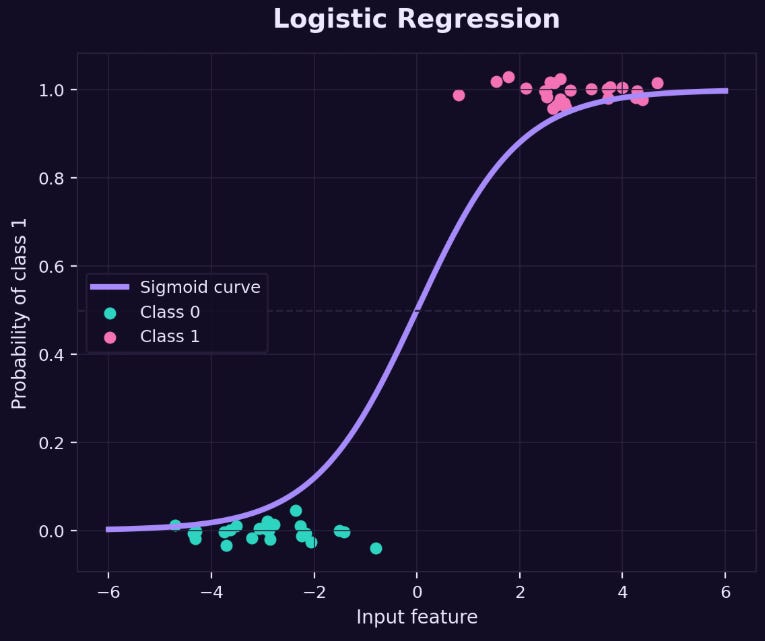
Logistic regression answers yes or no questions with a probability attached. It fits an S-shaped curve that squeezes any input into a probability between zero and one, then a threshold, usually 0.5, turns that probability into a decision.
Where it’s used at your job: churn prediction, fraud flags, loan approval or rejection, email spam filters
Why teams reach for it: every feature gets a weight, so you can say exactly how much it pushed the prediction toward yes or no. This matters in regulated industries like banking and insurance, where you must explain a rejection
Trade-off: fast, cheap to run in production, and a strong baseline, but it struggles when the real relationship in the data is not close to linear
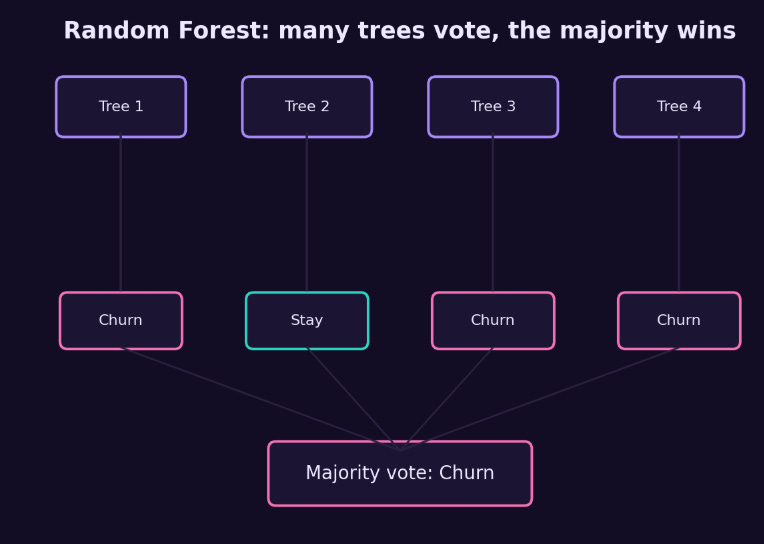
A random forest trains hundreds of decision trees on slightly different slices of your data and features, then lets them vote. The majority answer becomes the prediction, and averaging many trees cancels out each one’s individual mistakes.
Where it’s used at your job: customer churn, credit risk scoring, demand estimates, any tabular dataset with messy, mixed feature types
Why teams reach for it: it handles missing values and nonlinear relationships well, needs minimal tuning, and gives you feature importance out of the box, which is exactly what a stakeholder wants when they ask “what’s actually driving this”
Trade-off: very hard to overfit compared to a single tree, but it is slower to predict at scale than a single model and less interpretable than logistic regression
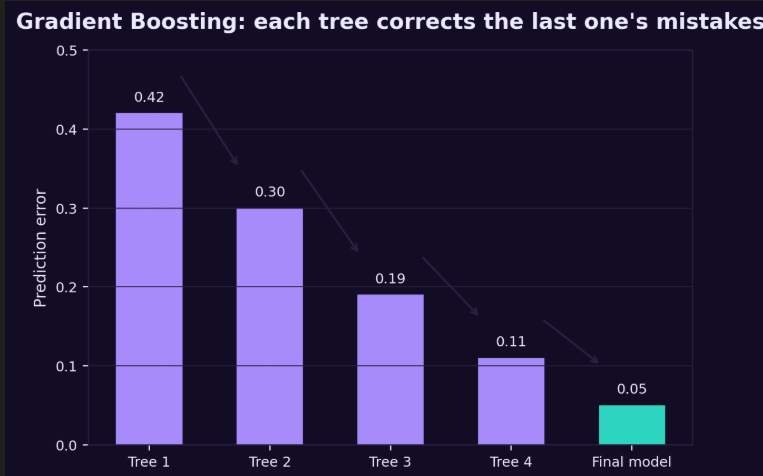
Gradient boosting builds trees one after another, and each new tree is trained specifically to correct the errors the previous trees made. This sequential correction usually produces the most accurate model on structured, tabular data, which is why XGBoost shows up in almost every industry job posting for a data role.
Where it’s used at your job: credit scoring, pricing models, fraud detection, ranking and recommendation scores
Why teams reach for it: it routinely beats random forests on accuracy once you have moved past a prototype and need the model to perform at its best
Trade-off: needs more careful tuning than a random forest and takes longer to train
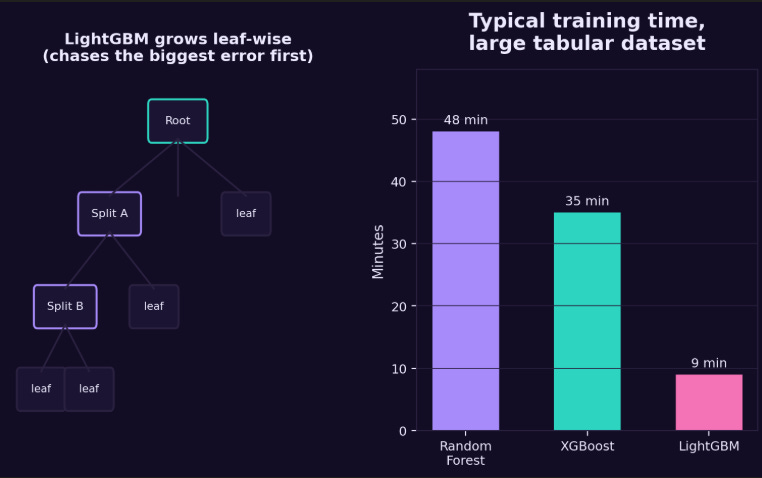
LightGBM is also gradient boosting, but it grows each tree leaf-wise instead of level-wise. Instead of expanding every branch of the tree evenly, it finds the single leaf with the largest error and splits that one first, which is what makes it faster on large datasets.
Where it’s used at your job: high-volume tabular problems, real-time pricing, click-through-rate prediction, anywhere you retrain models frequently and training time matters
Why teams reach for it: it trains significantly faster than XGBoost and a random forest on large datasets, while landing at similar or better accuracy
Trade-off: the leaf-wise growth can overfit small datasets faster than XGBoost, so it needs a bit more care with limits on tree depth
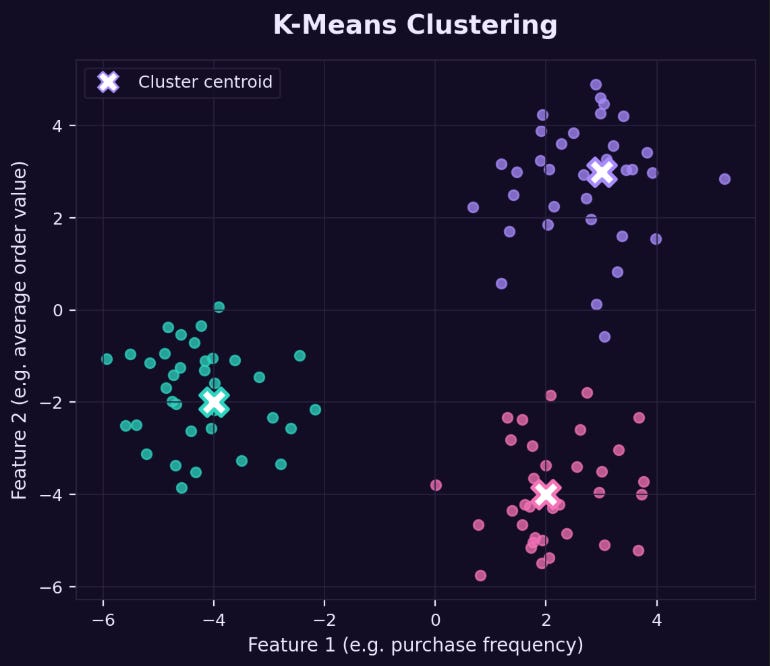
K-means is the main unsupervised algorithm you will use at work, meaning it finds structure in data that has no labels at all. You give it your data and a number of groups to find, and it places each point into the group whose center it is closest to, adjusting the centers until the groups stabilize.
Where it’s used at your job: customer segmentation by purchase frequency and spend, grouping support tickets, reducing a large dataset into personas an executive can act on
Why teams reach for it: simple, fast, and it turns raw, unlabeled data into groups a non-technical team can actually use
Trade-off: you have to choose the number of clusters yourself, usually by testing a few options and picking the one where the groups make business sense, not just the best mathematical score
A neural network connects layers of small mathematical units that pass weighted signals forward until the final layer produces a prediction. On tabular business data, a well-tuned LightGBM or XGBoost model often beats a plain neural network, so this is not your default choice for spreadsheet-style data. Neural networks earn their place once your input is images, text, or a sequence over time, and different shapes of input call for different architectures.
CNN (Convolutional Neural Network)
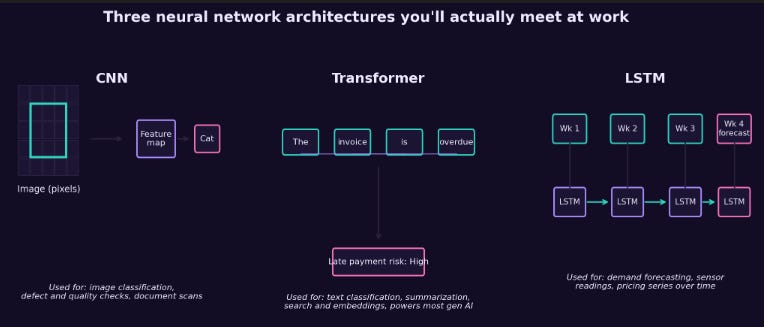
Where it’s used at your job: image classification, visual quality control on a production line, scanning receipts and invoices, medical imaging support
Why teams reach for it: it slides small filters across an image to detect edges, shapes, and textures, which makes it the standard choice whenever the input is a picture rather than a row of numbers
Transformer
Where it’s used at your job: classifying support tickets, summarizing documents, semantic search, embeddings, and the architecture behind almost every large language model you have used
Why teams reach for it: it lets every word in a piece of text weigh every other word at once, so it captures context and meaning far better than older text models, which is why it took over most NLP work in the last few years
LSTM (Long Short-Term Memory)
Where it’s used at your job: demand forecasting, sensor readings over time, stock and pricing series, predicting next week’s numbers from the past several weeks
Why teams reach for it: it reads data one time step at a time and carries memory of what it has already seen forward to the next step, which suits regression problems where the order of events matters and the dataset is not large enough to justify a transformer
Trade-off across all three: neural networks need more data and more compute than tree-based models, and they are harder to explain to a non-technical stakeholder, so most teams reach for them only once a simpler model has proven insufficient.
If you only remember one thing from this post: start simple, and only add complexity when the data proves you need it.
Logistic regression for yes or no questions
Random forest when you need a robust, low-maintenance baseline
Gradient boosting or LightGBM when accuracy on tabular data matters most, and LightGBM specifically when speed and scale matter too
K-means when you have no labels
CNN for images, Transformer for text, LSTM when your data is a sequence over time and you’re solving a regression problem
Thank you for reading, if you want to read my other data science, machine learning and AI guides consider subscribing. Founding members get 3 extra guides per week and hidden cheat sheets I send to them.
If you’re interested in learning machine learning & Modern AI, get lifetime access on my Roadmap.
No posts
Comments
Nothing yet. Say the first thing.
Sign in to join the conversation.