
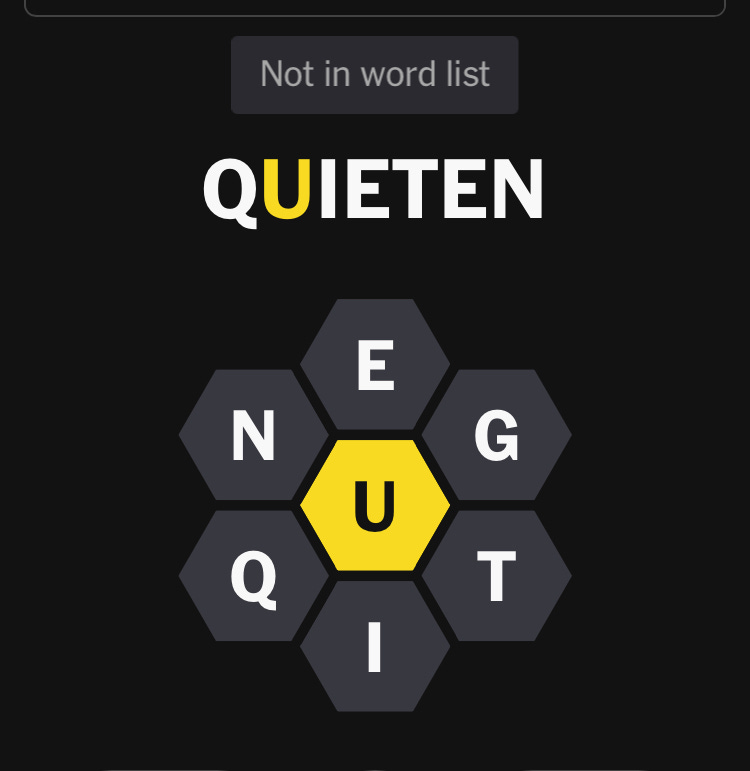
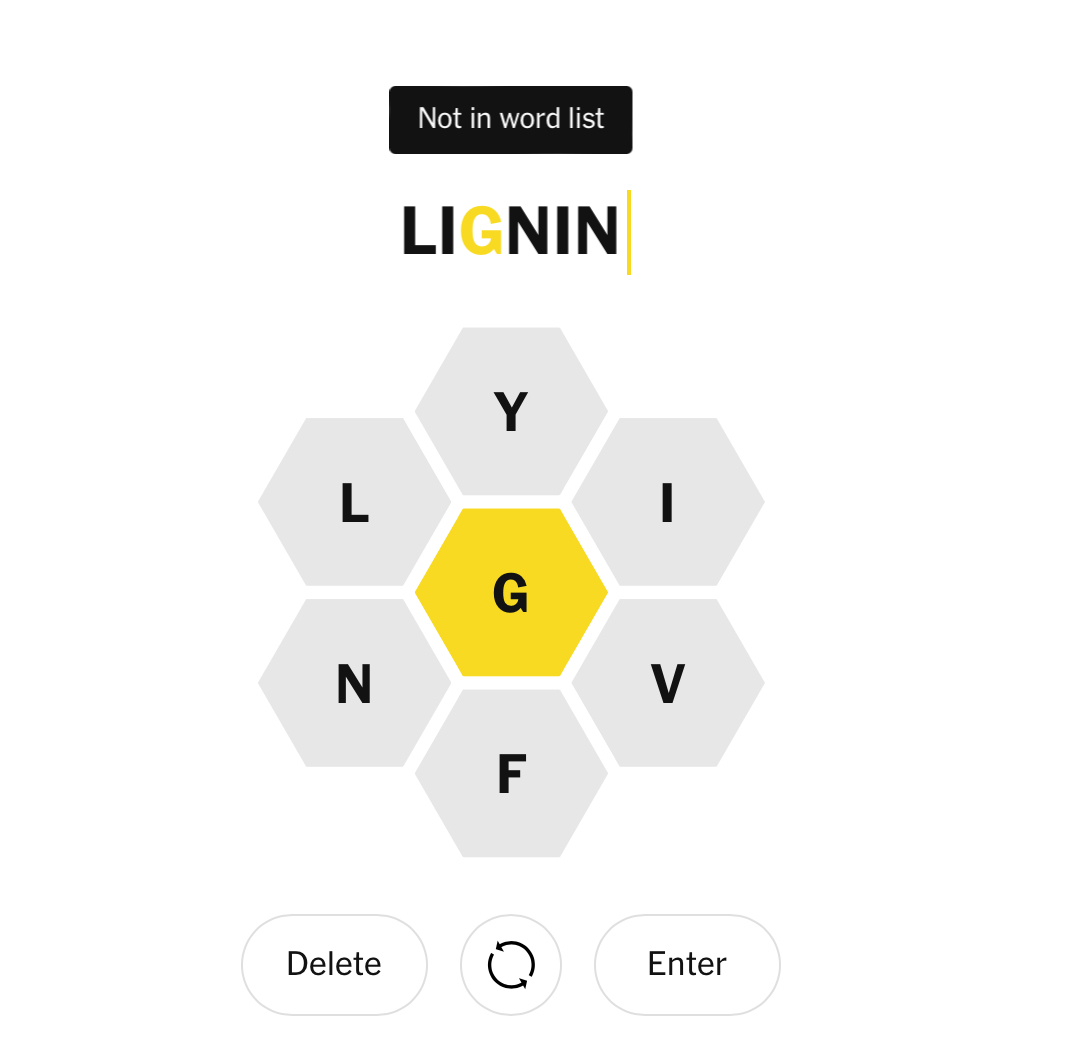
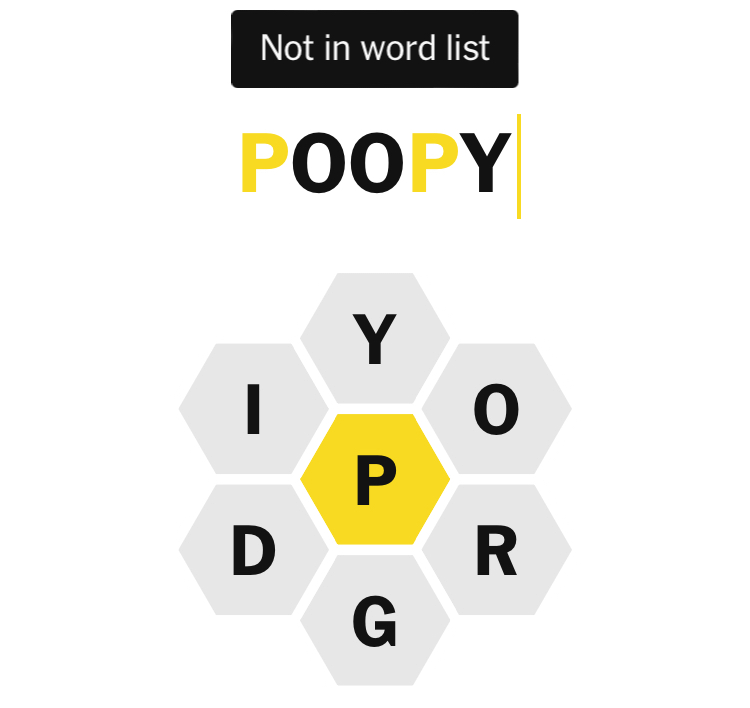
Many of you are aware of my regular mock dismay at basic words omitted from the accepted list at the New York Times Spelling Bee. So imagine my faux incandescence when the NYTimes published a smug article about some of the hardest words in the Spelling Bee this year. The writer was very proud that “pellicle,” “hamartia,” and “cicely” were included in the puzzle but, not at all to my surprise, did not explain why they had excluded the 3,108 simple words that I had emailed them (“Think we missed a word? Email us”) over the past couple of years including “clonal,” “lignin,” “haha,” and “turd.”
To my cardiologist and my wife’s relief, I don’t really care that much about the vagaries of the Spelling Bee, it is after all, just a game. Unfortunately, in a world where the fourth estate is under attack from politicians and opinionated pot-stirrers, professional journalism has to be at its best. There’s a crisis of reporting at the heart of our democracies and, unfortunately, the arbitrariness and laxness of the Spelling Bee is a symptom of how one of our best hopes is failing. After all, if this is how the New York Times — America’s paper of record — behaves when almost literally nothing is at stake then how are we supposed to trust it when everything — meaning the future of the country and the safety of my family — is at stake
The puzzle, shamelessly adapted without credit from the Times of London’s long-running Polygon puzzle, gives you a required letter and 6 other letters to make as many words with 4 or more letters as possible. On the app you select the letters to spell out the words and they are either accepted or rejected. The Spelling Bee scoring system is one point for a 4-letter word, one point per letter of words longer than that, and a 7-point bonus for using all the letters. Different point totals take you to different levels — “nice” “good” “amazing” — until you reach “Genius” or, if you get every word on the list, “Queen Bee.” Effectively, the game play is similar to many in this family of games but, by presenting the six optional letters in a hexagon like a honeycomb, the whole thing is cutely branded with “bee” imagery and bee language.
Absolutely key to this, obviously, is what words are allowed — the analog in puzzles to what facts are permissible in a story. The app says “Our word list does not contain words that are obscure, hyphenated, or proper nouns.” “No cussing either, sorry.” This is totally reasonable. It rules out the word “chink” for “gap” as it’s been used for centuries, as a hole the wall of A Midsummer Night’s Dream (Act 5, Scene 1, l141) and with double meaning (coin and sex) in Romeo and Juliet (Act 1, Scene 5 l130). It falls well within the puzzlers’ prerogative to avoid a racial slur or the four letter words it means by “cussing.” Nowhere in the app, or rules of the game, though does it say what words are actually included on the list. Merriam Webster? Oxford English Dictionary?
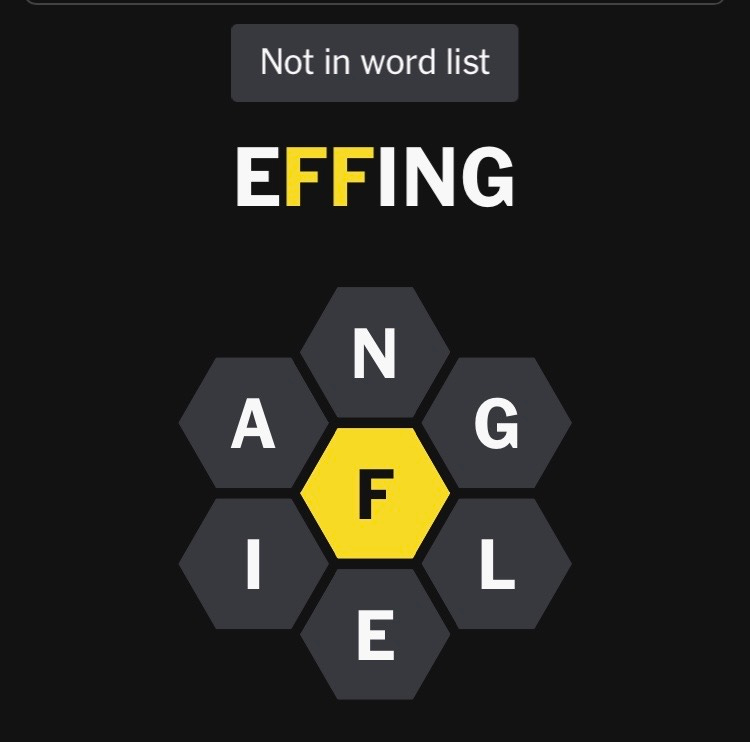
Though the game itself does not say so, related articles note that it is “hand curated” —“each daily Spelling Bee word list is curated by an editor and doesn’t include every possible solution.”
What??? Let’s parse this throwaway statement by the editor in charge. Effectively, this means that, every day, editors go through a complete list of words that would be in a “possible solution” and delete the ones that that they feel should not be included. That procedure does not have to go beyond the “hyphenated” or “cussing” words excluded by the rules stated above but, in fact, it clearly does.
What this means is that people trying to solve the puzzle are trying to guess what’s in the puzzler‘s mind. “Hamartia” is approved as not “obscure” while the words “cloacal” or “clonal” are rejected for no stated reason. From me, maybe a word is too British but there’s no stated policy of no British-isms and the rejected “twigging” and “pipping” are both in Merriam-Webster. This is not a game with a level playing field. There is no set Scrabble dictionary, not a set lexicon — just whatever the puzzler thinks should be on the list. Remember, in the paper of record, words are analogs of facts. There should be a clear and stated set of rules which define what is an acceptable fact or word and what is not.
The decision to disallow a basic set of simple middle school words on a daily whim (“lolly,” “piratical,” “quieten”) is outrageous, but the outrage is part of the point. As with many platforms that milk user generated content for engagement, friction is the point. People completing a puzzle with clear rules in peace is not good for “engagement,” just as talking inclusive common sense is no longer helpful for an American politician to get publicity on a campaign trail, or publishing “all the news that is fit to print” for subscribers is no longer sticky enough for a newspaper. Like algorithms that elevate the sensationally objectionable (“space lasers”) in a democracy, deliberately undermining the principles of the game comes at a social cost.
Sam Ezersky, who is nominally responsible for this puzzle, though seemingly not accountable for it, has said that he looks at the “Apple dictionary, which is based on New Oxford American, and Merriam-Webster’s online dictionary.” But then he goes on to say that decisions about what words are included “can seem arbitrary because every solver has a different background and vocabulary.” That Everdeen Mason, his boss as editorial director of game, has not fired him for this stated basic misunderstanding of how games work is incomprehensible to me. Run that logic past either Scrabble (“you can’t have that word because I don’t have it in my vocabulary”) or any news editor (“you can’t have that fact because it doesn’t fit into my worldview”) and you will see why. Games do not work because the puzzler makes arbitrary decisions about solvers’ backgrounds, games work — journalism works — by playing according to clear, transparent rules that are the same for everyone.
Ezersky goes on to say that if “an answer list had every possible word, it would be harder to make progress toward Genius and beyond.” Yes, if there are more, harder words, it’s objectively more difficult to complete, but at least it’s not more subjectively complicated by some black box of decision-making that censors what is “obscure” so solvers have to guess what some random puzzler is thinking. Entire staffs of people are dedicated to updating works about the agreed state of language — the Apple or Merriam-Webster dictionaries for example. Make a clear, stated decision of which you are using — citing them but not abiding by them is churlish and arbitrary.
Three of the key markers for journalism are transparency, consistency, and accountability. It is crucial where you get your facts from, what those facts are, and what happens when you get your facts wrong either once or repeatedly. Ezersky, who explicitly says that he is neither transparent nor consistent about his choice of facts, says he understands the “frustration” of solvers. But he clearly does not. And, after years of presenting a guess-what-words-I’m-thinking-of puzzle, he’s clearly not accountable. In a world where social media and mainstream media are increasingly controlled by billionaires who want to shape their own reality, the New York Times should be one of the remaining bastions of fact-based journalism. Our “frustration” is that every day, even on the puzzle page, we are reminded how it betrays that mission.
Comments
Nothing yet. Say the first thing.
Sign in to join the conversation.