
I wasn’t necessarily going to write a newsletter, but August 2025 marks the 10th anniversary of this newsletter, so — even though people may be on their hols — I thought I’d write and wish y’all happy anniversary. Here’s the first one, it was originally sent out from the late lamented Tiny Letter platform.

Also, finally, after having twice completed the New York Triathlon course without completing a real Olympic Triathlon, I am hoping it will be third time luck in the TOUGHMAN Westchester Triathlon in September (sounds virile, right?). My joints and muscles seem to be giving out at alarming rates, but I’m still hopeful I’ll complete it.
Not on Facebook click here. (If the “new” interface means you can’t tell them it’s in honor of me, that’s also cool)
Onto the substance.
Over the summer, when the weather is hot and swathes of the congregation vacation, our weekly synagogue services move down from the stuffy sanctuary to the air conditioned hall. The clergy also sometimes vacation but, even when they are present, give congregants — especially mouthy ones like myself — the opportunity to give the dvar Torah, the Shabbat sermon. I signed up for one and, on Saturday, I delivered it. I can’t remember exactly what I said — and it was somewhat context specific and performed, but the rough script is below. Just imagine it being delivered in a fluent, insightful way, with touches of humour. It would have changed your life if you had heard it, the text below is only a fraction of what I managed to convey. (Many thanks to Shira Hecht-Koller for helping me avoid what mistakes I did manage to avoid.)
In June, Neal Pollack, The Greatest Living American WriterTM and the editor of Book and Film Globe, where I had been writing SF reviews for several years, left to become the U.S. editor of The Spectator. So, as a trial run, I took over running that site in July. It covers, as you might expect, books and films, but also some industry scandal or analyses. So that means A. if you want to review a new book, show or movie for a pitifully small honorarium, hmu and B. I have written a number of reviews for that site under my own byline and you should check them out because most of the writing I have done this year is either with other people under their bylines or yet to appear.

I did, however, write a couple of pieces for the Forward. The first was a piece about a celebrated football player from the Netherlands who passed away but who, later in life, acknowledged the Jewish heritage and Holocaust survivor parents that he never spoke of during his playing career.
Was Rinus Israël our greatest Jewish soccer star? – The Forward
The second was a review of Gary Shteyngart’s latest novel, Vera, Or Faith. The editors over at the Forward gave it the cheery, but not inappropriate, title: Is Gary Shteyngart's dystopia any worse than Trump's America?
For Book and Film Globe I kept writing my SF column, first there was a fascinating but weird experimental book about aliens that might not be aliens, called Audition, from the New Zealand writer Pip Adams. Then there was a not-very-interesting new dystopian book by the king of the alternate realities, Harry Turtledove, Powerless — what if the USA were a patchwork of Soviets? And then a delightful, but maybe flawed, novella by Annalee Newitz, Automatic Noodle, about some robots who start (continue?) a restaurant.
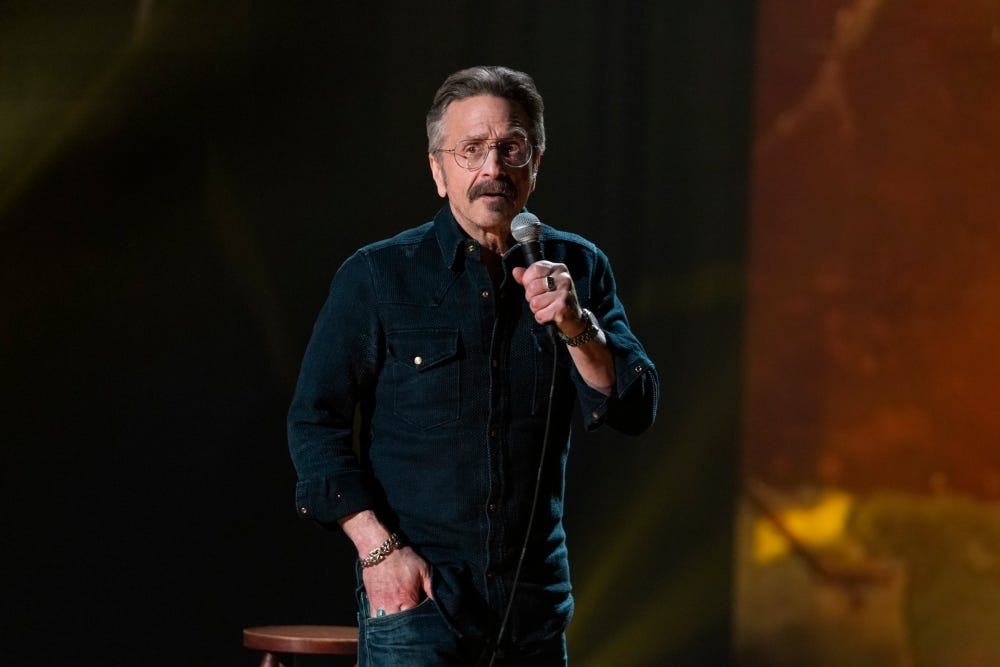
And then, because I write about comedy — even though the world has become so gloomy — I wrote about:
How a comedian pissed off Trump and got fired so his employer could make a billion dollars.
How the funniest ever TV show in Britain — it’s official!! — turned 50
How, a generation later, LA’s finest Police Squad returned
And, how Marc Maron dealt with quitting his podcast with a ‘Panicked’ HBO special
Hope you have a lovely rest of the summer. I might switch to Ghost for my next newsletter because, y’know Nazis and Nazis. Let me know if you have any thoughts about that.
Va’etchanan - I Plead, Shabbat Nachamu, Tu B’Av - Aug 9, 2025
Shabbat Shalom
On the rare occasions when I give a discuss the Torah on shabbat I usually like to deep dive into the meaning, etymology, or context of some choice words in the parsha: what they mean, why they are unusual, and how we can use them to think about the world unfurling around us.
Today, for example, I might have looked at the name of the parsha – “Va'etchanan” “I plead” which is grammatically about Moses pleading with God but thematically much more pleading with the Children of Israel. Or I might have asked why Moses designated three specific refuge cities as a haven for a person who committed accidental manslaughter. Or I might have counted the number of times we see “Shema” - “Hear,” or its cognates used (roughly one billion, count them.)
But Va'etchanan includes the biggies of the shema and the reiteration of the 10 commandments as well as a prolonged section anticipating entry to the land of Israel – including what does and what does not constitute that land.
If it reads a bit like a review week, that’s because it is. Moses cannot enter the Promised Land, so Moshe Rabeinu – Our Teacher Moses – is reviewing everything he’s told us: God is special and unique and scary, love God, love your neighbours and here are all the rules for doing that right.
But not only is it Moses’ stock taking, it is also the confluence of Shabbat Nachamu, the first Shabbat of consolation after Tisha B’Av when we commemorate the destruction of the Temples, and Tu B’Av – Judaism’s kinda sorta version of Valentine’s Day so it feels like a day to stay big picture.
At this point in time Moses and the Israelites are in the shadow of three idolatrous actions: the Golden Calf which led to the smashing of the tablets; Moses himself disobeying God by striking the rock at Meribah and being forbidden from entering the Promised Land; and worshipping the Baal of Peor, thus bringing on a deadly plague. Moses is worried, we’ve just been through these terrible traumas and I’m not allowed into the land to go with you so I’m just going to review the rules and principles.
So what do all these, the Shema, the Ten Commandments, Nachamu, Tu B’Av, Va'etchanan have in common?
They’re all about how we define and express love – not only romantically (perhaps even carnally), but spiritually, communally, and geographically.
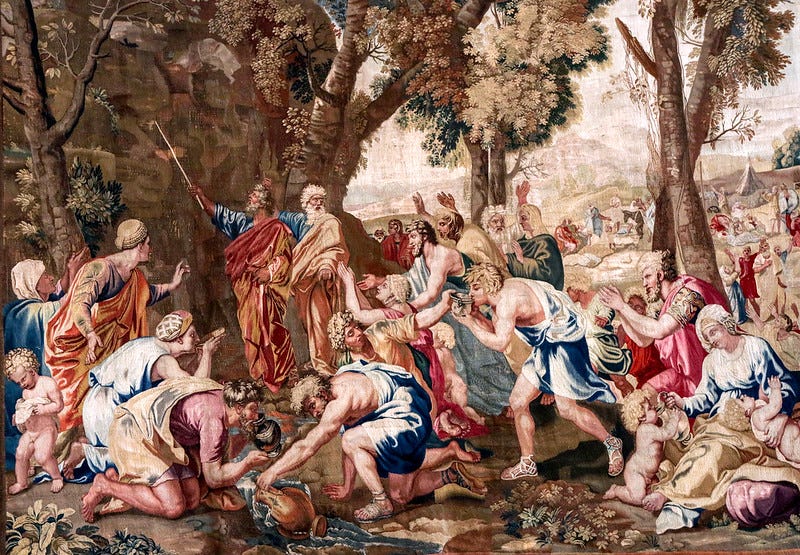
In Va'etchanan, Moses pleads to enter the Land of Israel and is denied. Instead, he turns to the people and begins to teach. That’s why this parsha contains the Shema, the ultimate statement of monotheistic faith. In the first paragraph, the V’ahavta commands:
“You shall love the Lord your God with all your heart, with all your soul, and with all your might.”
What does it even mean to command someone, a whole people even, to engage in an emotion? Can I just tell you to feel something and you have to feel it? And what are the implications? If you can be commanded to love, can you be commanded to control all your other emotions, positively and negatively?
These aren’t from this week, but in Leviticus we find: “You shall not hate your kinfolk in your heart” “Love thy neighbour as thyself”?
There’s a whole debate about what this might mean but we can skip over a lot of it by saying that whether you feel the emotion first or inculcate it first, the way that you perform, express or work up the love is through doing stuff. This is action-based love, what my friend and teacher Rabbi Mike Moskovitz calls “kinetic love.” Through observing commandments, through teaching our children, through placing words on our doorposts. It’s a love that demands discipline, memory, and presence, and above all, action.
And so, Va'etchanan becomes a masterclass in how to love God and Torah. These are not just something to passively feel, but something we actively build.
I’m not going to get into politics because we want to get to kiddush before havdalah but, as you can imagine, there’s plenty to get into in this parsha.
Geographically Moses gets very specific about where the Israelites must go and not go, and what should be the laws and statutes in those lands. But in a chapter that’s all about listening, it’s very careful not to say you should love the land. So, love God, act kindly to all the people around you, but live in the land dp not love the land. You have to be careful not to make the land just another idol
Then this week is also Shabbat Nachamu, named for the opening of the haftarah: “Nachamu, nachamu ami” - “Be comforted, be comforted, My people.” After the devastation of Tisha B’Av and mourning the destruction of the Temple, we enter a period of seven weeks of consolation.
Why two “nachamus”? Maybe God isn’t just comforting us with words, God is teaching us to comfort each other. After loss, destruction, and longing, love comes not through miracles, but through human tenderness.
One says to another “May you be comforted” and the other replies “May you be comforted.” For consolation we turn to one another.
Rather than the idea of consolation being, as I believe it is in Christianity, a movement toward the Godhead, in Judaism, consolation is found in loving oneself and being in community with folks who love you as themselves,
We aren’t simply told “Move toward God” or “It’ll be okay.” We’re told: “You are not alone.”
It’s also Tu B’Av (15th Av) once a matchmaking festival when unmarried Jewish would put on white garments and go out into the fields in search of “husbands.” And, well, the descriptions are all a bit modest, but I suspect the practices were not in the slightest bit modest.
Anyway, it’s now an opportunity to celebrate love, renewal, and second chances.
Coming just six days after Tisha B’Av, it reminds us that even in the shadow of destruction, there is the potential for joy. The Temple was destroyed, but love still blooms. Life continues. We still dance.
But this biblical Woodstock had another dimension, it was also a time when tribes reconciled.
Did I mention that the mishna says that this quite weird festival was to celebrate the grape harvest? I think it’s safe to say that this had a bit of the Purim about it. Women found “husbands” where they could, lots of barriers were lowered for the day, meaning also that those between communities softened, and — let’s just be optimistic — unity reigned. Love wasn’t just about finding your soulmate (or about your body mate), it was about repairing the soul of the nation.
So what ties these together?
Va’etchanan teaches us that love requires commitment.
Shabbat Nachamu teaches us that love requires compassion.
Tu B’Av teaches us that love requires joy.
Together, they offer a full vision of what it means to live as Jews in relationship with God and with each other.
Just as Moses couldn’t enter the land but still taught us how to live in it, we too may not see every dream fulfilled. But we are still called, indeed obligated, to love, to console, to rebuild, and to rejoice.
Because in Judaism, love isn’t just a feeling. It’s a commandment, a practice, and — at its best — a dance.
Comments
Nothing yet. Say the first thing.
Sign in to join the conversation.