
FBI emails I obtained show the administration is pushing state and local police to target Americans with left-wing views. As Donald Trump’s hot war in Iran enters its second month with no end in sight, a quieter, colder war is simmering on the home front.
Its target is not a foreign power thousands of miles away, but US citizens who disagree with the president and his hardline advisers. This domestic war’s chief weapon is a national security presidential memorandum, NSPM-7, which attempts to criminalize a laundry list of common left-wing beliefs and viewpoints.
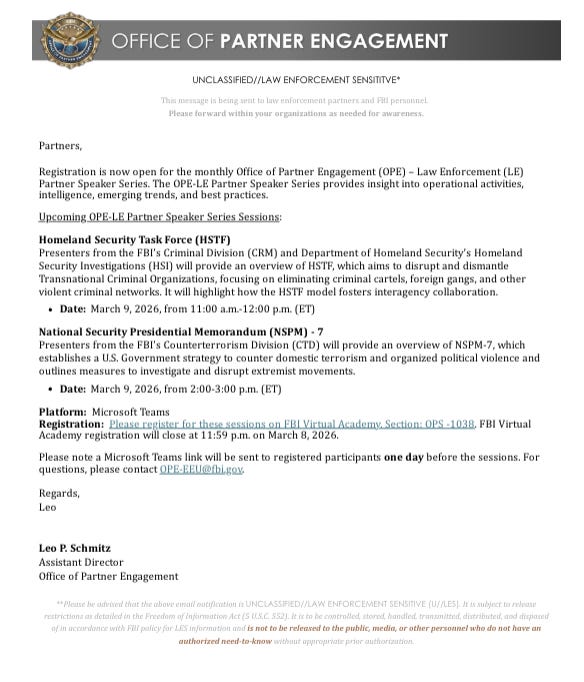
Trump’s FBI is conducting trainings for state and local law enforcement officials on the president’s NSPM-7 directive, in order to help enlist them in the administration’s ongoing crackdown on the left, emails show. And it’s happening at the same time as Trump’s war in Iran is throttling energy prices and the global economy – creating even more discontent with his administration.
What this development means in practice is if you have criticized a corporation on social media, held a sign that demands ICE leave your city, shared a meme about alleged UnitedHealthcare CEO killer Luigi Mangione, or publicly condemned Trump’s Iran war at a local town hall, both the federal government and your local police could take note and forward along a list of your thoughtcrimes to the FBI for further review.
Unlike a standard-issue presidential directive that nudges a sector of the federal bureaucracy or realigns a federal agency towards the president’s liking, national security directives target the entire intelligence and defense apparatus, which is why they are almost always classified. NSPM-7, which was published publicly by the White House in September, makes no effort to conceal its goals.
The presidential directive is the most significant shift in domestic counter-terrorism efforts since the Patriot Act was introduced into law in the wake of 9/11. The program is sweeping in its scope, not only for the list of subversive activities it seeks to target, but also in the joint terrorism task forces it relies upon.
In an effort to confront “domestic terrorism and organized political violence,” NSPM-7 lists the following ideological indicators as targets for surveillance and counter-terror enforcement: antifascism; anti-Americanism; anti-capitalism; anti-Christianity; support for the overthrow of the United States government; what it calls extremism on migration, race, and gender; and hostility toward those who hold traditional American views on family, religion, and morality.
Each of these terms gives law enforcement an incentive to surveil and investigate anyone even approximating the ideology in the above list. Criticizing US foreign policy, condemning neo-Nazi violence, speaking out against racial and gender inequality, or even disagreeing with the president are now bases for law enforcement investigations.
Emails I obtained show Trump’s new red scare is not confined to the Department of Justice and FBI – it is also being injected into local and state police forces across the country.
“Existing laws give the president great latitude in combating threats to national security,” Faiza Patel, the Brennan Center’s Senior director for Liberty and National Security wrote in an expert brief on the roll out of Trump’s national security directive, “NSPM-7 and the antifa executive order are an obvious abuse of this latitude, threatening to turn the full force of the federal government to rooting out a conjured-up left-wing conspiracy of political violence funded by shadowy figures… we will all be less safe as law enforcement resources are diverted from real threats to imagined ones.”
“The president’s [NPSM-7] memorandum is focused on investigating, disrupting, dismantling, and prosecuting individuals and entities engaged in organized political violence and domestic terrorism – specifically the sophisticated and organized campaigns that necessitate a new law enforcement strategy,” White House spokeswoman Abigail Jackson tells me, adding: “Left-wing organizations have fueled violent riots, organized attacks against law enforcement officers, coordinated illegal doxing campaigns, arranged drop points for weapons and riot materials, and more.”
At the beginning of March, the FBI’s Office of Partner Engagement sent out an email to the Homeland Security and Emergency Management Agency in Washington, DC. This agency houses one of the country’s fusion centers, which act as intelligence-sharing hubs between federal, state, and local law enforcement. (There are over 75 fusion centers in the US.)
“Presenters from the FBI’s Counterterrorism Division... will provide an overview of NSPM-7, which establishes a US government strategy to counter domestic terrorism and organized political violence and outlines measures to investigate and disrupt extremist movement,” reads the email, which was sent days after Trump launched his war in Iran.
According to a former fusion center director who spoke with me on the condition of anonymity, this NSPM-7 training will likely be replicated in the vast majority of fusion centers covering the contiguous continental United States, in addition to Alaska, Guam, and Hawaii. Those fusion centers will then pass NSPM-7 directives to the state and local police departments they include as partners.
The FBI email was sent by Leo Schmitz, the assistant director for the FBI’s Office of Partner Engagement. According to his Linkedin profile, Schmitz is the former chief of police at the Cook County Sheriff’s Department in Illinois, one of the largest sheriff’s offices in America.
According to Schmitz’s email, the FBI’s “law enforcement partner speaker series” provides insight into “operational activities, intelligence, emerging trends, and best practices.” In other words, it appears that the FBI is instructing police on who they are targeting, what they know, where police should go looking for more information, and how to carry out local investigations based on NSPM-7.
This type of explicit instruction was presaged in a December memo from (recently fired) Attorney General Pam Bondi to implement the president’s national security directive targeting Americans who oppose Trump’s MAGA movement.
“Federal law enforcement will prioritize this threat,” Bondi wrote. “Where federal crime is encountered, federal agents will act. And where domestic terrorism is encountered or suspected, law enforcement agencies shall refer such matters to the Joint Terrorism Task Forces (JTTFs) for the exhaustive investigation contemplated by NSPM-7.”
While technically predating 9/11 in limited scope, the FBI’s joint terrorism task forces proliferated after the terrorist attack and created an information sharing environment that combined FBI personnel with those from other federal agencies including the DHS, DEA, and at times even the CIA and NSA. The joint terrorism task forces also include members of local and state police, creating a vertically integrated law enforcement network.
The power of joint terrorism task forces to federalize local and state police has long been cause for concern. In New York City, civil liberties advocates have warned of the risks posed by NYPD officers being deputized into the FBI through the New York joint terrorism task force, and representing themselves as federal law enforcement during enforcement actions.
Those concerns have risen to a new high as documents obtained by a non-profit, Property of the People, show dozens of NSPM-7-related investigations at joint terrorism task forces across the country.
The Bondi memo, as it is known, instructs federal law enforcement to review its case files and submit to joint terrorism task forces any materials with a whiff of connection to the ideologies laid out in NSPM-7.
It also identifies laws that could be used by local and state police to target individuals for federal prosecution. Many of these appear to suggest a foundation for targeting protesters.
They include: assaulting, resisting, or impeding federal officers; obstruction during civil disorders; conspiracy to impede or injure officer; obstruction of judicial or agency proceedings; picketing or parading with intent to obstruct the administration of justice; interference with commerce by threats or violence; seditious conspiracy to prevent, hinder, or delay the execution of any law of the United States; and obstruction or disruption in or on federal property.
The statutory definitions of domestic terrorism in the US Code do not have corresponding criminal charging statutes. This has created a practice where a domestic-extremism designation carries enormous surveillance and investigative power, while formal charges must be brought under entirely different statutes. There is a significant range of criminal behavior that meets the definition of domestic terrorism but is prosecuted via nonterrorism charges, meaning that trials may exclude any hint of the investigative resources used to make the case.
This mirrors the logic of NSPM-7. A handful of high-profile cases related to so-called left-wing terrorism have surfaced over the past year – including the trial of the Prairieland nine, the charging of four anti-capitalists in southern California, and the arrest and prosecution of a self-declared antifa member in Portland, Oregon. All three of these cases included either a threat or the carrying out of actual violence tied in some way to a left-wing ideology.
But dozens, even hundreds more cases are likely being assembled that will never disclose how the case came to be: through NSPM-7 and the targeting of left-wing beliefs. This is a major priority for the FBI, which has created a new “NSPM-7 Joint Mission Center,” as Ken Klippenstein reported Sunday.
Despite the whole-of-government approach aimed at curbing dissent, Americans have taken to the streets in droves to protest the administration’s violent, masked federal agents storming into cities from New York to Minneapolis.
In the face of ongoing efforts to silence protesters, whether by gunning them down in cold blood, or by mobilizing the entire surveillance apparatus of the Department of Justice to spy on them, Americans continue to show up in the streets to demonstrate that their constitutional rights are alive and well.
In addition to protesting, there is another grassroots approach that has found success in the past for hitting back at the exact type of federalization of local law enforcement that NSPM-7 encourages: pressing cities and states to opt out of local partnerships with the FBI and fusion centers.
In the past decade, three municipalities have used their city councils to opt out of information sharing agreements with the FBI: Portland, San Francisco, and Oakland all terminated their agreements. The same tactic would be just as effective in compelling local law enforcement and state police to reject NSPM-7-related programming.
In 1965, as the first Marines landed in Da Nang to fight in the Vietnam war, the FBI’s Cointelpro program was swinging into full effect, surveilling and disrupting socialists, civil rights activists, and everyday American citizens who spoke out against US involvement in a conflict that was spiraling out of control.
At the time, the breadth and the scope of the FBI’s targeting of left-wing activists seemed unshakable in its power and breath. Ten years later, its architects were hauled before Senate committees, and forced to tear down the machine they had built in secret.
As a new, deeply unpopular war rages in the Middle East, Trump’s administration is expanding its war on left-wing opposition. Fortunately, thanks to public opposition, Trump has already cast out two of his secret war’s top generals – Pam Bondi and Kristi Noem – and mass discontent continues to grow.
No posts
Comments
Nothing yet. Say the first thing.
Sign in to join the conversation.