
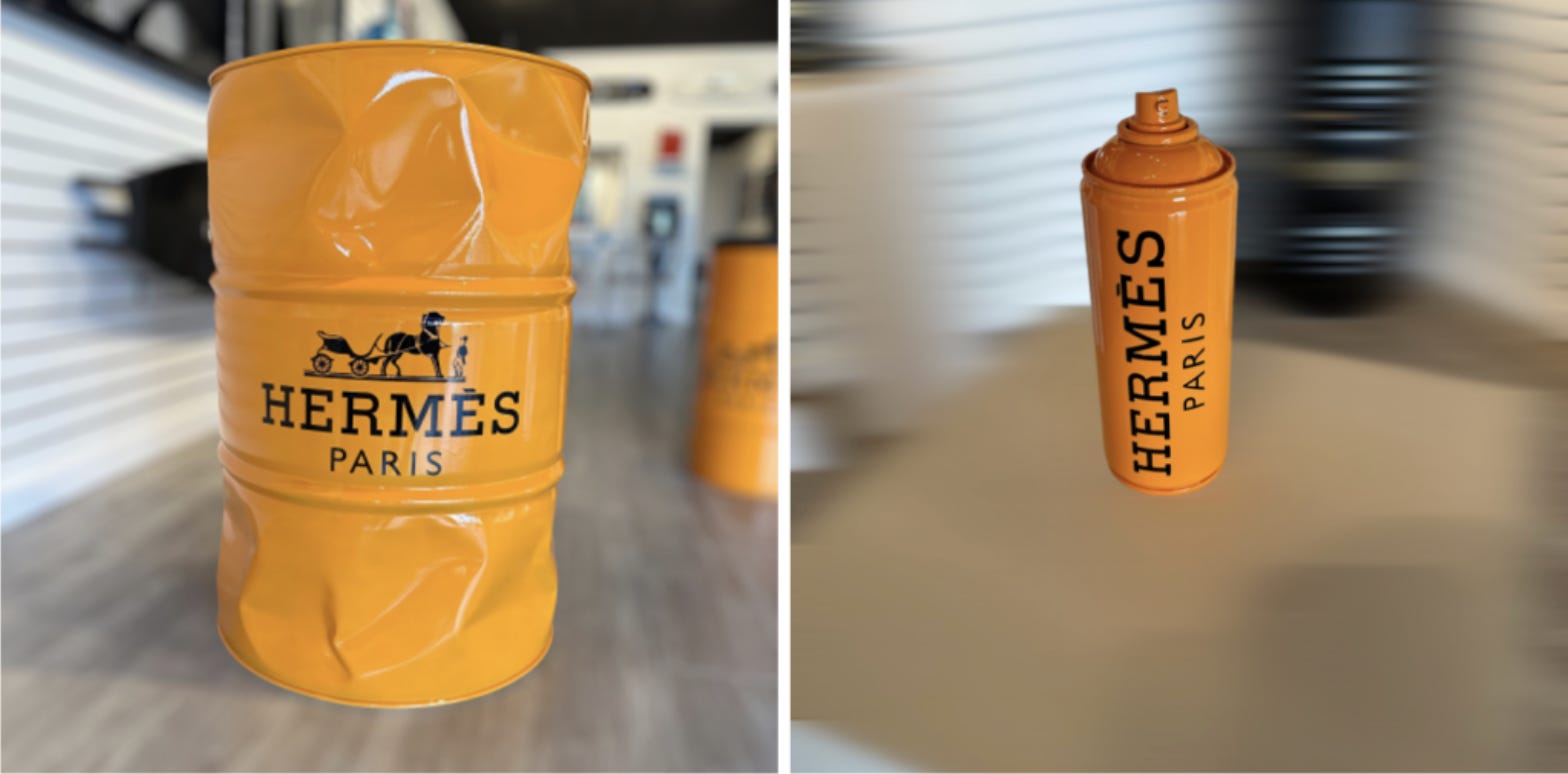
The Tribunal Judiciaire de Paris ruled earlier this month that Le Bidon Français, a French company that sells decorative objects covered with luxury logos, infringed on Hermès’s trademark, The Fashion Law reported this week. In the case, Le Bidon Français argued that the pieces were satirical artworks, juxtaposing one of the world’s most rarefied luxury brands with mundane—or even absurd—objects. The judges weren’t convinced.
The court’s reasoning is fascinating because it didn’t dismiss the idea that luxury trademarks can appear in works of art. Quite the contrary: It drew a distinction between artistic expression and commercial exploitation. Once identical Hermès trademarks were being used not merely as artistic material but to market, promote, hashtag, and sell products, the court found that consumers could reasonably believe there was a commercial relationship with Hermès.
It’s an important ruling, especially as the market for “luxury art objects,” upcycled designer goods, and logo-based collectibles continues to explode. But it also raises a larger question: Where, exactly, is the line? Because artists have been using luxury logos for decades as both subject matter and social commentary.
No one has understood this better than New York artist Tom Sachs.
In the mid-1990s, Sachs began making sculptures bearing with the logos of luxury houses. Sometimes, he painted the logo on the item, sometimes he upcycled existing luxury detritus, like logo-covered shopping bags and shoeboxes. He presented these pieces in a show called Creativity is the Enemy at Thomas Healy Gallery in New York in 1998, and at the Galerie Thaddeus Ropac in Paris in 1999. I attended the opening during Couture Week, and it was amazing to watch all these fashion people like Isabella Blow and André Leon Talley taking in art that skewered their work, and them personally. Sachs’ Prada Value Meal transformed a McDonald’s Happy Meal into an object of luxury obsession. His Hermès Value Meal performed the same sleight of hand.
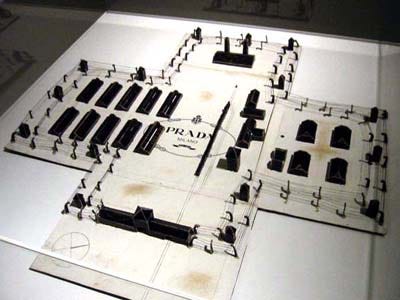
The Prada Deathcamp was a model of a World War II concentration camp built from Prada shoeboxes and packaging. It provoked outrage—as Sachs intended. His point was not to compare Prada to Nazi Germany. It was to ask why luxury brands exert such extraordinary psychological power over us. As he famously put it, “Fashion, like fascism, is about loss of identity.” It was a deliberately provocative way of arguing that consumer culture can demand conformity every bit as effectively as political ideology.
Most unsettling, however, was Chanel Guillotine, 15-foot-tall replica of the French execution device, painted black—a shade Coco Chanel transformed from funereal to fashionable—and bearing the house logo. Priced at roughly $45,000, Chanel Guillotine tied together one of fashion’s most enduring symbols of elegance with one of history’s most brutal instruments of death. San Franciscan art patron Dodie Rosekrans bought it for her palazzo in Venice. She later donated it to the permanent collection of the Centre Pompidou.

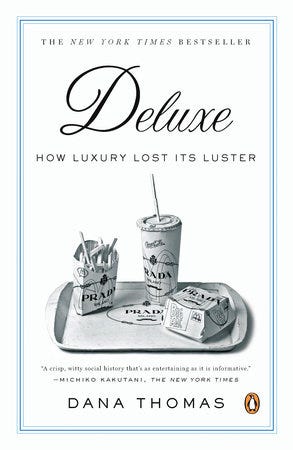
In the spring of 2006, I visited Sachs in Milan while he was installing an exhibition at the original Fondazione Prada, next to the company’s headquarters. As we walked through the galleries, I asked if I could use an image of Prada Value Meal for the cover of my forthcoming book, Deluxe: How Luxury Lost Its Luster. As I explained to him, the sculpture distilled, in one unforgettable image, the very argument I was making in the book: that luxury had become less about craftsmanship than branding, less about the object than the logo, and, in the age of globalization and corporatization, it had been massified. He said: “Absolutely.”
Comments
Nothing yet. Say the first thing.
Sign in to join the conversation.