
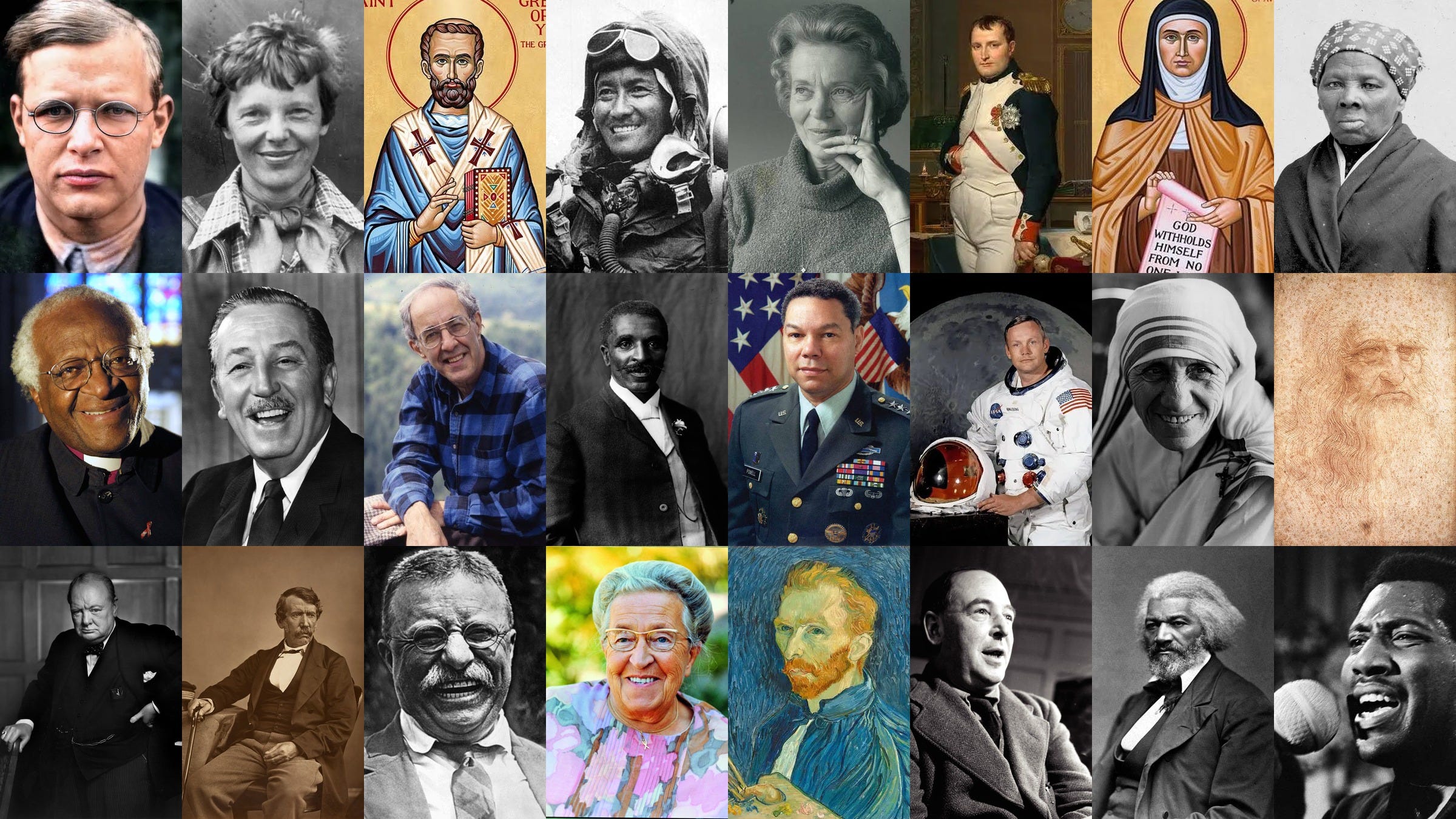
I like lists.
Some nights I fall asleep naming the fifty state capitals. It’s a thing, I know. And yes, I know Montpelier is the capital of Vermont, which is also the smallest state capital in the country by a wide margin.1 Other nights it’s Tom Cruise movies. Or Tom Hanks. I can usually get to around forty on either one before I’m out, which is usually somewhere around MI:Fallout or Bridge of Spies.
There’s a third list, and it’s my favorite. I lie there thinking about who I’d want to interview if I had a podcast and a time machine. Not people I’d want to meet. People I’d want to ask things. There’s a clear difference, and anyone who’s ever sat beside a fascinating person at a dinner, struggling to think of good questions, knows exactly what it is.
Two rules. Everybody on it is dead, and nobody on it is in the Bible. The second rule is the one that took discipline. Once you let Paul in, the list is over, because the list becomes Paul and then a lot of people who aren’t Paul.
Technically, the list lands at 52, but nobody is choosing Orville over Wilbur. And it feels wrong leaving Meriwether Lewis behind.
Winston Churchill
Frederick Douglass
Theodore Roosevelt
Corrie ten Boom
George Washington Carver
St. Gregory the Great
Dietrich Bonhoeffer
Leonardo da Vinci
C.S. Lewis
Elisabeth Elliot
Otis Redding
Harriet Tubman
Ulysses S. Grant
Abraham Lincoln
St. Teresa of Ávila
John Adams
Benjamin Franklin
Neil Armstrong
Johann Sebastian Bach
The Wright Brothers
Martin Luther King Jr.
Elie Wiesel
Mother Teresa
Timothy Keller
Albert Einstein
William Wilberforce
Brother Lawrence
Eugene Peterson
St. Ignatius of Loyola
St. John of the Cross
Henri Nouwen
Major Dick Winters
Walt Disney
Aretha Franklin
Vincent van Gogh
Ronald Reagan
Lewis and Clark
David Livingstone
Napoleon
Steve Jobs
Thomas Edison
Ernest Shackleton
Desmond Tutu
Nelson Mandela
Colin Powell
Fred Rogers
Amelia Earhart
Tenzing Norgay
Rembrandt
Jackie Robinson
I’ve read quite a few of their biographies. I intend to read all of them, which is either a reasonable goal or a confession about how I spend my evenings.
The list above is in rough order. Not a ranking, exactly, just the order I’d dial if somebody handed me the phone and an afternoon. Here’s what I’d be after from the top ten.
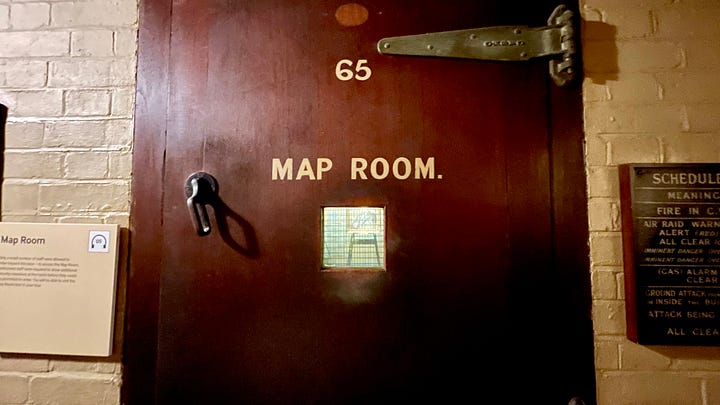

Winston Churchill. The Churchill War Rooms in London are one of my favorite places on earth. You go down under Whitehall into the actual rooms where he ran the war, and the maps are still on the walls with the pins still in them. I wouldn’t want his strategy. It’s the other thing. How do you talk to people who are being bombed every night and give them hope without lying to them? He was accessible in a way leaders at that altitude usually aren’t, and he had the nerve to stand when standing looked foolish.
Frederick Douglass. David Blight’s Frederick Douglass: Prophet of Freedom is riveting, and I highly recommend.2 I’ve stood in his house at Cedar Hill outside DC, up on the hill looking back across the river at the Capitol, and sensed the weight of what he carried.3 I want to be careful here. I can’t connect to what he lived. I’m not going to pretend I can. What I can admire is his ability to communicate. He taught himself to read in secret and then out-argued a country that had legislated against his literacy.

Theodore Roosevelt. What a guy. He lived three lives and never once slowed down. After he left the presidency he shot big game in Africa for the Smithsonian, ran again in 1912 and took a bullet in the chest mid-campaign and gave the speech anyway, and then at fifty-five went down an uncharted tributary of the Amazon that nearly killed him and broke his health for good.4 Read all three volumes of Edmund Morris. The post-presidency is the most riveting part, and almost nobody knows it.
Corrie ten Boom. A childhood hero, and one of the people who shaped me before I knew it. I’ve stood in the house in Haarlem, Holland, and seen the hiding place they built into the wall of her bedroom.5 I didn’t want to leave. Then there’s Munich, 1947. She’d just finished speaking in a church, and a man came up with his hand out, and she recognized him as a guard from Ravensbrück. She wrote later that she put her hand in his “woodenly, mechanically.” She chose to forgive, and except for grace, that cost was everything.



George Washington Carver. Another hero. He was born enslaved around 1864 with no birth date recorded, and spent his life trying to keep Southern farmers alive on soil that had been farmed to death. Among hundreds of inventions, he secured only three patents and let the rest. He treated his laboratory as a place to ask God for wisdom. Not devotion bolted onto the side of the work. Devotion inside the work. That should challenge any Christian who thinks making the world better is a side project while we wait for heaven.
Gregory the Great. He wrote The Book of Pastoral Rule in the 590s, and clergy were still handing it out a thousand years later. It has been around for fourteen centuries, and it’s still relevant.6 As a pastor, his account of what the work actually is pulls me back to what matters most. He also made “servant of the servants of God” the standard way a pope signs his name, and when he was elected he wrote to the emperor asking him not to confirm it. I’d like an hour with a man who wrote the manual and didn’t want the job.
Dietrich Bonhoeffer. Everybody knows the plot and the execution. I’m more interested in Finkenwalde, the underground seminary he ran from 1935 until the Gestapo shut it down in 1937, where he was training young pastors for a church that was busy accommodating itself to evil. Life Together came out of that house.7 He arrived in New York in June 1939 with a lectureship, a visa, and every reason to stay, but he sailed home in July. He was hanged on the morning of April 9, 1945, fourteen days before American troops reached the camp. The recent film and the popular biography both have their flaws, and both are still worth your time.
Leonardo da Vinci. Isaacson’s biography brought him to life for me.8 We file him under artist, but that’s the least interesting thing about him. Roughly seven thousand pages of his notebooks survive, and scholars think that’s maybe a quarter of what he actually filled, while he finished fewer than twenty paintings.9 He never stopped learning, and he never stopped being amazed by small things. Woodpecker tongues. How water moves around an obstacle. I want to ask him about the ratio of curiosity to finishing.
C.S. Lewis. What can I say. I love Narnia. The same mind built fantastical worlds and made apologetics something an ordinary person could grasp. I don’t know how one person does both. I’ve been to the Kilns outside Oxford, where he lived through all the Narnia years, and will never forget it. He gave in first to God, and only later to Christianity, and on the first night he wrote that he was “perhaps, that night, the most dejected and reluctant convert in all England.”10

Elisabeth Elliot. Her husband Jim was speared to death on a sandbar on the Curaray River in Ecuador in January 1956, along with four other men.11 Two years later she walked into Waorani territory to live among the people who killed him, with her three-year-old daughter Valerie.12 Courage is too small a word for that. Going back, forgiving, staying, loving, all of it while still in grief and not on the far side of it. That’s grace doing something a person can’t.
We’ve had the privilege of standing in a few of these rooms. But almost everything I know about these people came from books I read in a chair. Blight on Douglass. All three volumes of Morris on Roosevelt. Isaacson on Leonardo. Find the one you can’t stop thinking about and dive deep. And if you ever get the chance, go stand where they stood.
Last week I wrote about not worrying whether you’re remembered.
And this week I made a list of fifty people to remember.
I’m not sure what that means, but here we are.
Here’s the thing: almost nobody on the list was working to be remembered.
Brother Lawrence spent his life washing dishes in a monastery kitchen, telling anyone who asked that God was as present at the sink as at the altar. He didn’t write the book that made him famous. Somebody else wrote down his conversations after he died.13
Tenzing Norgay and Edmund Hillary agreed at first to say only that they’d reached the summit of Everest together, and two years later Tenzing wrote plainly that Hillary stepped up first. He was the one man alive who could have taken that, and he gave it away in print.
Almost nobody knew Vincent van Gogh’s name when he died. Everything he became happened without him.

Otis Redding cut “(Sittin’ On) The Dock of the Bay” on a Thursday in December of 1967 and was dead in a Wisconsin lake three days later, at twenty-six. It became the first posthumous number one in American chart history. He never heard it on the radio.
None of that is legacy management. It’s people absorbed in something else, and the remembering caught up later.
Theologians call this vocation, from the Latin vocare, meaning “to call.” The whole point of the word is that the work comes from outside you. You don’t go shopping for an assignment; you’re gifted (or burdened) with one, and the only real question is whether you’ll embrace it. Do the emotional labor, face your fears, and try anyway. We all have “chatter.” It’s the insecurity that says, “Is this worth it?” “Will anyone care?” “What if this fails?”
That’s why these two ideas aren’t truly at odds: don’t dedicate your life to striving to be remembered, but feel free to remember those who matter.
This is where you come in, and I’m asking for real.
I’m fascinated by what other people are fascinated by. And the list above says an embarrassing amount about me: heavy on the twentieth century, heavy on Americans, and heavy on people who held their ground even when it cost them.
So tell me, who would you add?
Give me number fifty-one. One name… or ten. Same two rules: no biblical figures, and they have to be gone. If you want to be ruthless, tell me which of my fifty you’d cut to make room, and I promise not to be precious about it.
I’ll read every one. And I’ll steal a few.
See you next week.
Montpelier’s population sits around 7,800. The next smallest is Pierre, South Dakota, at roughly 13,800.
David W. Blight, Frederick Douglass: Prophet of Freedom (Simon & Schuster, 2018). It won the Pulitzer.
The Frederick Douglass National Historic Site, 1411 W Street SE. He bought it in 1877 and died there in 1895.
The Milwaukee shooting was on October 14, 1912. The bullet was slowed by the folded fifty-page speech in his breast pocket and his steel glasses case; he spoke for about eighty minutes, and the doctors decided to leave it in him. The Smithsonian still has the manuscript with the hole in it.
It’s a museum now, free, by guided tour. The Munich scene is in Tramp for the Lord (1974), not The Hiding Place, which is in my Top 100 movies.
Alfred the Great had it translated into Old English in the 890s, which shows how quickly it spread.
The seminary moved to Finkenwalde in June 1935, and the Gestapo closed it in September 1937. Discipleship came out of the same period.
Walter Isaacson, Leonardo da Vinci (Simon & Schuster, 2017).
The figure of 7,200 pages quoted everywhere traces back to Isaacson rather than an actual count. Institutions say “roughly 7,000 sheets” and estimate that two-thirds to three-quarters of the material is lost.
The Kilns is a residential study centre rather than a museum, and visits are by arrangement. It’s really just an old, modest house. Lewis moved in in 1930 and died there in 1963. He did much of his actual writing in his rooms at Magdalen. The quote is from Surprised by Joy, chapter 14.
January 8, 1956, with Nate Saint, Ed McCully, Pete Fleming, and Roger Youderian. Nate Saint’s watch stopped at 3:12 in the afternoon.
October 8, 1958. The missionary literature of the period calls them “Auca,” which isn’t their word. It’s a Kichwa term meaning savage or enemy, applied from outside. They call themselves Waorani, which means “true people.”
The Practice of the Presence of God was compiled by Joseph de Beaufort from Lawrence’s letters and four recorded conversations, and published after his death.
No posts
Comments
Nothing yet. Say the first thing.
Sign in to join the conversation.