
In this letter, I attempt to talk about misinformation [meaning: false information shared in good-faith] in left/progressive storytelling AND the realities of assault on woman. It gets dicey. Care is recommended.
Dear Friend,
I got taken on an emotional whiplash journey last week. I’m still recovering. And I want to talk about it.
Algorithms are collaborative—to some extent. What is shown to you is crafted by forces both within you, conscious and unconscious, and the preferences of the platform you view.
So when you react to one kind of content, by liking or staying a few seconds longer, the algorithm adjusts itself. It wants to keep you locked in and engaged. That’s how it makes money, by getting to show you more advertisements.
We know this. But restating it feels important for what follows.
Yesterday, a surge of feminist content swept me along because I am very feminist. The story as it arrived to me in fragments via instagram reels: 62 million visitors in one month to an online “rape academy” where users learned how to drug their partners and produce content for others to see. The cited source: a CNN investigation.
The number 62 million sat on me like a loadstone that would drown me an inch of water.
When Robbie raised his eyebrows at the number repeated again and again in the reaction videos, I said “IT’S CNN.”
I try to practice awareness of where “facts” and stories come from. But I am prone to believing CNN and other formal news outlets who are known for fact checking. How could Robbie dismiss that number so easily when it was quoted so widely and from so reputable a source?
I angrily proceeded to look up the article so he could read it for himself.
And I could not find the article. I looked under multiple key words on the CNN website. How was this not front page news?
And then realized the article wasn’t linked in any of the videos I was watching / being fed. The videos included screenshots of the article but they were often flashed quickly, perhaps grabbed from another video rather than the article itself.
Robbie had to find it. Took a deep dive with the aid of ai but he found it. It was CNN in a series on women’s inequality for Women’s History Month in March.
The headline matched what I had seen/read on instagram. But the body of the article presented a very different picture than what had sunk me into a level of despair that filled my lungs and laid me flat.
My first search in the article: 62 million. This number does appear. But it does not mean visitors to a formal “how to drug your wife” tutorial. It was visitors to a porn site that (rather unethically in my opinion) does not moderate what users upload. 62 million visitors in one month to a free porn site seems totally… well… in keeping with human proclivities.
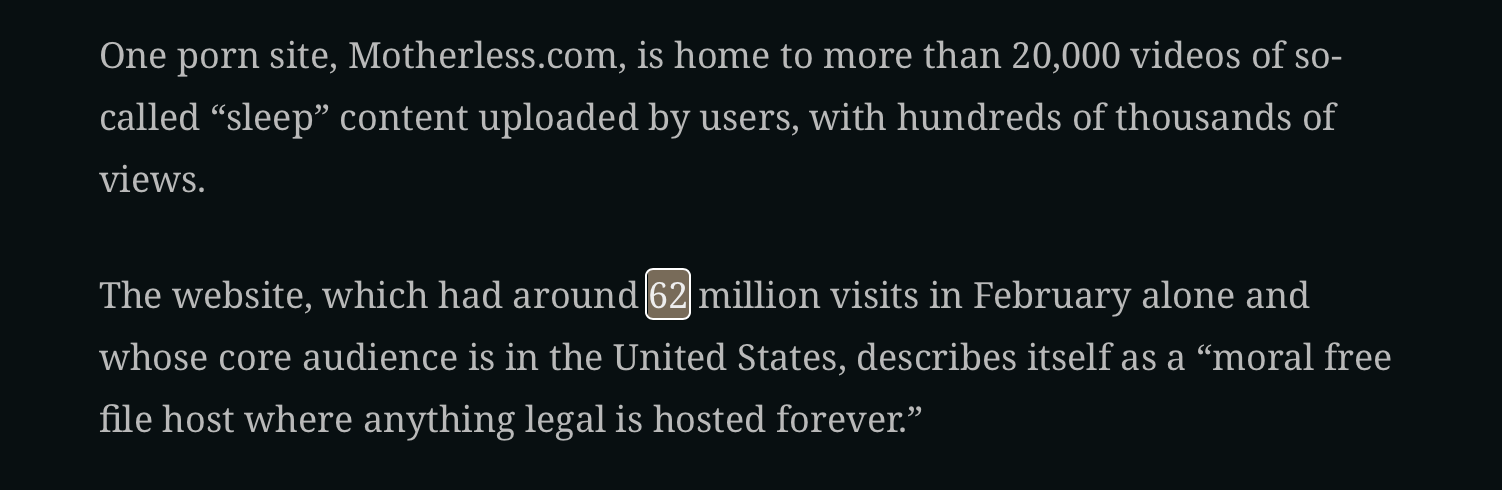
Not my fave. And also: not the same as 62 million men wanting to learn how to drug someone without detection.
Instead, there is a subset of videos on this site, numbering around 20k, that are defined by an unconscious-presenting woman. These videos have a few hundred thousands views.
Is this good? No. Is this more men than the population of NYC? No. It isn’t. Also: Not a webinar on how to drug.
The “rape academy” is a quote from a victim.
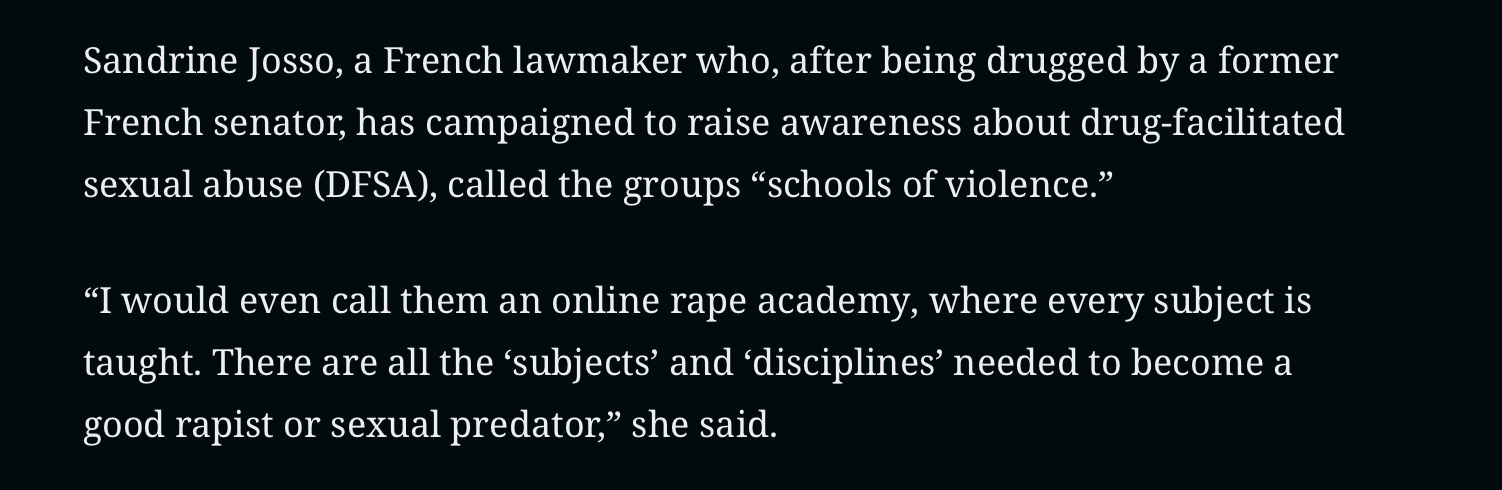
It’s a metaphor for real behaviors that educate in violence. How men who choose this kind of violence share how to produce it in comments on videos. Sales of “sleep aids” on porn sites. It’s the chat groups on Telegraph. It’s the presence of any content like this anywhere. It’s the quiet dissemination of information that underpins all violence that continues at scale.
And still: a metaphor.
Please hear me: this story is horrific. The existence of any coordination or spread of this form of violence, as we saw with the woman who refuses shame, Gisele Pelicot, is something should wreck us.
But I got taken on a very difficult and mentally devastating journey at a scale that is not what was happening in the article itself.
A screenshot from the article:
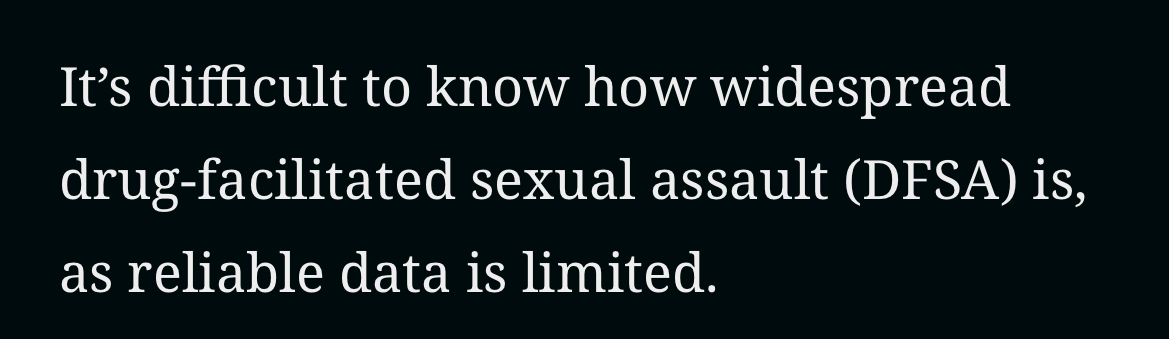
We know that all violence against women, especially intimate partner violence, is underreported and under prosecuted. This fact is hard to overstate.
And. Mis-quoting a number in an article is irresponsible. We cannot address real harm in this world if we run around screaming falsehoods framed as “the real story.”
The backlash to correcting these statements wasn’t great; the immediate assumption was that the data-corrector didn’t care about women or the scale of violence against women. That there was no empathy or alarm for the ways the internet proliferates violence when it connects the worst of human beings to others who affirm and hunger for this.
Frankly, I have empathy for myself and for the harm I feel from this instagram scroll. I felt played. I felt lied to by people who (I don’t believe) knew they were misrepresenting the story.
My feelings are not a critique of the thoughtful, well-researched and investigated article by Saskya Vandoorne, Kara Fox, Niamh Kennedy, Eleanor Stubbs and Marco Chacon for CNN. Nor of the media-centered design for how the story was told by CNN. It was a great experiment in how to bring readers into realities they are unaware of.
The frustration is with those who feel as passionately and as big and deep as I do. Who reject violence against women. Who work hard to address the misogyny woven into our every breath and movement in the world, the water we swim in.
To those of us longing for a world made by human beings who care for each other: We must must do right by facts in our work. We must reject telling others to change by using second-hand trauma as a goad. We must tell stories with the careful frame in which they were delivered to us by skilled people—not fragmented “facts” wielded as knives.
When we don’t, we’re all gashed and bleeding in the aftermath.
With Love and Trepidation,
Dana
Far more useful than anything I say here:
an analysis by philsopher Kate Manne on the whys of this particular type of violence by men.
Comments
Nothing yet. Say the first thing.
Sign in to join the conversation.