
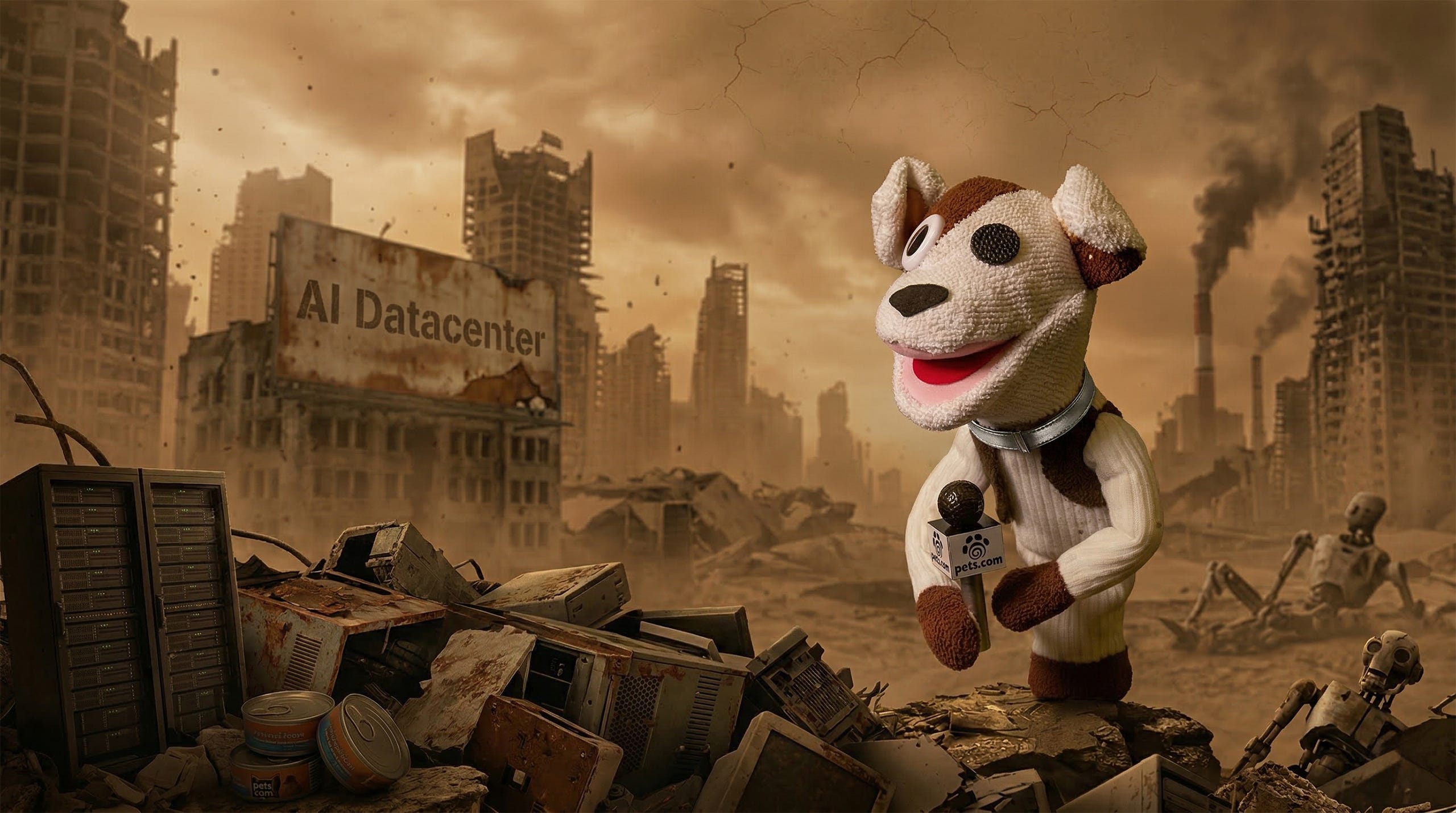
A few days ago, I saw an interesting question posed on Threads. Someone posted the following (lightly edited for clarity):
“I’d love to hear from folks who were in their careers in the 90s. Did the early web leading up to the dotcom boom and bust feel as exhausting as AI does now? And I’m wondering what the similarities are from the early web era. Is this fast movement the same, or is it…fake? Is it indicative of this being a trend destined to bust, or something else?”
And I thought, wow, that really encapsulates a lot of what feels familiar about the AI era to us old heads. I replied:
“I worked at print magazines back then that were just starting to add websites (often run totally separately by third-party companies). There was a definite feel of trying to shoehorn a web component into everything, much like AI now...but in the end, most everything went online-only, so they weren’t wrong.”
If you weren’t around back then, it’s true. Traditional media properties like magazines, radio stations, etc., were both fast to embrace the web in a way, but also slow to really embrace it.
By that I mean magazines I worked at, including Beer Connoisseur and Beverage World (both exactly what they sound like) added a web component very early on, in the late ‘90s. But, those sites were handled offsite, usually by a third-party marketing agency that would create a simple website and maybe pull in a couple of articles at most. After all, the thinking went, we’re charging cash money for a print magazine, why would we simply post the same content online for free?
If you think about it (and I have), those naysayers were entirely correct. Posting everything for free online that you used to charge for is the original sin of online media.
But within a couple of years, everyone was online-first, and the newsstand print magazines I used to freelance for, including SPIN, Blender, Maxim, and others, all went away, or became mere shadows of their former selves. Soon enough, the online strategy was the only one that mattered, even though -- and this was true in the early 2000s and remains true now -- we still haven’t come up with a monetization plan that beats paying five bucks an issue at the newsstand.
This moment feels like the 1997 of the AI era. We’re just warming up to a massive change that’s inevitable, like it or not. There are AI naysayers now, just as there were dotcom naysayers then. Those naysayers were both right and wrong about the dotcom boom. It did go bust, just as many businesses are going bust now because of the endless free(ish) labor of AI distorting and destroying business models.
This moment feels like the 1997 of the AI era.
But despite the dotcom bust wreckage, we emerged as an internet-first culture, something that won’t change anytime soon. We’ll likely have a giant AI bust as well, but the underlying concepts aren’t going away, and anyone who thinks otherwise hasn’t thought about the timeline it took to go from Alta Vista and Pets.com to Google and Amazon.
The dotcom boom and the AI boom are bookends for the democratization of content distribution. The first opened the door for anyone with a little talent and hard work to become a publisher. Now the AI boom closes that door in a way, flooding the internet with AI-generated slop, drowning out everyone else stuck at producing content at mere human speeds.
When everyone else started talking to their computers instead of typing, I laughed at them. I thought text-to-speech was something only weirdos did. Speech input and transcription tools were always merely okay. Functional, but not exciting and rarely extraordinary.
Then something strange happened. I tried it, and I liked it.
I didn’t try just any speech-to-text tool, although I had already started occasionally using the ones built into Google Gemini and similar apps in an effort to interact with AI using a more natural rhythm.
No, the major shift happened when I started to see people asking on social media to name software they paid for that was so worthwhile they didn’t mind paying for it. The most common reply in these social media threads was Wispr Flow.
There are plenty of tools that are worth paying for. Adobe’s Creative Suite comes to mind (I know...but it is). Yet to imagine a tool that people pay for and -- more importantly -- don’t mind paying for; well, that’s got to be something special. So eventually I put my anti-voice-typing bias aside and downloaded Wispr Flow on my Mac.
I’ll be goddamned if it wasn’t the most magical thing I had ever experienced. At least the most magical thing I’d experienced on a computer in years.
So if an old guy like me — old enough, as I admitted at the recent Apple MacBook Neo launch event, to have attended the original MacBook Air launch event — can learn some new tricks, including how to love Wispr Flow, well then it’s probably pretty okay for just about everybody.
I’ll be goddamned if Wispr Flow wasn’t the most magical thing I had ever experienced.
I’m calling it the era of audible computing. You can call it whatever you want: voice-first computing, conversational UI, natural language user interface. It’s not really ambient computing because that asks for your device to be listening to you all the time, much like Alexa.
I think the key to Wispr Flow’s success is that it’s only listening when you want it to, because you have to press and hold an activation key. It’s that tiny little bit of added friction that actually makes the tool so much more useful because it’s only listening when you ask it to.
Now Wispr Flow isn’t perfect. It works great on Macs. It doesn’t really work that great on iPhones, or I assume, Android phones. It also doesn’t seem to work as well on Windows PCs, which I use a lot because I’m primarily in the Windows PC business. But even the occasionally tricky implementation on Windows is still a lot better than previous text-to-speech tools I’ve used.
Hell, I’ve even dictated most of this newsletter using Wispr Flow. I’ll dictate a couple of lines off the top of my head, then I pause, think some more, then dictate some more. After I have a large enough block of text, I go back and edit it by hand. I dictated most of the previous newsletter using Wispr Flow as well.
The one big drawback is that I like to do a lot of writing and creating in coffee shops or in public. And talking to my computer like a maniac in front of strangers drinking their cappuccinos is not a great look for me. But the brain-to-mouth-to-screen connection already feels much more nimble than the old school brain-to-fingers-to-computer pathway.
For the ultimate coffee shop typing experience, I’d need to cut out the middleman and wait for someone to invent a simple brain-to-computer interface. Or maybe I should be careful what I wish for.
Read my NYT-reviewed gaming history book: The Tetris Effect
Play my tabletop game, Techlandia!
Threads: threads.net/@danack
Bsky: danackerman.Bsky.social
LinkedIn: linkedin.com/in/danackerman
TikTok: tiktok.com/@danacknyc
YouTube: youtube.com/danackerman
MC News: microcenter.news
Comments
Nothing yet. Say the first thing.
Sign in to join the conversation.