
A separate TL;DR is provided for paid subscribers.
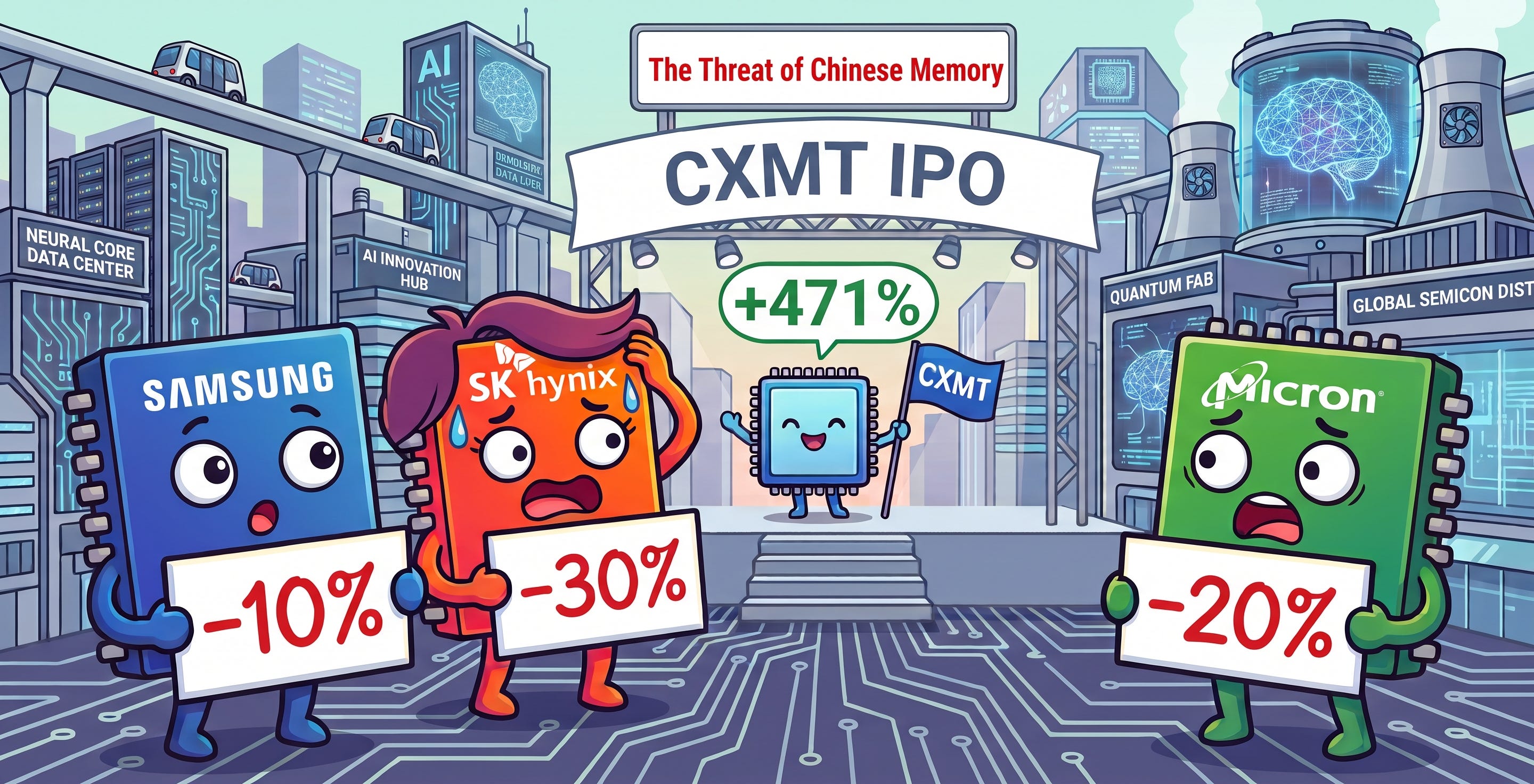
In mid-July 2026, when CXMT confirmed its listing date, Micron fell 8% and lost its one trillion dollar market capitalization, and Samsung Electronics and SK hynix sold off alongside it. The threat of Chinese memory had landed as a psychological shock.
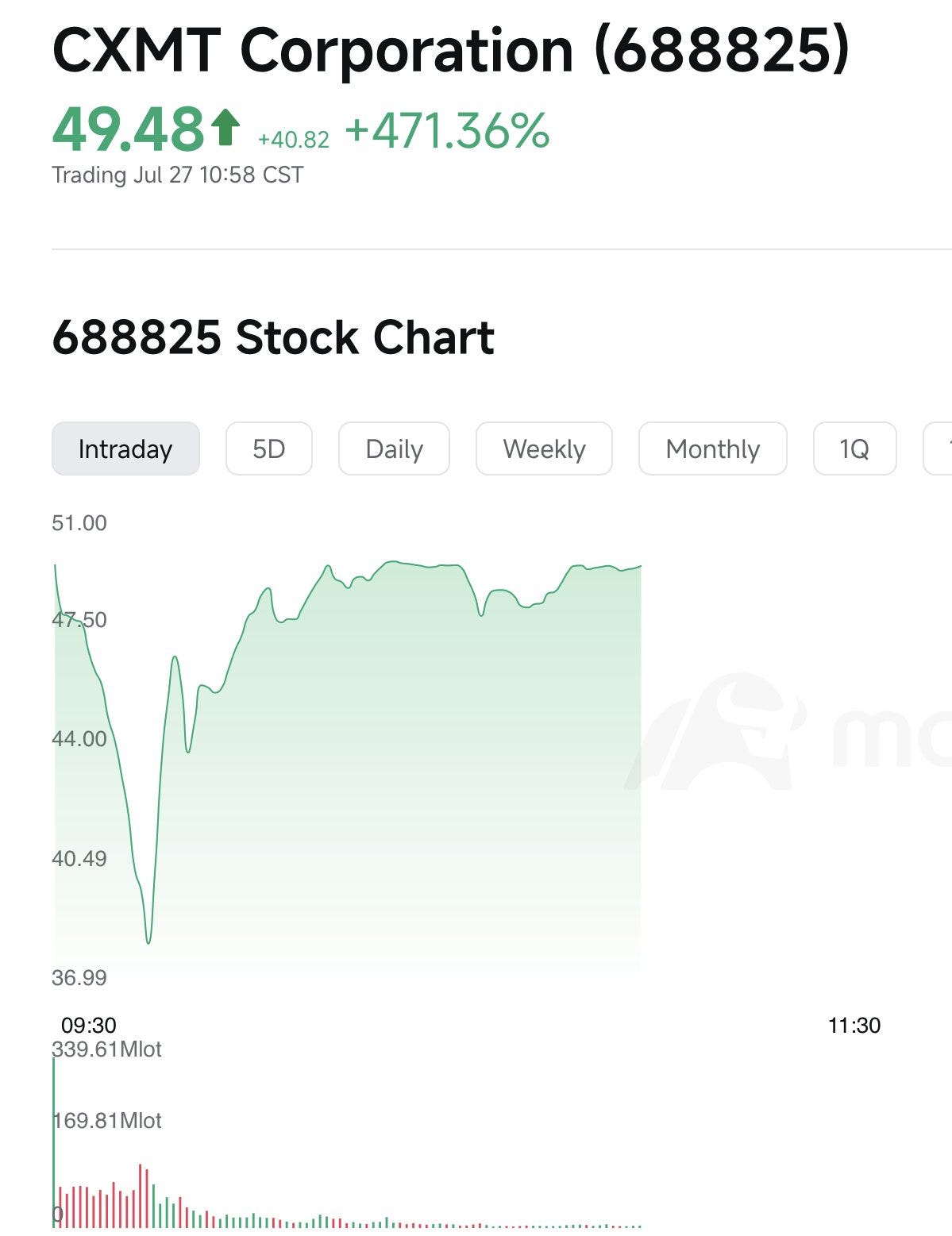
Then on 27 July CXMT opened at 49.50 yuan, 472% above its IPO price of 8.66. At that opening price its market capitalization of 3.31 trillion yuan made it the most valuable company listed on the A-share market, and by midday it had reached 54.65 yuan, up 531%. Samsung Electronics and SK hynix were both weak the same day, with foreign investors net sellers.
What exactly is the market worried about? In one sentence: that CXMT will break DRAM prices and shrink the profits of Samsung Electronics, SK hynix and Micron, the three incumbents. The claims that CXMT sells 30% below them and is taking their orders, that it already holds 8% of the market, that its IPO proceeds will flood the market with new supply, and that it is catching up in HBM all point at the same outcome.
This article takes those concerns one at a time and checks them against the available data, then lays out where the incumbents’ share prices go from the listing.
Memory
Is CXMT a Threat or an Illusion?
·
Apr 11
CXMT (长鑫存储, ChangXin Memory Technologies) is China’s largest DRAM company. Revenue surged in 2025, and the company is now pursuing a Shanghai IPO with a target valuation reportedly in the $42 billion range. It is already considered the world’s fourth-largest DRAM player by capacity.
Disclaimer
This article is for informational purposes only and is not a recommendation to buy or sell any security. The figures and facts it contains are compiled from publicly available sources including corporate disclosures, press reports and market research, and may carry errors from those sources or from the compilation. The author may hold positions in the companies mentioned. All investment decisions and their consequences rest with the reader.
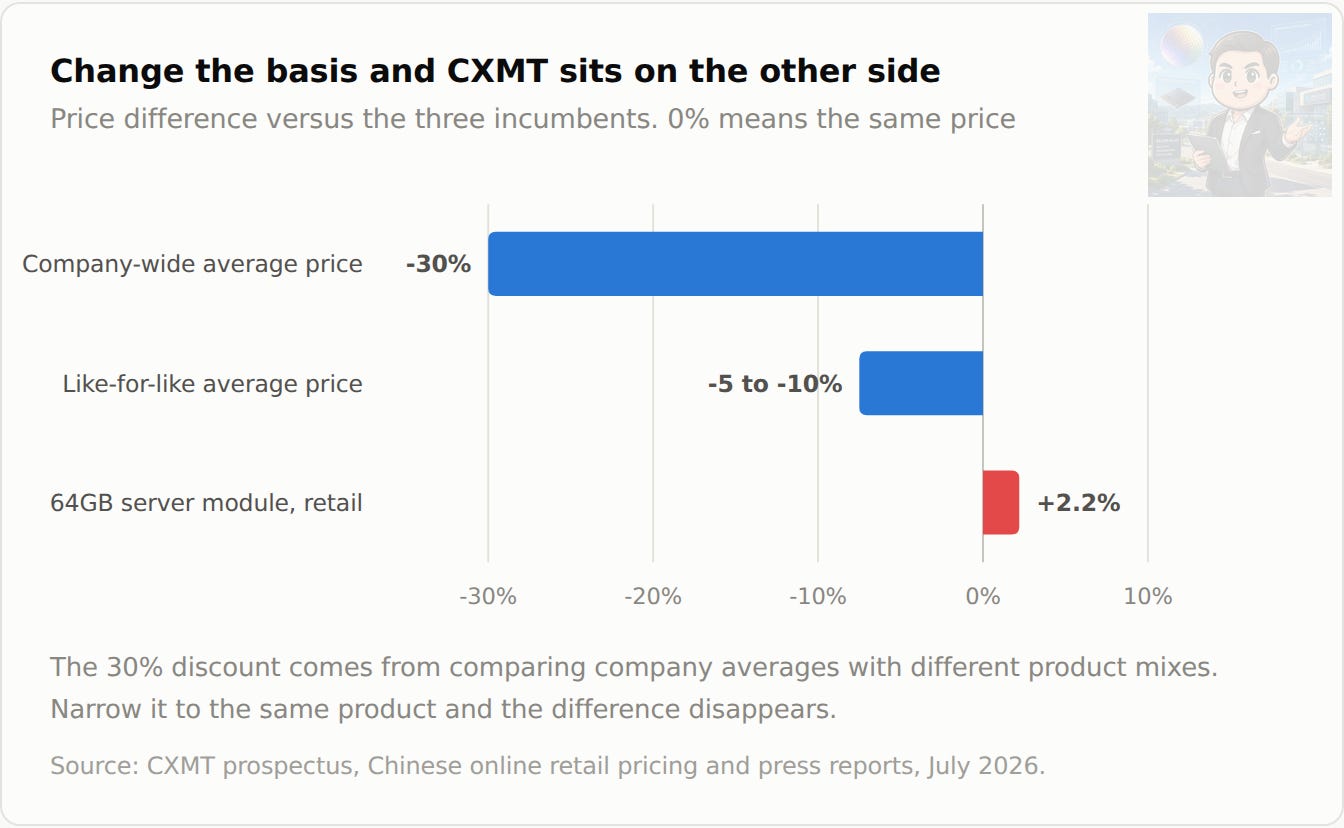
Start with what the 30% figure actually is.
It compares CXMT’s company-wide average selling price against the company-wide average selling price of the three incumbents. The gap is that wide because roughly two thirds of CXMT’s revenue comes from low-priced mobile memory, which pulls its company average down for reasons that have nothing to do with competitiveness.
Compare like for like and the picture changes.
The gap is 5% to 10% per the prospectus CXMT filed for its listing, and in server products the sign flips altogether.
In July 2026, a 64GB DDR5 server module built with CXMT chips sold for 18,999 yuan in Chinese online retail, while the same specification built with Samsung and SK hynix chips sold for 18,595 yuan, putting CXMT 2.2% higher.
In the contract market, CXMT was reported to have quoted above Samsung’s supply price of 1,240 dollars per module.
Why can CXMT not push its price lower? The reason is cost.
At its current level of technology, CXMT spends more than 30% more than the incumbents to produce the same amount of memory. Its chips are about 40% larger in area, and its yield, meaning the share of manufactured chips that work correctly, falls short of the 85% to 90% the industry treats as standard.
What about its market share? The 8% figure the market cites is a revenue number: CXMT booked 7.31 billion dollars of DRAM revenue in the first quarter of 2026, or 7.7% of the world market.
But revenue is a number that grows when prices rise.
Measure how much CXMT actually makes and the picture differs. It puts 13% of the world’s DRAM wafers into production and turns them into 6% of the memory capacity. Its chips are large and its yield is low, so half of what goes in disappears on the way from wafers to capacity. Wafer starts can be bought with capital, but the capacity that comes out of those wafers cannot.
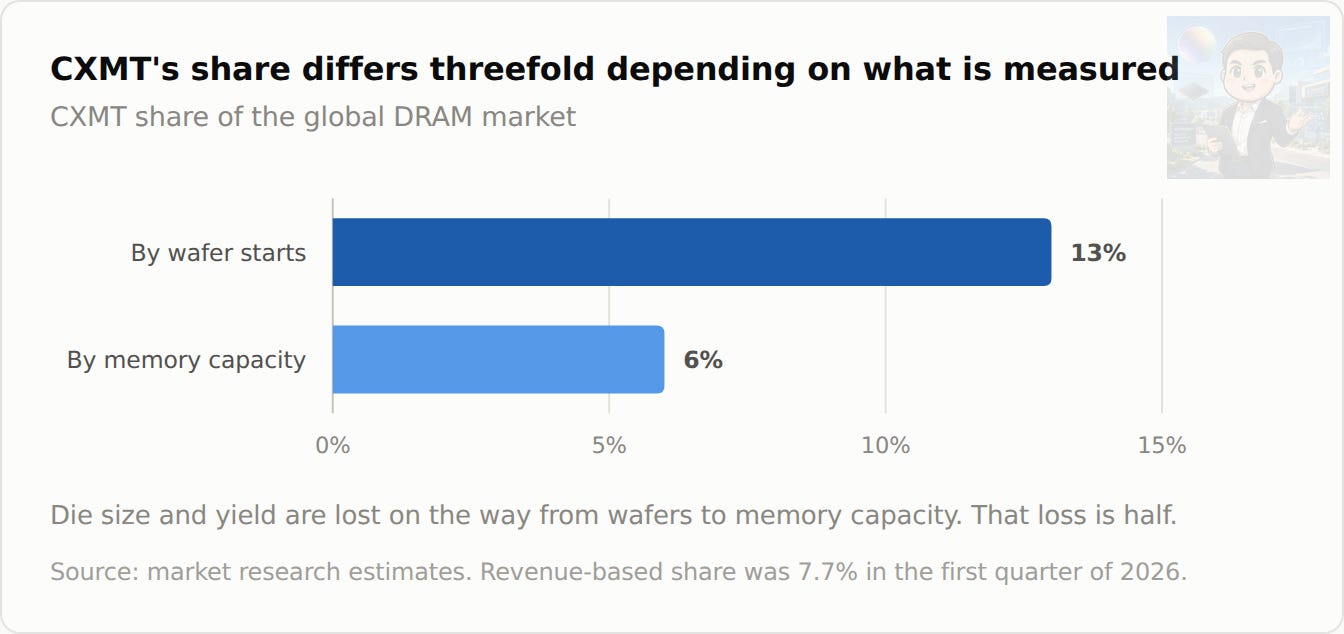
The number that startled the market is CXMT’s first quarter 2026 revenue, up 719% year over year. Measure that same quarter against the one before it, though, and the memory capacity it shipped grew only 11% while its average selling price rose 57%. What that means is that CXMT’s growth so far has been built by memory prices rather than by its own volume.
Memory
Will the Memory Stock Rally Keep Going?
·
May 12
SK hynix posted 72% operating margin in a single quarter. Micron is locking in 3-to-5-year supply agreements. Samsung had a quarter where conventional DRAM profitability exceeded HBM.
Conventional engineering wisdom says CXMT must carry a cost disadvantage because it uses DUV lithography, which prints circuit patterns with deep ultraviolet light, rather than the EUV equipment it cannot buy.
It has nonetheless kept shrinking its circuits using multi-patterning on DUV tools, printing the same layer in several passes. It brought 16nm-class DDR5 to volume production with no EUV option available to it at all.
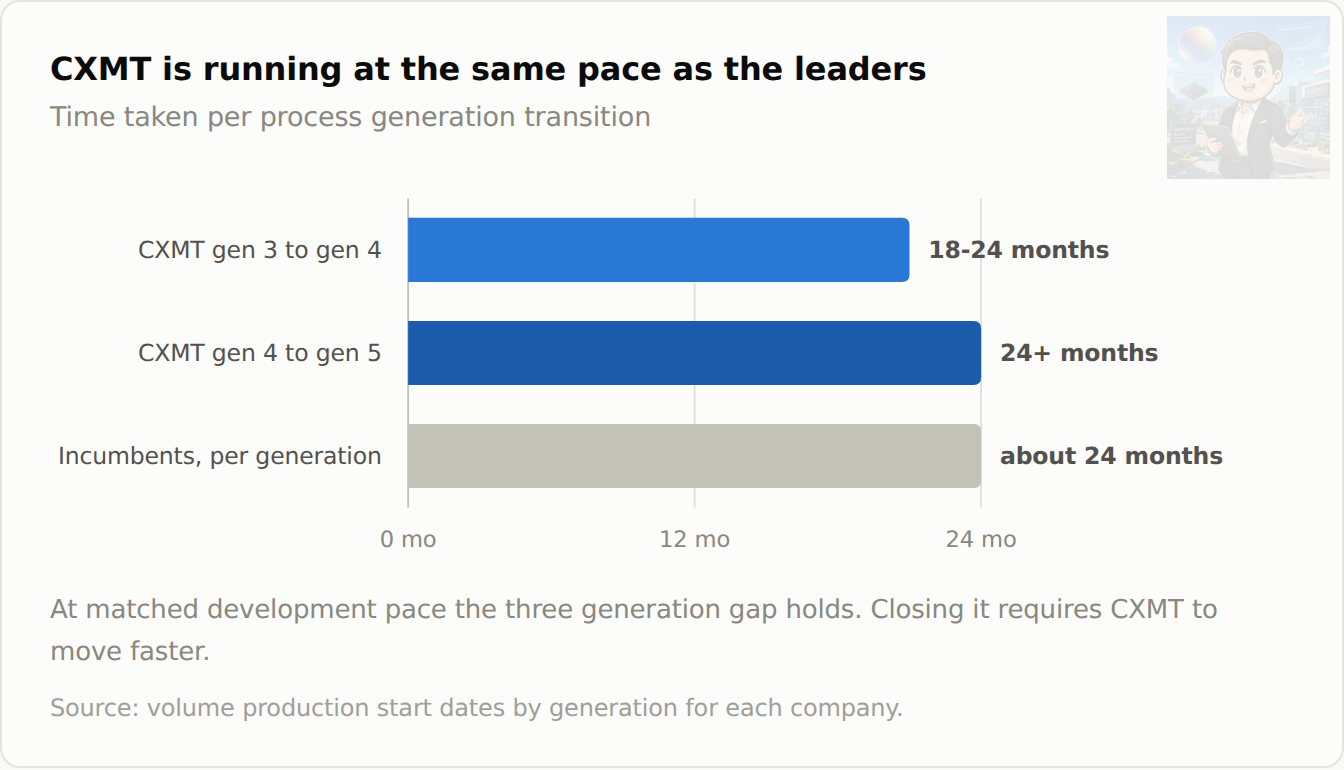
The problem is development pace. CXMT took 18 to 24 months to move from its third process generation to its fourth, and its fifth generation has already run past 24 months.
The incumbents also turn a generation roughly every 24 months, so even assuming CXMT holds that same pace, the fair conclusion is that the three generation gap to the major memory makers stays where it is.
The gap itself has closed quickly since 2019. But CXMT’s fifth generation has slipped toward the second half of 2026 while the incumbents ramp 1c and move on to the following node and to HBM4, so the rate of closing has flattened.
CXMT allocates less than 2% of its total wafer starts to HBM, or high bandwidth memory, which stacks DRAM chips vertically and connects them with electrodes running through the silicon. Its HBM3 schedule slipped on thermal problems, and the combined yield on the eight-high product is estimated at around 25%. The incumbents build the same product at 70% to 90%.
Memory
Why HBM Is So Hard to Make
·
Mar 20
HBM is everywhere in the conversation right now. Stock forums, news outlets, casual dinner tables — everyone’s heard that “HBM is in short supply” or “NVIDIA can’t build enough GPUs because of HBM.”
As CXMT shifts more capacity into HBM, ordinary DRAM prices come under upward pressure rather than downward. Stacking chips means HBM consumes roughly three times the wafer area of ordinary DDR5 for the same gigabyte. If CXMT converts 20% of its DRAM lines to HBM, the ordinary DRAM capacity coming off those lines drops to one third of what it was.
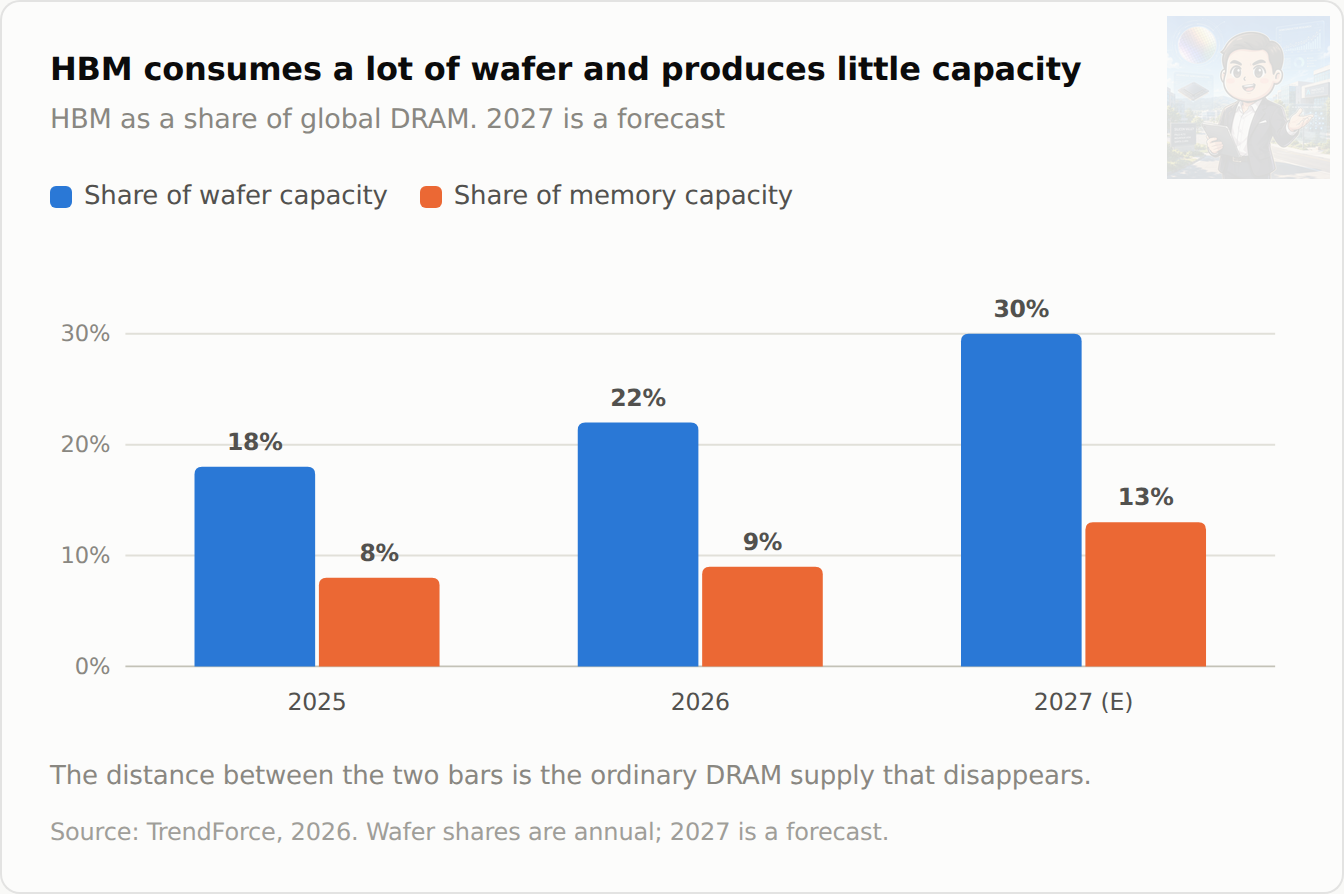
The same thing has already happened on the incumbents’ side. In 2026 HBM consumes 22% of global DRAM wafer capacity while producing only 9% of the memory capacity. That gap is the underlying reason ordinary DRAM is short today.
My view is that the concern about a flood of new supply from CXMT also needs to be placed on a different clock. Turning IPO proceeds into equipment orders and equipment into production takes 18 to 24 months, so the fair conclusion is that the supply this listing funds arrives in 2028 at the earliest.
There is also a story going around that CXMT will double its DRAM production capacity by 2030. It is said to have come out of a conference call Goldman Sachs held just before the listing.
I cannot verify whether the story is true, but there is something I want to stress.
Lately I keep seeing pieces written by press outlets and institutions without the technical background to write them, vague and rounded off, circulating as though they were established fact. The problem is that these distort what is actually happening, and the distortion reaches share prices.
Even if the story is true, what doubles is the number of wafers, not the memory capacity. Look again at the earlier figures. CXMT holds 13% of wafer starts and 6% of capacity. Doubling the wafers still leaves it near 12% on a capacity basis, and over those four years DRAM demand is set to grow far faster than that. Unless the technology gap between CXMT and the major memory makers narrows dramatically, I do not think this doubling figure has much effect on the market.
It makes more sense to read this news as good news for Chinese equipment makers such as Naura and AMEC than for the memory companies.
CXMT opened on 27 July at 49.50 yuan against an IPO price of 8.66, up 472%. At that opening price its market capitalization of 3.31 trillion yuan, or 489 billion dollars, made it the most valuable company on the A-share market. By midday it had reached 54.65 yuan, lifting the market capitalization to 3.7 trillion yuan, with more than 100 billion yuan traded in half a session.
Nomura initiated coverage on the day of the listing with a target price of 116 yuan. It expects CXMT to earn 5.80 yuan per share in 2028 and applies a multiple of 20 times to that, which works out to a market capitalization of 7.76 trillion yuan. Working backwards, the target assumes 2028 net profit of 388 billion yuan. That is 3.9 times what the market expects CXMT to earn this year, and more than Micron earns at the peak of a cycle.
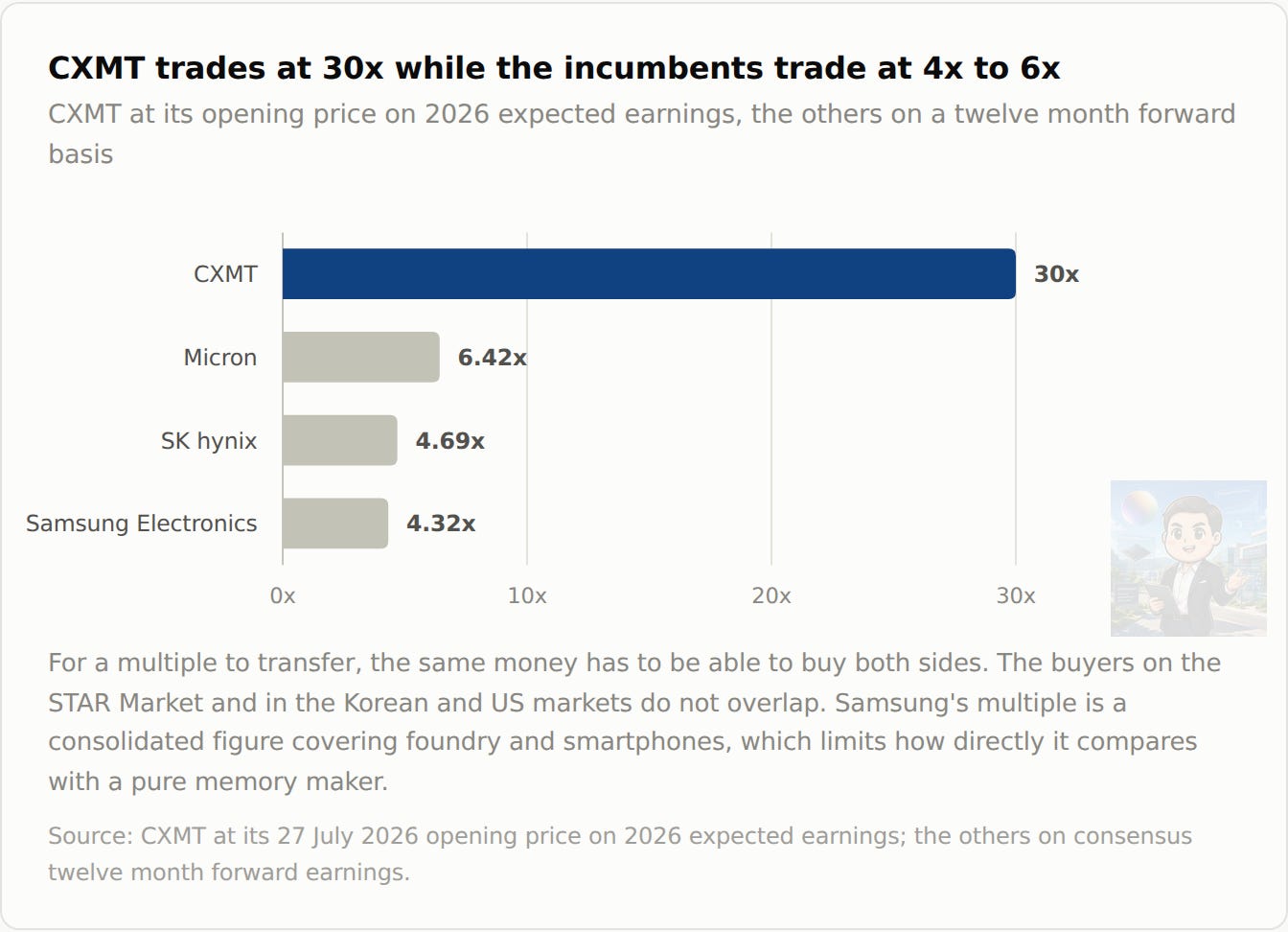
So where does the share price sit today? At its opening price, CXMT trades at roughly 30 times this year’s expected earnings. On the same day Samsung Electronics traded at 4.32 times, SK hynix at 4.69, and Micron at 6.42.
The closest precedent in the same market for judging where CXMT goes next is likely SMIC. It opened at 95 yuan on its first day in July 2020, up 246%, and never traded above that price again. Ten weeks later it was 48% below that high, and a year later it was still 32% below it. It never broke its IPO price, though, and remained 136% above it a year on.
CXMT does have far fewer freely traded shares than SMIC did, and it lists into the particular conditions of an AI infrastructure bottleneck, so its path may differ.
My forecast is nonetheless that the first day of trading, the point where expectations run hottest, marks the high, and that the high holds for a considerable period. A large correction around the first lockup release in January 2027 is also possible. I do not expect the stock to fall below its IPO price: state capital sits behind it, it is the only pure-play DRAM stock on the A-share market, and memory remains a powerful theme.
So what happens to the three incumbents’ share prices over that stretch?
My own view is that the recent memory correction is more likely to end after the CXMT IPO than to continue.
The market has already priced much of its concern about slowing earnings growth into memory shares, and for the decline to keep going you need either memory earnings to turn down or AI demand to reverse outright. Neither price nor volume shows any sign of coming down, and that is how the industry reads it today.
Let me look at the three companies more closely.
SK hynix has its earnings concentrated in HBM. CXMT cannot enter that segment, so of the three SK hynix is the most insulated from it. Against that, those earnings rest on the capital spending plans of the handful of customers buying AI accelerators. What moves SK hynix shares is that, not CXMT.
Samsung Electronics sells the largest share of its output to Chinese smartphone and PC manufacturers. It is hit first and hardest if Chinese procurement directives widen to memory, and what CXMT can push outside China is commodity mobile and PC DRAM rather than server product, so Samsung meets that price competition first as well. Against that, its forward multiple of 4.32 times is the lowest of the three, so much of the risk already sits in the price.
Micron has the least left to lose in China. Its mainland China revenue fell from 12% of the total to the 7% range after the 2023 purchase ban, and it exited the Chinese server memory business in October 2025. Its automotive and smartphone business in China continues, but the data center exposure is already gone. It competes with CXMT for the same customers outside China, but if the United States moves to exclude Chinese memory from data centers and government procurement, that competition never arrives in North America. Its multiple, at 6.42 times, is the highest of the three.
No posts
Comments
Nothing yet. Say the first thing.
Sign in to join the conversation.