
Scene: Saturday morning at home. Everybody gets up slowly. We have breakfast and read some books on the couch. Weather report says rain.
We start our weekend errands. Annie and F (the seven-year-old) head to the grocery store for our big weekly shop, while J (the toddler) comes with me to the hardware store for spackle, seeds for our vegetable garden, and a new laundry basket to replace the one F and J destroyed by using it as a rocket ship.
We’re back home by the time thousands of other New Yorkers are heading to Bryant Park for the Hands Off protest. It’s raining. I know it’s important to show up, and yet: do we really want to drag two soaked, screaming kids through packed crowds? In midtown??
I’m on the edge, and Annie wants to go, but what seals the deal is F insisting that we go. As she puts it: “Duh, rain jackets exist, you know.”
So we’re going. But F also insists that we have to bring signs. We re-purpose some boxes, get out the sharpies, and come up with some ideas. Lord help us for introducing our seven-year-old to the John Lewis quote about “good trouble”—I can just see the future ways she uses this one against us.
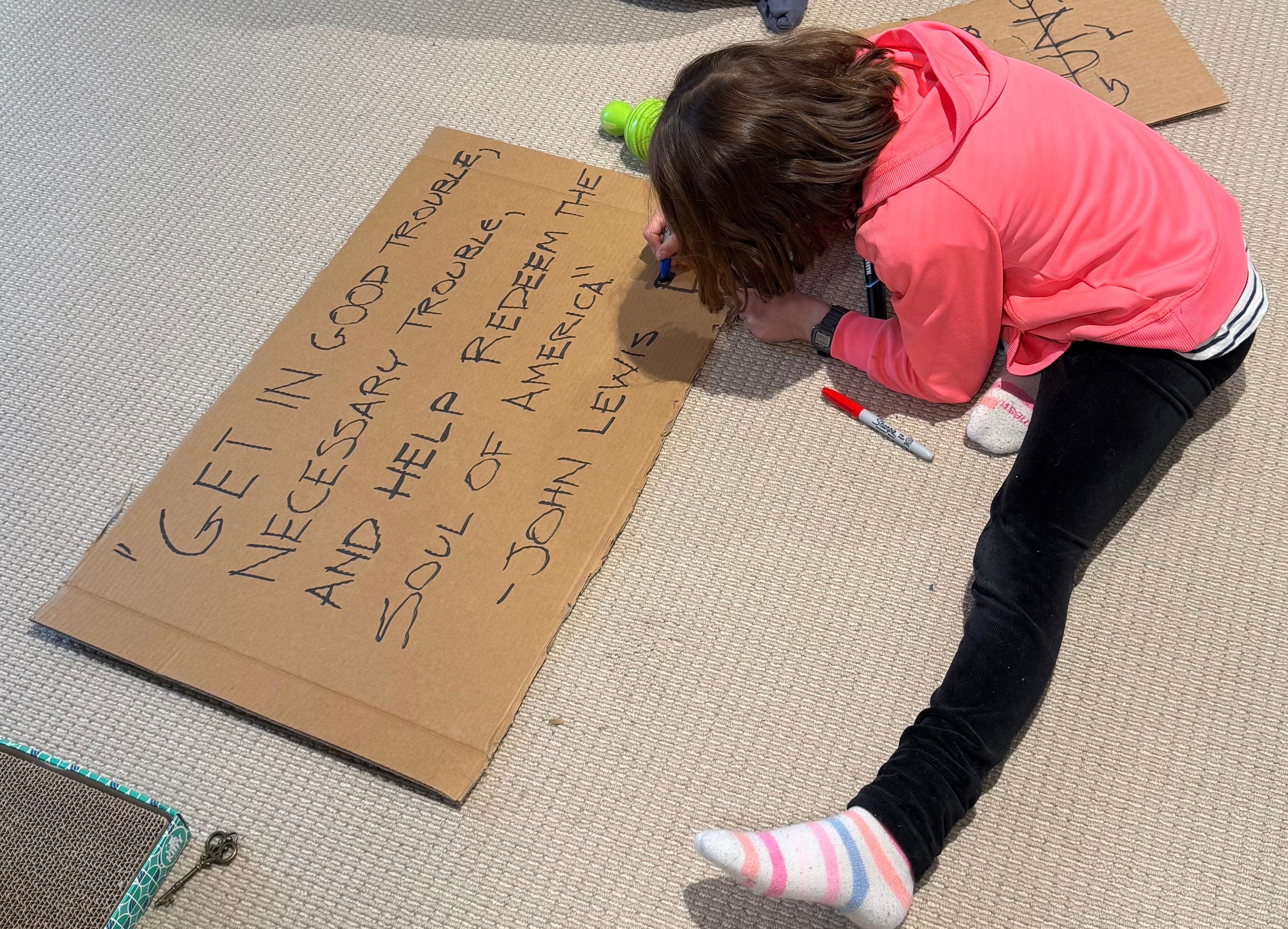
So far, so good. But what follows is a comedy of errors. By the time we’ve packed snacks, gotten shoes on everyone, and made it out the door, the protest is well underway. It should be a straight shot on our subway line, but they’re doing track maintenance (#ThanksCongestionPricing?) so we have to take a train heading deeper into Brooklyn first, then transfer to head back toward Manhattan. Other people on the trains comment on our signs, thank us for going, and tell us they’ll be at the next one.
J falls asleep in my lap, so I have to carry him off the train when we get to Bryant Park. We exit the station and see… no one. Well, midtown is always busy, but no one seems to be protesting anything. Turns out the protest was starting at Bryant Park, and it’s already moved on. We spot some barricades on 6th Avenue, and walk up the empty street, thinking we’ll catch up with the crowd.
After several blocks (still carrying this sleeping oversized toddler1) we see a group of people in kilts. Some sort of Scottish solidarity group? That’s cool. Except as we get closer, it looks like fully half the crowd is wearing kilts and so I’m wondering if we somehow missed the dress code. Annie is helping F keep her spirits up while simultaneously looking up the protest route on her phone.
Apparently there were two events that started by Bryant Park on Saturday. The “Tartan Week” Scottish heritage parade went up 6th Avenue toward Central Park. The Hands Off protest went west and then south on 5th Avenue, toward Madison Square Park. We’re following the wrong one.
By now, my back is killing me (did I mention J is in the 95th percentile for height and weight? Seriously: he’s not yet 3 but he wears 4-5yo clothes). We’re collectively running out of steam. Parenting is 50% emotional labor and 50% logistics, but at this point we’re 100% failing.
F spots a McDonalds. J wakes up. A bag of unnaturally good french fries and nuggets gives them both a boost. We muster the energy to find the nearest subway entrance and take the train home. I feel defeated by our poor planning, though I maintain that we went to the protest, even if we didn’t get there in time.
I have a running list of quotes and cliches about timing that make nice writing fodder. One classic: “There are decades where nothing happens; and there are weeks where decades happen.” (That’s often attributed to Lenin, but the actual origin is unknown.)
Another good one comes from Shakespeare: “We must take the current when it serves, or lose our ventures.”
There’s one I saw in a book by Michael Tomasky: “This is how change happens—over years and years, and then, to those who haven’t followed the story, suddenly.” Which is a nice variation on a joke I’ve seen in multiple places that change happens the way ketchup comes out of a bottle: slowly and then all at once.
But there are also the over-used bits of rhetoric like “the time for change is now” (from every advocacy campaign ever). And the false urgency of “rush a donation before our midnight reporting deadline” (texted to you from a generic Democratic candidate).
There’s a fine line between conveying the real urgency of the moment vs. creating false urgency that undermines trust. Timing matters for change, but also, it’s nearly impossible to know whether this time, this moment, this protest is really the one. If you say “this is the one!” too many times, it’s like the boy who cried wolf: the village stops showing up.
And yet I think this past weekend actually was a big one, if not the big one. Protests have been growing for months, mostly focused on specific parts of the bigger crisis or targeted actions, like the #TeslaTakedown. Saturday saw the first mass mobilization of the year, with over 1,300 events across every state. The organizers—a coalition of almost 200 groups—are claiming millions in attendance.
This turnout came four days after Cory Booker gave a 25-hour speech highlighting the Trump administration’s unique blend of malice and incompetence, and getting the attention of millions who watched the livestream and later coverage. It came three days after Trump’s tariffs started tanking retirement portfolios and driving grocery prices higher, making the stakes clear even for anyone whose daily life wasn’t already touched by the lawless dismantling of the federal government, civil rights abuses, deportations, or general corruption.
If you missed Saturday’s protests, there was a decent chance you saw #HandsOff on your phone if you opened TikTok (where it’s still a top ten hashtag), Instagram, or any other social media, even if it wasn’t covered as extensively by traditional media.
It’s easy to get cynical about the value of mass protest or going viral. What changed from last week to now? Maybe nothing concrete, but a whole bunch of people caught the fight-back bug and everyone in power saw that happen—from elected Democrats who weren’t fighting back, to the federal judges who can place critical checks on Trump’s agenda, to the elected Republican enablers deciding how much they want to tie their personal ethics and political futures to a president driving the country straight into an iceberg.
It’s no sure thing. Maybe it’s just a vibes shift, for now. I’m bummed that we missed Saturday’s protest, but we’ll be at the next one, and the one after that, and the one after that—rain or shine. Next time, we’ll make the signs and pack the snacks the night before.
If you want to join us in turning the vibes shift into change, sign up at Hands Off 2025 for national updates. And if you’re not already plugged into something local too—well, the time is now.
Incompetent or Evil: A False Dichotomy [Paul Krugman]
A Different Kind of Anti-Trump Resistance Is Brewing [Micah L. Sifry / NYT]
Resistance is alive and well in the United States [Erica Chenoweth, Jeremy Pressman, Soha Hammam / Waging Nonviolence]
How Sen. Elizabeth Warren Is “Fighting Like Hell” Against Trump, Musk & Big Tech Billionaires [Elizabeth Warren, Kara Swisher / On with Kara Swisher]
Obama’s Blistering New Takedown of Trump Gives Dems a Way Forward [Greg Sargent / TNR]
VCs Are World Eaters [Catherine Bracy, Alix Dunn / Computer Says Maybe]
Being alone has its benefits [Virginia Thomas / The Conversation]
This newsletter was written to the soundtrack of the Ani DiFranco’s Living in Clip and specifically:
“Why didn’t you bring a stroller??” is what I can hear you asking through the screen. Answer: because he currently hates being in a stroller, so it would just be one more thing to carry up and down the subway stairs.
No posts
Comments
Nothing yet. Say the first thing.
Sign in to join the conversation.