

It’s coming right at us!
I have promised to fully unpack my thinking on the Workforce Innovation and Opportunity Act (WIOA),1 the federal law that sets the basic premises for and substantially funds workforce development in the United States. Thinking about how to do this, I had an idea for a series of three posts. The first one would be on what the system is and does: the organization of the law, how it evolved from predecessor legislation,2 the metrics and outcomes by which it judges performance, and its culture and mindset. The second would feature a set of research questions that I think policymakers should look into as they consider potential changes to WIOA, and highlight a few state-level systems from which a new federal policy framework might take inspiration. The final post advances five basic principles that I think should inform our policymaking around workforce development.
I might or might not follow through with this plan.3 But while I was noodling how to lay out my thoughts, it occurred to me to ask a more immediate question—one prompted in part by some recent super compelling research that came out of the Brookings Institution and Opportunity@Work: how exposed are the most common job titles that people access through WIOA services might be to AI?
The answer is… a lot. The table below ranks occupations by volume of WIOA-paid training, noting “AI exposure”—the extent to which the technology is likely to impact work done under that occupation—in the second column.
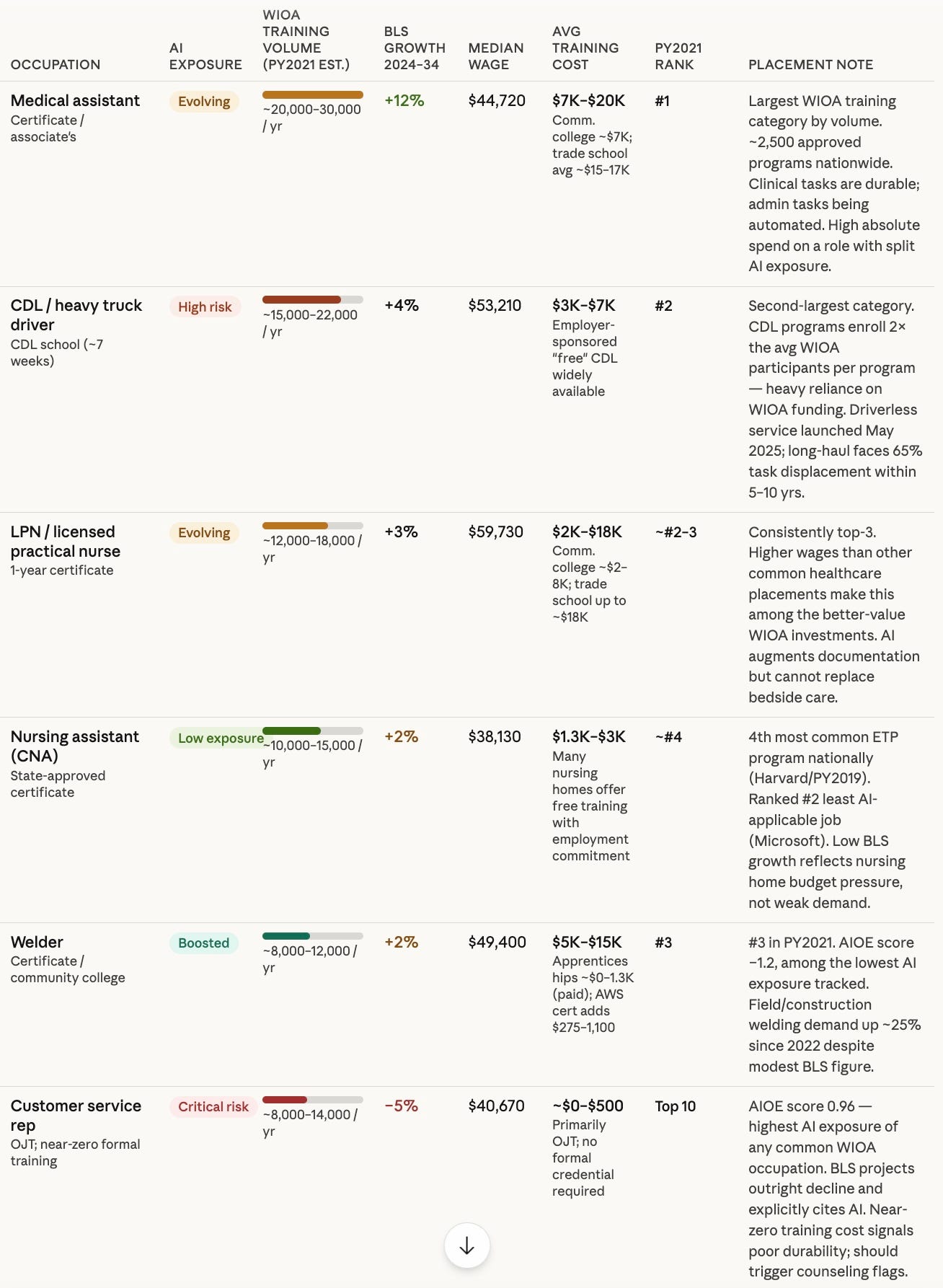
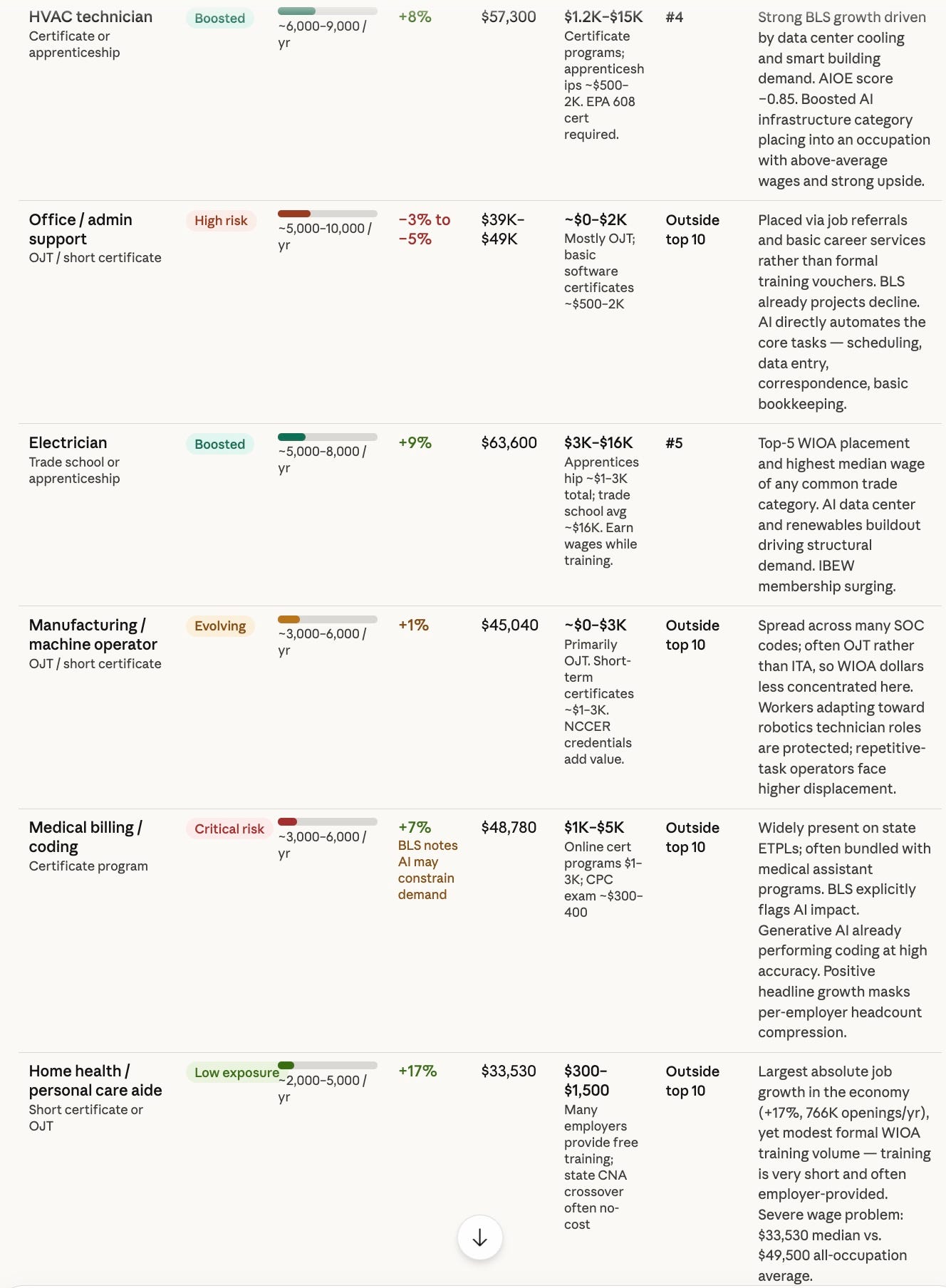
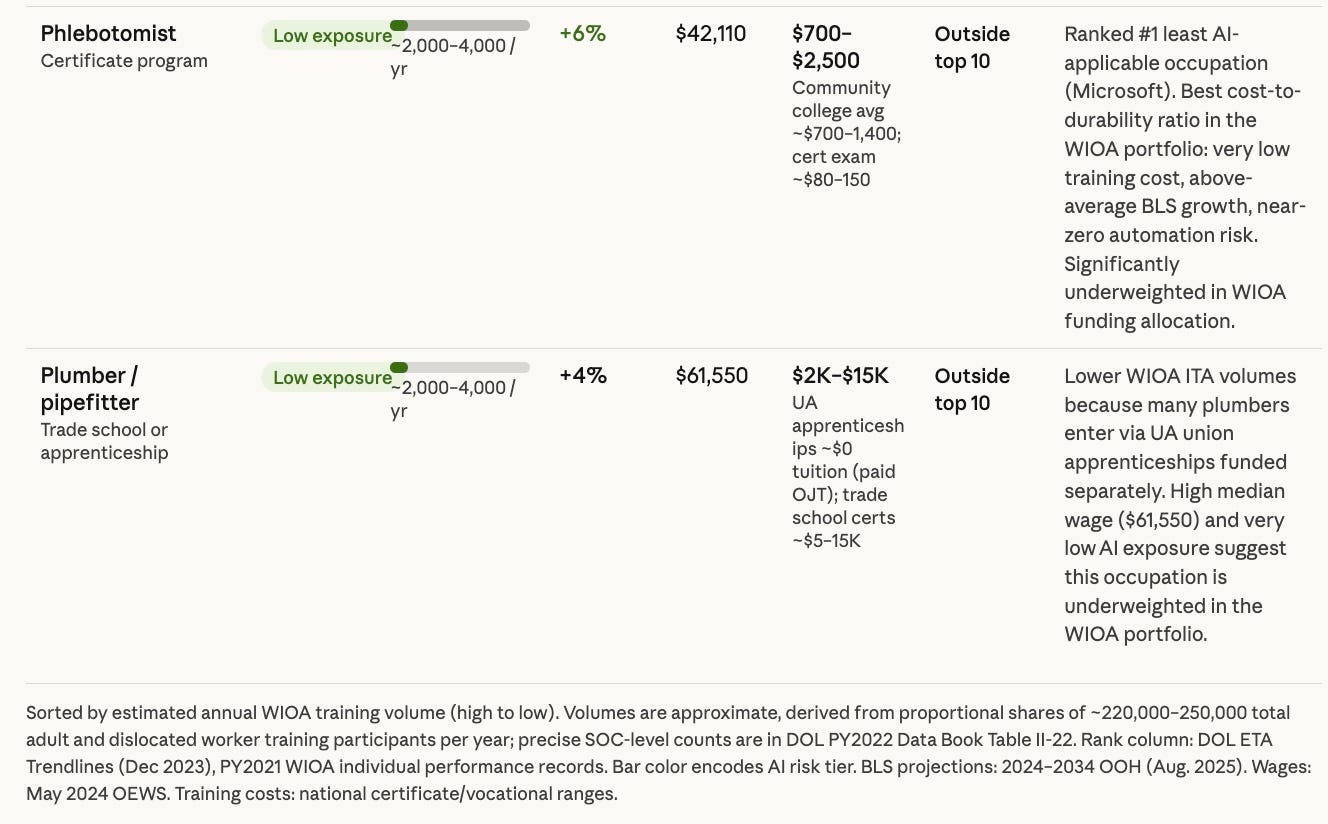
This presents the top 14 occupations by WIOA training volume, as of Program Year 2021 and drawn from USDOL sources. “Boosted” means that AI is actually increasing demand, largely owing to the construction of data centers and the related need for electricians and welders and HVAC techs. “Low exposure” means that AI is largely irrelevant to current hiring and projected demand.4 “Evolving” is a bit more ambiguous, but I understand it as projecting a likelihood that AI will change the description and day to day tasks of the role, and thus the preparation and credentialing required, but not demand itself. (For example, new diagnostic tools and information resources will alter how licensed practical nurses deliver care, hopefully for the better, but won’t replace them.)
Four occupations among the top 11—CDL/heavy truck driver, customer service representative, office admin support, and medical billing/coding—are at either “high” or “critical” risk in terms of exposure to AI. They combine to serve an estimated 31,000-54,000 trainees per year. That is, per the note at the bottom of the table, potentially more than 20 percent of all participants in WIOA-funded adult and dislocated worker training.
If you look at average wages, these are probably about median-quality WIOA placements. Their training costs are on the low side, compared to others in the table—in fact, with the exception of CDL, they’re all the cheapest.
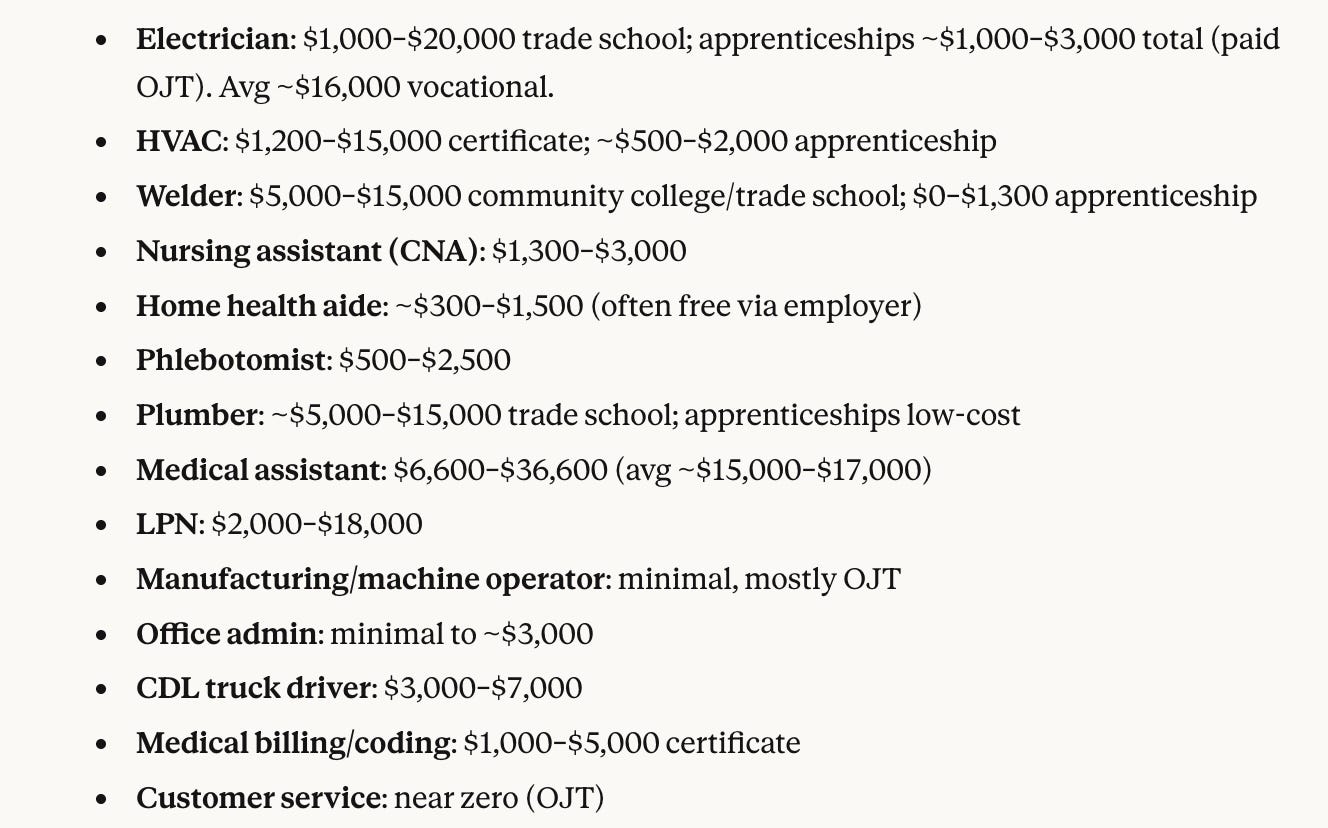
So, from the perspective of a WIOA contracted provider or local administrator, these four job titles have represented a strong value proposition. Strong (past) demand, modest upfront expense avoiding undue strain on the painfully inadequate local WIOA budget, average wages that won’t lift someone into a high tax bracket but, depending on where you live, might come close to meeting expenses.
And now those jobs are going away. Anyone who counsels a jobseeker into training in one of those four sections should do so with the warning that they are signing up for a high likelihood of coming right back to seek services again in a year or two or three.
Will they give that warning? The imperatives of the program from the perspective of the provider or local administrator—the need to hit volume goals for job placements—are in direct tension with the long-term best interest of the participant seeking training. Claude makes the point:5

If that’s going away, how shall the system respond? I’d suggest the answer is to emphasize the sectors where we see positive projected hiring demand and relatively higher average wages and limited exposure to AI in terms of risk. Among the top 14 listed above, eight occupations fit these three criteria.
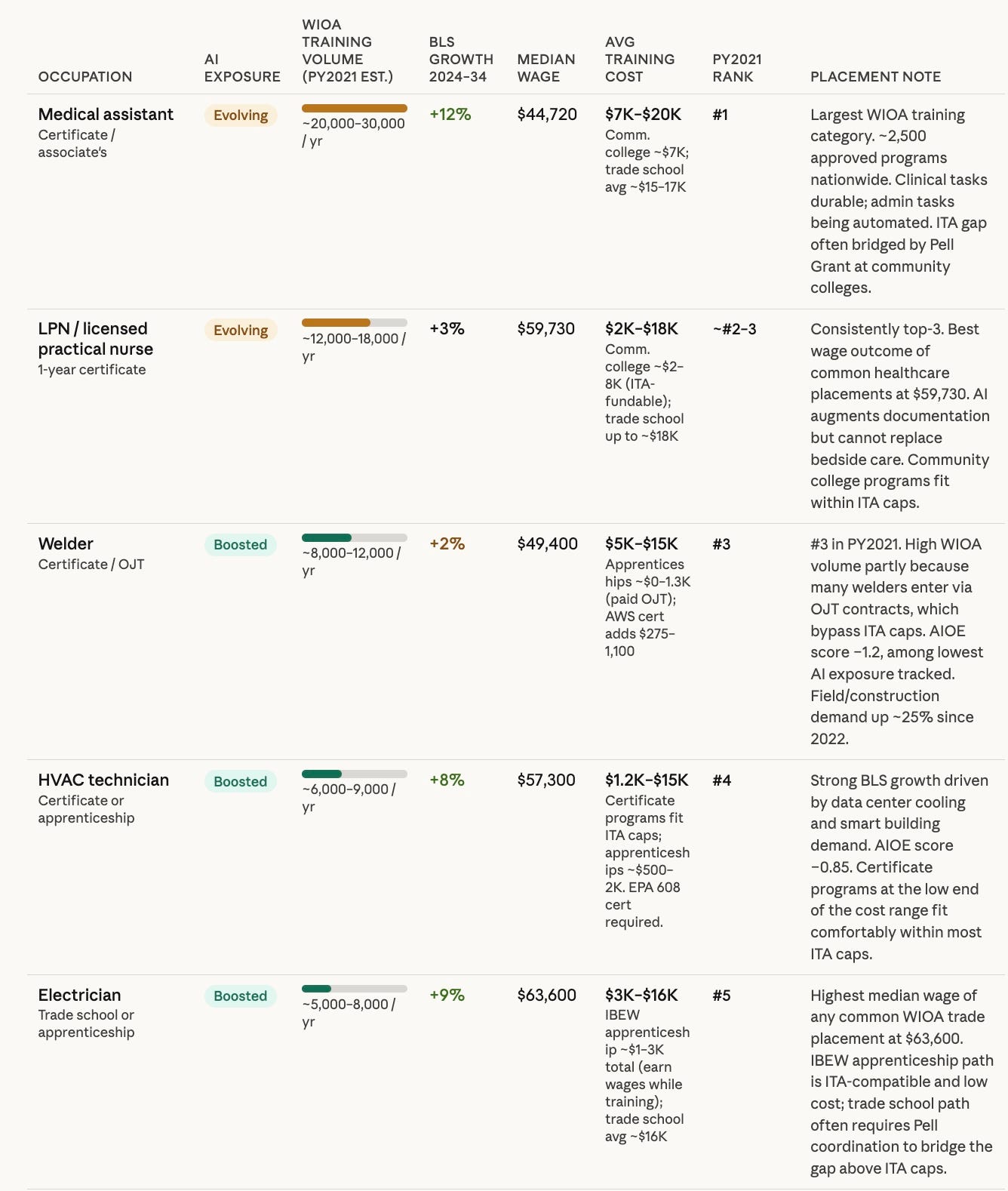
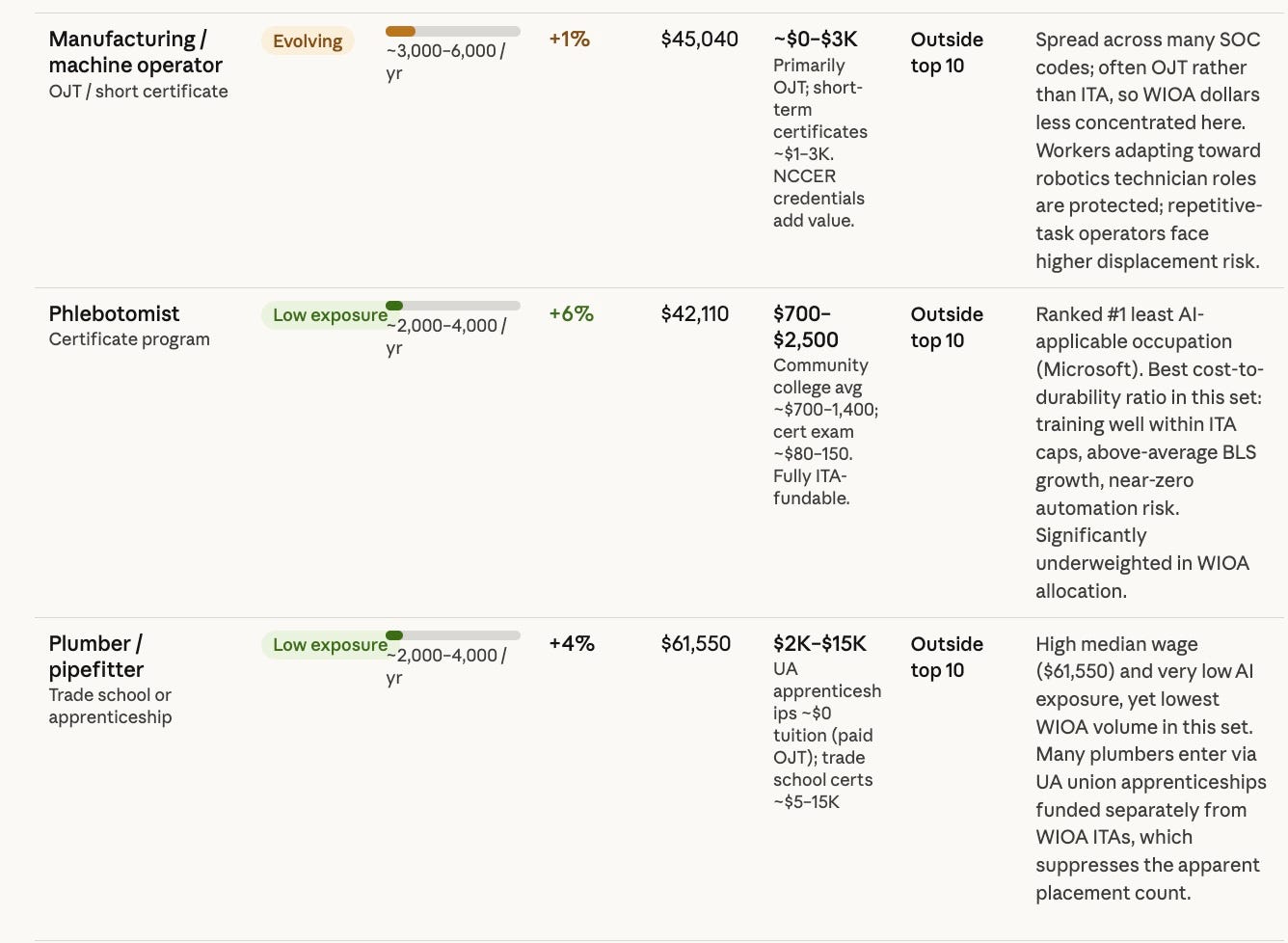
So here are eight occupations, all relatively AI-resistant, all offering median annual pay between $42,000 and $64,000 per year. (I omitted Nursing Assistant/CNA and Home Health/Personal Care Aide, which are job titles with enormous demand that offer poverty wages. Again, those jobs are perhaps best understood as a volume play for system actors. But until they pay a living wage, they shouldn’t be a priority option.) Note that the median wage across all occupations, per Claude, is $49,500.
I should note also that I asked Claude to show growth, not total openings—which is the more relevant number for planning purposes. The next phase of the analysis would include that, plus perhaps the median age of workers in these occupations or share of workers over age 50. One of the more notable reports I wrote as a think tank researcher6 looked at this issue of demographics-driven replacement,7 and it’s… I’ll go with “interesting” that so many of the same fields stick out for projected demand, even through all the economic twists and turns of the last two decades.
More to come, but I think the takeaway here is that WIOA as currently structured and targeted will become less and less viable as AI continues to transform the labor market and take out so many of the go-to occupational targets for trainees, providers, and local administrators.
My mom, who apparently reads this, has asked that I start spelling out acronyms.
I did a bit of this here back in February, which admittedly saps my motivation to revisit it, but we’ll see what happens.
If I’m being totally honest, I’ve already written a version of the third post, but I’m playing with the idea of using it for something else.
Think phlebotomists (which Claude interestingly describes as “the best value proposition in [the table above]).” As a guy with a long and varied history of health issues, I’ve had blood drawn dozens and dozens of times, and pretty much without exception the folks who do it are skilled and caring and present. Perhaps at some point a robot could wield the needle without risk: finding the vein, injecting with a minimum of discomfort, all of that. Personally I hope and intend never to find out.
In what I guess is a sign of how much I still have to learn about the mechanics of WIOA, I asked Claude to explain how participants could meet some of these training costs given the low price points of most Individual Training Account (ITA) awards. The answers include accessing other sources, including (traditional) Pell Grants; heavy usage of community college; and utilizing on-the-job training (OJT) through which employers hire participants and WIOA reimburses 50-75 percent of wages.
20 years ago next month. Terrifying.
In the context of “disconnected youth”—another subject I’ve had notes for a post on for a few weeks now, and will get to eventually.
No posts
Comments
Nothing yet. Say the first thing.
Sign in to join the conversation.