
The Sanatorial is a Q&A with artists and writers about fantasies of the sanatorium and the relationship between illness and practice
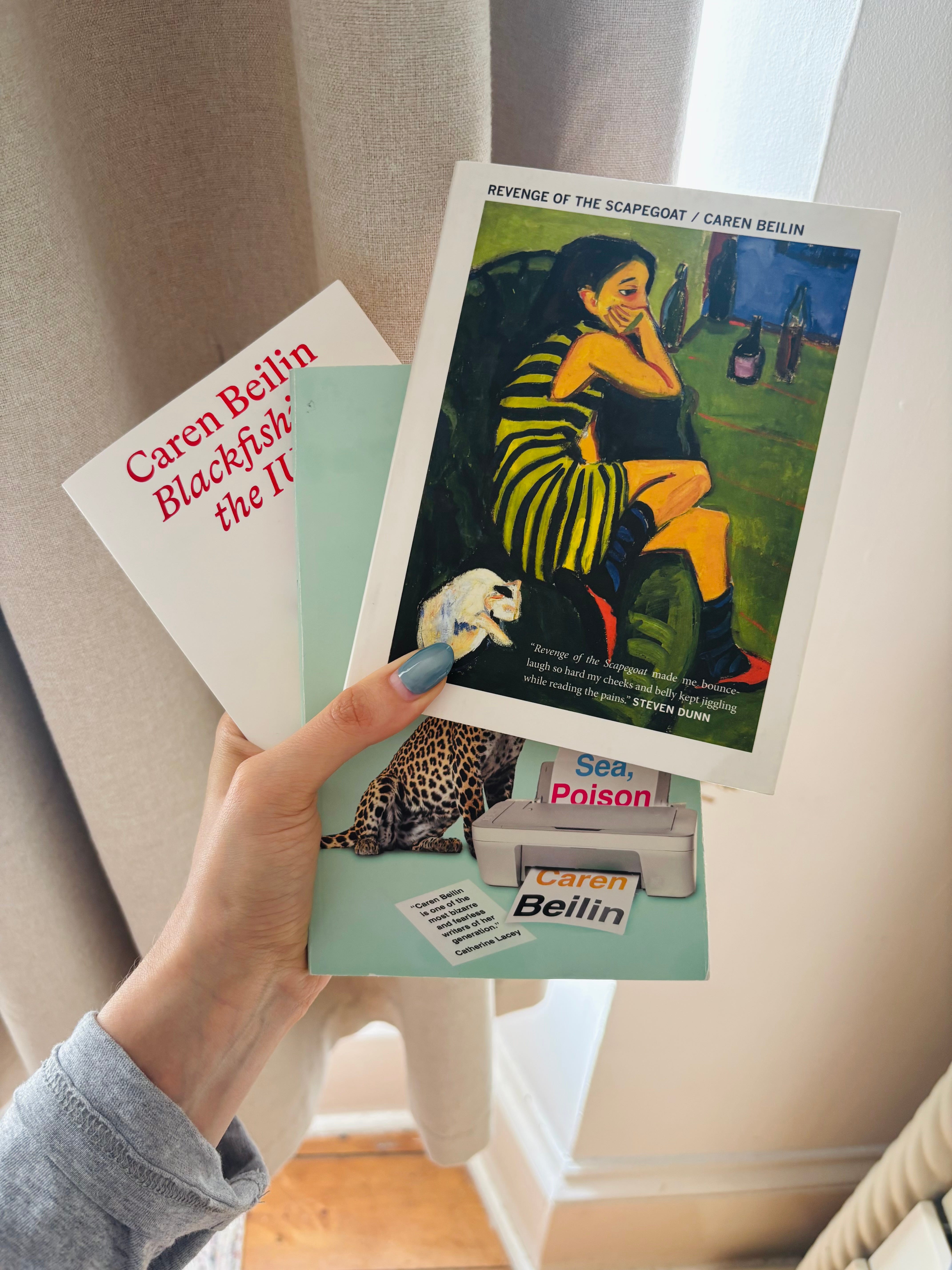
There’s a scene in Caren Beilin’s second novel, Revenge of the Scapegoat (2022) in which pain — both physical pain, and the attendant, pettier pain of illness’s effect on writing — is ventriloquised between the narrator’s two arthritic feet. One foot is Bouvard, the other, Pécuchet — named after the tiresome, bumbling characters of Flaubert’s unfinished novel. The protagonist Iris (who has rheumatoid arthritis) is sick to death of them. She kept up at night by pain and forced to listen to their self-aggrandising complaints:
“Bouvard, this so-called medication has ruined all of my focus and my neural synapses are completely shot—I can’t think, I can’t write … I hate what she takes.”
He was referring to the low doses of chemo I took for my arthritis and which I’d left at the house on Naudain St. So it wasn’t going to be a problem.
“Dear Pécuchet, you are only writing from a vessel that’s working best as it can, and maybe anyway all of that hyperconnectivity you remember so nostalgically needed to, you know, take a bow.”
“Bouvard, you don’t realize. You like me, but I am not fundamentally likeable, so what I write can’t ultimately be communicable.”
“Really, Pécuchet. You are a beautiful trying soul and anyone can see that!”
Their complaints, of course, are also kind of Iris’s own, as is the hoof of the cow that steps on her in the grounds of a luxury rural arts complex. Subjects and objects do not have clear boundaries in the world of Caren Beilin’s novels. Everything leaches into everything else, like some queasy cocktail of transubstantiation and Baader-Meinhof phenomena. The effect places Beilin’s books in a constellation of absurdist literature and methods, but is also produced by the constraints of illness itself; if, as Iris tells us, sickness is when ‘your body begins talking to you’, then annoyingly vocal body parts begin to feel less like a literary device, and more like the realism of pain’s weird, private logic. In Sea, Poison (2025), it’s revealed that a dodgy laser eye surgery was in fact ‘Medical OuLiPo’ — a biomedical-literary experiment by someone who disliked the protagonist’s previous novels. The formal constraints of OuLiPo become indistinguishable from the aphasia and brain fog of symptoms and medicinal side effects. Beilin’s novels are exhilarating and deeply, darkly funny; pain is their plotless engine that nevertheless wreaks plot-like havoc as it moves, chewing up conventions of form and narrative. As Caren describes below, a decade of seeking treatment at the coalface of the Medical Industrial Complex provides a writer with a lot of content; much of it plotless, much of it ridiculous. One of the things I love most about Beilin’s work (exemplified by the excerpt above) is its capacity to both permit and comically undermine all of illness’s ugliest feelings: paranoia, resentment, self-pity, regret, frustration, anger. Her books invite the reader to think more weirdly and obliquely about what symptoms — as well as the medical industry’s banal, profiteering evils — do to our embodiment, relationships, vocabularies and desires. I return to Beilin’s work whenever I sense my own body parts becoming too melodramatic, which is often. It’s a huge privilege to share this Sanatorial with the inimitable Caren Beilin.
— DL
Your ideal sanatorium
My ideal sanatorium would be a clinic for internet and phone detox. I have all kinds of ideas about other ways it could be— hot and dry, lots of private balconies, extra-silent— but I also think that leaving the internet could transform any space into paradise— or of interest— after about a week of detox. The air in front of you (or the wall, or another person’s face) would take on that quality of a painting, something to be with and look at, again.
A typical day when you’re not flaring
I’m in a space of less flares due to an effective med and am trying to actively take advantage by working out more and doing the most I can for my joints and heart, in this window of time that might be short in the scheme of things or I hope not. I was diagnosed with autoimmune arthritis in 2016. These opening moments with this disease were harsh, painful, and scary. I’m lucky to have come to an effective med and be in such a different place than I was, but I do think that for the past decade I’ve been very very ginger about exercise. I had to give up running, which was such a happy part of my old life. But yeah, I’ve been scared of flaring, I guess, or hurting things, or maybe sad about the running. I’ve been fearful around my joints. I’m trying, right now, to be less so. I try to strengthen my arms with exercise bands (weights cause too much wrist strain), and am up on the elliptical. It feels amazing to work out and try to get a bit stronger after about a decade of exploring wrist-free yoga, which is life-changing but more gentle. So lately a typical day is a bit ordered around exercising, which is novel for me this summer. I also am a lizard wanting a hot rock, which in my case means going up to my building’s roof and journaling there, sans phone, until I get so hot my heart starts beating too fast and then I come back, elated. One of the current joys.
A typical day when you’re flaring
When I’m flaring, I give up. If I don’t have to go into work or I guess I give up after work. I get into bed and hang out. I watch old sitcoms. A big part of autoimmunity, for me, is health anxiety— future anxiety. When I’m in a flare, my tendency would be to try to help out the bod in some way, or freak out, or feel sad or scared, and it’s better if I give up and hang out and recognize that things pass through the body and that this journey is really various. Things get worse and then something lifts. Pain doesn’t only settle in and stay there (especially not with Rheumatoid Arthritis— it tends to move around!). There are things I can do that might help, little adjustments, a heating pad, of course, an epsom salt bath. But mostly I’ll say to myself and others, I’m feeling autoimmune-y today and I let it go. Low pressure. Things lift.
Relationship between your condition and your practice
My condition (and subsequent time spent navigating the medical system) has provoked a lot of content (about chronic illness and also medical abuses ranging from gaslighting to assault) and has skewed my writing into absurdist, comedic territories. My plots make fairly bonkers, radical shifts in part because of my perspective as a chronically ill person. Things suddenly change. Or lift. Pain darts from joint to joint. Everything was fine, now your finger is twice its size and pushing a button would be a hell. Experiences like this make things like character-building, world-building, plot-progression, building-a-life, these sort of craft concepts, feel like a fucking joke. Digression is life. A character or me goes up in an elevator to pursue a romance plot but the novel and life ends up in the elevator for five chapters because pushing the button to the romance plot would be like a hell, plus who else is in the elevator? Probably somebody with something to say about something else and who in no way can notice pain in another person (which is, to be fair, really hard for humans to do). Pain is reasonless and can’t be reasoned with and has no plot. Some of the bonkers energy in my writing comes from this. Being chronically ill is also a great way to observe the failure of the medical system because it is so specifically not built to help with long-term, holistic, interconnected issues. Having a front-row seat to this failure has given me plenty of novel and story ideas. Of course being female gets you in the front row with, like, a backstage pass (where you might mingle with other people who also got that pass). But as far as *practicing* I really would mostly say how incredibly full of gratitude I am that I can bend my fingers, write and type with ease, that I am not struggling with fatigue, just wonderful mercies associated with a med I got on about 6 years ago. With my latest book, Sea, Poison, given my own reduction in pain, I was ready to continue writing about the medical system but to move towards other issues outside of my own. The narrator, Cumin Baleen, is struggling with an autoimmune disease that increasingly gets better as she comes to a helpful med *as* she’s learning about a spate of OB/GYN crimes. It is perhaps a hopeful thought, to me, that my experience of pain or injustice would open me to a sensitivity to other issues.
Relationship to diagnosis
Amidst the failures of the medical system, I have a rheumatologist I really connect with (and who is refreshingly circumspect about the system he must operate in). Early on, I read a sort of self-help/guide book for people with RA and it had such a great, basic recommendation— find a doctor who has a positive outlook. Before I came to my current rheumatologist I’d seen about 5 others, and they were not so positive. They said things to me like, Be prepared for a life of pain. They had major shrugging energy. They looked at my tests and said, Yeah, you’ve got it particularly bad. My current rheumatologist looked over those same tests and said something like, “You know, in a way it looks like you have RA, but what do we know? There are people who have these same numbers [autoantibody count, stuff like that] who never get a symptom.” I guess he’s circumspect about the medical system and about diagnosis, about RA as a category and as a destiny. This is a place I can start from. His attitude set me up for a way (a style) of having this diagnosis that is casual, experimental, noncommittal (to pain, hey, maybe it’ll lift), and humanizing.
What is most misunderstood or contradictory about your condition
Going off of this last question, I think there’s a doom factor when people hear about RA. This has to do, in part, with how much treatment has improved in even the last 5 years. So people may have memories of very disabled grandparents or other older relatives, who really couldn’t do much. My book Blackfishing the IUD chronicles some of this helplessness through history. Basically I think there’s more hope these days around effective (and more targeted) treatment. This is why, in part, in Sea, Poison I included (amidst a very distressing arc around OB/GYN abuse) a fairly positive RA arc— the narrator works with a helpful (and non-abusive) rheumatologist to effectively treat her condition. The world could use a few more hopeful RA arcs to keep up with the times.
The metaphor or analogy most often invoked to explain your condition
Autoimmunity in general is discussed as your body fighting with itself. Tearing itself apart. Or, confused. Your dumbass immune system starts hurting you, the thing it was supposed to protect. What an idiot. A reframe: my immune system energetically wants to be of assistance, if it’s for something awesome. Might go a bit overboard. That’s what I’m like, too.

Caren Beilin is the author of the novel Sea, Poison (New Directions, 2025), longlisted for the National Book Critics Circle Award in Fiction and the Carol Shields Prize for Fiction. Her previous books include Revenge of the Scapegoat (Dorothy, 2022)—winner of the Vermont Book Award for Fiction—Blackfishing the IUD (Wolfman Books, 2019), Spain (Rescue Press, 2018), The University of Pennsylvania (Noemi Press, 2014), and the chapbook Americans, Guests, or Us (Diagram/New Michigan Press, 2012). Some of these titles have been published abroad with Scribner (UK), The Last Books (Amsterdam), and los tres editores (Madrid). She lives in Cleveland where she is Fiction Editor for Cleveland Review of Books and an Assistant Professor at Case Western Reserve University.
No posts
Comments
Nothing yet. Say the first thing.
Sign in to join the conversation.