
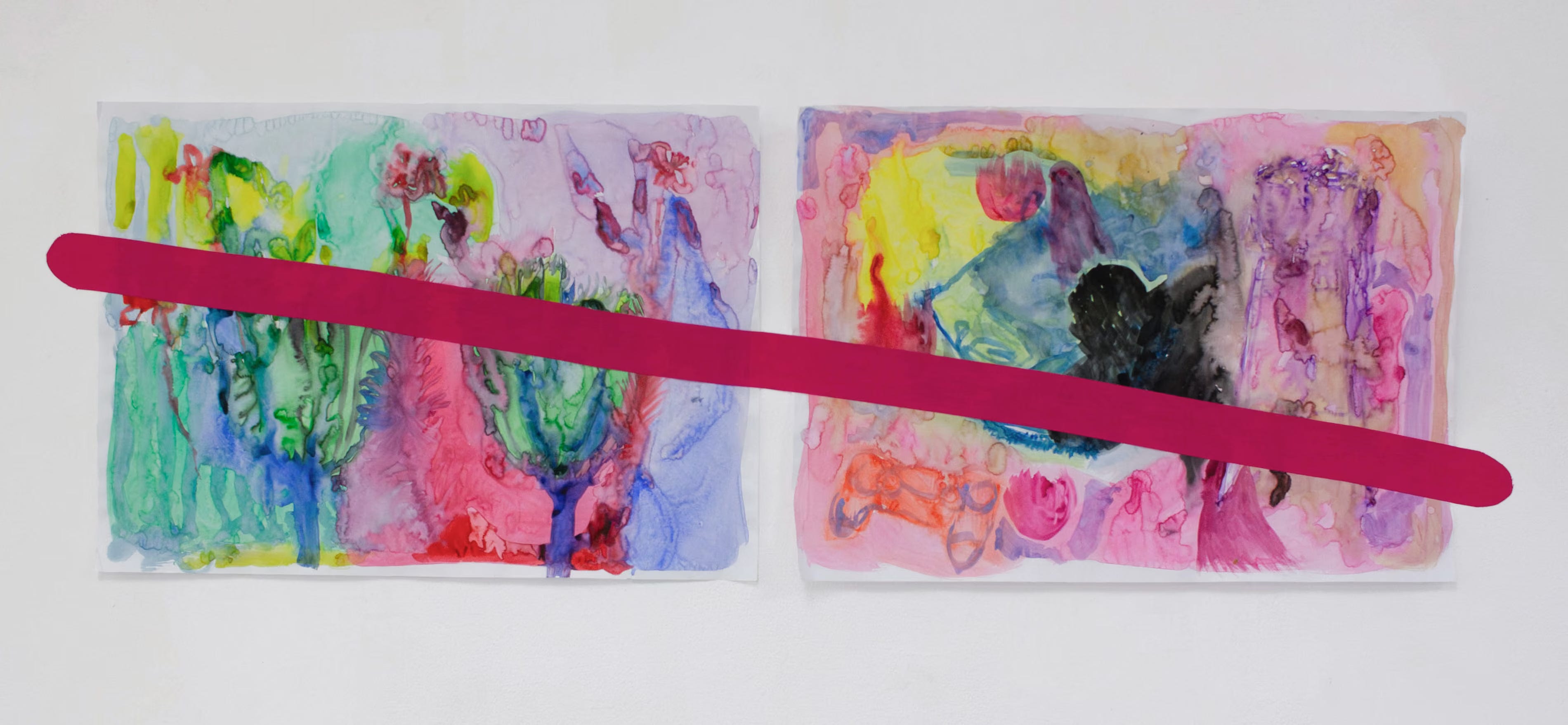
Below is the full transcript of an interview that published today in the guardian, ahead of a group show, We Contain Multitudes (with me, Nnena Kalu, Jo Longhurst and Andrew Gannon), opening at DCA this weekend. With thanks to author and journalist Kathryn Bromwich for the excellent questions.
KB: How did this series of paintings come to be, and what you were trying to explore with them?
DL: They were all made in a period when I had the sudden worsening of a lot of conditions all at the same time, and quite a severe injury, which left me unable to function in a way I previously had been. It was my first time experiencing myself as not being able-bodied, and that also extended to not being able to work – I wasn’t able to read because I had too much brain fog and I wasn’t able to write. I didn’t plan to make the paintings; they were a response to a really extreme physical situation I was in. At the same time, I was also trying to navigate trying to get support as a newly chronically ill and disabled person in the UK and finding those processes incredibly difficult and punitive. So the paintings really came out of this place of, on the one hand, frustration at really wanting to make something but encountering the limits of my body, and on the other hand, encountering the limits of being able to access things that would help.
But there’s also something I think quite playful and intuitive in them, that I was actually able to get to through not being able to write. I went to art school originally; I was trained as an artist. While I don’t think of myself as a visual artist, the way I approach the things I make is I have a practice, and that practice sometimes manifests as different forms of writing, sometimes as books. But there are also other kinds of work I make as well, and I see them as being in a constellation together. So I was on my living room floor, and I wasn’t able to move or sit up for a long period of time. I wasn’t able to work with any heavy materials. I just used quite cheap paper, paints, brushes. I was trying to make them quickly and associatively, whilst being in quite a lot of pain.
Pain is a very totalising thing. It’s chronic. You can start to feel like it’s stealing something from you. And then also, when you’re trying to get support from these institutions, which are demeaning in various ways, that can feel like it’s taking a lot from you as well. So I suppose I was trying not to override the pain, but I felt like I wanted to get something out of that time, to have something to show for it. The paintings sometimes would start out as still lives or things that were just in the room, like my cat is in there, my boyfriend’s PlayStation controller. It’s all very banal. But I was really trying to get away from being too figurative at the same time.
Making the paintings was a way of coexisting with pain and disability, but exhibiting them is a way of dealing with my own internalised ableism – by which I mean that they are very provisional, unrefined records of a particular moment, which challenge my overthinking, overworking control freak tendencies. For that reason there’s something quite raw and vulnerable about them. I’ve always been fascinated by artists and writers who turn limitations into formal constraints, and I see the paintings as my own attempt at that. They were made in rhythm with what I was able to do in that moment, rather than trying to push beyond it.
Could you explain what kinesiology tape is and the way you used it in the paintings?
It’s a stretchy fabric sport tape that is sometimes used by athletes, but I use it in relation to having unstable joints because of Ehlers Danlos Syndrome and severe muscle fatigue, because basically my ligaments won’t do their job. So I sometimes have to use it to provide extra support to my muscles and to my joints. And it hugely reduces injury and strain. You have to cut it into these really particular shapes where you round the edges off, and you’re left with these butterfly shaped remnants. And the tape is quite expensive, and it always annoyed me that I was left with these bits in the middle, so I started saving them, and started sculpting little roses with them. When I first installed these paintings as part of a show at a small show in Glasgow, I realised I could use these remnants to attach the paintings to the wall. I like that they’re a found form. I suppose it relates to what I was talking about: trying to steal something back.
In The Romance of the Sick Rose, from the poetry pamphlet that accompanies the paintings, I was struck by the line “I have no choice but to romanticise you”, about the narrator trying to extract something valuable from suffering. What was the impetus behind the poem cycle?
The poems and the paintings have a different genesis. The poems were written partly from notes I made throughout the time I was making the paintings, and they draw on a 13th century text called The Romance of the Rose. That relates to the tradition of courtly love poetry, the origins of modern romance tropes, so when I’m talking about romanticising in that poem, I’m referring to this whole lineage. It took a few years, really, to figure out how to write about pain, because I felt that I didn’t want to do a kind of cold realism, “Here’s how much pain I’m in,” because I’m already living that. I think about things best through analogy, through imagery, through metaphor, which I think is why I’m always so drawn to medieval texts. The poem cycle is very allegorical: the experience of pain is conceived as a relationship. And pain is this lover that the speaker of the poems is in a relationship with, and it’s sometimes quite violent and oppressive but there’s also something really intoxicating about it. I was trying to get at the overwhelmingness of pain. It’s so private and no one else can see it. In that sense, it is a little bit like when you’re obsessed with someone; it does have that enclosed erotic energy to it. So I was trying to dramatise pain through the allegory of the garden and the rose and the lover and the beloved and this claustrophobic, intense, toxic thing that they’re in.
Writing about illness as a slightly toxic relationship definitely works better as an analogy than the more usual military metaphor, which you wrote about in Lovebug. How would you say your own relationship with your condition has changed over the years?
Oh, God. I was only diagnosed with the main condition three years ago, and then I’ve had subsequent related diagnoses. It’s difficult, because at the beginning, I really didn’t want to over-identify with it and say, “I am a writer with this condition.” I just wanted to be a writer, or I wanted to be an artist. But then you come up against these really harsh material realities where you cannot even have a hope of accessing certain forms of support unless you have certain diagnoses. And even when you do have those diagnoses, you’re still not really able to get the support you need. So that puts this pressure on having to outwardly identify with something you also might feel personally ambivalent about. It’s frustrating.
I often find with any marginalised group, but especially with disability, that it seems to negate any other aspects about the person, like the work itself can be overlooked.
I think that it’s overlooked, but also maybe given a free pass, as if it’s above criticism. There’s this really strange thing of navigating the realities of being a person with a disability in the UK right now – we had this huge assault on disabled people’s rights last year. There’s this very reactionary rhetoric of claiming ‘overdiagnosis’, in a context of 15 years of austerity and an eviscerated NHS. Diagnosis is an acknowledgement of having needs or requiring care, so withholding or belittling diagnosis aligns with a political context that is objectively making disabled people’s lives worse. On the other hand, there’s shows like the one in Dundee, which are really great. But then there’s this strange thing where I have to wear different hats where one day I’ll be trying to get someone to believe me that I’m not lying about not being able to do something, in order to get Pip. And then I’m being included in the show on the grounds of my disability, and the disparity between those two things is really disorienting.
In The Romance of the Sick Rose you write about having to “bleed on the dotted line”. How has the bureaucratic side of things impacted your life, in terms of NHS waiting times and assessments?
I live in Scotland, and there is no specialist in my condition, Ehlers Danlos Syndrome, so I’ve never been able to see a specialist on the NHS. It’s a condition that can affect absolutely every part of your body. So that means I always have to go back through the GP and say “Something else has gone wrong.” And the more times you do that, the more you are treated with suspicion. If there was a specialist I could talk to who knew that it affected all these different parts, then that wouldn’t be suspicious. So I have really got to the point where unless I think I’m absolutely at death’s door, I just don’t go. I recently saw a specialist neurosurgeon in Barcelona, who diagnosed me with these quite serious set of conditions. I’ve passed that on to my GP, and I haven’t heard anything. There’s no one I can be referred to. This specific set of conditions is being discussed in parliament at the moment. It’s really hard for people to imagine – unless they have long Covid or something like it – but there’s such a huge difference between having a specific problem, like breaking your leg, or needing something removed, and having something chronic that has all these complications where you do need sustained care, and not being able to access that. So yeah – it’s bad.
The exhibition brings together four artists on the basis of their conditions, which obviously serves a purpose to champion disabled artists at a time when they’re not getting a lot of attention. But do you feel like there should be more integration in the rest of the art world as well?
There absolutely should be. One great thing to come out of this show would be for people to go and see it and say, ‘Oh, I wouldn’t have assumed that the artist who made that is disabled,’ because it shouldn’t have to be obvious from the content. And what’s interesting about the show in Dundee is that we all represent a real-life diversity of disabilities, ranging from what some people might be more willing to accept as a disability to someone like me, who maybe presents or can pass as able-bodied, and then has to explain what’s happening. But also, the degree to which disability is explicit in our work is really different. And I think that’s really interesting. I think it’s great that Nnena Kalu won the Turner Prize – I’m yet to see her work in the flesh but I love the way it takes up space, its undaunted physicality. I hope it leads to more inclusion of disabled artists alongside able-bodied artists, because we’re one in four people – it’s not unusual.
Do you feel like Nnena Kalu’s Turner prize win could be a turning point for artists with disabilities? Or do you think it will take more than that?
I don’t know how to answer that question, because I find it so hard to disentangle from the fact that disabled artists are disabled people, so is it really a turning point unless disabled people can afford to be alive in this country? And that comes down to structural issues, like are they allowed to heat their own homes and pay their carers and just access very, very basic things? It’s been an incredibly bleak time from that perspective, so I don’t want to be naively optimistic. I think that a celebratory representation without actual, material change to people’s lives that minimises inequality is kind of meaningless.
That’s a very good answer. What would you say the art world is doing well to support artists with disabilities?
It’s interesting, because I move across both the art world and the publishing world. And I think it’s far from perfect, but what the art world is now normalising more is having something called an access document, which is good. I don’t actually know who invented them, but the artist and writer Johanna Hedva talks about them a lot, and the UK writer Alice Hattrick was also involved in setting something up. But it’s basically a document where disabled artists put down, if they’re invited to do a show or a talk or something, if they’re traveling, they can say I need to be able to stay overnight, I will need a wheelchair accessible room, I will need an access support worker for this amount of time, the maximum amount of public engagement I’ll be able to do is three hours. Basically it’s saying, “I’m an art worker, but I’m also a disabled person. These are my access needs, in order for me to work with you as an institution.”
When an institution invites you to do something, you send over your access document, and most of the time now, thankfully, they’ll come back and say, yeah, we can meet your access needs. Let’s do this. But sometimes they’ll say, No, we can’t. But the conversation has just become more normalised. DCA, who I’m doing the show with, was really great with my access document, very attentive, checking in on what my capacity is going to be. Institutions have specific funds in order to meet any extra costs that come about from artists who have access needs, whereas in publishing, I think that’s completely unheard of. I think publishing still has this huge ableism problem, and there’s an expectation that you can, if you’re a writer, travel to and sit through an unlimited amount of events. And unless you’re writing a book that explicitly has a disabled character, there isn’t really much conversation around disability in books and in publishing. So I suppose that’s one thing where the art world is maybe slightly more ahead.
Do you ever feel frustrated by the way disabled artists’ work is discussed? What are some of the pitfalls you see?
It can be incredibly patronising. And there’s also maybe an attitude towards art made by people with disabilities, which is that you have to like it, or you have to accept it, because it’s made by someone who is disabled. But that robs it of its power to be surprising or unsettling or have any other interesting effect. Another thing people don’t realise is that it’s about them as well. Johanna Hedva has this amazing talk where they say something like, “We will all become disabled,” so therefore reading books by disabled writers, or engaging with art by disabled artists, it’s not like looking onto this strange kingdom as an anthropologist, “Oh, isn’t it so great what they’re doing over there?” That work is also about you, because you will, either through old age or through injury or long Covid or something, you will come to know something of that experience. I think there should be more understanding around the fact this is about all of us, and it implicates all of us. That’s how I hope the paintings and the poems will come across – you don’t have to be disabled in order to engage with this. That’s a diminishing of it.
We Contain Multitudes is at Dundee Contemporary Arts (DCA) from 7 February to 26 April.
No posts
Comments
Nothing yet. Say the first thing.
Sign in to join the conversation.