
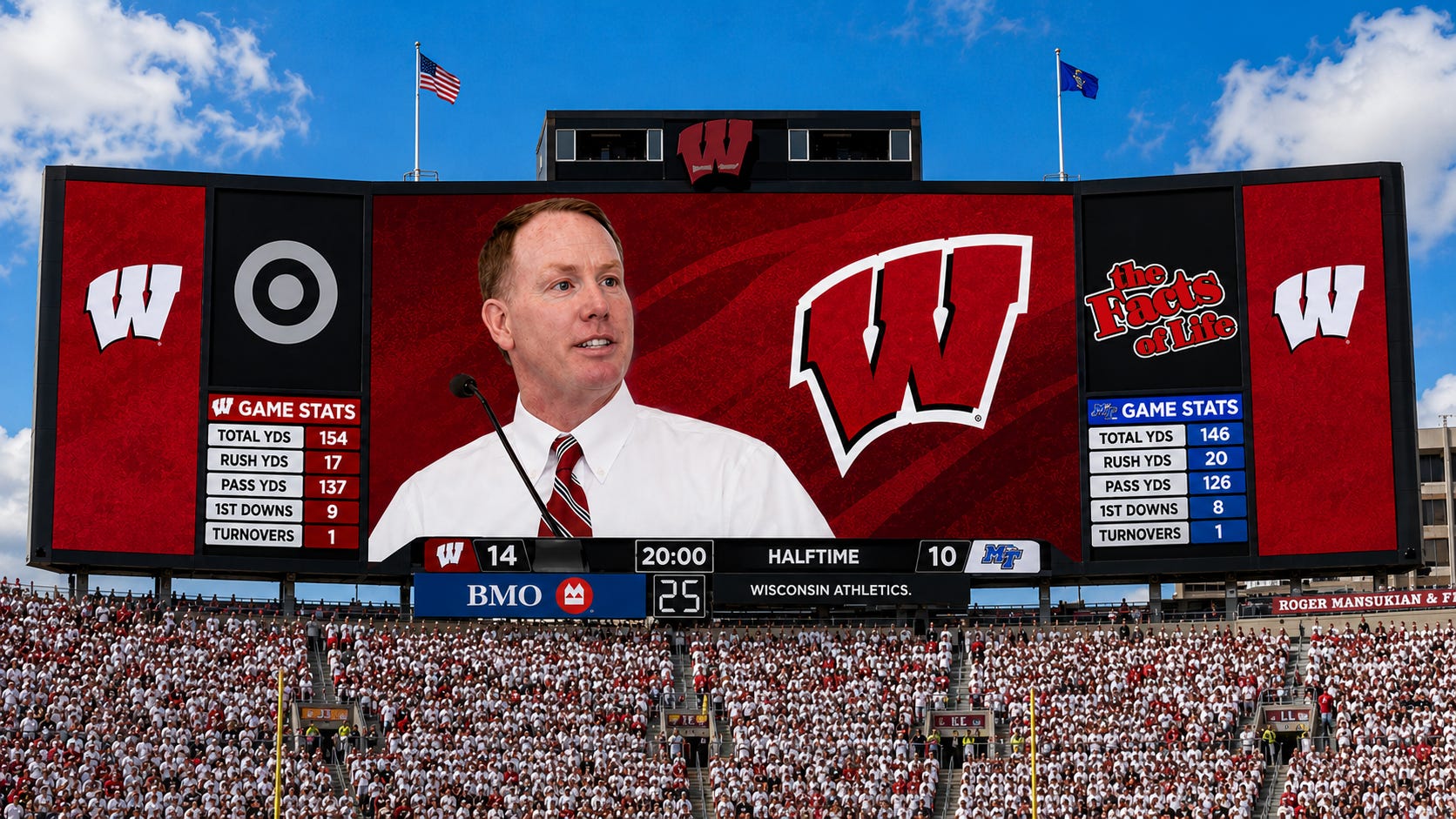
I’ve probably spent more time thinking about the Shawn Eichorst hire than most sane people would admit for what is a pretty standard athletic director move. It’s probably why this piece is being release several days after the news cycle has moved on from it.
Strip the name away and Eichorst’s resume is solid and uncontroversial. Eight years at Texas, power conference AD experience (x2), and a return to a place he already knows. You don’t really have to squint to understand why a search committee would land there. However, don’t live in a world built in a LinkedIn profile.
Content creators and wannabe sports writers like yours truly are wired to overanalyze. Sometimes we’re uncovering something meaningful, and sometimes we’re just manufacturing intrigue out of ordinary decisions. Either way, I couldn’t help but do the same with this hire, and the deeper I looked the less those lines on a resume answered my questions. They are jumping off points resolve until you start thinking about what they mean in Madison.
And just like that a simple personnel move turns into a rabbit hole. The same resume can point you in completely different directions depending on what you emphasize. One reading makes this feel like a steady, experienced hire built for the moment Wisconsin is in. Another makes it look like the program defaulted to familiarity and tries to call it fresh leadership. The facts don’t change only the interpretation does.
Let’s take a look at the pros and cons of this hire, and why they are not so pro or so con.
Positive: Eight Successful Years at Texas
Our new athletic director was most recently inside one of the most powerful athletic departments in the country during the most volatile period the history of college athletics. NIL has reshaped the entire landscape of college athletics. Revenue and revenue sharing became an operational reality and because of that conference realignment pushed Texas toward the SEC. The entire department had to adjust in real time while still competing at a championship level. And that it did. It’s impossible to ignore his time with the Longhorns because it’s the strongest point in the entire resume.
From the outside that looks like exactly the kind of environment Wisconsin needs someone to understand. Just the massive scale of it all, which you can’t really separate from the success. And that’s where Wisconsin woefully lags behind. Texas operates with resources that most athletic departments can’t realistically match with a massive donor infrastructure built around national brand that recruits itself. Regardless of recent success the football program sits at the center of the sport, and and because of that an NIL ecosystem functions on a different financial tier than most of the B1G outside of Ohio State and Michigan.
So when someone spends nearly a decade inside that structure the assumption is that they’ve seen how an elite program operates. They have learned how decisions get made when money isn’t the limiting factor because donors are already aligned. The coaching staffs are supported, but with the expectations anything short of a championship is a failure. It has to be liberating to operate in a world where money isn’t an object and the only goal is success at all costs. But...of course there’s a but. Eichorst wasn’t the athletic director. Chris Del Conte is the one setting the direction. The Texas boosters were the ones funding NIL at a level that changes recruiting outcomes. So the question becomes less about whether Texas was successful and more about what Eichorst’s specific role was as part that success. That distinction matters a lot more in Madison than it does in Austin.
The Wisconsin athletic department doesn’t get to operate with advantages that Texas has. There isn’t a donor base that automatically keeps pace with the blue bloods. There isn’t recruiting geography in the revenue generating sports that is consistently offsetting gaps in NIL. There isn’t the margin for error that allows you to simply maintain a machine. Wisconsin requires a different kind of athletic department leadership. Less stewardship of an infinite money glitch, and more grinding problem solving under constant pressure. Which raises the uncomfortable question sitting underneath the Texas resume which is does experience inside such a silver spoon environment prepare anyone to go back to the real world?
Negative: He Failed at Nebraska
For Wisconsin fans this is where the conversation inevitably turns. Shawn Eichorst ultimately failed and that naturally raises the question does his experience inspire confidence? To be fair the answer isn’t as simple as pointing to one failed hire because the college athletics landscape Eichorst left at Nebraska is almost unrecognizable compared to the one he’ll enter at Wisconsin. There was no NIL or revenue sharing. The transfer portal wasn’t reshaping roster construction every offseason. The responsibilities of an athletic director have changed dramatically making past experience more nuanced than simply labeling it a success or failure. If Nebraska is viewed as the defining chapter of Eichorst’s career, then this hire feels like a gamble. But if it’s viewed as the most visible mistake in a much longer career, the conversation changes. Experience isn’t only about repeating success it’s also about learning from failure.
Since the start of the Luke Fickell era, there’s been a lot of talk about Wisconsin “becoming the next Nebraska.” I’ve never fully bought into that comparison. Nebraska’s decline came after decades as one of college football’s true national powers. Wisconsin’s history is different. The Badgers built one of the nation’s most consistent programs over the last 30 years, but they were never operating from the same historical peak. Their success was built on stability, favorable scheduling (hello B1G West), and a run of generational running backs. Ironically, Eichorst’s time at Nebraska may provide exactly the perspective Wisconsin needs.
He has seen firsthand what an administration and boosters can do to accelerate the decline of a proud football program. Now after spending time in a modern football program, and athletic department as a whole, at Texas he has also seen how an elite program are adapting to the realities of today’s college athletics. The fear is he recreates Nebraska, but what could happen is he combines the lessons from what went wrong there with what he’s learned at Texas to help build a blueprint for Wisconsin to recapture the success of its golden era...and maybe take the program a step beyond it.
Positive: He’s a Wisconsin Guy
It just makes sense. He grew up in Wisconsin, played at UW-Whitewater, studied at Marquette, and worked under Barry Alvarez inside the athletic department. That kind of familiarity usually gets framed as stability, and there’s truth to that. Athletic director transitions often lose time early because relationships have to be rebuilt from scratch bt Wisconsin doesn’t lose that time here. But the more important question might not be what he already knows. The question is because he knows it will he fall back into the status quo that on the surface level lead to “success” but on a national scale set the program farther behind then a money making program like it should.
Wisconsin’s biggest challenges have never been cultural. They’ve always been structural. Building everything from within because it’s cheaper than going outside. Keeping things small and local and hoping for that hometown discount. Building relationships with donors who care more about looking mad at half court at the Kohl Center then building programs that keep up with the schools they claim superiority over. Old school positives turn into new school problems.
To catch up with the rest of the old B1G and to hopefully join the upper echelon of the new B1G we need an AD who isn’t going to rely on nostalgia and the Old Boys Network. NIL fundraising, revenue generation, branding, recruiting competitiveness require change in how the program operates and communicates that new message. And why should we expect a “Wisconsin Guy” to do anything different than anyone else has done in the past?
The more I’ve thought about this hire the less I’ve become interested in Shawn Eichorst’s resume and the more I’ve become interested in what we expect him to accomplish. We can debate Texas, Nebraska, and his Wisconsin roots all we want, but none of those things will determine whether this hire succeeds. They simply provide clues about how he might approach the job. Every point in Eichorst’s favor comes with a legitimate counterargument.
His time at Texas exposed him to the inner workings of one of the premier athletic departments in the country, but it also came in an environment with financial resources Wisconsin can only dream about. His tenure at Nebraska ended poorly, but failure can be one of the greatest teachers if the right lessons are taken from it. His familiarity with Wisconsin should allow him to hit the ground running, but it also raises the concern that the department will continue to rely on the same thinking that has slowly allowed the rest of the B1G to pass it by.
That uncertainty is why this hire feels so fascinating. Wisconsin doesn’t need someone to bring back what Barry Alvarez built. It needed someone capable of adapting that foundation to a completely different era of college athletics. The schools that thrive over the next decade won’t necessarily be the ones with the richest traditions or the loudest fan bases. They’ll be the ones whose leadership recognizes that the business of college athletics has changed and acts accordingly.
Wisconsin’s biggest challenge is convincing itself that tradition alone is no longer enough. The athletic department has spent years leaning on stability, continuity, and the idea that the “Wisconsin Way” could continue producing the same results while the rest of college athletics evolved around it. That is why this hire matters so much. Shawn Eichorst isn’t inheriting an athletic department, or even a football program, in crisis. The decisions he makes over the next several years will matter far more than anything listed on his resume. His past may have earned him the opportunity, but his willingness to challenge old assumptions will determine whether Wisconsin merely protects its place in college athletics or reclaims its ambition to become one of the programs setting the standard.
As college athletics enters a new era will Wisconsin have the courage to evolve with it or was it content to remember when it didn’t have to?
No posts
Comments
Nothing yet. Say the first thing.
Sign in to join the conversation.