
Brain Health & Exercise Resilience

What to do: Run the Norwegian 4x4 HIIT protocol 1–3 times a week — 4 minutes at 85–95% max heart rate, 3 minutes rest, repeat 4 times. Pair it with multi-joint resistance training twice a week.
Why it works: Different exercises hit different brain structures. High-intensity cardio spikes cortisol and lactate, which cross the blood-brain barrier and stimulate BDNF — protecting gray matter. Resistance training stimulates IGF-1, which builds and maintains white matter, the myelin “cables” connecting brain regions. Per Dr. Tommy Wood, neuroscientist and medical doctor.
The evidence: In a 6-month trial, older adults doing 4x4 HIIT showed far greater improvements in hippocampal function and structure than a moderate zone-2 cardio group — and held onto those gains for 5 full years after the program ended.
Real-world proof: In the Brain Power and SMART studies, postmenopausal women who strength-trained just once or twice a week saw measurable white matter improvements and sharper executive function versus a control group.
Mental Health & Connection

What to do: Break your rigid, hyper-optimized routines to connect with people randomly placed in your path. Reframe frustrating interruptions as “assignments to love.”
Why it works: A highly regimented, metrics-driven life creates an “industrialized self” — a major joy-blocker. Happiness is built on ease, but joy engages the stress system directly, striking as a sudden, unpredictable sense of connection and grace. Breaking perfectionism to serve others pulls you out of accidental narcissism and despair. Per Kate Bowler, PhD, historian and author.
The evidence: Sociological tracking since the 1970s shows a shift toward only “intermittent” volunteering. Deep, long-form community ties built through consistent service are proven to offset today’s rising cultural tide of nihilism and hopelessness.
Real-world proof: Diagnosed with Stage 4 colon cancer at 35, Kate Bowler experienced profound, surreal joy and interconnectedness at the peak of her physical suffering. Years later, she met an 84-year-old foster parent whose secret to navigating life’s disappointments was simply deciding his job was to “love the people God puts in your way.” Adopting that mindset, she found herself laughing in a hospital room when a doctor accidentally sprayed her blood while removing a surgical drain — finding the “ta-da” in the trauma.

What to do: Stop strength sets when you have 1 to 3 reps still “in reserve” — don’t push muscles to complete failure. Keep your tempo steady and prioritize consistency over maximum intensity.
Why it works: Training to failure triggers a massive stress response that delays nervous-system recovery and causes severe DOMS. Leaving 1–3 reps in the tank produces the same muscle-building adaptations without burying the body in systemic fatigue or tipping into a chronic catabolic state. Per Dani Coleman, VP of Training at P-Volve.
The evidence: A 12-week University of Exeter trial on perimenopausal and menopausal women doing this controlled-intensity method 4 times a week found significant gains in lean muscle mass, hip mobility, and energy — proof hormonal status doesn’t blunt muscle-building if recovery is respected.
Real-world proof: Jennifer Aniston had to untrain the belief that “if I’m not sore, it wasn’t a good workout.” By lifting heavy but stopping short of failure, she’s built progressive, sustainable strength over 5.5 years without the burnout or injuries common in high-achieving women.

What to do: Take 750 mg of Creatine Hydrochloride (HCl) daily instead of a standard 5-gram Creatine Monohydrate scoop. Add a second 750 mg dose on high-stress or intense workout days.
Why it works: Creatine is the battery pack for cellular ATP. Women naturally store 70–80% less tissue creatine than men. HCl absorbs up to seven times better than Monohydrate, crosses the blood-brain barrier efficiently, and skips the gut distress standard creatine causes. Per JJ Virgin, certified nutrition specialist.
The evidence: Up to 76% of people on standard Monohydrate experience gas and bloating from its poor 15% absorption rate. The brain uses 20% of the body’s total creatine reserves, making absorption efficiency critical for cognitive function.
Real-world proof: Perimenopausal women who switched from Monohydrate to HCl reported faster swim times, heavier lifts, and zero bloating within a single week. Clinical studies also show depressed women taking creatine alongside SSRIs respond better, with significantly lower depression rates than those who don’t.
Environmental Health & Detoxification

What to do: Eat 30 different plant foods a week, drink broccoli sprout beverages (or add them to meals), and commit to a daily 12-hour fast — say, 8 PM to 8 AM.
Why it works: Environmental toxins like persistent organic pollutants and phthalates are fat-loving and accumulate in fat tissue. Varied plant fiber binds to them in bile so they aren’t reabsorbed in the gut. Broccoli sprouts contain concentrated sulforaphane, which ramps up Phase II liver detoxification. A 12-hour fast triggers the migrating motor complex and autophagy, sweeping the gut and clearing out damaged cells. Per Shawn Stevenson, health researcher, referencing Dr. Tim Spector.
The evidence: A 12-week randomized trial found participants drinking a broccoli sprout beverage excreted 61% more benzene-derived compounds and 23% more acrolein — both dangerous airborne pollutants — than a control group.
Real-world proof: A University of Michigan study found phthalates — common in plastics and cosmetics — act as “obesogens” in humans. Mid-life women exposed to them gained body fat far faster, entirely independent of caloric intake.
Metabolic Health
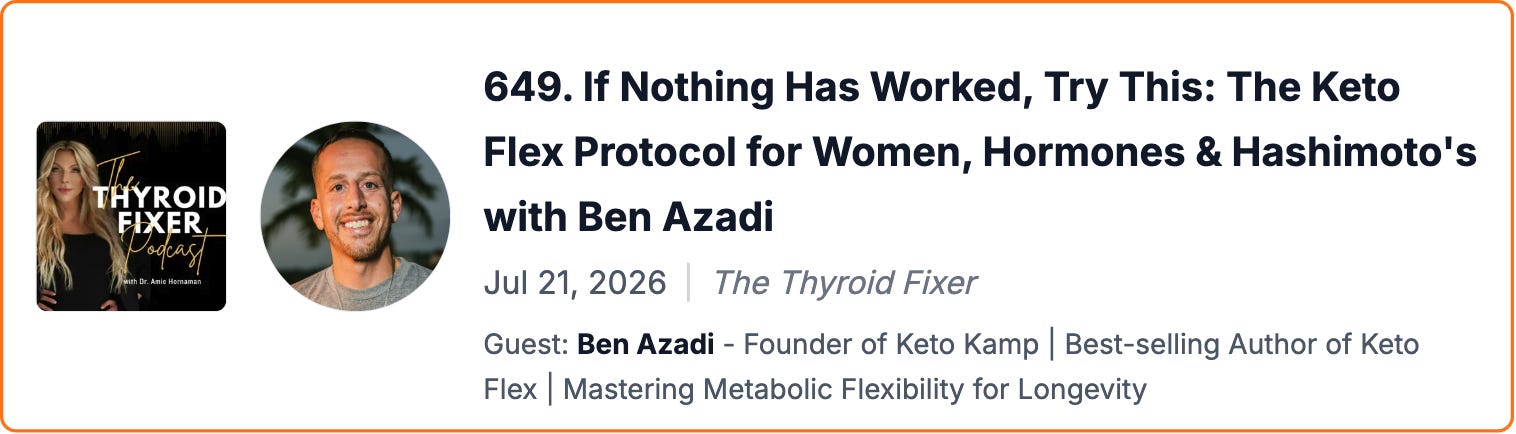
What to do: Don’t stay low-carb forever — cycle in and out of ketosis with the “5-1-1 Rule.” Spend 5 days doing 16–20 hour intermittent fasting with ketogenic meals, 1 day on a full 24-hour water fast, and 1 “Keto Flex” feast day eating whole-food carbs like yams or fruit while keeping fat under 40 grams.
Why it works: Chronic ketosis becomes its own stressor over time, straining the adrenals and stalling metabolism. Cycling mimics ancestral feast-famine patterns, forcing mitochondria to keep adapting, lowering cell-membrane inflammation, and resensitizing hormone receptors. Per Ben Azadi, functional diagnostic nutrition practitioner.
The evidence: Switching from burning glucose to burning ketones boosts cellular ATP production by roughly 400% — from 32–36 ATP molecules to over 130.
Real-world proof: Azadi himself was 80 pounds overweight, pre-diabetic, and depressed before cycling fats and carbs instead of just restricting calories — he dropped to 6% body fat in 9 months and cleared his brain fog entirely. Separately, a stage 4 cancer patient named Owen used ketosis and fasting to starve his tumor’s glucose supply, shrinking a rare thymoma by 30% in three months.
Put these six habits into practice:
Become metabolically flexible. Follow a keto flex approach instead of staying in ketosis all the time, and consider adding 750 mg of Creatine HCl daily to support cellular energy, mental clarity, and healthy body composition.
Train your brain and body together. Do 1–3 HIIT workouts each week, pair them with two strength-training sessions, and stop each set with 1–3 repetitions left in reserve to maximize muscle and brain benefits while recovering better.
Support your body’s natural detoxification. Aim for a 12-hour overnight fast and eat 30 or more different plant foods each week to promote gut health, lower inflammation, and help eliminate environmental toxins.
Prioritize connection every day. Make time for a meaningful conversation, help someone, or strengthen a relationship. Small moments of genuine human connection build resilience just as powerfully as nutrition and exercise.
Together, these practical habits can improve energy, sharpen cognitive function, preserve muscle, reduce inflammation, and help you build a longer, healthier, and more vibrant life.
Talk soon,
Acknowledgement

Comments
Nothing yet. Say the first thing.
Sign in to join the conversation.