
Most longevity advice arrives as a sledgehammer: eliminate all stress, never eat sugar, run ten miles a day. Most people carry that sledgehammer for about a week before setting it down for good — the burden of doing everything perfectly, all the time, is simply too heavy. The more useful research isn’t blunt instruments at all. It’s a set of small, precise lock picks: counterintuitive, specific, and — once you see the mechanism — hard to unsee.
Consistency beats duration when it comes to sleep.
Start with the metric everyone gets wrong about sleep. A 2024 study from researcher Daniel Windridge dismantled the obsession with total hours slept, finding that sleep consistency — going to bed and waking at the same time every day, weekends included — predicts all-cause mortality more strongly than duration does. Sleep researcher Dr. Andrew Phillips found the same pattern in Harvard undergraduates: the regularity of a student’s sleep schedule predicted their GPA better than how many total hours they slept. Students who slept less, but on a rigid schedule, outperformed those who slept longer on a chaotic one.
The mechanism is anticipation rather than reaction. Picture your body as a restaurant kitchen: if the dinner rush hits at exactly 6 p.m. every night, the staff preps early — vegetables chopped, pans hot, ready before the doors open. Your body does the same with melatonin, beginning production roughly two hours before a consistent bedtime, so your core temperature is already dropping and your sleep drive is already peaking the moment you lie down. Show up at a random hour — midnight Tuesday, 2 a.m. Saturday — and the kitchen has nothing ready. You lie there while your body scrambles to synthesize the hormones from scratch. That’s also exactly what happens with “social jet lag,” the common pattern of keeping a strict weekday schedule and then sleeping in on weekends — biologically equivalent to flying across three time zones and back every single week, which is a large part of why Mondays feel so brutal.
Give your brain something worth repairing overnight.
What you do right before bed matters too, and the standard advice — wind down, dim the lights, quiet the mind — turns out to be incomplete. Sleep scientist Dr. Matthew Walker’s research points somewhere almost opposite: engaging in a genuinely demanding mental task shortly before sleep, especially for older adults, produces deeper, more intact sleep architecture, not more insomnia. The mechanism traces back to how the brain triages overnight repair. Demanding mental work pushes specific patches of cortex to metabolic fatigue; the brain registers that localized exhaustion and responds by generating deeper, more targeted slow-wave sleep over exactly those regions overnight. In one study, researchers taught subjects a deliberately awkward, complex finger-tapping sequence right before sleep, then watched the same neural circuits reactivate and replay the sequence once the subjects fell asleep — the brain running a workout on itself while its owner was unconscious. The near-term payoff is sharper memory retention by morning; the long-term payoff is more efficient clearance of metabolic waste from neural tissue.
A few explosive seconds today can prevent a devastating fall tomorrow.
The same triage logic applies to muscle, and here the conventional wisdom about aging misses something important. General consensus leans toward cardio and light resistance training for healthy aging, but researchers Dr. Alyssa Olenick and Dr. Andy Galpin point to a different priority: training for power, specifically preserving fast-twitch muscle fiber. These are the fibers responsible for explosive, reactive movement, and they’re the first to atrophy with disuse — the nervous system is efficient enough to simply stop maintaining hardware it isn’t asked to use. Low-impact cardio, however good for the cardiovascular system, doesn’t send the neurological signal needed to keep them online. It’s the difference between optimizing a car’s fuel efficiency and installing a serious braking system: fuel efficiency won’t help you in a crash, and the “crash” here is a fall later in life. The relevant concept is a loss of physical power that precedes actual muscle loss — when someone in their 70s or 80s trips, it’s rarely a lack of endurance that puts them on the ground, but a lack of reactive strength to catch themselves fast enough. Galpin’s own routine reflects this: standing broad jumps, aiming to clear a distance greater than his own height, training both the explosive launch and the eccentric strength needed to absorb the landing. Bone tissue needs the same kind of loaded, high-force signal — swimming and walking don’t provide enough mechanical stress to trigger new bone density. In one study, postmenopausal women — a group especially vulnerable to bone loss — meaningfully improved bone density over a year doing nothing more than 10 to 50 “pogo hops” a day: stiff-ankled, explosive bounces on the balls of the feet, taking well under a minute. For anyone for whom even that feels like too much impact, the regression is simply heel drops — rising onto your toes and dropping your heels hard to send mechanical vibration up through the skeleton.
You can't always think your way out of stress—but you can breathe, hum, or gargle your way through it.
Controlled stress, whether a jump or a puzzle, is useful because you choose it. Uncontrolled stress is a different problem entirely, and psychotherapist Amy Morin and neuroscientist Dr. Dave Rabin offer an unusually specific tool for it. Chronic, uncontrolled stress triggers sustained inflammation, suppresses immune function, and reroutes blood flow away from healing organs in preparation for a threat that usually isn’t physical. Their countermeasure: 60 seconds of loud humming, singing, or gargling water. Morin describes high-level executives using this in office bathrooms before high-stakes meetings — not glamorous, but mechanistically sound. In situations too visible for gargling, a quiet hum or a slow, throat-constricted exhale works the same way. The target is the vagus nerve, the command center of the parasympathetic nervous system; vocal cord vibration sends a direct, top-down signal to the amygdala that the body is safe — you can’t out-think a stress response with logic alone, because the cognitive parts of the brain are actively suppressed during it, but you can override it physiologically. Sixty seconds of this measurably lowers blood pressure and raises heart rate variability, acting as a genuine reset rather than a distraction.
Morning sunlight is one of nature's most powerful longevity signals. Light is information. Your cells are always listening.
None of these internal systems work in isolation from the environment powering them, and the final piece is light. Brian Richards, founder of Sauna Space, built a near-infrared incandescent light bath modeled on early-1900s light therapy cabinets, using it to resolve his own severe insomnia, adrenal fatigue, and brain fog. The relevant contrast is with the blue light most of us are bathed in constantly — phones, monitors, overhead LEDs — which measurably increases oxidative stress. Near-infrared light, abundant in natural sunlight, penetrates far deeper into tissue, reaching cells and repolarizing their electrical charge. More specifically, it restructures the water inside cells into what’s called exclusion zone water: instead of moving chaotically, water molecules align into an organized grid along the cell membrane, creating something close to a frictionless track for mitochondria. In that structured state, mitochondria produce ATP with far less metabolic exhaust, lowering oxidative stress throughout the body, and prompting cells to synthesize their own antioxidants — including melatonin and glutathione — as a defense against future UV and blue-light damage. None of this requires an expensive light cabinet: morning sunlight delivers the same infrared spectrum, and swapping a desk’s blue LED for a cheap incandescent red bulb accomplishes much of the same thing.
Five protocols, none of them a sledgehammer: a fixed sleep schedule, a hard mental task before bed, a handful of explosive jumps, sixty seconds of gargling, and a little more infrared light. As these fields mature, it’s worth noticing what they have in common — none of them are chemistry. They’re physics: light, sound, vibration, force. The pharmacy of the future might look a lot less like a pill bottle and a lot more like a tuning fork and a light bulb.
Key Takeaways
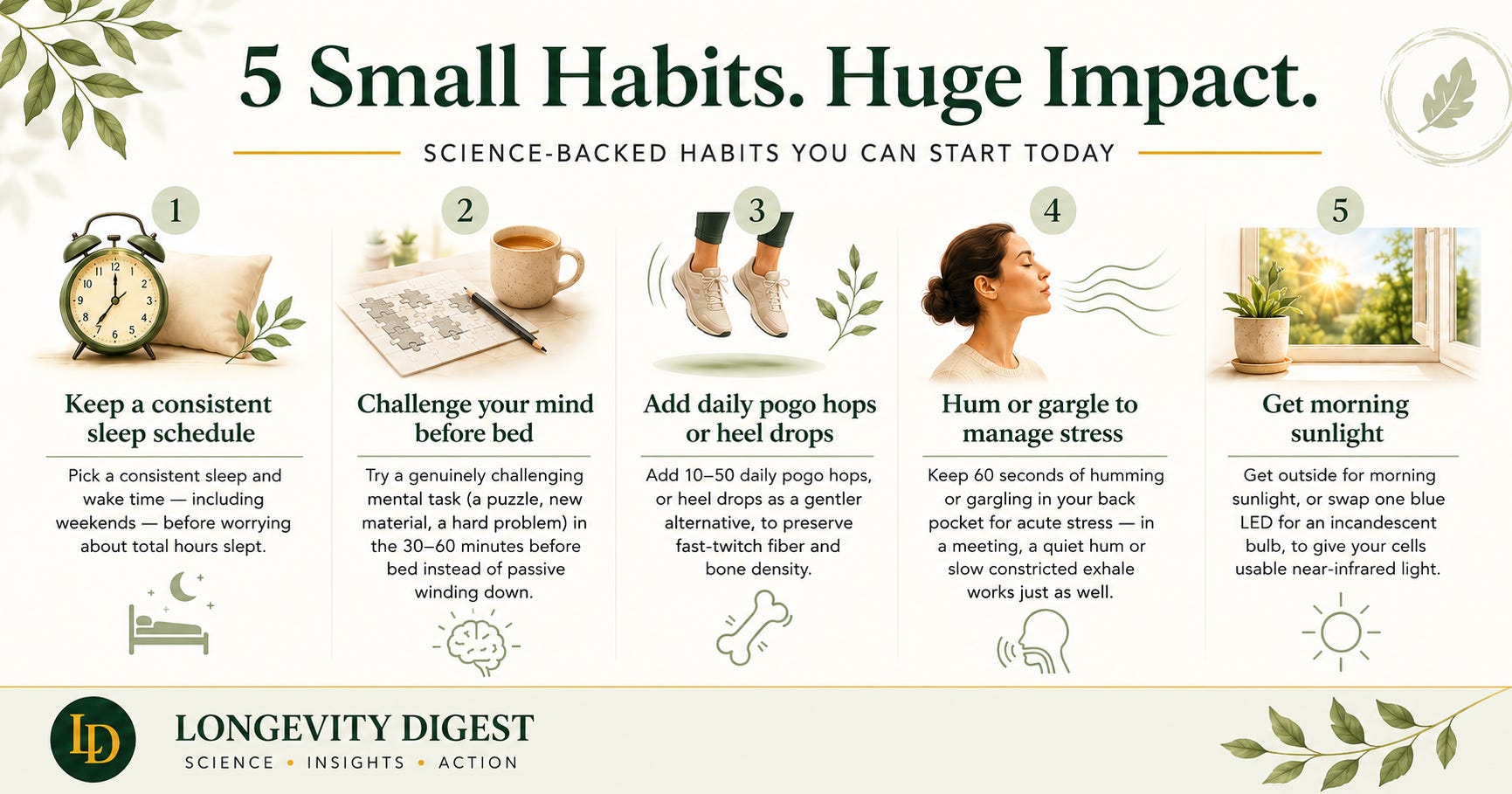
Pick a consistent sleep and wake time — including weekends — before worrying about total hours slept.
Try a genuinely challenging mental task (a puzzle, new material, a hard problem) in the 30–60 minutes before bed instead of passive winding down.
Add 10–50 daily pogo hops, or heel drops as a gentler alternative, to preserve fast-twitch fiber and bone density.
Keep 60 seconds of humming or gargling in your back pocket for acute stress — in a meeting, a quiet hum or slow constricted exhale works just as well.
Get outside for morning sunlight, or swap one blue LED for an incandescent bulb, to give your cells usable near-infrared light.
Acknowledgments

Sources:
Jul-8, Chris Koerner, The Fastest Way To Make $10,000 A Month | Chris Koerner, on, The School of Greatness
Jul-8, Zane Griggs, Why Zane Griggs Believes Extreme Biohacking Fails You, on, Well Beyond 40
Jul-8, Richard Isaacson, How Brain Inflammation Drives Depression, Alzheimer’s, and Parkinson’s, on, The Dr. Hyman Show
Jul-8, Dom Francks, Is Your House Making You Sick? I Tested My Home for the Top Toxins, Here’s What I Learned, and How to Reduce Exposure in Your Home with Dom Francks Lightwork Home Health, on, Dhru Purohit Podcast
Jul-8, Treatment, on, Century Lives
Jul-8, Amy Morin, Use These Science-Backed Strategies to Instantly Reduce Anxiety, Boost Confidence, & Feel Your Best - With Amy Morin, on, The Model Health Show
Jul-8, Sharon Salzberg, How To Communicate Effectively With Difficult People: When to Tell the Truth, When to Push Back, and Why Kindness Isn’t the Same as Being Nice | Sharon Salzberg, on, 10% Happier with Dan Harris
Jul-8, David Rabin, Ep. 616 How the Nervous System Shapes Stress, Trauma, and Recovery with Dr. David Rabin | Menopause, Perimenopause, Nervous System, on, Everyday Wellness: Midlife Hormones, Menopause, and Science for Women 35+
Jul-8, Selena Gomez, Jay’s Must-Listens: The Biggest Lessons From 10 of Our Most Inspiring Conversations, on, On Purpose with Jay Shetty
Jul-8, Dave Rabin, 585: The Real Reason Modern Life Feels So Overwhelming, and What to Do About It | Dave Rabin, MD PhD, on, The Genius Life
Jul-7, James O’Hara, Quick Hits: The Testosterone Replacement for Women Conundrum: Libido Highs and Hair Loss Lows with James O’Hara, on, The Hormone Solution with Karen Martel
Jul-7, Brian Richards, The 1910 Secret: How Light Turns Water Into Medicine | Brain Richards : 1497, on, The Human Upgrade
Jul-7, Guy Oseary, #874: Guy Oseary — The Legendary Hollywood Power Broker on 5-Minute Decisions, 36 Years of Managing Madonna, 26 IPOs, and Spotting Magic First, on, Tim Ferriss Show
Jul-7, Alyssa Olenick, Cardio vs Strength Is a Myth and the Science Proves It - Alyssa Olenick, on, The Dr. Gabrielle Lyon Show
Jul-7, Dr. Ivan Rusilko, 645. You Can’t Take Weight Loss Advice from a Fat Doctor: Confessions and Longevity Hacks from America’s Most Hated Doctor, on, The Thyroid Fixer
Jul-7, Dr. Kristen Holmes, The Science of Human Performance: Your Guide To Better Sleep, on, The WHOOP Podcast
Jul-7, Dr. Teo Soleymani, #453: From ‘Tan Maxing’ To The Growing Debate Over Sunscreen | A Look At Trends & Myths With Dr. Teo Soleymani (Plus GHK-Cu Peptide), on, LONGEVITY with Nathalie Niddam
Jul-7, Dr Michael Breus, How To Finally Fix Your Sleep, Wake Up Rested & Transform Your Life with Dr Michael Breus #672, on, Feel Better, Live More with Dr Rangan Chatterjee
Jul-7, Jane Ollis, The Nerve in Your Ear That Controls Stress | Jane Ollis (Sona), on, Health Longevity Secrets
Jul-7, Dr. Rachel Goldman, 760: The Mindset Shift That Helps You Stop Feeling Stuck with Dr. Rachel Goldman, on, Energized with Dr. Mariza
Jul-6, Bronson Dant, BONUS: Muscle Matters: Transforming Metabolic Health for Weight Control with Bronson Dant | Metabolic Health, Weight Control, Muscle Matters, on, Everyday Wellness: Midlife Hormones, Menopause, and Science for Women 35+
Jul-6, Encore: Your Nervous System Controls Your Gut, Hormones, and Weight — Here’s How to Fix It, on, The Dr. Hyman Show
Jul-6, Chris Stepien, The 4 Things That Control Chronic Pain & The Real Reason Your Body Isn’t Healing - With Dr. Chris Stepien, on, The Model Health Show
Jul-6, Guy Winch, Your Job Is Hijacking Your Life: How to Set Limits, Decrease Work Stress, and Reclaim Your Evenings | Guy Winch, on, 10% Happier with Dan Harris
Jul-6, Layne Norton, Building strength and muscle mass: how to optimize training, nutrition, and more for longevity (AMA #71 rebroadcast), on, The Peter Attia Drive
Jul-6, The 5 Wealth Secrets No One Ever Taught You | Lewis Howes, on, The School of Greatness
Jul-6, Dr. Anthony Ricci, The Truth About MMA Weight Cuts: Fat, Water & Performance: Dr. Anthony Ricci, on, Optimal Protein Podcast with Vanessa Spina
Jul-6, The Brain Habits Highly Successful People Use Every Day, on, Kwik Brain
Jul-6, #142 - How Memory Affects Sleep, on, The Matt Walker Podcast
Jul-6, Andy Galpin, Look. Feel. Perform. Why Muscle Is the Answer to All Three After 40 with Andy Galpin, PhD, on, BETTER! Muscle, Mobility, Metabolism & (Peri)Menopause with Dr. Stephanie
Jul-6, Dr. Trupti Gokani, Healthy Revisit: Ancient Wisdom Meets Modern Neurology with Dr. Trupti Gokani, on, Well Beyond 40
Jul-6, Lucy Guo, Lucy Guo: The Fastest Way to Build a Business Today (The #1 Strategy That Saves You Months of Wasted Work), on, On Purpose with Jay Shetty
Jul-6, Danny McBride, Thrilling Tales Of Modern Men: Danny McBride On Ego, Grievance & The Stories Men Tell Themselves, on, The Rich Roll Podcast
Jul-6, Cesar Millan, Raising a Dog & Mastering Calm Assertive Energy | Cesar Millan, on, Huberman Lab
Jul-6, Naveen Jain, This AI Can Detect Disease Before Symptoms, on, Longevity.Technology UNLOCKED
Jul-5, I Tried EVERY Legal Focus Drug, Here’s What Actually Works : 1496, on, The Human Upgrade
Jul-5, 378. Heated Rivalry episode 4 - Frotting, Ferrets, and Ferris Wheels — Wait, Wrong Show. Just Frotting., on, You Are Not Broken
Comments
Nothing yet. Say the first thing.
Sign in to join the conversation.