
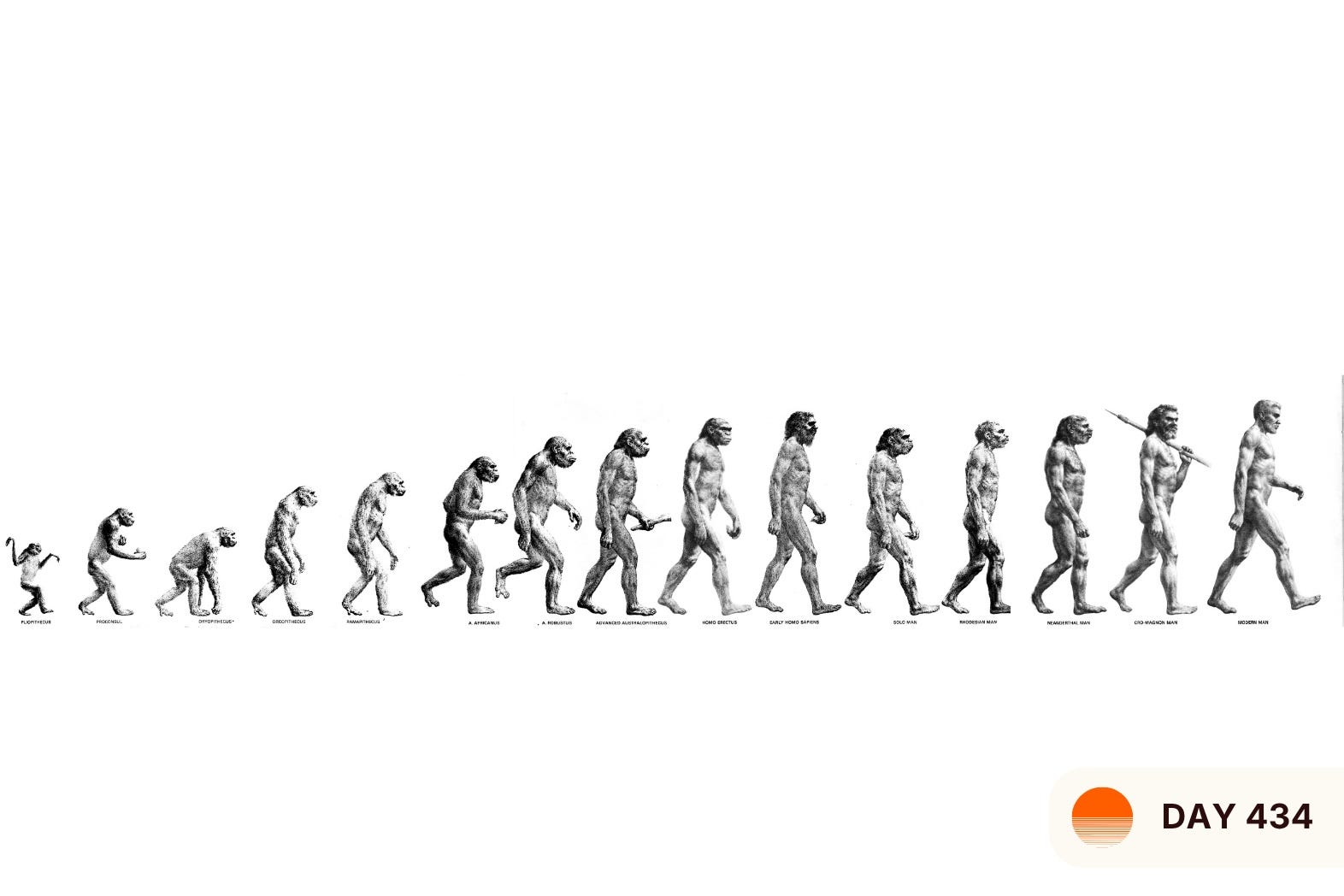
Copyright Zallinger Family, LLC
Every day I look at a color separation of this image. Why? It hangs in my study. Since it has been there for such a long time, I would give it a fleeting glance. Today, I realize that the “March of Progress” may just be one of the most iconic pictures of hope ever created.
I know that you’ve seen a reproduction of it. Seemingly everyone has. Depending upon which “version” of it you’ve seen, you have viewed either 6, 10 or 15 “individuals” walking. They start hunched over and end up upright. The appearance is that as a group, they are striding forward. Most people don’t know its real name. Originally it was “The Road to Homo Sapiens” but it is more commonly known as the “March of Progress.”
It is one of the most reproduced and parodied images in the history of science illustration, having been used in company logos, album covers, political cartoons, fitness ads, and internet memes. The essence of it has been borrowed now for over sixty years. When I tried to research how many times it has been parodied, the best answer I could find, online was, “into the thousands if you count every meme and ad riff, though nobody's kept a real tally.”
I’m guessing that somewhere in this hopeful community of ours (spread across 96 countries now), I’d bet a good number of you have looked at this exact image or a parody of it at some point in your life without knowing where it came from.
Here’s where it came from, and it is personal. The man who painted “The March of Progress” was my father-in-law, Rudolph Franz Zallinger. Time-Life Books commissioned him to do it in 1965, for a volume called “Early Man,” part of their Life Nature Library series. Little known fact: what Rudy handed in wasn’t a timeline at all. It was a set of individual plates — fifteen separate figures, each one researched and drawn on its own. Rudy wanted them to be understood as a family, spread out across branches (like a tree) and not lined up in a parade.
Time-Life didn’t see it that way. The paleoanthropologist who authored Early Man, F. Clark Howell, pushed to arrange the figures shoulder to shoulder, marching toward modern man in a straight line. Rudy pushed back as he didn’t think that was the correct way to represent things. Frankly, he was absolutely correct. Human evolution isn’t a relay race where one species hands off the baton to the next. It’s closer to a family tree with a lot of branches growing at once. Many of the individuals in that image lived at the same time, on different continents, never crossing paths. What became “March of Progress” is, biologically speaking, more of a family reunion photo than a finish line.
Another set of facts. Look closely at the original and you’ll notice some parts of each figure are shaded darker than the rest. That is not meant to be a decoration. The darkened area was where an actual fossil had been recovered for that individual. The rest of the “picture” was built by Rudy using the best science available to him at the time. He actually worked with what researchers had actually dug up. Rudy also gave each figure the tools of his own era; the specific implement that individual would plausibly have carried and used. None of those tools made it into the final representation we all know. The editors wanted strong memorable statement, which is exactly what they got. The “March of Progress” has been called one of the most reproduced images in the history of science illustration, and it’s still being copied and mocked more than sixty years later.
I don’t think the answer is clean, and I’m not going to pretend it is. The picture itself is at least a simplification. Real change doesn’t move in a straight line, upward and to the right, one clean step after another. Anyone who’s tried to lose weight, or change any behavior already knows that. Progress loops back on itself. It stalls. Sometimes it looks like regression for a long stretch before it looks like anything else.
Yet, the reason this image grabbed the whole world, and never let go, isn’t that it was scientifically precise. It’s that it told a story people needed — that where we start isn’t where we have to end up. That’s not biology. That’s psychology, and it’s a real thing. Researchers who study motivation will tell you that people don’t sustain effort toward goals they can’t picture reaching. You need some image, even an oversimplified one, of the distance covered and the distance left. Rudy’s fifteen honest, complicated plates might have been better science. But the six-figure march is what people needed to see to believe that where they stood wasn’t the end of the story.
So maybe progress doesn’t equal hope in any tidy, provable sense. But hope needs something to point toward, and progress is generally a messy, non-linear, three-steps-forward-two-steps-back approach; the best evidence that we’ve got motion. I’d argue the family tree is more accurate. I’d also argue the “March of Progress” is more useful on the days you need to believe you can still get somewhere. Both can be true, even though they’re not the same picture.
Where in your life does it feel like you’re moving in circles, but might actually be climbing?
U2 actually created their own versio of the “March of Progress,” which they displayed in one of their concert series.
And if today’s dose was useful, share it with someone who could use some hope.
Most people wait for life to feel lighter before they feel hopeful again.
This was built for the days when it doesn’t.
For $5/month, you can help to support my work—or just subscribe for free.
A Daily Dose of Hope — one short reflection each day about where hope lives in our world.
Read in 50 states in the US and 96 countries throughout the World.
“March of Progress” (also titled “The Road to Homo Sapiens”) was painted by Rudolph Franz Zallinger for Early Man, F. Clark Howell and the Editors of Time-Life Books, Life Nature Library series, Time-Life Books, 1965. — Wikipedia: March of Progress
The linear arrangement of Zallinger’s individual plates is credited to paleoanthropologist Elwyn Simons, who advised on the book; Zallinger himself favored a non-linear, family-tree presentation. — On the Origins of “The March of Progress,” Washington University ProSPER; Grokipedia: March of Progress
The scientific consensus that human evolution is a branching, non-linear process, with multiple hominid species living concurrently, rather than a single-file lineage. — IFLScience: The Famous “March of Progress” Image Is Wildly Wrong; Genetics Unzipped: The Mythical March of Progress
Details on the darker-shaded fossil-evidence areas of each figure and the era-accurate tools depicted are drawn from research done by Rick Potts of the Smithsonian Museum of Natural History.
Comments
Nothing yet. Say the first thing.
Sign in to join the conversation.