
Your phone tells you the air quality is unhealthy. Now what?
Should you stay inside?
Close your windows?
Skip your morning walk?
Turn on an air purifier?
Wear a mask?
Take your medication?
And perhaps the most important question of all: Is the air pollution affecting you?
For millions of people living with asthma, COPD, allergies, cardiovascular disease, and other conditions affected by the environment, the answer is rarely simple.
Air quality indices have become one of the primary ways we communicate environmental health risk. Government agencies, weather services, mobile apps, and news organizations routinely warn the public when pollution reaches potentially unhealthy levels.
These alerts serve an important purpose. But an alert is not a solution. Knowing the air is unhealthy is only the beginning of managing environmental health risk.
The Air Quality Alert Model
Most air quality alerts follow a relatively simple model. Pollutants are measured across a geographic area. Those measurements are translated into an Air Quality Index, or AQI. The AQI range is assigned to a color and risk category.
Green - Good
Yellow - Moderate
Orange – Unhealthy for Sensitive Groups
Red – Unhealthy
Purple - Very Unhealthy
Magenta - Hazardous
The public is then given general recommendations based on those categories.
People in sensitive groups may be advised to reduce prolonged outdoor activity.
People with respiratory conditions may be encouraged to monitor their symptoms.
Everyone may be advised to limit exposure when pollution becomes severe.
This system provides valuable population-level guidance. But people don’t breathe population-level air.
They breathe the air around their homes, schools, workplaces, sidewalks, parks, and commuting routes. And their individual response to that air can vary significantly.
Knowing the AQI Does Not Tell You What to Do Next
Consider someone with asthma who receives an alert that the AQI is 125. The air is considered unhealthy for sensitive groups.
But several important questions remain unanswered.
Which pollutant is driving the elevated AQI?
Is it particulate matter?
Ozone?
Wildfire smoke?
Traffic pollution?
How long will conditions remain elevated?
Are conditions improving or getting worse?
Is the pollution equally severe across the entire community?
Is the person’s indoor air actually cleaner than the outdoor air?
Most importantly: Have you experienced symptoms under similar environmental conditions before?
The AQI alert alone cannot answer these questions.
Air Quality Risk Is Personal
Two people standing in the same neighborhood can experience the same environmental conditions very differently.
One person may have asthma.
Another may have COPD.
One may be sensitive to ozone.
Another may experience symptoms when particulate matter rises.
A child may breathe more air relative to their body weight and spend more time exercising outdoors.
An older adult may have cardiovascular disease that increases vulnerability to air pollution.
Even among people with the same medical condition, environmental triggers can differ. This means that the same air quality alert can represent very different levels of personal risk. Yet most air quality communication systems deliver essentially the same information to everyone.
Exposure Matters as Much as Air Quality
There is another important limitation. Air quality is not the same thing as exposure. A monitoring station may report elevated particulate matter across a city.
But your actual exposure depends on where you are, how long you are there, what activities you are performing, and the air quality inside the buildings where you spend most of your time.
Consider two people living in the same city on a high-pollution day.
One works from home with a properly sized HEPA air purifier operating in the room where they spend most of the day.
The other spends several hours commuting near heavily traveled roads and works outdoors.
They receive the same AQI alert. Their exposures may be dramatically different. Understanding environmental health requires moving beyond ambient air quality measurements toward understanding personal exposure.
Alerts Rarely Learn from Your Symptoms
Perhaps the greatest limitation of today’s air quality alerts is that they generally know nothing about the person receiving them.
They don’t know whether you were wheezing yesterday.
They don’t know whether your breathing is worse today.
They don’t know that you used your rescue inhaler three times last week.
They don’t know that your symptoms repeatedly worsen when PM2.5 rises.
They don’t know that your breathing improves when you reduce outdoor activity during high-ozone afternoons.
Every day, people generate valuable information about how their bodies respond to the environment. Yet most air quality systems never capture that information. As a result, alerts remain generic.
From Air Quality Alerts to Environmental Health Intelligence
The next generation of environmental health tools should do more than tell people that pollution is elevated. They should help individuals understand the relationship between their environment, their exposure, their symptoms, and their actions.
Imagine a different type of air quality alert.
Instead of:
“Air Quality Alert: AQI 135. Unhealthy for Sensitive Groups.”
A person might receive:
“Your breathing has worsened on three of the last four days when PM2.5 reached similar levels. PM2.5 is expected to remain elevated for the next six hours. Consider reducing prolonged outdoor activity and using the strategies that have helped you reduce exposure in the past.”
The first message communicates environmental conditions.
The second provides environmental health intelligence.
That distinction matters.
The Missing Feedback Loop
Managing environmental health should involve a continuous cycle.
Measure the environment.
Track symptoms.
Understand the potential risk.
Act.
Measure the environment again.
Track whether symptoms improve.
Learn what works.
Most air quality alerts stop after the first step. They tell people something may be wrong with the air.
But they don’t help people determine whether the environmental conditions are affecting them, what actions they should take, or whether those actions made a difference.
Without that feedback loop, people remain passive recipients of warnings. Environmental health technology should help them become active participants in managing their exposure.
From Warnings to Decisions
Air quality alerts will continue to play an important role in public health. But alerts should be the beginning of the conversation, not the end.
The future of environmental health communication must help people answer three questions:
What is happening in my environment?
How is it affecting me?
What should I do about it?
Answering those questions requires combining environmental data with symptom tracking, exposure history, location, health context, and the outcomes of previous interventions.
That is how warnings become intelligence. And intelligence becomes action.
The DailyBreath Perspective
At DailyBreath, we believe knowing the air quality is important.
But knowing the AQI alone is not enough.
People need to understand how the environment affects their health.
They need to recognize patterns between pollutants, allergens, weather conditions, and symptoms.
They need practical actions that can help reduce exposure.
And they need the ability to determine whether those actions worked.
The future of environmental health is not another air quality alert. It is a personalized environmental health feedback loop:
Awareness → Exposure → Symptoms → Action → Outcomes → Learning.
Because the goal should not simply be to warn people about unhealthy air. The goal should be to help people make better decisions, reduce their exposure, and breathe easier.
Haven’t tried DailyBreath yet? There’s no better time to take a more informed, proactive approach to the air you breathe. The DailyBreath platform helps you understand today’s air quality, spot potential triggers, and plan your day with confidence. Get started to stay informed and make smarter daily decisions.
Start your journey in personalized environmental health intelligence by downloading the DailyBreath-The Air U Breathe mobile app. Explore the free version, but to customize and personalize your experience, DailyBreath Plus lets you track patterns over time and see how allergens, pollution, and weather uniquely affect YOU, so you can plan ahead with even greater confidence.
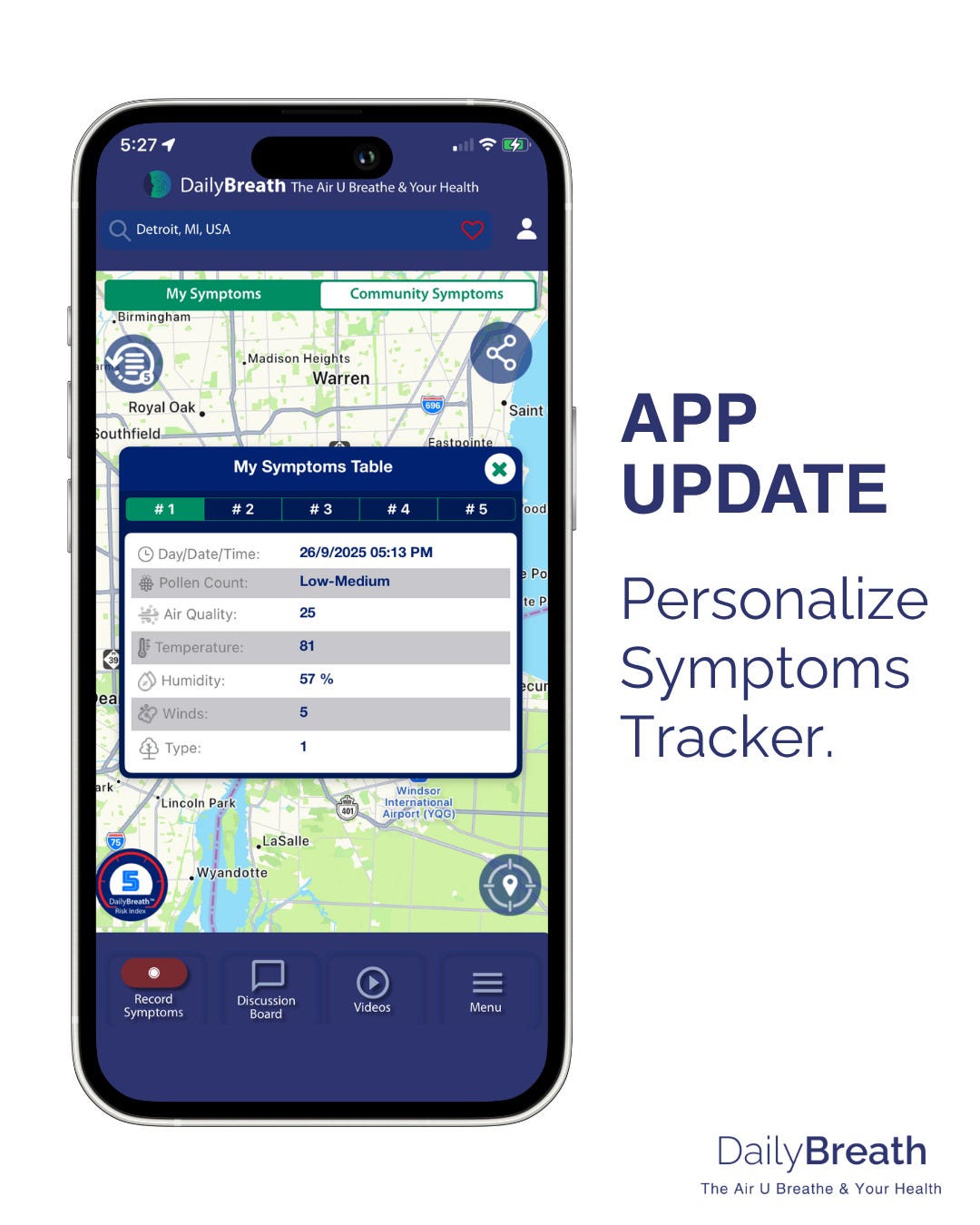
You are not at the mercy of environmental triggers. You can protect your health. You can change behaviors. You can purchase solutions that serve as upstream interventions that help you avoid a path towards acute symptoms, and, overall, to a better quality of life every day.
The Air U Breathe Store offers a marketplace of solutions that are part of a constant effort required to reduce and avoid pollutants, allergens, and weather exposures that contribute to a symptom march towards potentially preventable acute symptoms or just a general deterioration in health over time.
DISCLAIMER: The Air U Breathe Store includes affiliate links, and DailyBreath may earn a small commission at no extra cost to you.
By subscribing, you are joining a movement to provide a personalized approach to the air you breathe and your health. You can’t manage what you don’t measure and it’s time to measure the personalized impacts of allergens, pollutants, and weather conditions on your health.
Keep an eye out for our next edition, where we continue to explore and support your path to managing the air you breathe every day. With DailyBreath, you’re equipped not just to face environmental challenges, but to thrive amidst them. Stay well and breathe healthy!
Comments
Nothing yet. Say the first thing.
Sign in to join the conversation.